Local
Jury deliberating Marine murder case
Suspect allegedly shouted anti-gay slur before stabbing victim
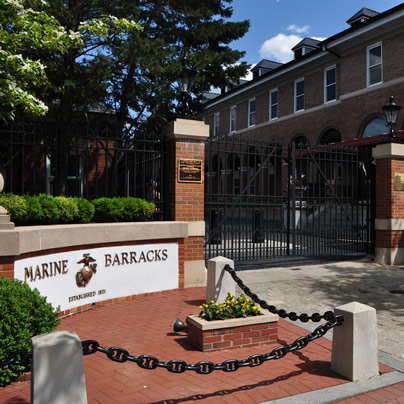
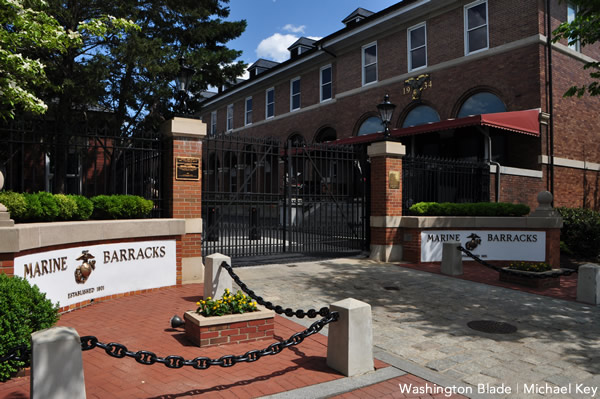
Lance Corp. Phillip Bushong was stabbed in the upper chest with a pocketknife on 8th Street, S.E., across from the Marine Barracks. (Washington Blade file photo by Michael Key)
A D.C. Superior Court jury completed its third day of deliberations on Tuesday without reaching a verdict over whether a 21-year-old former U.S. Marine should be found guilty of second-degree murder while armed for stabbing a fellow Marine to death after allegedly shouting an anti-gay slur during an April 2012 altercation.
Judge Russell Canan gave jurors Wednesday and Friday off for the Thanksgiving holiday weekend and instructed them to return Monday, Dec. 2, to resume their deliberations.
Pfc. Michael Poth, who has since been discharged from the Marines, has been held in jail since the time D.C. police arrested him on April 21, 2012, minutes after witnesses said he stabbed Lance Corp. Phillip Bushong, 23, in the upper chest with a pocketknife on 8th Street, S.E., across the street from the Marine Barracks.
Bushong was pronounced dead less than an hour later after being taken to a hospital. An autopsy showed he died of a single knife wound that punctured his heart.
Gay congressional staff member Nishith Pandya, a friend of Bushong’s who emerged as a lead prosecution witness, testified that Poth called him and Bushong a “faggot” while the two stood with others on the sidewalk outside Mollie Malone’s restaurant and bar as Poth walked by.
Pandya, who works for U.S. Rep. Bobby Rush (D-Ill.), told the jury he’s gay and that he and Bushong, who was straight, were platonic friends.
Assistant U.S. Attorney Michael Liebman, the lead prosecutor in the case, said Poth hurled the anti-gay slur with the intent of provoking Bushong into a confrontation to give Poth an excuse to stab Bushong. Liebman cited testimony by witnesses that Poth became angry over a remark that Bushong made to Poth about an hour earlier when the two Marines first crossed paths on 8th Street.
A police report says Poth told D.C. police homicide detectives after the stabbing that Bushong called him a “boot,” a slang term used for a Marine just out of boot camp.
“Call me boots and the fight started,” the police report quoted Poth as saying. “He was talking shit so I stabbed him…I stabbed him because he punched me in the head,” the report quoted him as saying.
Pandya testified that Bushong never hit Poth.
In his closing argument, Liebman pointed to a civilian witness who testified that she saw someone fitting Poth’s description walking along 8th Street saying to himself he was going to stab somebody. Liebman cited testimony by a police detective that Poth told police at the time of his arrest, upon learning that Bushong was being taken to a hospital, “Good, I hope he dies.”
The prosecutor said other witnesses, including Marine guards who were watching Poth walk past them on 8th Street and nearby streets prior to the stabbing, made it clear that Poth wanted to confront Bushong again and was walking up and down the street looking for him.
“You don’t get to claim self-defense when you proclaim intent to stab someone before you come into contact with them,” Liebman told the jury. “The law doesn’t allow you to use deadly force before you have contact” in a self-defense claim, Leibman said.
Poth’s attorney, Bernard Grimm, told the jury Poth acted in self-defense and that the stabbing came after Bushong and Pandya walked toward Poth at the time of the verbal altercation outside Mollie Malone’s. Grimm said the jury should be skeptical about Pandya’s claim that Poth made an anti-gay slur.
Grimm pointed out repeatedly that Poth, who weighs 140 pounds and is five-feet-seven inches tall, was far smaller than Bushong, who was over 6 feet tall and Pandya, who weighs more than 200 pounds.
He said one of several videos obtained from security cameras deployed by businesses along 8th Street suggested that Poth had been on the ground and stood up just before the stabbing. This corroborated Poth’s claim that Bushong punched him in the head and knocked him down and that Poth stabbed Bushong in self-defense, Grimm said.
Grimm pointed to testimony by a Marine guard who witnessed part of the altercation that Bushong at one point changed directions and followed Poth after the two crossed paths on the sidewalk while walking on 8th Street.
The Marine testified that Bushong reached toward Poth and put one hand on Poth’s shoulder and motioned with his other hand as if he was about to throw a punch. It was at that time that Poth appears to have stabbed Bushong, the Marine said.
Leibman and Grimm played video footage from security cameras of several of the businesses along the street, but none of the video footage captured the stabbing.
Grimm called Pandya’s testimony unreliable, saying that Pandya told police the person who stabbed Bushong was wearing khaki colored short pants when it was clear to all other witnesses that he was wearing blue jeans. He said Pandya, knowing that the stabbing took place after Bushong followed Poth and acted as the aggressor, didn’t want police to talk to Poth out of fear that it would become clear that his friend was the instigator of the fight that broke out between Bushong and Poth.
“He was in it up to his ears,” Grimm said. “He egged Bushong on.”
Grimm also reminded the jury that witnesses said Bushong was asked to leave one of the bars on 8th Street on the night of the incident because he was intoxicated and acting in a boisterous and disruptive manor.
“Someone said don’t let him get near anyone on the street,” Grimm told the jury, saying someone in the bar feared Bushong would hurt someone.
Liebman told the jury that although Pandya got the clothing description of Poth wrong, his testimony on what unfolded between Poth and Bushong was correct.
“Mr. Grimm wants you to believe that you can’t believe anything that Mr. Pandya said,” Liebman told the jury, including Pandya’s testimony that Poth used the word “faggot” to insult Bushong.
“Mr. Pandya is gay. Do you think he heard that right?” said Liebman. “You better believe it. He had no reason to make that up.”
Although Liebman said at a pre-trial hearing in April 2012 that prosecutors considered the stabbing to be a hate crime, the government never formally charged Poth with a hate crime. A hate crime designation enables a judge to hand down a more severe sentence than what is normally required for a particular offense.
The jury began its deliberations about 2 p.m. on Friday, Nov. 22, 10 days after the trial began on Nov. 12. Judge Russell Canan, who’s presiding over the trial, sent the jurors home for the weekend just before 5 p.m. They resumed deliberations about 10 a.m. Monday, Nov. 25 and continued through Tuesday afternoon.
A conviction on second-degree murder while armed carries a possible maximum sentence of 70 years in jail. If the jury finds Poth not guilty on the second-degree murder charge it has the option of finding him guilty of a lesser offense of manslaughter.





District of Columbia
SMYAL receives $25,000 award for ‘courageous acts’
D.C. group provides support services for LGBTQ youth
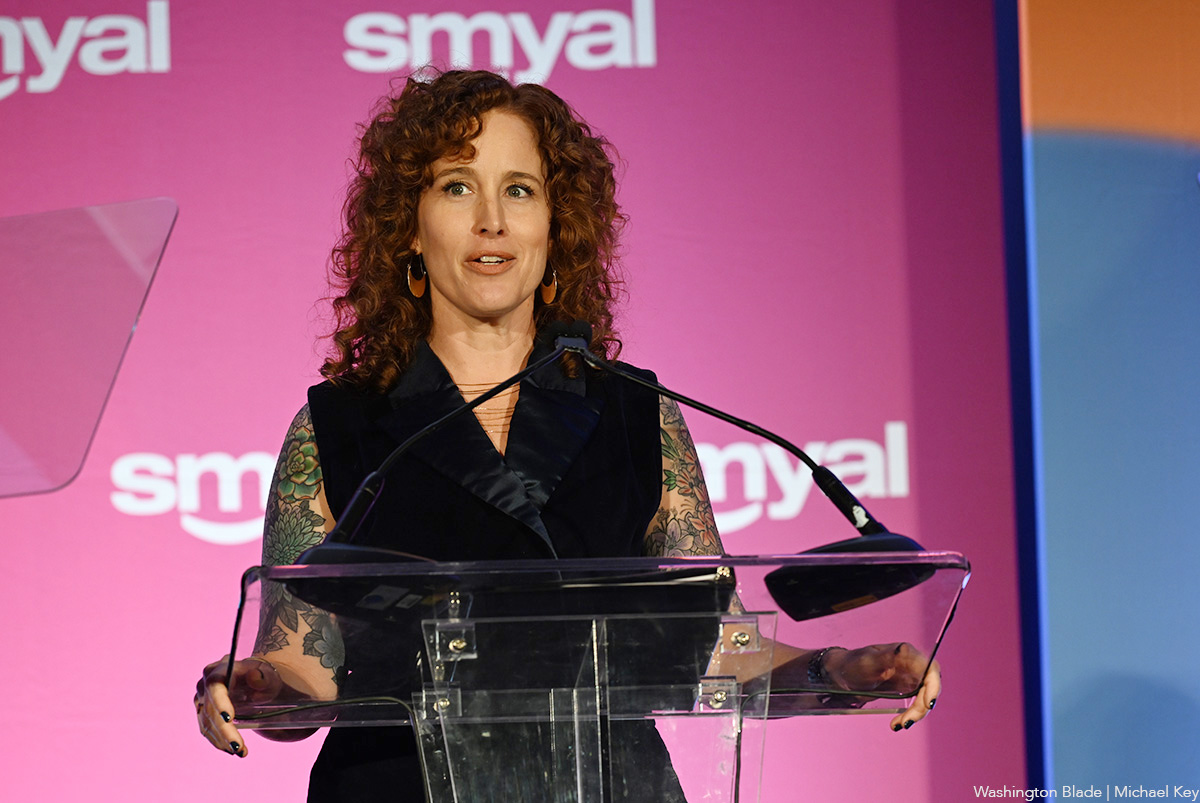
The D.C.-based organization SMYAL, which provides services for LGBTQ youth in the D.C. metro area, including housing for homeless LGBTQ youth, announced on June 30 that it received a $25,000 award for its “courageous acts” in support of the community it serves.
The award was a monetary grant from The Courage Project, which describes itself as a “national initiative investing in acts of courage and compassion that strengthens our communities and democracy.”
A statement on its website says it was launched in May 2025 and is funded and backed by leading national foundations in the U.S.
“At SMYAL, we are deeply grateful to receive support from The Courage Project and are inspired by their bold investment in LGBTQ+ youth at such a critical moment,” SMYAL CEO Erin Whelan said in a statement. “For queer and trans young people, simply showing up as themselves each day requires immense courage, and that courage is strengthened when organizations like The Courage Project stand behind them loudly, proudly, and without hesitation,” Whelan said.
In its statement announcing the award SMYAL says The Courage Project will recognize SMYAL and other awardees and their work on July 3 at the Washington National Cathedral as part of a special interfaith service marking the U.S. 250th anniversary.
“The Courage Project is a bold initiative honoring everyday acts of bravery – the quiet, often unseen acts of heroism that reflect the best of the American spirit and strengthen democracy at the community level,” the project states on its website.
Delaware
Delaware approves amendment protecting same-sex marriage
Measure must pass second vote in next year’s session

The Delaware General Assembly passed Senate Substitute 2 for Senate Bill 100 on the last day of the legislative session on Tuesday after being rescinded last week.
Senate Substitute 2 for Senate Bill 100 (SB-100) passed with 28 ‘yes’ votes, meeting the two-thirds threshold required for the bill to pass. Tuesday was the last day of the 153rd General Assembly.
The amendment would enshrine the right to same-sex and interracial marriage in the Delaware Constitution.
SB-100 was rescinded last week after it did not receive enough votes to pass. Democrats were short by three votes, with two Democratic members missing from the vote.
Rep. Josue Ortega (D-03) voted ‘no’ on SB-100 and Rep. Medinah Anton-Wilson (D-27) did not vote. However, both members voted ‘yes’ for Senate Substitute 2 for SB-100 on Tuesday.
Prime sponsor of SB 100, Rep. Claire Snyder-Hall (D-14), made the technical decision to change her vote last week from a ‘yes’ to a ‘no’ at the last minute to keep the bill alive.
Additionally, Republican Assemblyman Michael Smith (R-22) joined the Democrats with a ‘yes’ vote after voting ‘no’ on SB-100 last week.
In order for SB 100 to be enshrined into the state Constitution, it must be passed by two consecutive General Assemblies. Thus, the amendment will not be officially added to the Constitution unless it passes in the 154th General Assembly next year.
Rep. Snyder-Hall introduced the measure earlier this week.
“Just one week ago, we failed to pass this legislation. We failed the people of Delaware. But today, on the final day of the legislative session, the 153rd General Assembly affirmed that every Delawarean has the fundamental right to marry the person they love, regardless of race or gender,” said Snyder-Hall.
“Thank you to my colleagues for recognizing that the right to marry is a right worthy of protection and for voting yes on this important constitutional amendment.”
District of Columbia
Longtime Blade staffer Stephen Rutgers steps down after 14 years
Plans to focus on running Crush Dance Bar, other ventures

Longtime Washington Blade employee Stephen Rutgers announced he is stepping down after 14 years to focus on other ventures, including his part ownership of the popular Crush Dance Bar.
Rutgers was hired by the Blade in 2012 to help plan Pride festivities and over the years was promoted to director of sales and marketing. In addition to his broad set of responsibilities, Rutgers planned the annual Pride on the Pier celebration at the Wharf, which has exploded in popularity over the seven years since its launch.
“Watching Pride on the Pier grow from a new community event into one of D.C.’s signature Pride celebrations has been incredibly rewarding,” Rutgers said. “Expanding Pride on the Pier into a two-day festival for WorldPride in 2025 was definitely a career highlight. Seeing thousands of people come together to celebrate our community while supporting the Blade’s mission is something I’ll always be proud of.”

Rutgers described his biggest challenge as navigating the changing media landscape.
“More than ever, we’ve had to remind our community that local journalism matters and that it needs their support,” he said.
He added that he’s most proud of helping to ensure the Washington Blade is positioned to thrive for the next 50 years.
“I was fortunate to be part of the Blade during its 50th anniversary — a milestone that reflects its incredible history and impact,” Rutgers said. “The Blade has been an important voice for the LGBTQ community for more than five decades, and knowing I played a small part in helping its future is most important to me.”
Blade Publisher Brian Pitts praised Rutgers for juggling multiple responsibilities.
“We wish Stephen all the best,” Pitts said. “For the past 14 years, Stephen has been a vital part of the Blade, handling many things — marketing and advertising, sponsorships, and Blade signature events. We will all miss him.”
Blade Editor Kevin Naff thanked Rutgers for his years of service to the community.
“After 14 years, it’s hard to imagine the Blade without Stephen and his boundless energy and creativity,” Naff said. “He’s one of the hardest working and most dedicated people I’ve ever known and he will be missed. But change is the only constant and I know Stephen will move on successfully to new challenges and the Blade will expand on Stephen’s important work.”
As for what’s next for Rutgers, he said he plans to focus on Crush as well as his real estate business.
“I’ve always been someone who likes to stay busy,” Rutgers said. “For the past 12 years, I’ve balanced my work at the Blade and in real estate. Two years ago when I opened Crush, I never realized just how much time and energy it would take. The passing of my father earlier this year also gave me a new perspective. It reminded me that life is short and that it’s important to make time for the people and experiences that matter most. Stepping away from the Blade will allow me to focus on those ventures while also creating more balance in my life. After 14 incredible years, it feels like the right time for a new chapter.”
Naff said that for now Rutgers’s responsibilities will be divided between existing staff along with several new freelance contractors.
“The Washington Blade plays a unique role in our community’s fight for equality,” Rutgers said. “It’s the only LGBTQ news organization with White House credentials, giving it direct access to the people and institutions shaping policies that affect our community. The Blade continues to hold elected officials accountable, report on the issues that matter most to LGBTQ people, and tell the stories that often go uncovered by mainstream media.
“The Blade has been my family for most of my adult life. For 14 years, it has been part of my daily routine, so it’s going to feel very strange waking up and not logging on each morning.”

When a church fears the rainbow

Under-the-radar Delaware beach towns smart buyers are targeting

‘My Favorite Sociopath’ debuts at Shepherdstown’s CATF

‘Transcendent’ a tough but important read

SMYAL receives $25,000 award for ‘courageous acts’

ACLU says trans athletes ruling is narrower than many believe

Centenares de personas participan en la Marcha del Orgullo en la capital salvadoreña

Delaware approves amendment protecting same-sex marriage

Actually, I’m gay and I’m queer. It matters

Democratic Socialists of America are not automatically Democrats
-

 National5 days ago
ACLU says trans athletes ruling is narrower than many believe
-
Noticias en Español5 days ago
Centenares de personas participan en la Marcha del Orgullo en la capital salvadoreña
-
Delaware5 days ago
Delaware approves amendment protecting same-sex marriage
-
Opinions5 days ago
Actually, I’m gay and I’m queer. It matters