News
Log Cabin urges Dave Agema to resign
Gay GOP group calls for committee member’s ouster after anti-gay comments


Log Cabin is calling on Dave Agema to resign from RNC after saying gays want free health care because they’re dying of AIDS.
Pressure is increasing on Republican National Committee member Dave Agema to resign after he delivered remarks saying gay people are claiming HIV-positive partners to obtain health care.
The Log Cabin Republicans and the Log Cabin Republicans of Michigan jointly issued a statement on Friday calling for Agema’s ouster on the grounds that he’s imperiling Republican success at the ballot.
Gregory Angelo, executive director of Log Cabin, said resignation is the only appropriate action for Agema in the aftermath of his anti-gay remarks.
“One word: resign,” Angelo said. “Dave Agema has repeatedly shown that he is unfit to represent the many good Republicans in Michigan who understand that his brand of ‘conservatism’ isn’t doing the party any favors.”
Agema has been under fire for remarks he reportedly made at a local Republican Party holiday reception last week in Berrien County. According to the Herald Palladium, Agema said he’s seen gay people working for American Airlines claim to have HIV-infected partners to obtain spousal health coverage.
“Folks, they [gay people] want free medical because they’re dying between 30 and 44 years old,” Agema was quoted as saying. “To me, it’s a moral issue. It’s a biblical issue. Traditional marriage is where it should be and it’s in our platform. Those in our party who oppose traditional marriage are wrong.”
According to Log Cabin, there’s currently no mechanism to remove a Republican committee member in Michigan, but the Michigan Republican Party can amend its bylaws to allow for the removal of members who harm Republican prospects of winning elections. Short of that, Log Cabin wants Agema’s colleagues and RNC Chair Reince Priebus to insist he step down.
The Michigan Republican Party will have an opportunity to address the call for Agema’s resignation over the weekend at a Michigan Republican Party state committee meeting. According to the Associated Press, Jason Watts, an activist from Western Michigan, will propose a resolution not mentioning Agema by name, but disavowing the party of “demagogic rhetoric that is incendiary and unbecoming of civil discourse.”
Agema has a history of taking on anti-gay positions. He was responsible for introducing a resolution before the Republican National Committee that reaffirmed the party’s opposition to same-sex marriage. Agema has also compared being gay to being an alcoholic.
Agema, the Michigan Republican Party and the RNC did not respond to the Washington Blade’s request for comment on Log Cabin’s call for Agema’s resignation.
Agema’s remarks have already been condemned by Michigan Gov. Rick Snyder, Michigan Republican Party Chair Paul Welday, Michigan House Speaker Jase Bolger and Senate Majority Leader Randy Richardville.
Joe Sylvester, chair of Log Cabin Republicans of Michigan, said the Michigan Republican Party must find a way to take action against Agema.
“The Michigan Republican Party is acting as if it is helpless in this situation by saying that there is nothing that they can do about it,” Sylvester said. “It’s just a ploy. They are deflecting and hoping the issue goes away. They can do something about it and they should.”





Botswana
Lorato ke Lorato: marriage equality, democracy, and the unfinished work of justice in Botswana
High Court considering marriage equality case

As Botswana prepares for the resumption of a landmark marriage equality case before the High Court on July 14–15, the country finds itself at a critical constitutional crossroads.
At first glance, the matter may appear to be about whether two women, Bonolo Selelelo and Tsholofelo Kumile, can have their love legally recognized. At its core however, this case is about something far more profound: the dismantling of patriarchy, the decolonization of law, and the integrity of Botswana’s constitutional democracy.
Beyond marriage: a question of power
Marriage, as a legal institution, has never been neutral. It has historically functioned as a mechanism for regulating women’s bodies, sexuality, and social roles within a patriarchal order. To deny LBQ (lesbian, bisexual, and queer) women access to marriage is not merely to exclude them from a legal benefit, it is to reinforce a hierarchy of relationships, where heterosexual unions are deemed legitimate and all others invisible. This case therefore challenges the very foundations of who gets to love, who gets to belong, and who gets to be protected under the law.
As feminist scholars have long argued, patriarchy is sustained through institutions that appear ordinary but are deeply political. The law is one such institution. And it is precisely here that this case intervenes: by asking whether Botswana’s legal system will continue to uphold exclusion, or evolve to reflect the constitutional promise of equality.
A constitutional journey: Botswana’s courts and human dignity
This is not the first time Botswana’s courts have been called upon to affirm the dignity of LGBTQI+ persons. Over the past decade, the judiciary has built a progressive body of jurisprudence grounded in equality, nondiscrimination, and human dignity.
In Attorney General v. Rammoge and Others (Court of Appeal Civil Appeal No. CACGB 128-14, 2016), the Court of Appeal upheld the right of LEGABIBO to register as an organization. The court affirmed that:
“The refusal to register the appellant society was not only unlawful, but a violation of the respondents’ fundamental rights to freedom of association.”
This was followed by the ND v. Attorney General of Botswana (MAHGB-000449-15, 2017) case, where the High Court recognized the right of a transgender man to change his gender marker. The court held:
“Gender identity is an integral part of a person’s identity … and any interference with that identity is a violation of dignity.”
In Letsweletse Motshidiemang v. Attorney General (MAHGB-000591-16, 2019), the High Court decriminalized same-sex activity, declaring sections of the Penal Code unconstitutional. Justice Leburu powerfully stated:
“Human dignity is harmed when minority groups are marginalized.”
This decision was affirmed by the Court of Appeal in Attorney General v. Motshidiemang (CACGB-157-19, 2021), where the court emphasized:
“The Constitution is a dynamic instrument … it must be interpreted in a manner that gives effect to the values of dignity, liberty, and equality.”
These cases collectively establish a clear principle: the Constitution of Botswana protects all persons, not just the majority.
The marriage equality case now asks a logical next question: If LGBTQI+ persons are entitled to dignity, identity, and freedom from criminalization, why are their relationships still denied recognition?
Decolonizing the law: What is truly ‘UnAfrican’?
Opponents of marriage equality often argue that homosexuality is “unAfrican.” This claim, while politically powerful, is historically inaccurate. Same-sex relationships and diverse gender identities have existed across African societies long before colonial rule. What is foreign, however, are the laws that criminalize these identities.
Botswana’s anti-sodomy laws were inherited from British colonial legal systems, not from indigenous Tswana culture. As scholars of African history have demonstrated, colonial administrations imposed rigid Victorian moral codes that erased and suppressed existing sexual diversity. To claim that homosexuality is unAfrican, while defending colonial-era laws, is therefore a contradiction.
A truly decolonial approach to the law requires us to ask: Whose morality are we upholding? And whose history are we erasing?
Marriage equality, in this sense, is not a Western imposition: it is part of a broader project of reclaiming African dignity, plurality, and humanity.
Democracy on trial: the question of separation of powers
This case also raises important questions about the health of Botswana’s democracy.
Following the 2021 Court of Appeal decision affirming the decriminalization of same-sex relations, Botswana witnessed public demonstrations, including marches led by groups such as the Evangelical Fellowship of Botswana (EFB), opposing the judgment and calling for the retention of discriminatory laws.
While public participation is a cornerstone of democracy, these events raise deeper concerns about the separation of powers. Courts are constitutionally mandated to interpret the law and protect fundamental rights, even when such decisions are unpopular. When judicial decisions grounded in constitutional principles are publicly resisted on moral or religious grounds, it risks undermining the authority of the courts and the rule of law itself.
Democracy is not simply about majority opinion: it is about the protection of minority rights within a constitutional framework.
Botswana is not a theocracy
It is also important to clarify a recurring misconception: Botswana is not a Christian nation.
Botswana is a secular constitutional democracy and more accurately, a pluralistic society that recognizes and respects diversity of belief, culture, and identity. The Constitution does not elevate one religion above others, nor does it permit religious doctrine to dictate legal rights. The law must serve all citizens equally, regardless of faith.
To frame marriage equality as a threat to Christianity is therefore misplaced. The question before the courts is not theological, but constitutional: Does the exclusion of same-sex couples from marriage violate the rights to equality and nondiscrimination?
Love, equality, and the future of justice
At its heart, this case is about love, but it is also about power, history, and justice. It asks whether Botswana is prepared to move beyond colonial legal frameworks and patriarchal norms, and to embrace a future grounded in equality, dignity, and inclusion.
It asks whether the Constitution will continue to be interpreted as a living document, one that evolves with society, or remain constrained by outdated moral assumptions. Ultimately, it asks whether Botswana’s democracy can hold true to its founding promise: that all persons are equal before the law.
As the High Court prepares to hear this case in July 2026, the nation has an opportunity to affirm not only the rights of two individuals, but the broader principle that love, in all its diversity, deserves recognition, and protection.
Lorato ke lorato.
Love is love.
Justice, if it is to mean anything at all, must make space for it.
Nozizwe is the CEO of LEGABIBO (Lesbians, Gays and Bisexuals of Botswana)
District of Columbia
‘No Kings’ protests set for D.C.
Anti-Trump demonstrations to take place across country on Saturday

As President Donald Trump and his administration escalate rhetoric targeting transgender youth and student athletes, push efforts to restrict voting access for millions of Americans, and pursue foreign policy decisions that critics say bypass congressional authority, organizers across the country are once again mobilizing in protest.
For many LGBTQ advocates, the moment feels especially urgent.
In recent months, activists have pointed to a surge in anti-trans legislation, attacks on gender-affirming care, and efforts to roll back nondiscrimination protections as direct threats to the safety and visibility of queer and trans communities. Organizers say the demonstrations are not just about policy, but about defending the right of LGBTQ people — particularly trans youth and people of color — to live openly and safely.
Thousands of “No Kings” protests are planned nationwide, with multiple demonstrations set to take place in D.C.
One of the primary events, “No Kings Washington,” will be held in Anacostia, an overwhelmingly Black area of D.C. that is often at the center of conversations around racial justice, policing, and access to resources in the nation’s capital.
The protest in Anacostia is focused on what organizers describe as the “power behind the throne,” specifically Stephen Miller, the White House Deputy Chief of Staff for Policy and Homeland Security Advisor. Miller has been closely associated with the administration’s “zero tolerance” immigration policy, including the family separation practice that resulted in thousands of children being separated from their parents at the Southern border.
Activists have also linked immigration enforcement policies to broader concerns about LGBTQ migrants, including queer asylum seekers who often face heightened risks of violence and discrimination both in their home countries and within detention systems.
Anacostia protest details:
Participants are asked to gather starting at 1:30 p.m. on the southeast side of the Frederick Douglass Bridge. The closest Metro station is Anacostia on the Green Line, about an 8-minute walk from the starting point. Organizers strongly encourage attendees to use public transportation, as street parking is limited.
The march will proceed past Fort McNair and conclude near the Waterfront Metro station.
D.C. icon and LGBTQ activist Rayceen Pendarvis is set to speak at the protest around 2 p.m.
Kalorama protest details:
A separate protest will take place earlier in the day in Kalorama, a neighborhood long associated with political power and home to presidents, cabinet officials, and foreign ambassadors. Demonstrators are expected to gather at 10 a.m., with a march running until approximately noon near the intersection of Connecticut Avenue and Kalorama Road.
Arlington/National Mall protest details:
Another group is expected to assemble at Memorial Circle near Arlington National Cemetery at 10 a.m. before crossing the Memorial Bridge into D.C., passing the Lincoln Memorial and continuing on to the Washington Monument. Organizers say the march is intended to defend “American democracy, the rule of law, and a healthy planet.”
Unlike last June — when organizers discouraged large-scale demonstrations in D.C. due Trump’s military/birthday parade — activists are now explicitly calling on people to show up in the nation’s capital and surrounding areas.
The protests also coincide with Transgender Day of Visibility weekend, which includes additional gatherings and celebrations on the National Mall. At the same time, peak bloom for the National Cherry Blossom Festival is expected to draw large crowds to the city. With multiple major events happening simultaneously, officials and organizers anticipate significant congestion, increased traffic, and crowded public transit throughout the weekend.
Organizers are urging participants to plan ahead and come prepared.
“Bring your signs, noisemakers, music, and creative ideas, and gather in joyful, nonviolent protest,” they said. “Children are very welcome.”
For more information, visit nokings.org.
Pennsylvania
Pa. House passes bill to codify marriage equality in state law
Governor supports gay state Rep. Malcolm Kenyatta’s measure
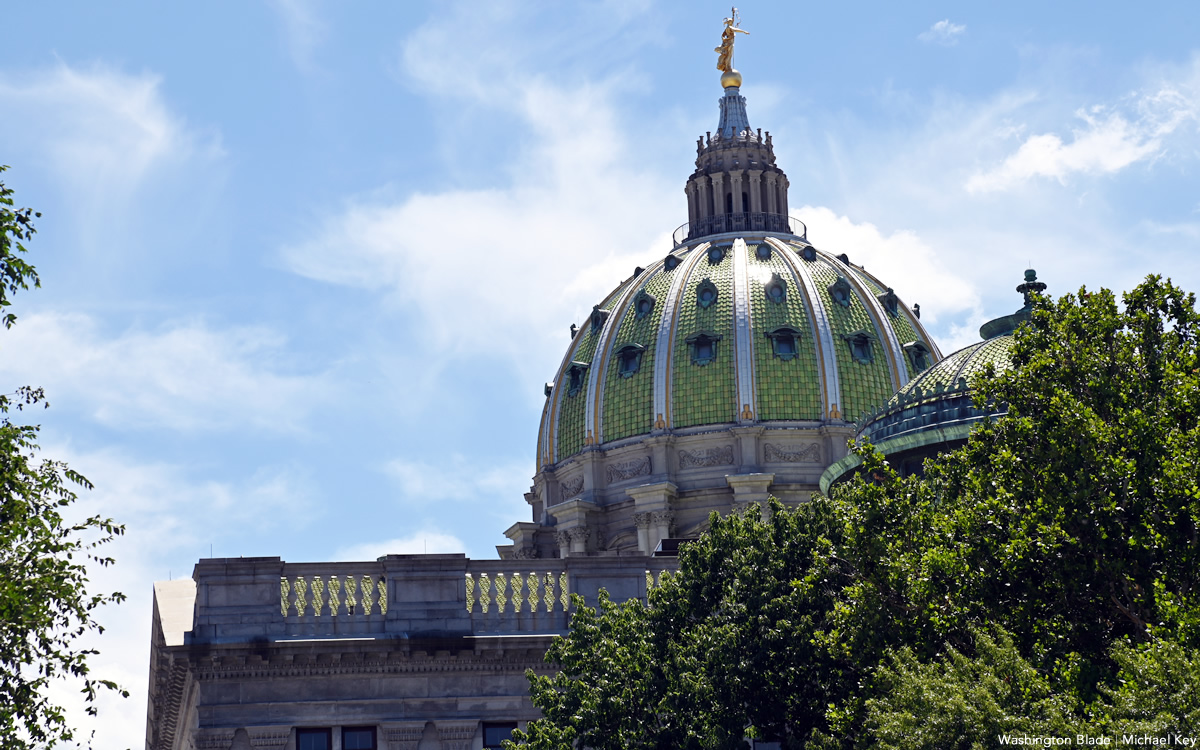
The Pennsylvania House of Representatives on Wednesday passed a bill that would codify marriage equality in state law.
House Bill 1800 passed by a 127-72 vote margin. Twenty-six Republicans voted for the measure.
The Republican-controlled Pennsylvania Senate will now consider the bill that state Rep. Malcolm Kenyatta (D-Philadelphia), who is the first openly gay person of color elected to the state’s General Assembly, introduced. Democratic Gov. Josh Shapiro supports the measure.
“Here in Pennsylvania, we believe in your freedom to marry who you love,” said Shapiro on Wednesday. “Today, the House has stepped up to protect that right.”
BREAKING: The Pennsylvania House just passed @RepKenyatta's bill to codify marriage equality into law in PA — and they did it with broad bipartisan support.
— Governor Josh Shapiro (@GovernorShapiro) March 25, 2026
Here in Pennsylvania, we believe in your freedom to marry who you love. Today, the House has stepped up to protect that…

Lorato ke Lorato: marriage equality, democracy, and the unfinished work of justice in Botswana

‘No Kings’ protests set for D.C.

Border to border: modern slavery and human trafficking in refugee movements across East Africa

New IOC policy bans trans women from Olympics

Introducing the Torchbearers Awards honoring queer, trans women and nonbinary people

PHOTOS: Capital Stonewall Democrats 50th anniversary

‘Inherit the Wind’ isn’t about science vs. religion, but the right to think

Small is beautiful: subcompact SUVs

Polish court rules country must recognize same-sex marriages from EU states

Capital Stonewall Democrats 50th anniversary gala draws sold out crowd
-

 Photos4 days ago
PHOTOS: Capital Stonewall Democrats 50th anniversary
-
Theater5 days ago
‘Inherit the Wind’ isn’t about science vs. religion, but the right to think
-
Autos5 days ago
Small is beautiful: subcompact SUVs
-
Poland4 days ago
Polish court rules country must recognize same-sex marriages from EU states