News
DNC chair discouraged support for ENDA directive: sources
Wasserman Schultz’s office calls allegation a ‘bald-faced lie’
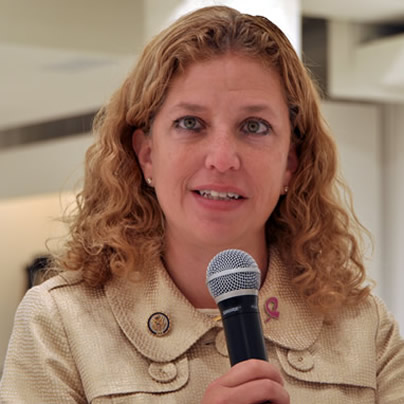
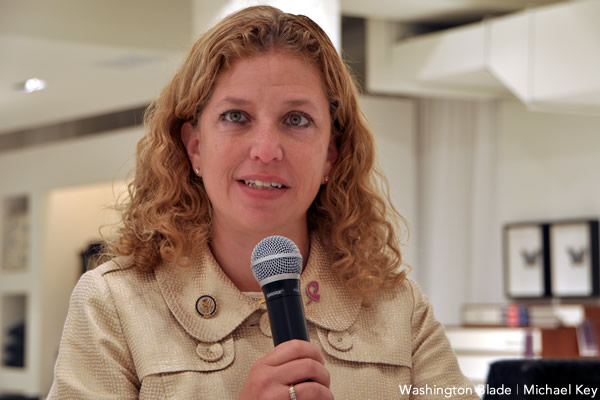
DNC Chair Debbie Wasserman Schultz is among those who haven’t articulated support for an ENDA executive order. (Washington Blade file photo by Michael Key)
A gay Democratic activist claims that Democratic National Committee Chair Debbie Wasserman Schultz (D-Fla.) has discouraged House members from asking President Obama to take administrative action to protect LGBT workers, an assertion her office calls a “bald-faced lie.”
Paul Yandura, political director for gay philanthropist Jonathan Lewis, made the allegation when speaking with the Washington Blade from his home in West Virginia on Thursday regarding a 2013 missive that was circulated among House members by Reps. Frank Pallone (D-N.J.) and Lois Capps (D-Calif.).
“I was told personally by two members that she was tamping down on public calls for the president to make good on his promise — this was last year when the issue was really getting hot,” Yandura said. “She is most likely doing the same still.”
Yandura’s allegation comes as lawmakers — led by the LGBT Equality Caucus and Sen. Jeff Merkley (D-Ore.) — are circulating a new missive among members of Congress calling on Obama to sign an executive order barring federal contractors from engaging in anti-LGBT workplace discrimination.
Two sources familiar with the 2013 letter told the Washington Blade that Wasserman Schultz discouraged members of Congress from signing it, but Yandura was the only source willing to go on the record. The other source, who spoke on condition of anonymity, said Wasserman Schultz, who represents Florida’s 23rd congressional district in the U.S. House, dissuaded Democrats from signing the letter in private conversations on the House floor.
Although these sources said Wasserman Schultz may be engaging in the same tactic for the letter currently being circulated, no one has made the same claim to the Blade about the upcoming letter. As the Blade reported this week, House Minority Whip Steny Hoyer (D-Md.) has already pledged to sign it.
Yandura said he wouldn’t disclose the names of the House members who told him Wasserman Schultz was discouraging support for the 2013 letter because he didn’t want to “rat them out.”
“I’m sure she’ll come with something that sounds like a good excuse, but it’s about time,” Yandura said. “It’s time that she not only signs it, but tells people that they should publicly, and that it’s OK and that there’s no pressure not to sign it.”
Mara Sloan, a Wasserman Schultz spokesperson, disputed the allegations made by Yandura, saying any assertion that she discouraged members from signing the letter “is a bald-faced lie.”
“The congresswoman believes the most effective way to ensure equal rights for LGBT Americans in the workplace is through passing comprehensive non-discrimination legislation,” Sloan said. “The congresswoman regularly speaks to the administration about issues important to the LGBT community, and will continue to be a fierce advocate for full equality.”
Sloan didn’t immediately respond to a follow-up email about whether that response means Wasserman Schultz won’t sign the group letter currently being circulated among House members calling for the LGBT executive order. The response is along the lines of responses to requests for comment about the order by the White House, which consistently redirects attention to the Employment Non-Discrimination Act.
Despite her record of support for the LGBT community, Wasserman Schultz has never explicitly called on Obama to sign an executive order barring LGBT discrimination among federal contractors. Asked about the issue in January by The Huffington Post, Wasserman Schultz said she supports the idea of Obama using his executive authority in “as broad a way as he can to ensure that we can move this country forward.”
Yandura said he thinks Wasserman Schultz refuses to express support for the executive order and has discouraged House members from speaking out in favor of it for political reasons.
“I think she doesn’t want to embarrass the president, and still doesn’t want to embarrass the president, because it is an embarrassment that he still hasn’t done it,” Yandura said. “We’re now coming down to the end of the second term, and if they don’t get moving on it, it’ll never even get implemented.”
House Speaker John Boehner (R-Ohio) has refused to bring ENDA to the floor for a vote; the Senate passed a version last year.
Yandura said he heard from House members about Wasserman Schultz because he was part of the effort to gather signatures for the 2013 letter. It ultimately was signed by 110 House Democrats. A separate letter to the same effect was signed by 37 Senate Democrats.
At the time, Yandura said he didn’t speak to the media about what he heard, but urged other groups working on the letter — Freedom to Work and most likely GetEQUAL — to address the situation with Wasserman Schultz. Freedom to Work didn’t immediately respond to a request to comment.
Heather Cronk, managing director for GetEQUAL, said she couldn’t corroborate allegations that Wasserman Schultz was actively discouraging House members from signing the letter.
“I actually can’t corroborate that,” Cronk said. “I’ve heard that she wasn’t a fan of the Executive Order, but I don’t have any evidence that she actively worked against it.”
Fred Sainz, vice president of communications for the Human Rights Campaign, said he hasn’t heard anything about Wasserman Schultz discouraging members from the signing the letter, even though his group was active in gathering signatures.
Yandura said he didn’t contact HRC about about Wasserman Schultz “probably because I don’t see them as good accountability enforcers for the president or Dems.”
The offices of Capps and Pallone, who were responsible for gathering signatures for the House letter, didn’t immediately respond with information about whether they had heard anything about Wasserman Schultz discouraging support for it.
Yandura has a history of making inflammatory statements against the DNC for not undertaking sufficient efforts on behalf on LGBT rights. In 2004, he landed his partner Donald Hitchcock, then the DNC’s LGBT liaison, in hot water by publicly asserting that the Democratic Party wasn’t doing enough to combat the multitude of anti-gay marriage amendments on the ballot that year.
Yandura’s boss has contributed to LGBT organizations such as Freedom to Work and GetEQUAL. Last year, Lewis announced that he would no longer donate to the Democratic Party after Senate Democrats excluded same-sex bi-national couples from immigration reform legislation (which was later remedied by the U.S. Supreme Court’s decision against the Defense of Marriage Act) and President Obama’s decision to continue to withhold an executive order barring LGBT discrimination.
Invoking the assertion from LGBT advocates that the executive order is a 2008 campaign promise from then-candidate Obama, Yandura said the best way to convince Obama to pen his name to the directive is increased pressure.
“I think that if the pressure could get built again, we might be able to shame him into doing it,” Yandura said. “We’ve waited for him to do the right thing. Now, I don’t know what it will take other than what it took to get him to do other things — and that is causing a shitstorm, getting up in his face and demanding it get done.”



The White House
Report: Grenell wants Russian ambassadorship
Country’s anti-LGBTQ record a reported barrier

Richard Grenell, President Donald Trump’s special envoy for “special missions,” is making it known that he is interested in the Russian ambassadorship.
According to reporting by the Daily Mail, Grenell has “floated” his interest in the role to coworkers, but issues surrounding the former German ambassador’s sexuality have made securing the position more difficult.
“He had an interest in the job — or at least he floated the idea to select colleagues. But Putin’s regime is extremely anti–LGBTQ, so I’m sure they didn’t take that thought too seriously,” one source close to Grenell told the Daily Mail. “That would never happen anyway.”
Grenell has long been one of Trump’s closest allies and was the first openly gay person to hold a Cabinet-level position. He was ousted last month as acting director of the Kennedy Center, a position he had held since Trump reestablished the board to be composed of his political supporters in 2025.
In addition to leading the nation’s cultural arts center, Grenell previously served as the U.S. ambassador to Germany from 2018 to 2020, and as the special presidential envoy for Serbia and Kosovo peace negotiations from 2019 to 2021. He was also a State Department spokesperson to the U.N. under the George W. Bush administration and a Fox News contributor.
Russia has a longstanding history of being anti-LGBTQ.
In 2013, the country passed a law banning any public endorsement of “nontraditional sexual relations” among minors. In December 2022, Putin signed legislation expanding the ban, making it illegal to promote same-sex relationships or suggest that non-heterosexual orientations are “normal” for people of any age, widening censorship across media and public life.
The Russian courts have also supported the restriction of LGBTQ identity in the country. In November 2023, Russia’s Supreme Court granted a request from the Justice Ministry to outlaw the “international LGBT movement” as “extremist,” allowing authorities to criminalize advocacy and potentially prosecute individuals for expressions of LGBTQ+ identity or support.
In addition to LGBTQ rights issues, the war between Russia and Ukraine has become a global concern. Ukraine, which was part of the former Soviet Union, includes the territory known as Crimea, which Russia annexed in 2014. The annexation remains a major point of international dispute over sovereignty. Since 2022, Russia’s large-scale invasion of Ukraine has escalated the conflict, drawing global attention and sanctions while straining U.S.-Russia relations.
The U.S. has spent $188 billion in total related to the war in Ukraine since the Russian invasion in February 2022, according to the Council on Foreign Relations.
The Russian ambassadorship seems to be a difficult role to fill, according to additional information presented by the Daily Mail. With Trump already being seen as relatively positive by Russian President Vladimir Putin, and with close ties to members of his Cabinet and family — like son-in-law Jared Kushner — the ambassadorship is complicated and viewed as less critical than in previous administrations.
“There is no rush to fill that role because it has now been deemed unnecessary,” another source told the U.K.-based publication.
Bob Foresman, a seasoned businessman with decades-long ties to the Kremlin, was reportedly once the frontrunner, according to the Daily Mail. Foresman served as vice chair of UBS Investment Bank and Deputy Chairman of Renaissance Capital between 2006 and 2009, and earlier led investment banking for Russia at Dresdner Kleinwort Wasserstein from 1997 to 2000.
“This is a pattern, especially in the Trump administration — special envoys big–footing the ambassadors,” a source told the Daily Mail. “It is shocking that we are already in April and we don’t have an ambassador to one of the most important countries in the world.”
Politics
Log Cabin Republicans to honor Scott Presler
Event to take place at Capitol Hill Club on Friday
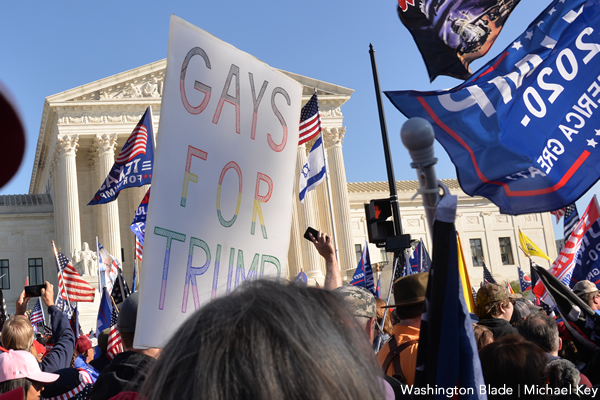
The Log Cabin Republicans, a group representing LGBTQ conservatives and their allies within the Republican Party, is set to honor gay conservative commentator and activist Scott Presler on Friday.
Presler will receive the organization’s 2026 “Game Changer Award” during its Spring Forward Cocktail Reception at the Capitol Hill Club, a private club steps from the U.S. Capitol that regularly hosts Republican political events.
Presler has risen to prominence through a combination of pro-LGBTQ conservative activism, political organizing, and a series of controversial affiliations.
He first gained national attention in 2017 for organizing the “March Against Sharia” rallies across the country. The demonstrations came amid heightened tensions in Portland, Ore., following a deadly attack on a metro train, in which Jeremy Joseph Christian killed two people and injured others after harassing Muslim women for wearing a hijab.
The rallies were organized in partnership with ACT for America, which advocates against what it describes as “the threat of radical Islam” in the U.S. and has been labeled a hate group by the Southern Poverty Law Center. Presler volunteered with the organization for three months.
He has said he was first motivated to “fight Muslim extremism” following the Pulse nightclub massacre, he told NPR, in which a gunman who pledged allegiance to ISIS killed 49 people at an LGBTQ nightclub in Orlando, Fla. The site now serves as a memorial to the victims of the attack.
Born May 15, 1988, in Jacksonville, Fla., Presler is the son of a U.S. Navy captain and was raised in both Florida and Fairfax County. He later attended George Mason University, where he earned a degree in criminal justice.
In addition to his anti-Islam activism, Presler has been involved in a number of other high-profile and controversial efforts. He co-founded “Gays for Trump” and attended their 2017 DeploraBall in Maryland for the first inauguration of Trump. According to a 2021 report from Media Matters for America, he also promoted the QAnon conspiracy movement through social media posts in 2018 and 2019.
He has also faced criticism tied to his early political work. According to a 2023 report from Politico Playbook, Presler’s work with the Republican Party of Virginia in 2016 ended after he allegedly engaged in sexual activity in a shared office space and posted explicit images online.
Beyond ideological activism, Presler has also organized community-focused initiatives. In 2019, he led a widely publicized cleanup effort in Baltimore that drew more than 100 volunteers and resulted in approximately 29 tons of trash being removed. The event was a result of criticism from President Donald Trump, calling the area, represented by then-U.S. Rep. Elijah Cummings (D-Md.) a “rodent infested mess.”
Presler has also been active in election-related organizing, leading a two-day “Stop the Steal” demonstration at the Pennsylvania State Capitol following the 2020 presidential election. He has appeared on the “War Room” podcast hosted by former Trump strategist and well-known right-wing populist conspiracy theorist Steve Bannon.
He has also expressed a controversial stance within the LGBTQ community for supporting then-candidate Trump for President over Hillary Clinton. He told prioritizing Second Amendment rights over certain LGBTQ policy goals, saying he is more supportive of gun rights than efforts to codify same-sex marriage, and adding, “I 100 percent believe in the notion that armed gays don’t get bashed. It is our right to feel safe.”
Presler voiced his support for the Florida Parental Rights in Education Act, more commonly referred to as the “Don’t Say Gay” law, signed into law by Republican Gov. Ron DeSantis in 2022.
Cuba
Cuba bajo presión y sin respuestas
Cubanos no hablan en términos geopolíticos. Hablan de sobrevivir

Las tensiones entre Estados Unidos y Cuba han vuelto a subir de tono. No es algo nuevo, pero este momento se siente distinto. Las medidas más recientes desde Washington buscan cerrar aún más los espacios financieros del gobierno cubano, limitar sus fuentes de ingreso y presionar sectores clave de la economía. No es simbólico. Es una política directa.
Desde Estados Unidos, el mensaje es claro. Se busca provocar cambios que no han ocurrido en más de seis décadas. También hay un componente interno, una presión política que responde a sectores del exilio que llevan años exigiendo una postura más dura. Todo eso forma parte del escenario.
Pero esa es solo una parte.
Del lado cubano, la respuesta sigue un patrón conocido. El gobierno habla de agresión externa, de guerra económica, de un embargo que se endurece. Cada medida se convierte en argumento para reforzar su narrativa y cerrar filas. No hay espacio para reconocer errores propios. Todo apunta hacia afuera.
Mientras tanto, la vida en la isla va por otro camino.
La crisis energética que hoy vive Cuba no empezó con estas medidas. Lleva años acumulándose. El sistema eléctrico está deteriorado, sin mantenimiento suficiente, con fallas constantes. Los apagones no son nuevos. Lo que ha cambiado es la frecuencia y la duración.
Durante años entró petróleo a Cuba, especialmente desde Venezuela. Hubo acuerdos. Hubo suministro. Y aun así, la vida del cubano no mejoró. La electricidad seguía fallando, el combustible seguía racionado, el transporte seguía siendo un problema diario.
Entonces la pregunta sigue siendo la misma.
Si el petróleo estaba entrando, ¿por qué nada cambiaba?
¿Dónde fue a parar ese recurso?
¿Dónde está el dinero que generó?
Hoy se habla de restricciones al petróleo como si fueran la causa principal de la crisis. No lo son. Empeoran una situación ya frágil, pero no la explican completamente.
Hay una historia más larga que no se puede ignorar.
Lo mismo ocurre con las brigadas médicas.
Durante años se presentaron como un gesto de solidaridad internacional. Y en muchos casos lo fueron. Médicos cubanos trabajaron en condiciones difíciles, salvaron vidas, sostuvieron sistemas de salud en otros países. Eso es real.
Pero también funcionaron como una de las principales fuentes de ingreso del Estado cubano.
Muchos de esos profesionales no recibían el salario completo por su trabajo. Una parte significativa quedaba en manos del gobierno. En algunos casos, ni siquiera tenían control sobre el dinero que generaban.
Y hay algo más duro.
Si uno de esos médicos decidía no regresar a Cuba, ese dinero no llegaba a su familia. Se quedaba retenido.
Hoy varios países están revisando o cancelando esos acuerdos. Y otra vez, la respuesta oficial es señalar hacia afuera. Pero la pregunta sigue siendo inevitable.
¿Se está perdiendo un modelo de cooperación o un sistema que dependía del control sobre sus propios profesionales?
Dentro de Cuba, la conversación suena diferente.
La gente no habla en términos geopolíticos. Habla de sobrevivir. De cómo llegar al final del día. De los apagones, de la comida que no alcanza, del transporte que no aparece, de una vida que cada vez se hace más difícil.
Hay quienes miran las medidas de Estados Unidos con cierta expectativa. No porque quieran más escasez, sino porque sienten que el sistema no cambia por sí solo. Hay una sensación de estancamiento que pesa.
Pero esa expectativa convive con una realidad concreta.
Las sanciones no golpean primero a quienes toman decisiones. Golpean al ciudadano común. Al que hace la fila. Al que pierde la comida por falta de electricidad. Al que no tiene cómo moverse.
Esa es la contradicción.
El gobierno cubano pide solidaridad internacional. Y la recibe. Países que envían ayuda, organizaciones que se movilizan, voces que defienden a la isla.
Pero hay otra pregunta que también está ahí.
¿Esa ayuda llega realmente al pueblo?
La falta de transparencia en la distribución de recursos es parte del problema. Porque no se trata solo de lo que entra, sino de lo que realmente llega a quienes lo necesitan.
Reducir lo que pasa en Cuba a un conflicto entre dos gobiernos es no querer ver el cuadro completo.
Aquí hay responsabilidades compartidas, pero no iguales.
Estados Unidos ejerce presión con efectos reales sobre la economía cubana. Eso no se puede negar. Pero dentro de la isla hay un sistema que ha tenido décadas para corregir, para abrir, para responder a su gente, y no lo ha hecho.
Esa parte no se puede seguir esquivando.
Yo escribo esto como cubano. Desde lo que vi, desde lo que viví y desde la gente que sigue allá tratando de resolver el día.
Porque al final, más allá de lo que se diga entre gobiernos, la realidad es otra.
Cuba hoy está más apretada, sí. Pero también lleva años arrastrando problemas que nadie ha querido enfrentar de verdad.
Y mientras eso siga así, da igual lo que venga de afuera. El problema sigue estando adentro.

Report: Grenell wants Russian ambassadorship
Log Cabin Republicans to honor Scott Presler

Cuba bajo presión y sin respuestas
Tenn. lawmakers pass transgender “watch list” bill

LGBTQ groups condemn Trump’s threat to destroy Iranian civilization

How Pepper the courthouse dog helps victims of abuse

Iconic Eddie Izzard takes on 23 characters in ‘Hamlet’

Surviving spring cleaning

Risking it all for love during World War II