Sports
‘Queens’ for a day
New documentary explores lives of out tennis players
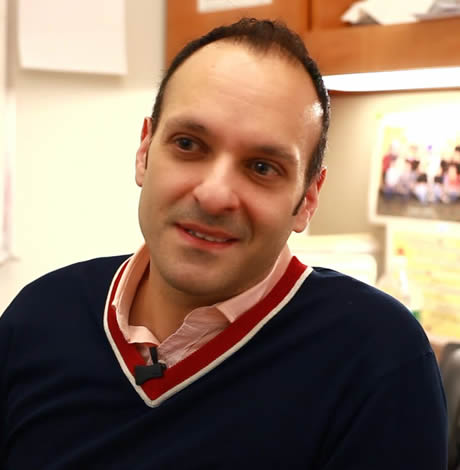
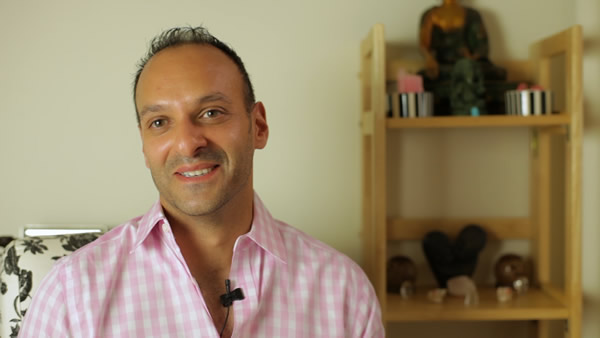
Out filmmaker Shiv Paul. (Photo courtesy Paul)
One of the things that continues to fascinate about the LGBT sports community is the diverse athletes who come together to form families. Shiv Paul has captured just that in his tennis documentary, “Queens at Court.”
The film follows four players from the Gay and Lesbian Tennis Alliance (GLTA) over the course of eight months, both on and off the court. The four players represent the wide spectrum of athletes on the tour. Featured in the film is a military veteran, a transsexual, a cross-cultural player and an overweight player.
The GLTA sponsors about 65 tournaments throughout the world and its membership is in excess of 8,000 players. Here in D.C., the Capital Tennis Association hosts one of the tournaments, the Capital Classic and one of its players, Chip Hines, is spotlighted in the film.
Paul was born in India and grew up in the market town of Epsom in England. His father introduced him to tennis at age 7 and enrolled him in local tennis schools. He left the sport behind while attending the University of Glasgow and after arriving in New York in 2006, he discovered the GLTA.
“I didn’t have much social structure when I moved to the United States,” Paul says. “I joined the local LGBT rugby, volleyball and tennis teams, but it was the tennis community that pulled me in.”
Paul’s first GLTA tournament was in New Orleans and he was fascinated and taken by the fact that the GLTA even existed. Subsequently he attended his first Gay Games in Cologne in 2010 and it was there that he initially felt the need to document the environment.
“I was completely surprised by the competitive nature of the Gay Games in Cologne,” Paul says. “It was a bigger and more meaningful experience than I was expecting. I love that LGBT sports allows people to return to a sport where they may not have been competitive.”
He began making the documentary about the GLTA athletes but as filming progressed, he realized it was more about adversity and exploring how athletes find their “sense of self.”
He didn’t intend to be one of the subjects of the film but at several of the screenings, the audience members insisted he shed some light on himself.
“It only seemed fair that I tell my own story since I was asking others to share their journey,” he says.
“Queens at Court” premiered in New York City at the Sage Center and in attendance at the event was the head of the United States Tennis Association (USTA) Diversity & Inclusion Program, D.A. Abrams. He arranged a screening for the USTA staff in White Plains, N.Y., and they agreed to screen the film at three stops on the Emirates Airlines U.S. Open Series, a series of hard court tournaments leading up to the U.S. Open.
“Queens at Court” was seen at the Washington, Toronto and Winston-Salem tournaments in the Series this summer.
Bob Koch, president of the Capital Tennis Association, was at the screening in D.C. at the Citi Open and says, “‘Queens at Court’ provides a neat snapshot into the LGBT tennis community. We are a tight-knit, welcoming and supportive group and the film captures that sense of community. The fact that the USTA was streaming the film serves to show their willingness to be inclusive.”
Paul, a recent Gay Games bronze medalist in tennis, says going forward he would like to coach workshops on promoting self-awareness, diversity and inclusion. He’s part of a team that is working with the Trevor Project on educational issues involving the transgender community such as finding the financial means needed to pay for reassignment surgery.
“It is cool to be part of something that results in change,” he says.
Members of the GLTA tennis community will be playing at the Capital Classic XXII on Sept. 13-15 in Washington.



Iran and Egypt on Friday faced off during the World Cup’s “Pride Match” in Seattle.
Iran is among the handful of countries in which consensual same-sex sexual relations remain punishable by death. Discrimination and persecution based on sexual orientation and gender identity is commonplace in Egypt.
Friday’s match coincided with Pride weekend in Seattle. The Egyptian Football Association and the Football Federation Islamic Republic of Iran both objected to playing in the “Pride Match.”
Egypt and Iran tied 1-1.
FIFA, for its part, allowed Pride flags inside the stadium during the match.
“The FIFA World Cup 2026 is an inclusive event that welcomes people from all backgrounds,” a FIFA spokesperson told the Washington Blade in a statement. “Fans of all sexual orientations and gender identities are welcome at matches and events. General statements of human rights, including rainbow flags and other flags representing sexual orientation and gender identity, are permitted under the FIFA World Cup 2026™ Stadium Code of Conduct and may be displayed inside stadiums provided they are used in a manner consistent with the code.”
Human Rights Watch welcomed FIFA’s decision to allow Pride flags inside the stadium. Outright International, a global LGBTQ and intersex rights group, distributed Pride flags in Seattle on Friday, which was Pride Match Day.
“Visibility matters,” said Outright International Executive Director Maria Sjödin. “Pride is now being celebrated in more than 100 countries, including this weekend in Seattle. For many LGBTIQ people, seeing a Pride flag in public is a reminder that they are not alone, and that their rights and dignity are recognized.”
FIFA President Gianni Infantino earlier this year told Die Weltwoche, a Swiss magazine, that “there will be no ‘Pride Match’ at the (FIFA) World Cup.”
“There will be a FIFA World Cup match in Seattle, and on the same day, events organized by external organizations will be taking place in the city,” said Infantino. “But that has nothing to do with the match itself.”
Peter Tatchell, a long-time LGBTQ activist from the U.K. who is director of the Peter Tatchell Foundation, was among those who traveled to Seattle for Friday’s match. Tatchell accused FIFA of not vetting World Cup teams — specifically Iran, Egypt, Saudi Arabia, Ghana, Senegal, Qatar, Tunisia, Morocco, Iraq, Uzbekistan, and Algeria — over whether they would allow gay players.
“FIFA is protecting LGBT+ visibility in the stands while failing to protect LGBT+ players on the pitch,” said Tatchell.
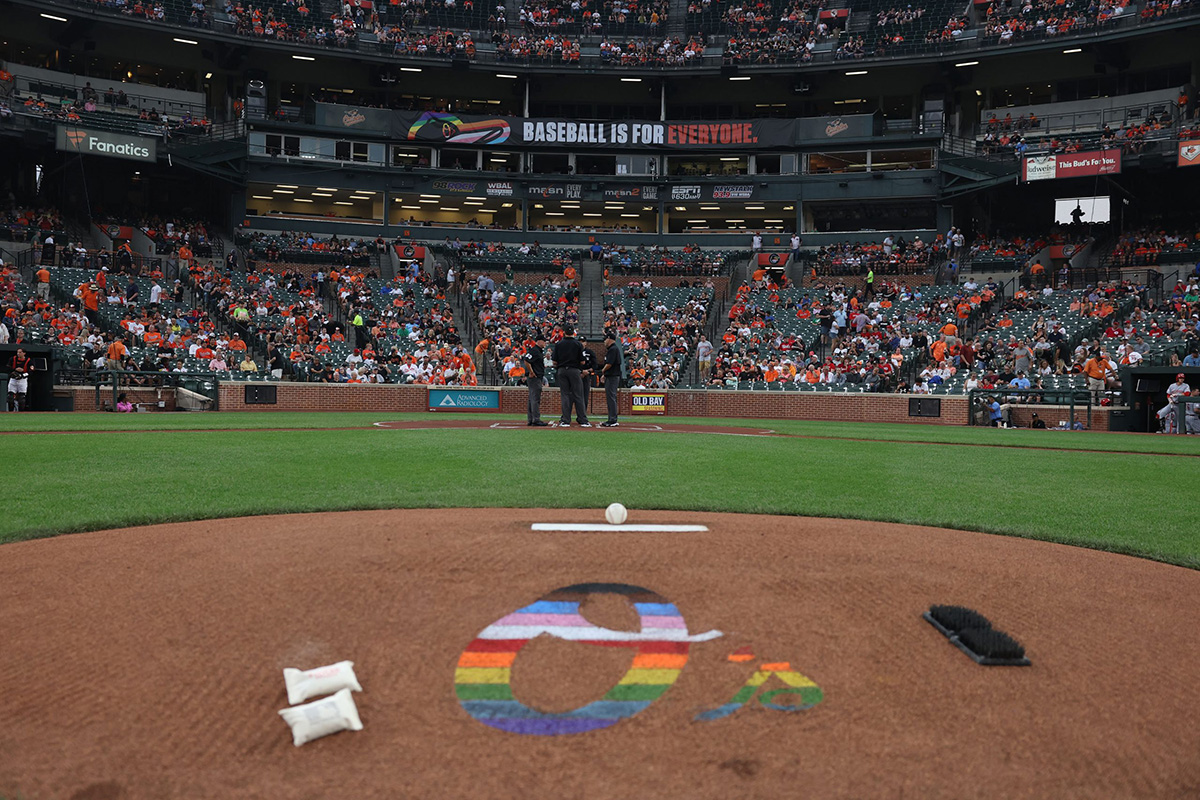
The Baltimore Orioles will take on the Washington Nationals on Friday, June 26 at 7 p.m. for Pride Night at Oriole Park.
The first 15,000 fans will receive an exclusive Pride Night Orioles jersey. The Washington Blade is a media sponsor of this event.
To purchase tickets, visit Orioles.com/Tickets.
Sports
Minor league team in York, Pa., forfeits Pride Night game after some players refuse to wear special jersey
City is roughly 20 miles north of Md. border
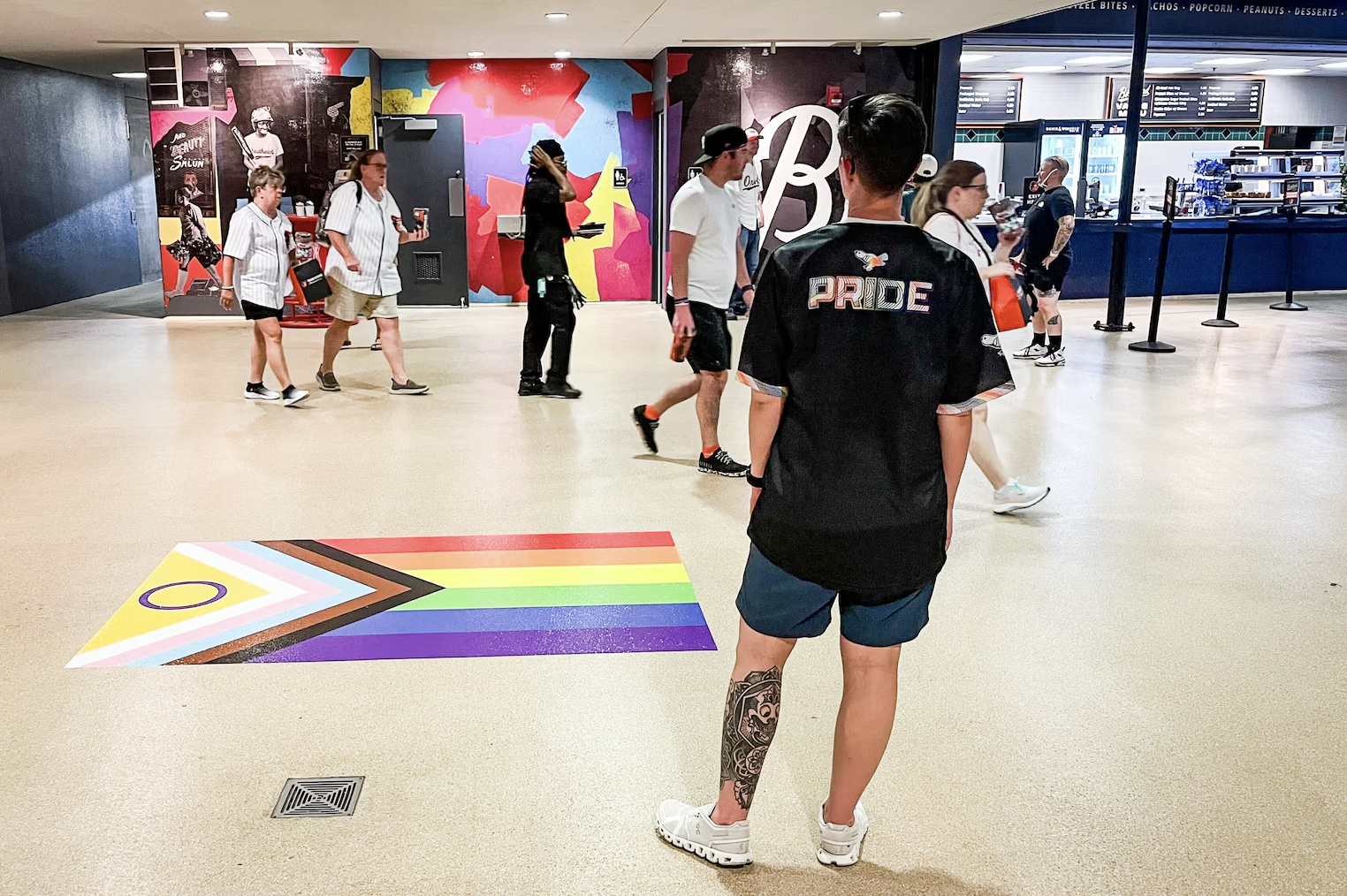
An independent minor league baseball team says it is forfeiting a game because some of its players refused to wear a special Pride Night jersey.
The Atlantic League Pro Baseball’s York Revolution were planning to hold their 11th annual Pride Night event Thursday for a game against the Southern Maryland Blue Crabs.
But the Revolution announced the day of the game that it wouldn’t be played. York is about 20 miles north of the Maryland line. The Blue Crabs play in Waldorf.
The rest of this article can be found on the Baltimore Banner’s website.

PHOTOS: Petal Release Party

Madonna headlines World Pride Music Festival in Amsterdam

Reggie White relishing first season as artistic director of Woolly Mammoth

PHOTOS: Amsterdam Pride Canal Parade

Amsterdam Pride Canal Parade draws hundreds of thousands

‘Heartstopper Forever’ delivers satisfying conclusion

Madonna to perform at World Pride in Amsterdam

BLADE ENDORSEMENT: Susan Stewart for mayor of Rehoboth Beach

PHOTOS: Lambda Legal in the Pines