Arts & Entertainment
Blond ambition
National ‘Evita’ touring production sturdy, serviceable
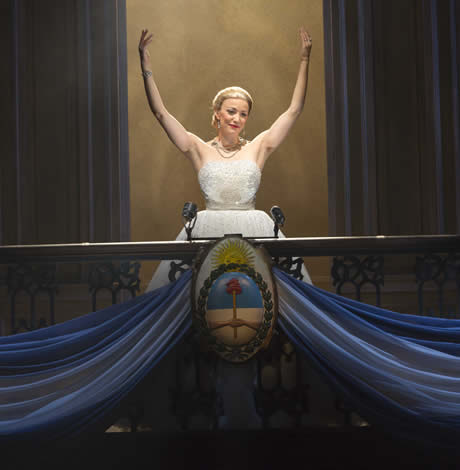
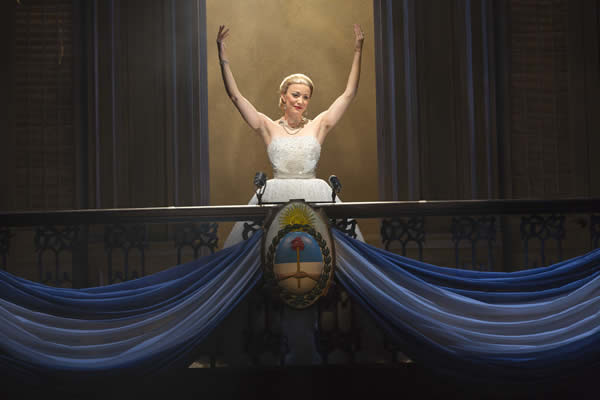
Caroline Bowman in ‘Evita.’ (Photo by Richard Termine; courtesy Kennedy Center)
‘Evita’
Through Oct. 19
The John F. Kennedy Center for the Performing Arts
2700 F St. NW
$39-125
Kennedy-center.org
Since its London world premiere in 1978 and subsequent global success, Andrew Lloyd Weber’s “Evita” has been produced ad infinitum.
And whether it’s Broadway’s Patti LuPone or Madonna on the big screen, the woman in the title role ultimately determines each version’s success. Playing Argentina’s controversial first lady who slept her way to power and position and died young isn’t easy — the part is vocally challenging and requires more than a modicum of charisma.
In the national tour of the 2012 Broadway revival now at the Kennedy Center Opera House, Caroline Bowman takes on the part. As the young Eva Duarte, Bowman misses the grit and energy of the provincial teenage dancehall girl — she might as well be playing the naïve ingénue in a comedy of manners. But it’s her turn as the slightly older and blonder Eva in which Bowman excels, skillfully conveying the outsized ambition and complexities churning behind Eva’s calculated façade.
In fact, neither Bowman’s performance nor the entire production staged by Michael Grandage really take off until Eva bleaches her hair.
Told in flashbacks, the sung-through pop opera begins and ends with Eva’s funeral. Young Eva and the musical fable’s narrator Che (Max Quinlan) emerge from a shadowy gathering of mourners and the story unfolds. In fast moving scenes, Eva climbs from poor, illegitimately born provincial girl to radio actress to girlfriend and later wife of military officer and politico Juan Perón (Sean MacLaughlin). Yes, in pursuit of fame and fortune she changes men like underwear but all that stops with Perón. In him, Eva finds her ticket to the big time.
Despised by the bourgeoisie and the military for her low birth and undue influence her husband, Eva finds an adoring power base in the working classes. “I am you,” she sings to them. As first lady, she gains popularity by funding numerous charities.
Her ascent is tracked musically with “Buenos Aires,” “High Flying, Adored” and, most memorably “Don’t Cry for Me Argentina,” which she sings to the crowds from the presidential residence’s balcony. Diamond like in a shimmering strapless ball gown, Eva’s beatification is complete. Not one to miss an opportunity, Perón puts his wife’s charisma to use and sends her on a European goodwill tour. Her Rainbow tour is cut short by the cancer that will soon kill her at 33 in 1952.
Set and costume designer Christopher Oram envisions a gloomy Buenos Aires of soaring colonnades, tall arched windows and heavy doors. His costumes are painstakingly period (‘30s and ‘40s). Most striking are Eva’s balcony scene gown and Dior-inspired traveling suits.
Throughout the show, choreographer Rob Ashford cleverly employs tango in scenes involving mourners, lovers and friends. He even partners soldiers in a more combative variation of the dance.
Lloyd Weber’s score is gorgeously sung by the three principals and Christopher Johnstone as Magaldi, the schmaltzy tango singer who reluctantly brings teenage Eva to Buenos Aires.
Without his trademark beret, Quinlan’s Che is less politicized. He possesses the irony but lacks the fire of a revolutionary. As quietly ambitious Perón, McLaughlin (whom local audiences will remember from Signature Theatre) is terrific. He’s a seductive presence and makes a believable love match for Bowman’s Eva.
Unfortunately an otherwise strong and energetic effort is marred by some audio problems. On press night, Tim Rice’s lyrics were difficult to decipher. Those familiar with the songbook fared best.
Still, this “Evita” is a production well worth seeing.
Theater
‘Octet’ explores the depths of digital addiction
Habits not easily shaken in Studio Theatre chamber musical
‘Octet’
Through Feb. 26
Studio Theatre
1501 14th Street, N.W.
Tickets start at $55
Studiotheatre.org
David Malloy’s “Octet” delves deep into the depths of digital addiction.
Featuring a person ensemble, this extraordinary a capella chamber musical explores the lives of recovering internet addicts whose lives have been devastated by digital dependency; sharing what’s happened and how things have changed.
Dressed in casual street clothes, the “Friends of Saul” trickle into a church all-purpose room, check their cell phones in a basket, put away the bingo tables, and arrange folding chairs into a circle. Some may stop by a side table offering cookies, tea, and coffee before taking a seat.
The show opens with “The Forest,” a haunting hymn harking back to the good old days of an analog existence before glowing screens, incessant pings and texts.
“The forest was beautiful/ My head was clean and clear/Alone without fear/ The forest was safe/ I danced like a beautiful fool / One time some time.”
Mimicking an actual step meeting, there’s a preamble. And then the honest sharing begins, complete with accounts of sober time and slips.
Eager to share, Jessica (Chelsea Williams) painfully recalls being cancelled after the video of her public meltdown went viral. Henry (Angelo Harrington II) is a gay gamer with a Candy Crush problem. Toby (Adrian Joyce) a nihilist who needs to stay off the internet sings “So anyway/ I’m doing good/ Mostly/ Limiting my time/ Mostly.”
The group’s unseen founder Saul is absent, per usual.
In his stead Paula, a welcoming woman played with quiet compassion by Tracy Lynn Olivera, leads. She and her husband no longer connect. They bring screens to bed. In a love-lost ballad, she explains: “We don’t sleep well/ My husband I/ Our circadian rhythms corrupted/ By the sallow blue glow of a screen/ Sucking souls and melatonin/ All of my dreams have been stolen.”
After too much time spent arguing with strangers on the internet, Marvin, a brainy young father played by David Toshiro Crane, encounters the voice of a God.
Ed (Jimmy Kieffer) deals with a porn addiction. Karly (Ana Marcu) avoids dating apps, a compulsion compared to her mother’s addiction to slot machines.
Malloy, who not only wrote the music but also the smart lyrics, book, and inventive vocal arrangements, brilliantly joins isolation with live harmony. It’s really something.
And helmed by David Muse, “Octet” is a precisely, quietly, yet powerfully staged production, featuring a topnotch cast who (when not taking their moment in the spotlight) use their voices to make sounds and act as a sort of Greek chorus. Mostly on stage throughout all of the 100-minute one act, they demonstrate impressive stamina and concentration.
An immersive production, “Octet” invites audience members to feel a part of the meeting. Studio’s Shargai Theatre is configured, for the first, in the round. And like the characters, patrons must also unplug. Everyone is required to have their phones locked in a small pouch (that only ushers are able to open and close), so be prepared for a wee bit of separation anxiety.
At the end of the meeting, the group surrenders somnambulantly. They know they are powerless against internet addiction. But group newbie Velma (Amelia Aguilar) isn’t entirely convinced. She remembers the good tech times.
In a bittersweet moment, she shares of an online friendship with “a girl in Sainte Marie / Just like me.”
Habits aren’t easily shaken.
Sports
Blade, Pride House LA announce 2028 Olympics partnership
Media sponsorship to amplify stories of LGBTQ athletes
The Los Angeles Blade and Washington Blade on Friday announced a media partnership with the Out Athlete Fund, which will produce Pride House LA for the 2028 Summer Olympics.
Pride House is the home for LGBTQ fans and athletes that will become a destination during the L.A. Summer Games in West Hollywood in partnership with the City of WeHo. This 17-day celebration for LGBTQ athletes and fans will include medal ceremonies for out athletes, interactive installations, speakers, concerts, and more.
The Los Angeles Blade will serve as the exclusive L.A.-area queer media sponsor for Pride House LA and the Washington Blade will support the efforts and amplify coverage of the 2028 Games.
The Blade will provide exclusive coverage of Pride House plans, including interviews with queer athletes and more. The parties will share content and social media posts raising awareness of the Blade and Out Athlete Fund. The Blade will have media credentials and VIP access for related events.
“We are excited to partner with the Washington Blade, the oldest LGBTQ newspaper in the United States and the Los Angeles Blade, already a strong supporter of Out Athlete Fund and Pride House LA/West Hollywood,” said Michael Ferrera, CEO of Pride House LA. “Our mission is about increasing the visibility of LGBTQ+ athletes and fans to challenge the historical hostility toward our community in the sports world. Visibility is what publications like the Washington and Los Angeles publications are all about. We know they will play a key part in our success.”
“LGBTQ visibility has never been more important and we are thrilled to work with Out Athlete Fund and Pride House LA to tell the stories of queer athletes and ensure the 2028 Summer Games are inclusive and affirming for everyone,” said Blade Editor Kevin Naff.
Out Athlete Fund is a 501(c)3 designed to raise money to offset the training cost of out LGBTQ athletes in need of funding for training. The Washington Blade is the nation’s oldest LGBTQ news outlet; the Los Angeles Blade is its sister publication founded nine years ago.
In honor of Black History Month, the DC LGBTQ+ Community Center will host a series of events uplifting the histories, artistry, and resilience of Black LGBTQ+ communities through dialogue, film, and intentional gathering.
The series begins with “Ballroom Culture: Rhythms of Resilience,” a panel discussion on Tuesday, Feb. 10, 2026 at 7 p.m. Artists, activists, and leaders from the ballroom community will explore ballroom’s historical, cultural, and political significance as a site of resistance, kinship, creative expression, and social justice within Black, Latinx, and LGBTQ+ communities.
On Friday, Feb. 13 at 12:30 p.m., the Center will host a screening of the groundbreaking documentary “Paris is Burning,” which chronicles New York City’s ballroom scene and house culture while examining themes of race, class, identity, and survival through the voices of legendary performers including Willi Ninja, Pepper LaBeija, and Dorian Corey.
The month will conclude with “Soul Centered: A Black LGBTQ+ Gathering” on Saturday, Feb. 21, 2026 at 3:30 p.m. This free, RSVP-required event invites Black LGBTQ+ community members into a space of rest, connection, and reflection centered on love in all its forms. The gathering will feature a panel conversation with Black LGBTQ+ creatives, healers, and community members, followed by intentional speed connections and a closing social mixer.
For more details and to RSVP, visit the Center’s website.
-
Virginia4 days agoHashmi speaks at Equality Virginia Lobby Day
-
District of Columbia4 days agoNorton hailed as champion of LGBTQ rights
-
Maryland4 days ago4th Circuit dismisses lawsuit against Montgomery County schools’ pronoun policy
-
District of Columbia3 days agoD.C. Council gives first approval to amended PrEP insurance bill