News
Ohio agrees Supreme Court should consider same-sex marriage case
DeWine seeks reversal of rulings finding right to gay nuptials under Fourteenth Amendment
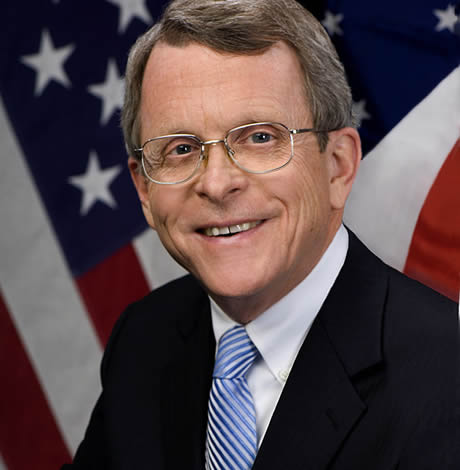
Ohio Attorney General Mike DeWine agrees the Supreme Court should take up a same-sex marriage case. (Photo public domain)
Ohio Attorney General Mike DeWine signaled on Friday he agrees the U.S. Supreme Court should take up litigation seeking recognition of out-of-state same-sex marriages in Ohio, but for the purposes of determining that states have a right to prohibit marriage rights for gay couples under the U.S. Constitution.
In a 34-page filing, DeWine and State Solicitor Eric Murphy make the case for review of the consolidated case of Henry v. Hodges and Obergefell v. Hodges following a decision to uphold Ohio’s ban on same-sex marriage from the U.S. Sixth Circuit Court of Appeals, which is thus far the only federal appeals court that found such laws are constitutional.
Even though the Sixth Circuit ruled in favor of the state, DeWine says the Supreme Court should consider the case to issue a nationwide ruling overruling other courts that have determine the Fourteenth Amendment prohibit states from banning same-sex marriage through the democratic process.
“The country deserves a nationwide answer to the question — one way or the other,” DeWine writes. “For its part, Ohio asks the Court to answer the legal question in favor of a dynamic view that permits the democratic debate over proper policy to continue now and going forward, rather than a wooden view that takes that policy question out of the hands of this generation and all future generations.”
The filing responds to a petition filed by plaintiff same-sex couples in the Ohio litigation asking the Supreme Court to reverse the Sixth Circuit and find a right to state recognition for out-of-state same-sex marriages throughout the country. The petition is one among five before the Supreme Court calling on justices to take up a case seeking a nationwide ruling in favor marriage equality. Petitions have been filed by plaintiff same-sex couples in Michigan, Ohio, Kentucky, Tennessee and Louisiana. But the Ohio and Tennessee cases are unique because they seek recognition of same-sex marriage, not the right for same-sex couples to marry outright.
DeWine presents two major arguments for why the Supreme Court should consider the Ohio marriage case: (1) a square circuit conflict exists over whether the Fourteenth Amendment includes a right to same-sex marriage, and (2) the court should review the Fourteenth Amendment question in the licensing and recognition contexts.
“Given the circuit split, the Court should review whether the Fourteenth Amendment includes a right to same-sex marriage,” DeWine writes. “It should ideally do so in two contexts. The Court should review a case (like the Michigan or Kentucky cases) involving whether the Fourteenth Amendment requires a State to license same-sex marriage within its borders. And it should review a case (like the Ohio cases) involving whether the Fourteenth Amendment requires a State to recognize out-of-state, same-sex marriages.”
Although DeWine says he agrees the Supreme Court should take up the Ohio marriage to resolve the issue of whether the Fourteenth Amendment guarantees the right of same-sex couples to marry, he says he opposes consideration of litigation to determine whether states must recognize out-of-state same-sex marriage on the basis of the Full Faith & Credit Clause.
DeWine offers three reasons why the Supreme Court shouldn’t consider the marriage issue based on the Full Faith & Credit Clause: (1) it would require the Court to resolve a difficult preliminary issue; (2) it does not involve a deep circuit divide like
the first question; and (3) it was barely addressed by either of the lower courts in the Ohio case.
“The Court should instead allow for additional percolation in the lower appellate courts on this subsidiary question,” DeWine writes. “Review now would, in the end, only divert the Court from the more far-reaching constitutional questions that all of the cases out of the Sixth Circuit present.”
The Ohio filing means that state officials in each of the states with marriage cases before the Supreme Court thus far back review. The only remaining state official not to articulate a position on the issue is Tennessee Attorney General Herbert H. Slatery III.
Leigh Ann Apple Jones, a spokesperson for his office, said he has yet to file a response as of late Friday. The deadline to file the response is Monday.





Federal Government
Protesters say SAVE Act targets voters, transgender youth
Bill described as ‘Jim Crow 2.0’
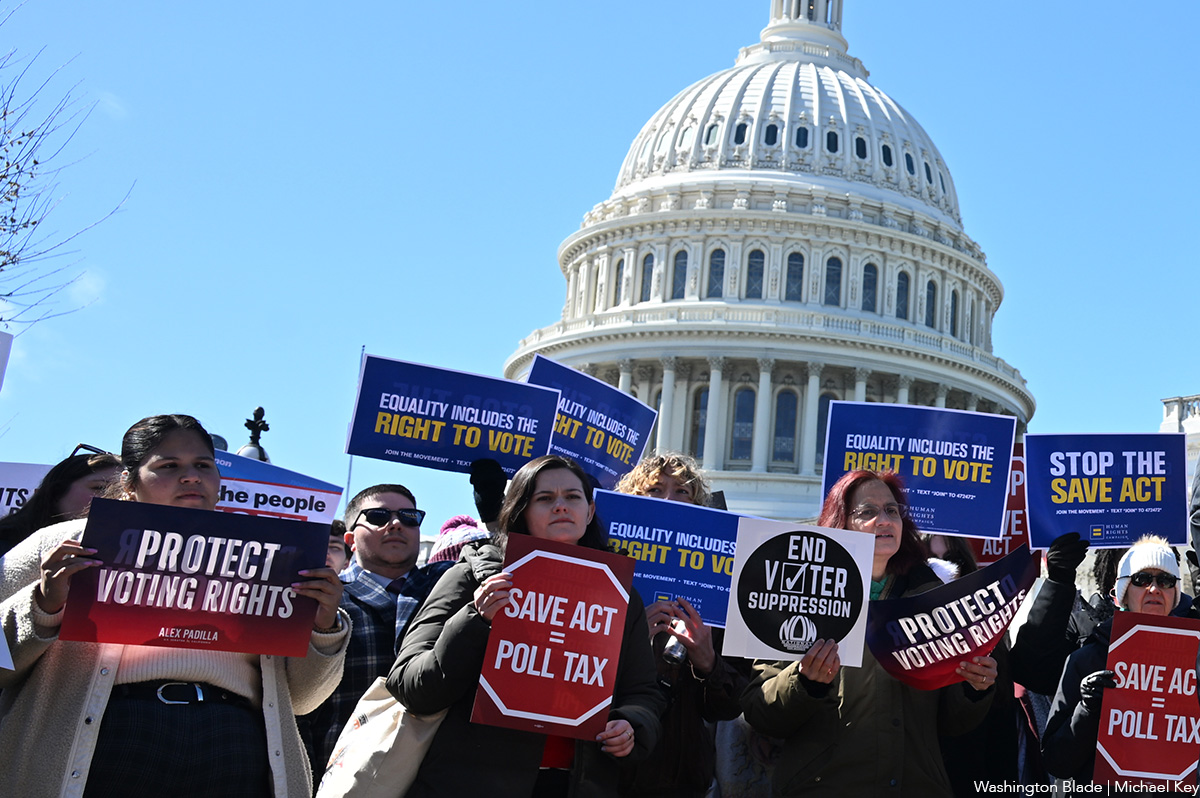
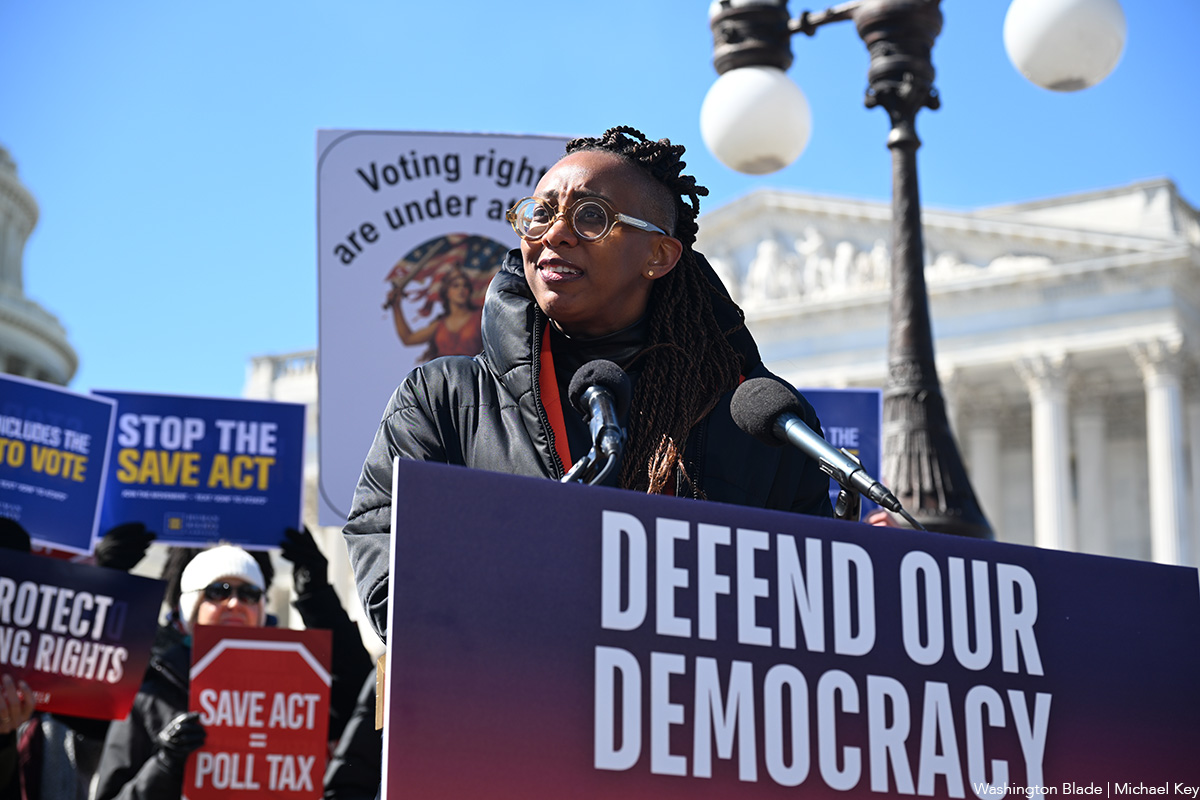
Members of Congress, advocates, and people from across the country gathered outside the U.S. Capitol on Tuesday to protest proposed federal legislation that voting rights activists have deemed “Jim Crow 2.0.”
The Safeguard American Voter Eligibility (SAVE) Act would amend the National Voter Registration Act of 1993 to require in-person proof of citizenship for anyone seeking to vote in U.S. elections.
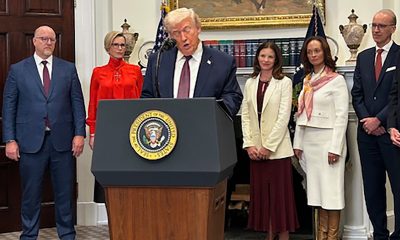
President Donald Trump has also pushed for the proposed legislation to include a section that would ban gender-affirming medical care for transgender minors, even with parental consent, and prohibit trans people from participating in school or professional sports consistent with their gender identity rather than their sex assigned at birth.
In addition to changing voter registration requirements, the bill would limit acceptable forms of identification to documents such as a birth certificate or passport — records that the Brennan Center for Justice estimates more than 21 million Americans do not have — effectively restricting access to the ballot. It would also ban online voter registration, DMV voter registration efforts, and mail-in voter registration.
A 2021 investigation by the Associated Press found that fewer than 475 people voted illegally or improperly, a tiny fraction of the estimated 160 million Americans who voted in the 2020 election.
Senate Minority Leader Chuck Schumer (D-N.Y.) spoke at the event.
“It will kick millions of American citizens off the rolls. And they don’t even require you to be told,” the highest-ranking Democrat in the Senate told protesters and reporters outside the Capitol. “If this law passes — and it won’t — you’re gonna show up in November … and they’ll say… sorry, you’re no longer on the voting rolls.”
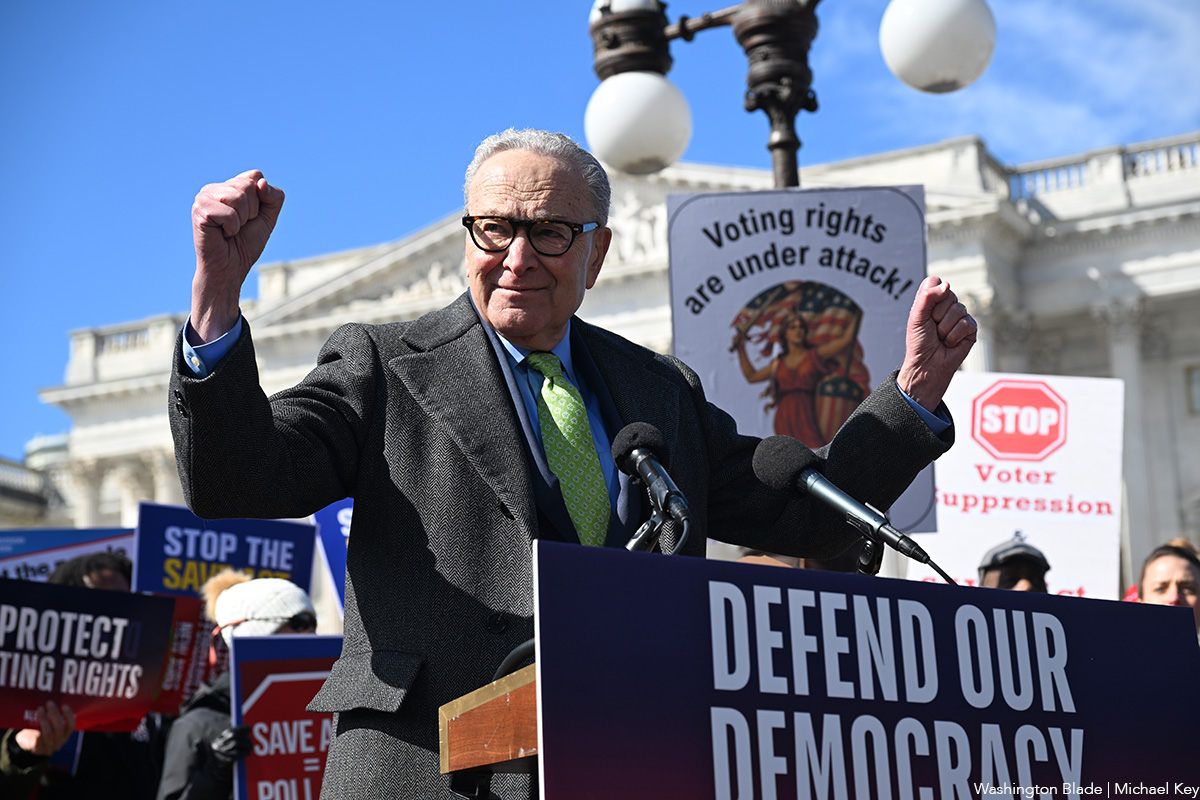
He, like many other speakers, emphasized the bill in the context of American history, pointing to what he described as its racist roots and its impact on Black and brown Americans.
“I have called this act, over and over again, Jim Crow 2.0 … because they know it’s the truth.”
U.S. Sen. Alex Padilla (D-Calif.) was one of the lawmakers leading opposition to the legislation and spoke at the rally.
“It’s not just voting rights that are on the line — our democracy is on the line,” the California lawmaker said. “It’s not a voter I.D. bill. It’s a bait and switch bill.”
He added historical context, noting the significance of voting rights legislation passed more than 60 years ago. In 1965, Alabama civil rights activists marched to protest barriers to voter registration. Alabama state troopers violently attacked peaceful demonstrators at the Edmund Pettus Bridge in Selma, using tear gas, clubs, and whips against more than 500 — mostly Black — protesters.
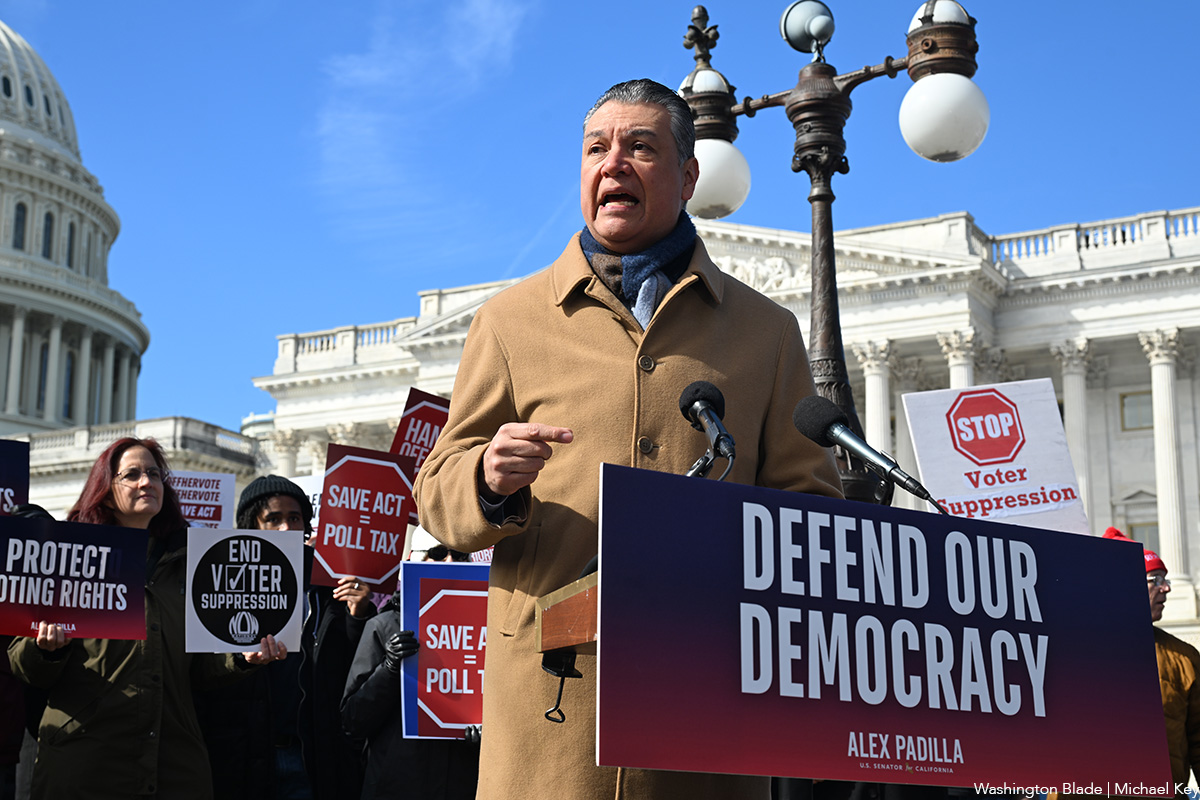
“61 years ago — not to the day — but this week, President Lyndon Johnson came to the Capitol and addressed a joint session of Congress in the wake of Bloody Sunday and pushed Congress to pass the Voting Rights Act,” Padilla said. “61 years later, Donald Trump and this Republican majority wants to take us backwards. We’re not gonna let that happen.”
U.S. Sen. Ben Ray Luján (D-N.M.) also spoke, emphasizing that he views the effort as a Republican-led and Trump-backed attempt to restrict voting access, particularly among Black, brown, and predominantly Democratic communities.
“President Trump told Republicans when they were meeting behind closed doors that ‘The SAVE Act will guarantee Republicans win the midterms and ensure they do not lose an election for 50 years,’” Luján said. “The first time I think Donald Trump’s been honest … This voter suppression bill is only that. Taking away vote by mail? I hope my Republican colleagues from states that voted for Donald Trump or where vote by mail is popular have the courage and the backbone to stand up and say no to this nonsense, because their constituents are going to push back.”
U.S. Sen. Lisa Blunt Rochester (D-Del.) also spoke.
“Our Republican colleagues have already cut Medicaid, Medicare, people don’t know how they’re gonna be able to afford energy,” she said, providing context for the broader political moment. “We’re in the middle of a war that they can’t even get straight while we’re in it and don’t have a way to get out of it. And we are now faced with defending our democracy?”
She then showed the crowd something that she said has been with her throughout her political journey in Washington.
“I brought with me something that I carried on the day that I was sworn into the House of Representatives when I was elected in 2016, and I carried it with me on the day that I was sworn in as United States senator. And I also carried it with me when I was trapped up in the gallery on Jan. 6 and all I could think to do was pray … This document allowed my great great great grandfather, who had been enslaved in Georgia, to have the right to vote. We took this and turned it into a scarf. It is the returns of qualified voters and reconstruction code from 1867. This is my proof of what we’ve been through. This is also our inspiration.”
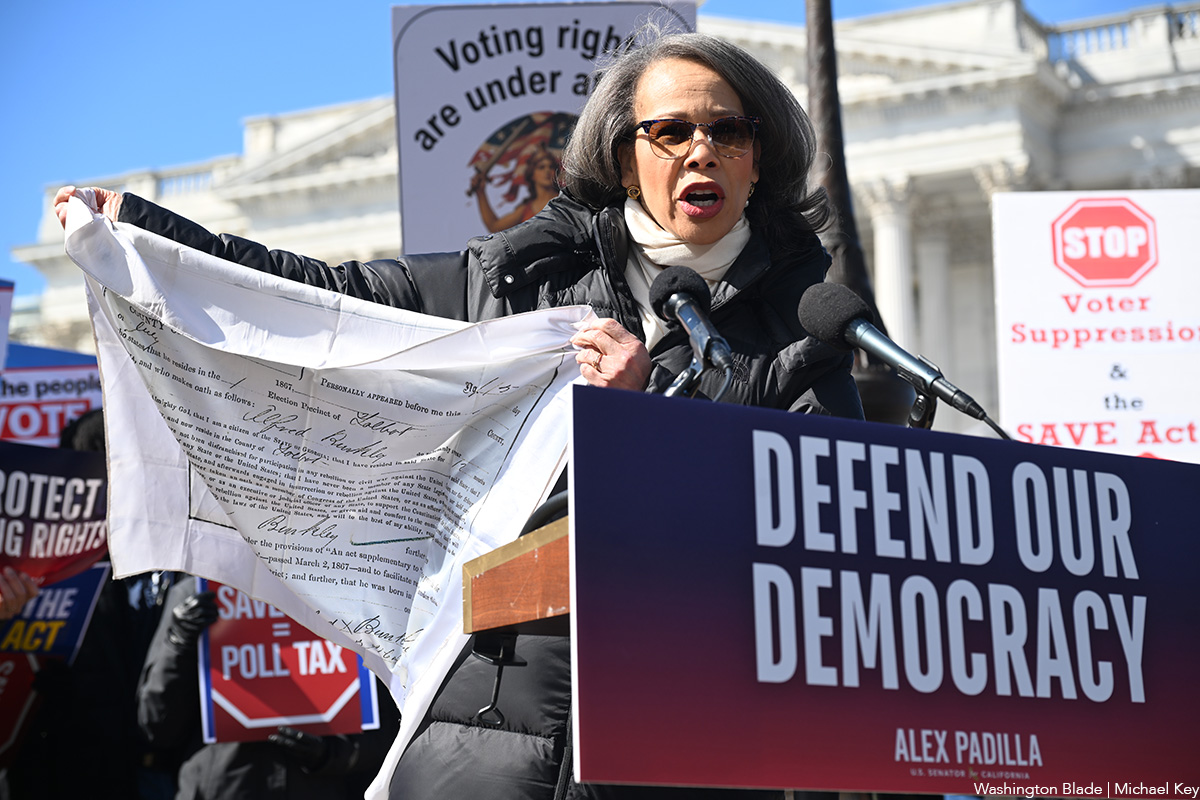
“I got to travel between the Edmund Pettus Bridge two times. And even as I thought about this moment, I recognized that while we wish we weren’t in it, while we don’t know why we’re in it, I do know we were made for it … So I came today to tell you that, um, just like the leader said, that he calls it Jim Crow 2.0. I call it Jim Crow 2.NO.”
Kelley Robinson, president of the Human Rights Campaign, the largest LGBTQ advocacy organization in the U.S., also spoke, highlighting the impact of the bill’s proposed provisions affecting trans people.
“This bill is not about saving America. This bill is about stealing an election. This bill is about suppressing voters,” Robinson said. “This bill not only tries to disenfranchise voters that deserve their right to vote, it also tries to criminalize trans kids and their families … It tries to criminalize doctors providing medically necessary care for our trans youth.”
The SAVE Act passed the U.S. House of Representatives on Feb. 11 but has not yet been considered in the U.S. Senate.
Obituary
Thomas A. Decker of Arlington dies at 73
Active in visiting AIDS patients, urging Congress to fight HIV
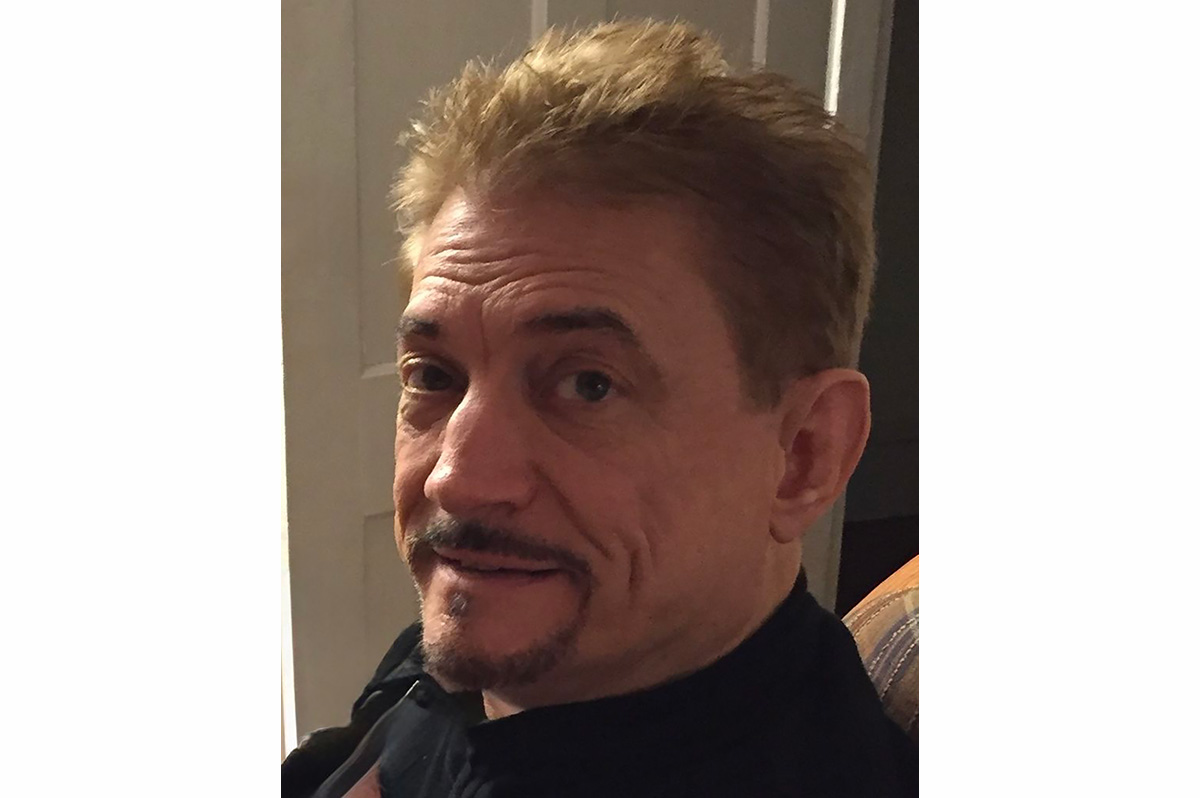
Thomas A. Decker Jr, of Arlington, Va., died March 3, 2026 following an extended illness, according to a statement released by his family. He was 73.
Born and raised in Canton, Ohio, Decker attended the University of Akron and earned his bachelor’s degree in political science. He then moved to the Washington, D.C. area and accepted a position with Beaver Press where he worked for 32 years, according to the statement.
He later worked in the Inova Juniper Program working with HIV/AIDS clients to assist them with support services and was active as a volunteer visiting AIDS patients in the hospital or advocating on Capitol Hill for HIV funding.
Tommy, as he was called by family, is survived by three sisters, a sister-in-law and two brothers-in-law: Carol Decker and Kathryn Kramer of West Newbury, MA, Margaret and Thomas Williams of Bluffton, SC, Mary Sue and Timothy Desiato of New Philadelphia, Ohio, Niece’s Trina and Chad Wedekind of Jacksonville Fl and great niece Isabella, Lindsay and Will Burgette of Dublin, Ohio and great nephews Colin and Luke and Nephews David Williams of Jacksonville, Florida, and Michael and Lucy Desiato of Dublin, Ohio and great nieces Lena and Stella. In accordance with Tom’s wishes, he will be buried at Calvary Cemetery in Massillon, Ohio.
District of Columbia
Gay candidate running for D.C. congressional delegate seat
Robert Matthews among 19 hoping to replace Eleanor Holmes Norton
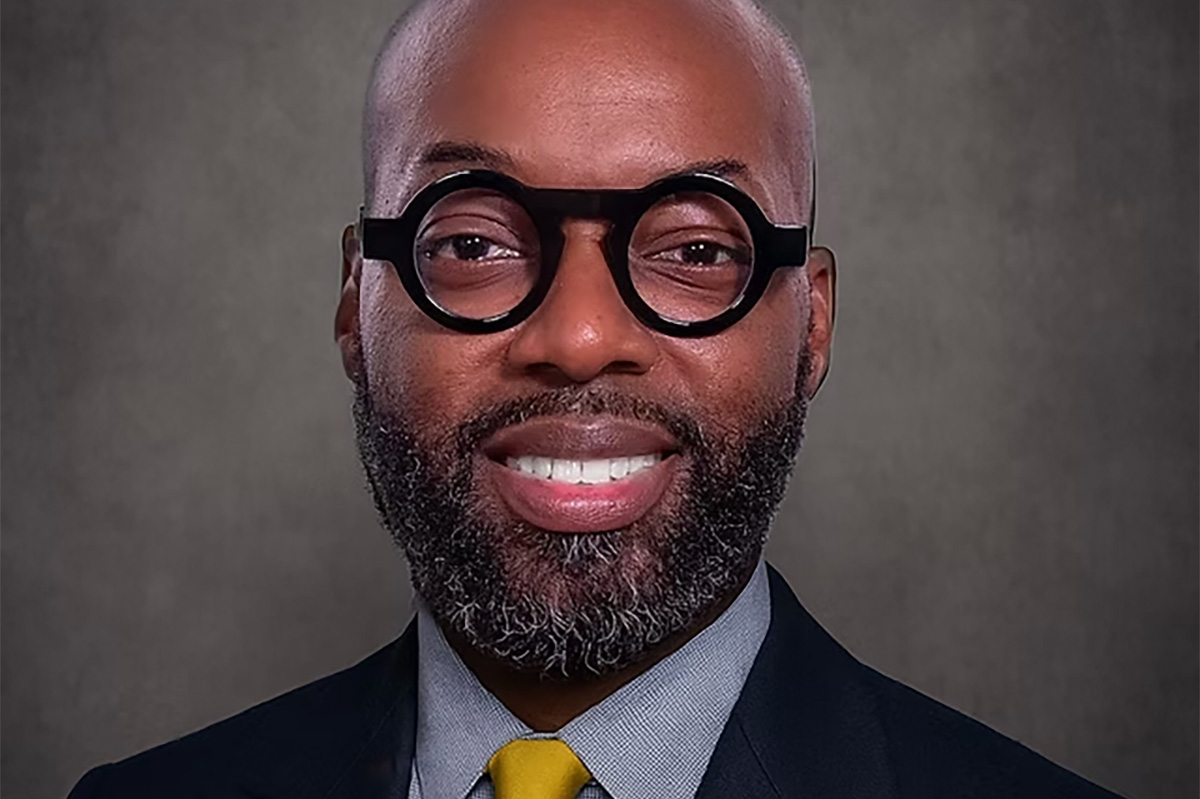
Robert Matthews, a former director of the D.C. Child and Family Services Agency, is running in the city’s June 16 Democratic primary for the D.C. Congressional Delegate seat as an openly gay candidate, according to a statement released by his campaign to the Washington Blade.
Matthews is one of at least 19 candidates running to replace longtime D.C. Congressional Del. Eleanor Holmes Norton (D), who announced earlier this year that she is not running for re-election.
Information about the candidates’ campaign financing compiled by the Federal Elections Commission, which oversees elections for federal candidates, shows that Matthews is one of only six of the candidates who have raised any money for their campaigns as of March 17.
Among those six, who political observers say have a shot at winning compared to the remaining 13, are D.C. Council members Brooke Pinto (D-Ward 2) and Robert White (D-At-Large). Both have longstanding records of support for LGBTQ rights and the community.
The FEC campaign finance records show Matthews was in fourth place regarding the money raised for his campaign, which was $49,078 as of March 17. The FEC records show Pinto’s campaign in first place with $843,496 raised, and White in third place with $230,399 raised.
The Matthews campaign statement released to the Blade says Matthews’s “commitment to the LGBTQ community is not a campaign position. It is the foundation of his life and his life’s work.”
The statement adds, “As the former director of D.C.’s Child and Family Services Agency, Robert led the District’s child welfare system with an explicit commitment to LGBTQ-affirming care.” It goes on to say, “He ensured that LGBTQ, trans, and nonbinary youth in foster care — among the most vulnerable young people in our city — were served with dignity, cultural humility, and genuine support.”
Among his priorities if elected as Congressional delegate, the statement says, would be “fighting to end homelessness among queer and trans seniors and youth,” opposing “federal roadblocks” to LGBTQ related health services, and defending D.C.’s budget and civil rights laws “from federal interference that directly threatens LGBTQ residents.”
The other three candidates who the FEC records show have raised campaign funds and observers say have a shot at winning are:
• Kinney Zalesne, former deputy national finance chair at the Democratic National Committee and an official at the U.S. Justice Department during the Clinton administration, whose campaign is in second place in fundraising with $593,885 raised.
• Gordon Chaffin, a former congressional staffer whose campaign has raised $17,950.
• Kelly Mikel Williams, a podcast host and candidate for the Congressional Delegate seat in 2022 and 2024, whose 2026 campaign has raised $3,094 as of March 17.
The Blade reached out to the Zalesne, Chaffin, and Williams campaigns to determine their position on LGBTQ issues. As of late Wednesday, the Zalesne campaign was the only one that responded.
“Kinney believes LGBTQ rights are fundamental civil rights and central to what makes Washington, D.C. a strong and vibrant community,” a statement sent by her campaign says. “At a time when LGBTQ people (especially transgender and nonbinary neighbors) are facing escalating political attacks across the country, she believes the District must continue to lead in protecting dignity, safety, and freedom for all,” it says.
The statement adds, “Throughout her career in government, business, and nonprofit leadership, Kinney has worked alongside LGBTQ and queer advocates and leaders. She is committed to maintaining an active partnership with the community to make sure LGBTQ voices remain central to the District’s future.”

Housewives take Capitol Hill by storm

Protesters say SAVE Act targets voters, transgender youth

‘It’s Dorothy’ traces lasting influence of a cultural icon
SAVE Act could silence millions of trans voters

The frightening rise of antisemitism, Islamophobia

Ensuring safer drinking water

A season of renewal for D.C. theater

PHOTOS: Awesome Con

Kennedy Center leadership changes as Trump ally Grenell departs