a&e features
Don’t label Maria Bello
Actress-turned-author explores power and pain of typecasting
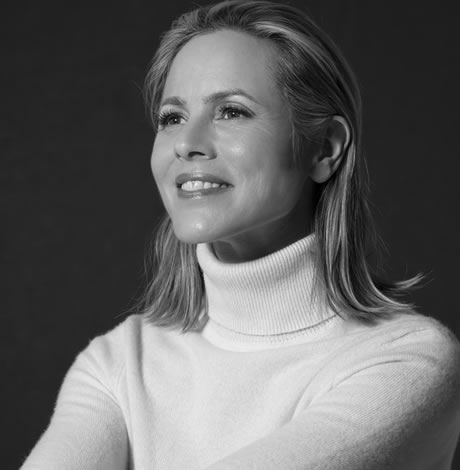
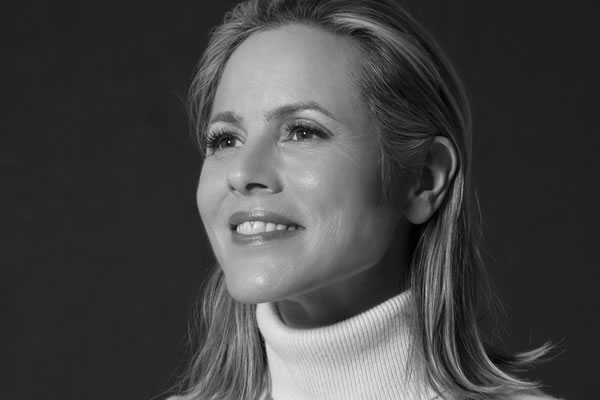
Maria Bello says a 2013 illness that sidelined her gave her time to rethink the rigid way society categorizes love, sexuality and relationships, labels she says never fit her own life. (Photo by Amanda Demme; courtesy Dey Street Books)
Maria Bello
In conversation with Daniel Jones (New York Times)
Sixth & I Historic Synagogue
600 I St. N.W.
$17 (ticket
$30 (ticket and book)
$38 (two tickets, one book)
Actress Maria Bello spent the summer of 2013 in bed ill with a parasitic illness she contracted while doing relief work in Haiti.
Turning to the roughly 150 journals she’s been keeping since age 10, the actress, best known for her roles in the films “Payback,” “Coyote Ugly” and “A History of Violence” as well as the TV hit “ER,” found herself pondering all sorts of questions from all facets of her life from work, family, romantic relationships and more.
She eventually distilled her personal discoveries into the new book “Whatever … Love is Love: Questioning the Labels We Give Ourselves.” On Monday night she’ll be in Washington at the Sixth & I Synagogue to discuss the book with Daniel Jones of the New York Times, which published her essay “Coming Out as a Modern Family,” in which she discussed her current relationship with partner Clare Munn.
We talked with her Tuesday — the day of the Supreme Court marriage arguments — by phone to find out why she has such a thorny relationship with labels. Her comments have been slightly edited for length.
MARIA BELLO: How are you?
WASHINGTON BLADE: We’re good. It’s a big day in Washington!
BELLO: I know! I’ve been watching all day and tweeting about it. I’m so excited and the whole community must be.
BLADE: Yes, it feels momentous.
BELLO: It is. We’re on the verge and the tide is changing and it’s very exciting.
BLADE: It sounds like you had an epiphany of sorts when you began your relationship with Clare. Prior to that, had you had much involvement or investment in LGBT issues?
BELLO: Yes, always, even when I was going to a Catholic university. I’ve always been involved in LGBT rights because they have always been a huge force in human rights in general and it’s a human right to be able to marry who you love and love who you love. I was very inspired by Marsha P. Johnson, a famous African-American transgender, flamboyant, really beautiful woman when I used to live on Christopher Street. She threw the first shot glass at Stonewall.
BLADE: Did you journal continuously or in spurts over the years?
BELLO: Pretty consistently. I started at 10 but only have them going back to age 13. The first one I have is a green notebook with little hearts drawn all over it. The challenge with my journals was trying to choose the material to go into the book and what I realized more and more was that I wasn’t just taking a walk down memory lane, I was uncovering all these pieces and I had so many questions about the girl I was, the woman I had become, about my family, you know, myself, my religion, my sexuality and as I started asking more questions, I heard from so many more people that they were asking similar questions. I had no idea it would become part of a larger conversation. I always journalized pretty consistently. I can’t imagine I ever went more than three months or so without writing. Sometimes they were just gratitude lists I made because I was so miserable.
BLADE: What big picture started to emerge from reading them?
BELLO: Relationships are fluid, partnerships are fluid, life is fluid and the more you accept that, which is sometimes a very hard thing to accept, you become more mindful. It doesn’t mean you’re happy all the time. Sometimes it’s just being where you’re at. Sometimes you could be miserable and mindful and I have to allow myself space to have those days and sometimes those weeks where, you know, you’re sad, angry confused. But my mom always told me unless you hit the bottom, you’re not able to push yourself back up. I always loved that.
BLADE: How do you differentiate between happiness, joy and containment?
BELLO: It’s kind of what I just answered. More coming from my preferred self, my most authentic self. When I can do that and be in the moment, I am more curious and happier when I have an understanding of that and, you know, connect to my higher power. Call it God, call it whatever you like. For me, it’s that connection that brings me joy. And also watching my son play soccer. He’s going to Ireland this summer to play in like the world cup of kids’ soccer. He’s freaking awesome.
BLADE: How old is Jackson?
BELLO: He’s 14. He was 12 when he said those amazing words (that became the book title).
BLADE: How long were you ill?
BELLO: A few months. Actually when I was quite sick and recovering and frail, I think your body has a way of telling you when it’s time to take a break or take a breath. It was a real transforming time in my life. I looked around my bedside and saw who was there — my mom, my brother and Jack and Jack’s dad and Clare and many of my friends. I’m so proud to have so much love in my life.
BLADE: Are you healthy now?
BELLO: I am. … Except for the smoking thing, which I’m working on again. It’s my vice.
BLADE: You say nobody should feel judged or afraid because of a label. We use labels all the time to decide where to put things in a grocery store, to decide what genre a film or book is, to say if someone is a blond or brunette even when there are so many variations of different things. Why have the labels associated with sexuality gotten such a bad rap?
BELLO: Because it’s not just about sexual orientation, it’s about partnerships and family and how traditional labels, you know, seem to put people in these tidy little boxes and those traditional labels don’t seem to be working anymore. In the end, I always feel like call me whatever you want, I’ll label myself practically anything to advance human rights and that feels good for me, but I see these poor kids ashamed and being blamed for their sexuality or having partnerships that are different. … It’s important to claim the labels that make you feel your authentic self.
BLADE: When you see the studies about how monogamous people really are and how many stay married their entire lives, it does make you question whether these societal expectations are realistic.
BELLO: In one of my chapters I write about having an affair and talk about this very issue. It’s said that more than 50 percent of married people have admitted having affairs. Men, women, conservative, liberal, across the board. And yet we just don’t talk about it. We seem to just wave our finger and say, “OK, you’re a bad guy or bad girl if you had an affair,” but what we should really be talking is the question of why this is happening and the complications of sexuality. What does it mean. … There has to be a reason these people in long-term, committed relationships go outside the relationship for something besides partnership.
BLADE: True, but don’t we need some sort of compartmentalization system in the world for such matters if only to make sense of all the thousands of people we encounter? Wouldn’t things get too overwhelming if we shunned labels altogether?
BELLO: Oh yes, we need some. My point is that only use the ones you are proud of and make you feel part of a community. Identifying a movie or a person by the way they look, that’s really simplistic. What we’re talking about are bigger issues. Facebook added 51 new gender options last year. I’m at least 15 of them. I think our lexicon needs to expand to include all of those.
BLADE: You write about growing up Roman Catholic. Do you have any relationship with the church today?
BELLO: I’m so excited about the new pope, with his openness and his attention to what really matters, which is love and (addressing) poverty and peace. … I’m happy to be part of this movement that’s happening in the church, even in the church I go to in Santa Monica, more of an acceptance and getting back to real values and what it’s all about, which is love.
BLADE: Has it been hard to take the good and leave the dogma you don’t agree with behind?
BELLO: It’s getting easier and easier as I get older because I’m doing that with everything in my life. I guess part of it is being middle aged and menopausal, but I’m excited about the question and I hope the book will help people question their own labels and look at the ones that empower them and get rid of the ones that disempower them.
BLADE: You were so good with Viggo Mortensen in “History of Violence.” What is he like as a fellow actor?
BELLO: Oh my god, such an incredibly authentic and funny man. You would never think the funny part, but he’s hysterical.



a&e features
Memorial for groundbreaking bisexual activist set for May 2
Loraine Hutchins remembered as a ‘force of nature’
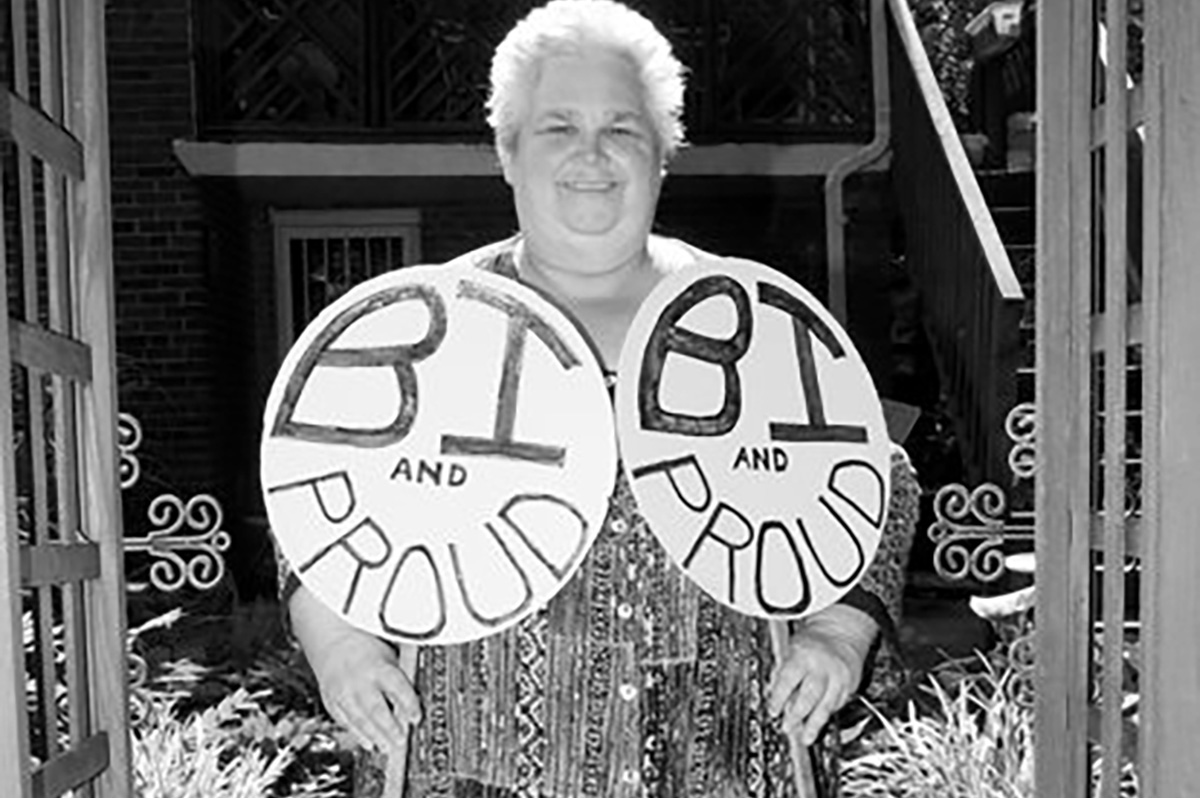
The Montgomery County Pride Center will host a celebration honoring the life and legacy of Loraine Hutchins, Ph.D., on May 2. People are invited to attend the onsite memorial or a livestream event. The on-site event will begin at 10 a.m. with a meet-and-greet mixer before moving into a memorial service around the theme “Loraine a Force of Nature!” at 11 a.m., a panel talk at 12 p.m., break out sessions for artists, academics, and activists to build on her legacy at 1 p.m. and a closing reception at 2 p.m.
Attendees are encouraged to register for the on-site memorial gathering or the livestreamed memorial. The goal of this event is also to collect stories and memories of Loraine. Attendees and others can share their stories at padlet.com.
An obituary for Hutchins was published in the Bladelast Nov. 24, where people can learn more about her activism in the bisexual community. A private service for friends and family was held in December but this memorial service is open to all.
Alongside her groundbreaking work organizing for U.S. bisexual rights and liberation including co-editing “Bi Any Other Name: BIsexual People Speak Out” (1991), she also integrated faith into her sexual education and advocacy work. Her 2001 doctoral dissertation, “Erotic Rites: A Cultural Analysis of Contemporary U.S. Sacred Sexuality Traditions and Trends,” offered a pointed queer and feminist analysis to sex-neutral and sex-positive spiritual traditions in the United States. Her thesis was also groundbreaking in exploring the intersections between sex workers and those in caregiving professionals, including spiritual ones.
In an oral history interview conducted by Michelle Mueller back in August 2023, Hutchins described herself as a “priestess without a congregation.” While she has occasionally had a sense of community and feels part of a group of loving people, she admitted that “I don’t feel like we have the shape or the purpose that we need.”
“I’ve often experienced being the Cassandra in the room, the Cassandra in the community. Somebody who’s kind of way out there ahead, thinking through the strategic action points that my community hasn’t gotten to yet, and getting a lot of resistance and hostile responses from people who are frightened by dissent and conflict and not ready for the changes we have to make to survive,” she said.
“For somebody who’s bisexual in an out political way and who’s been a spokesperson for the polyamory movement in an out political way, it’s very exposing. And it’s very important to me to be able to try to explain and help other people understand the connection between spirituality and sexuality,” she explained citing how even as a graduate student she was “exploring how to feel erotic and spiritual, and not feel them in conflict with each other in my own spiritual contemplative life and my own sensual body awareness of being alive in the world.”
“Every religion has a sense of sacred sexuality. It’s just they put a lot of boundaries and regulations on it, and if we have a spiritual practice that is totally affirming of women’s priesthood and of gay people, queer people’s ability to minister to everyone and to be ministered to be everyone, what does that do to the gender of God, or our understanding of how we practice our spirituality and our sexuality in community and privately?”
“There’s no easy answer,” she concludes, and she continued to grapple with these questions throughout her life, co-editing another seminal text, “Sexuality, Religion and the Sacred: Bisexual, Pansexual, and Polysexual Perspectives,” published in 2012. Her work blending spiritual and queer liberation remains groundbreaking to this day.
Rev. Eric Eldritch, a local community organizer and ordained Pagan minister with Circle Sanctuary who has worked for decades with the DC Center’s Center Faith to organize the Pride Interfaith Service, is eager to highlight this element of her legacy at the memorial service next month.
a&e features
Queery: Meet artist, performer John Levengood
Modern creative talks nightlife, coming out, and his personal queer heroes
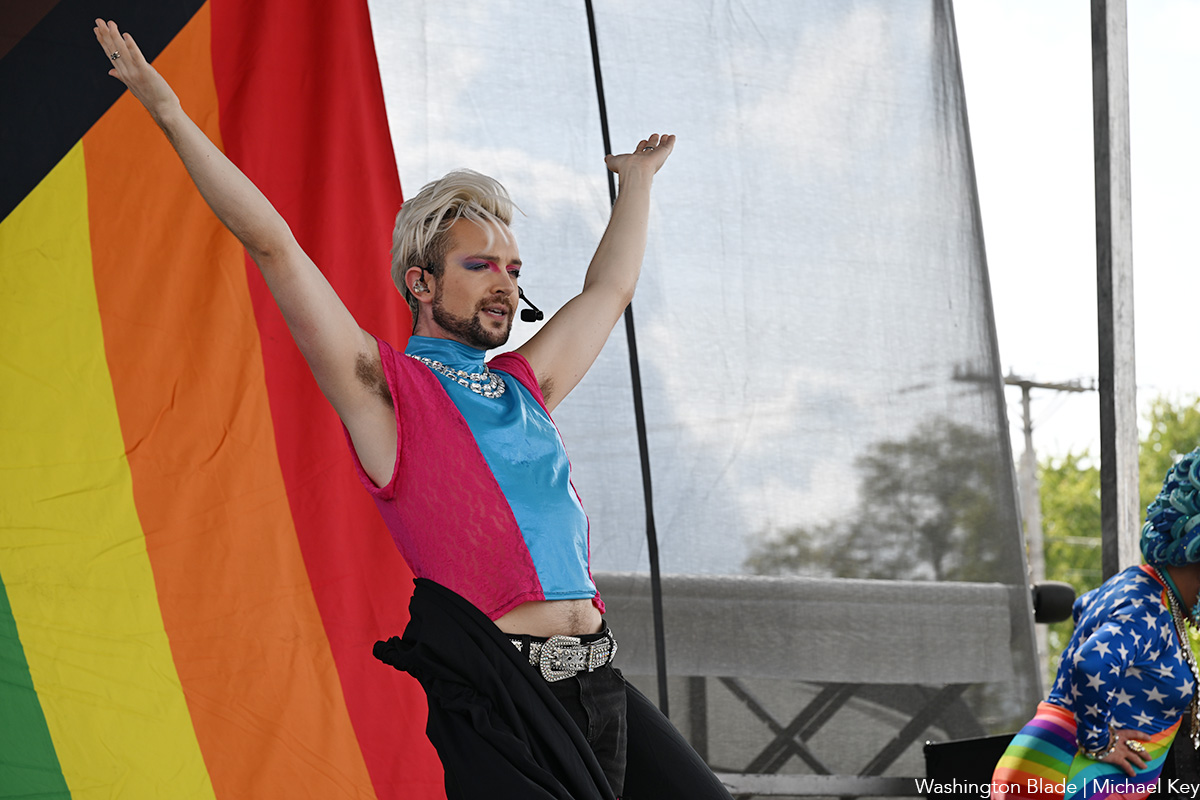
John Levengood (he/him) describes himself as a modern creative with a wide‑ranging toolkit. He blends music, technology, civic duty, and a sharp sense of wit into a cohesive artistic identity. Known primarily as a recording artist and performer, he’s also a self‑taught music producer and software engineer who embodies a generation of creators who build their own lanes rather than wait for one to appear.
Levengood, 32, who is single and identifies as gay and queer, is best known as a recording artist who has performed at Pride festivals across the country, including the main stages of World Pride DC, Central Arkansas Pride, and Charlotte Pride.
“Locally in the DMV, I’m known for turning heads at nightlife venues with my eye-catching sense of style. When I go out, I don’t try to blend in. I hope I inspire people to be themselves and have the courage to stand out,” he says.
He’s also known for hosting karaoke at Freddie’s Beach Bar in Arlington, Va., on Thursday nights. “I like to create a space where people feel comfortable expressing themselves, building community, and showcasing their talents.”
He also creates social media content from my performances and do interviews at LGBTQ+ bars and theatres in the DMV. Follow the Arlington resident @johnlevengood.
How long have you been out and who was the hardest person to tell?
I have been fully out of the closet since 2019. My parents were the hardest people to tell because my family has always been my rock and at the time I couldn’t imagine a world without them. Their reactions were extremely positive and supportive so I had nothing to fear all along.
I remember sitting on the couch with my mom, dad, and sister in our hotel room in New Orleans during our winter vacation and being so nervous to tell them. After I finally mustered up the nerve and made the proclamation, I realized my dad had already fallen asleep on the couch. My mom promised to tell him when he woke up.
Who’s your LGBTQ hero?
My LGBTQ heroes are Harvey Milk for paving the way for gays in politics and Elton John for being a pioneer for the fabulous and authentic. My local heroes in the DMV are Howard Hicks, manager of Green Lantern, and Tony Rivenbark, manager of Freddie’s Beach Bar. Both of them are essential to creating spaces where I’ve felt welcome and safe since moving to the DMV.
What’s Washington’s best nightspot, past or present?
Trade tops the list for me because of the dance floor and outdoor space. It’s so nice to get a break from the music every once and a while to be able to have a conversation.
We live in challenging times. How do you cope?
I’m still figuring this out. What is working right now is writing music and spending time with family and friends. I’ve also been spending less time on social media going to the gym at least three times a week.
What streaming show are you binging?
After “Traitors” Season 4 ended, I was in a bit of a show hole, but “Stumble” has me in a laughing loop right now. The writing is so witty.
What do you wish you’d known at 18?
At 18, I wish I would have known how liberating it is to come out of the closet. It would have been nice to know some winning lottery numbers as well.
What are your friends messaging about in your most recent group chat?
We are planning our next trip to New York City. If you can believe it, I visited NYC for the first time in 2025 for Pride and I’ve been back every quarter since. Growing up in the country, I was subconsciously primed to be scared of the city. But my mind has been blown. I can’t wait to go back.
Why Washington?
It’s the closest metropolitan area to my family, but not too close. I love the museums, the diversity, the history, and the proximity to the beach and mountains. It’s also nice to live in a city with public transportation.
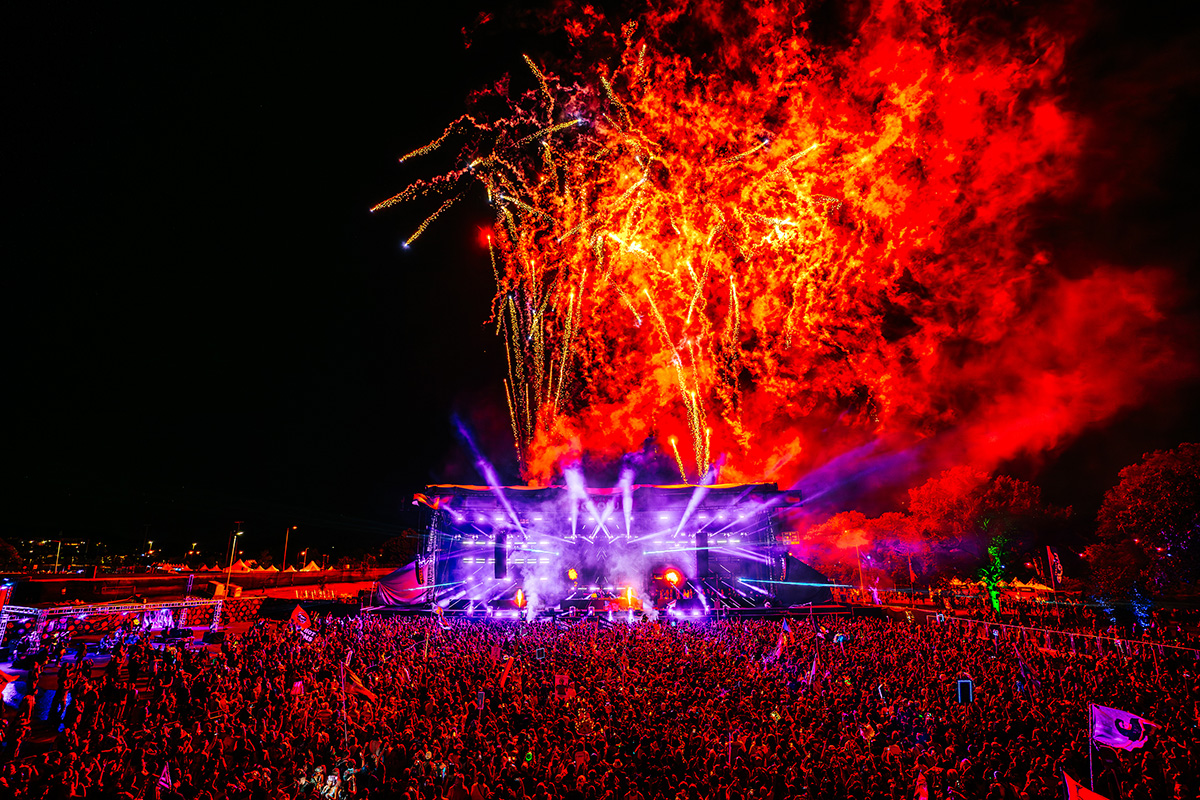
Aging RFK Stadium has come down, but the RFK grounds are still getting lit up. Welcome back to the stage Project GLOW, D.C.’s homegrown electronic festival, on May 30-31. Back for its fifth year on these musically inclined acres, Project GLOW returns with an even more diverse lineup, and one that continues to celebrate LGBTQ antecedents, attendees, and acts.
Project GLOW 2026 headliners include house and techno star Mau P, progressive house legend Eric Prydz, hard-techno favorite Sara Landry, and bass acts Excision b2b Sullivan King, among the lineup of trance, bass, house, techno, dubstep, and others for the fifth anniversary year.
President & CEO Pete Kalamoutsos — born and raised in D.C. — founded Club GLOW in 1999. In 2020, GLOW entered into a partnership with global entertainment company Insomniac Events to produce live events like Project GLOW, which kicked off in 2022.
As in past years, Project GLOW not only makes space, but is intentionally inclusive of the LGBTQ community, one of its most dedicated fan bases. The festival’s LGBTQ-focused Secret Garden stage blooms again — a more intimate dance area that stands on the strength of DJs and musicians who draw from the LGBTQ community. D.C.’s LGBTQ nightlife mastermind Ed Bailey is the creative mind behind Secret Garden again. He joined Project GLOW in 2023.
“Kalamoustos says that “he’s proud of his partnership with Ed Bailey, along with Capital Pride and [nightlife producer] Jake Resnikow. It’s amazing to collaborate with Bailey at the Secret Garden stage, especially after the curated lineup we worked on at Pride last year.”
The Secret Garden will be a bit different from other stages: Eternal (“At the Eternal stage, time stands still. Lose yourself in the dance of past, present, and future, surrendering to the eternal rhythm of the universe”) and Pulse (“Feel the rhythm of the beat pulse through your veins as the heartbeat of the crowd synchronizes into one. Here, every moment vibrates with life as it guides you through a new dimension of euphoria”). The Secret Garden stage is in the round, surrounded by 16 shipping containers. The containers play canvas to muralists from around the world, who are coming in to paint them in a vibrant garden-style vibe. “We gave this stage some extra love with this layout,” K says, “ we finally cracked the code.”
K says that this will be the biggest lineup yet for the Secret Garden, featuring Nicole Moudaber b2b Chasewest, Riordan b2b Bullet Tooth, Ranger Trucco, Cassian, Eli & Fur, Cosmic Gate and Hayla. The stage is also the largest yet, featuring an expanded dance floor and 360-degree viewing.
Across all stages, K says that his goal for the fifth anniversary is “More art and fan interactive experience, more like a festival, strive to be like a Tomorrowland, as budget grows to add more experience.” Last year’s Project GLOW alone drew 40,000 attendees over two days.
K, however, was not satisfied with one festival this spring. GLOW recently announced a “pop-up” one-day event. Teaming up with Black Book Records, GLOW is set to throw a first-of-its-kind dance-music takeover of Pennsylvania Avenue, N.W., headlined by electronic music star Chris Lake. Set for April 18, this euphoric block party will feature bass and vibes blocks from the White House. Organizers expect as many as 10,000 fans to attend. Beyond music, there will be food, activations, and plenty of other activities taking place around 6th St and Pennsylvania Ave NW – a location familiar to many in the LGBTQ community, as this sits squarely inside the blocks of the Capital Pride party that takes place in DC every June.
Over the past two decades, Club GLOW has produced thousands of events, from club nights to large-scale festivals including Project GLOW, Moonrise Festival, and more. Club GLOW also operates Echostage.

Diverse cast tackles ‘Aguardiente’ at GALA Hispanic Theatre

New books reveal style trends for a more enlightened century

Tennessee’s trans data bill a frightening omen

The queer appeal of ‘The Devil Wears Prada’

Lesbifriends Travel to host queer night out

European Parliament backs EU-wide conversion therapy ban

Rep. Sarah McBride reflects on first year in Congress amid political backlash

Baltimore Heritage wants Md. LGBTQ historical sites added to National Registry

Republicans attach five anti-LGBTQ riders to State Department funding bill

Rehoboth’s Blue Moon sold; new owners to preserve LGBTQ legacy
-

 European Union4 days ago
European Parliament backs EU-wide conversion therapy ban
-
Delaware5 days ago
Rep. Sarah McBride reflects on first year in Congress amid political backlash
-
Maryland5 days ago
Baltimore Heritage wants Md. LGBTQ historical sites added to National Registry
-
Federal Government3 days ago
Republicans attach five anti-LGBTQ riders to State Department funding bill