Sports
Sports leagues lend a hand in fight for LGBT rights
Arizona, Indiana efforts boosted by NFL, NCAA
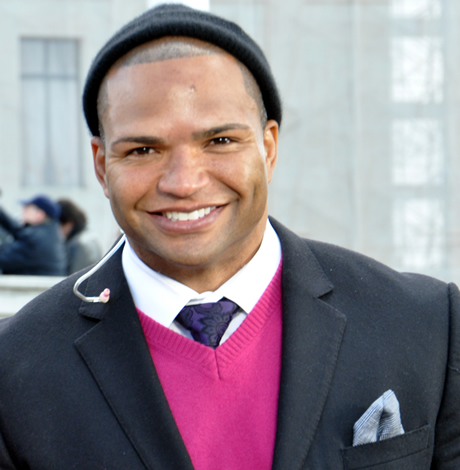
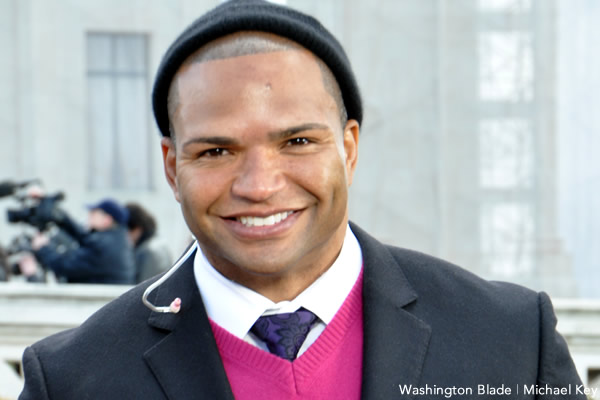
Former Ravens player Brendon Ayanbadejo is among high-profile pro athletes who’ve endorsed LGBT rights in recent years. He served as guest editor of the Blade Sports Issue two years ago. (Washington Blade photo by Michael Key)
As the LGBT community faces new challenges, including religious freedom measures seen to enable anti-LGBT discrimination, advocates have found a new ally in their fight: sports teams and related organizations.
In the past two years, professional and collegiate sports organizations helped derail measures that would have undermined LGBT rights in Arizona and Indiana. By speaking out, their statements aided efforts to combat the proposals.
Sarah Kate Ellis, president of GLAAD, said, “We’re seeing the sports landscape change” in terms of support for the LGBT movement.
“We’re seeing more and more professional leagues, and collegiate sports, actually take a stand for LGBT fans and players,” Ellis said.
In Arizona last year, the state legislature sent to Gov. Jan Brewer’s desk SB 1062, a controversial bill that would have enabled businesses and individuals to discriminate against LGBT people in the name of religious freedom.
Brewer vetoed the bill after a media firestorm and opposition from Republicans like Mitt Romney, Newt Gingrich, John McCain and Jeff Flake. Key opposition came from the National Football League, which at the time was planning to host Super Bowl XLIX in Scottsdale, Ariz.
As controversy over the measure intensified, the Arizona Super Bowl host committee issued a statement saying it disagreed with the bill and voiced concerns about its impact on America’s economy.
“On that matter we have heard loud and clear from our various stakeholders that adoption of this legislation would not only run contrary to that goal, but deal a significant blow to the state’s economic growth potential,” a committee spokesperson said. “We do not support this legislation.”
Catherine Alonzo, co-chair of Equality Arizona, said the contributions from the NFL and sports teams were “really important” in defeating SB 1062.
“It really was this diverse upsurge of people…who weren’t necessarily traditionally involved in the movement, but stood up and said, ‘This is wrong,'” Alonzo said. “The sports teams were part of this overwhelming diverse response.”
Alonzo said it’s “difficult to know” if Brewer would have vetoed the bill anyway without help from the Super Bowl organizers, but she maintained the support of the NFL “can’t be overstated.”
The situation repeated itself this year in Indiana with SB 101, except this time the firestorm didn’t emerge until after Indiana Gov. Mike Pence signed the measure into law. The controversy that later ensued prompted him to sign a fix clarifying the law won’t enable LGBT discrimination in the state in most situations.
Among the critics of the initial law was Mark Emmert, president of the National Collegiate Athletic Association, which is based in Indianapolis and was planning on hosting the Men’s Final Four basketball tournament in Indiana that year.
“We will work diligently to assure student-athletes competing in, and visitors attending, next week’s Men’s Final Four in Indianapolis are not impacted negatively by this bill,” Emmert said. “Moving forward, we intend to closely examine the implications of this bill and how it might affect future events as well as our workforce.”
Another critic of the Indiana measure was retired basketball star Charles Barkley, who called the law “unacceptable” and said officials should move the Final Four out of the state. Moving the tournament would have resulted in a loss of an estimated $70.8 million in revenue from Indiana.
David McFarland, founder of the Los Angeles-based United for Equality in Sports & Entertainment, said the events in Arizona and Indiana demonstrate the power of sports to influence people on LGBT rights.
“What we saw play out in Indiana and Arizona is how sport can act as a universal language and a common denominator that has the ability to break down walls and barriers to create social impact and change that can help violations against LGBT people,” McFarland said.
Before Arizona and Indiana, sports teams haven’t been overtly opposed to LGBT rights, but support from those organizations in fights against religious freedom measures stand out because they provided a crucial element of support when LGBT rights were in danger.
Other efforts on behalf of LGBT rights include NFL players Chris Kluwe and Brendon Ayanbadejo filing briefs in support of litigation against California’s Proposition 8 before the Supreme Court in 2013. The four major men’s sports leagues — the NFL, the MLB, the NHL and the NBA — have enacted sexual orientation non-discrimination protections for players and workers (although gender identity protections remain omitted from those polices). WNBA enacted a similar policy.
Five major sports leagues — the NFL, the MLB, the NHL, the NBA and the WNBA — are among the organizations that coordinate with GLAAD for Spirit Day, an annual event each on Oct. 15 that encourages individuals to wear purple to express opposition to anti-LGBT bullying.
McFarland said the atmosphere within the sports world, however, is another matter entirely for LGBT people.
“Even though America’s cultural, social and political climate is becoming increasingly accepting of LGBT Americans, competing and participation in sports is still considered to be an unsettling environment for many LGBT people,” McFarland said. “In fact, many Americans believe homophobia and transphobia are more common in sports than in the rest of society.”
But just as sports organizations have helped the general public become more accepting of LGBT rights, LGBT advocates have pushed the sports community.
One example is the public transition this year of Caitlyn Jenner, the transgender athlete and TV personality who won the Olympic decathlon title in 1976 and this year won the Arthur Ashe Courage Award at ESPN’s annual ESPY awards show.
Ellis, who was in attendance during the ceremony, said Jenner’s speech helped change the hearts and minds of audience members at the high-profile award show.
“It turned those people you could see were uncomfortable and might be leaning over talking to their seat mates and sort of giggling and whatever people do when they feel discomfort [and] silence them,” Ellis said. “And I thought that was a pretty profound momentum in sports for this year, for this decade.”
LGBT advocates also continue pressing for openly LGBT players in the major leagues to enhance LGBT visibility.
Robbie Rogers, a Major League Soccer player for LA Galaxy, is currently the only openly LGBT player for a major sports team in the United States. Jason Collins, who came out as gay in 2013, played for a year with the Brooklyn Nets, but then retired. Michael Sam was drafted into the NFL, but never saw time on the field.
Just this week, David Denson, a first baseman with the Milwaukee Brewers minor league affiliate in Helena, Mont., came out as gay, but no active player in Major League Baseball is openly gay.
McFarland said having more openly LGBT players would have “tremendous impact” on visibility for the LGBT community, but acknowledged sports organizations aren’t yet in that place.
“Unfortunately, for too many LGBT young people the built in safety nets of support, acceptance and caring do not exist fully in sport,” McFarland said.
Another opportunity for the sports world to support the LGBT community may come in Houston, where LGBT advocates are fighting to pass an LGBT-inclusive non-discrimination ordinance at the ballot in November and the NFL is planning to host Super Bowl LI in 2017.
Ellis said the NFL has a similar opportunity to speak out in favor of the Houston Equal Rights Ordinance just as it came out against the Arizona religious freedom measure.
“I’m hoping that we’ll see the NFL again take a stand like they did in Arizona and send a message that the Super Bowl doesn’t belong in a place where there’s anti-LGBT discrimination allowed,” Ellis said.
The NFL didn’t respond to a request for comment this week on whether it would support HERO as it prepares for Super Bowl LI.
Alonzo said the ability of a sports team to carry a message of LGBT inclusivity to an audience that might otherwise not hear it will be important for any effort for LGBT advocates going forward.
“This is a fight that we’re all in together, and this is something that we’re all affected by whether it is a part of your daily life or not,” Alonzo said. “Sports teams have been really important in bringing that message to their fans and will continue to be.”






Sports
New IOC policy bans trans women from Olympics
New regulation to be in effect at 2028 summer games in Los Angeles
The International Olympic Committee on Thursday announced it will not allow transgender women from competing in female events at the Olympics.
“For all disciplines on the Sports Program of an IOC event, including individual and team sports, eligibility for any Female Category is limited to biological females,” reads the new policy.
The policy states “eligibility for the Female Category is to be determined in the first instance by SRY Gene screening to detect the absence or presence of the SRY Gene.”
“On the basis of the scientific evidence, the IOC considers that the SRY (sex-determining Region Y) Gene is fixed throughout life and represents highly accurate evidence that an athlete has experienced or will experience male sex development,” it reads. “Furthermore, the IOC considers that SRY Gene screening via saliva, cheek swab or blood sample is unintrusive compared to other possible methods. Athletes who screen negative for the SRY gene permanently satisfy this policy’s eligibility criteria for competition in the Female Category.”
The policy states the test “will be a once-in-a-lifetime test” unless “there is reason to believe a negative reading is in error.”
The new regulation will be in place for the 2028 Summer Olympics in Los Angeles.
“I understand that this a very sensitive topic,” said IOC President Kirsty Coventry on Thursday in a video. “As a former athlete, I passionately believe in the rights of all Olympians to take part in fair competition.”
“The policy that we have announced is based on science and it has been led by medical experts with the best interests of athletes at its heart. The scientific evidence is very clear: male chromosomes give performance advances in sport that rely on strength, power, or endurance,” she added. “At the Olympic Games, even the smallest margins can be the difference between victory and defeat. So, it is absolutely clear that it would not be fair for biological males to compete in the female category. In addition, in some sports it would simply not be safe.”
(Video courtesy of the IOC)
Laurel Hubbard, a weightlifter from New Zealand, in 2021 became the first trans woman to compete at the Olympics.
Imane Khelif, an Algerian boxer, won a gold medal at the 2024 Summer Olympics in Paris. Khelif later sued JK Rowling and Elon Musk for cyberstalking after they questioned her gender identity.
Ellis Lundholm, a mogul skier from Sweden, this year became the first openly trans athlete to compete in any Winter Olympics when he participated in Milan Cortina Winter Olympics in Italy.
President Donald Trump in February 2025 issued an executive order that bans trans women and girls from female sports teams in the U.S.
The U.S. Olympic and Paralympic Committee last July banned trans women from competing in female sporting events. Republican lawmakers have demanded the IOC ban trans athletes from women’s athletic competitions.
“I’m grateful the Olympics finally embraced the common sense policy that women’s sports are for women, not for men,” said U.S. Sen. Tom Cotton (R-Ark.) on X.
An IOC spokesperson on Thursday referred the Washington Blade to the press release that announced the new policy.
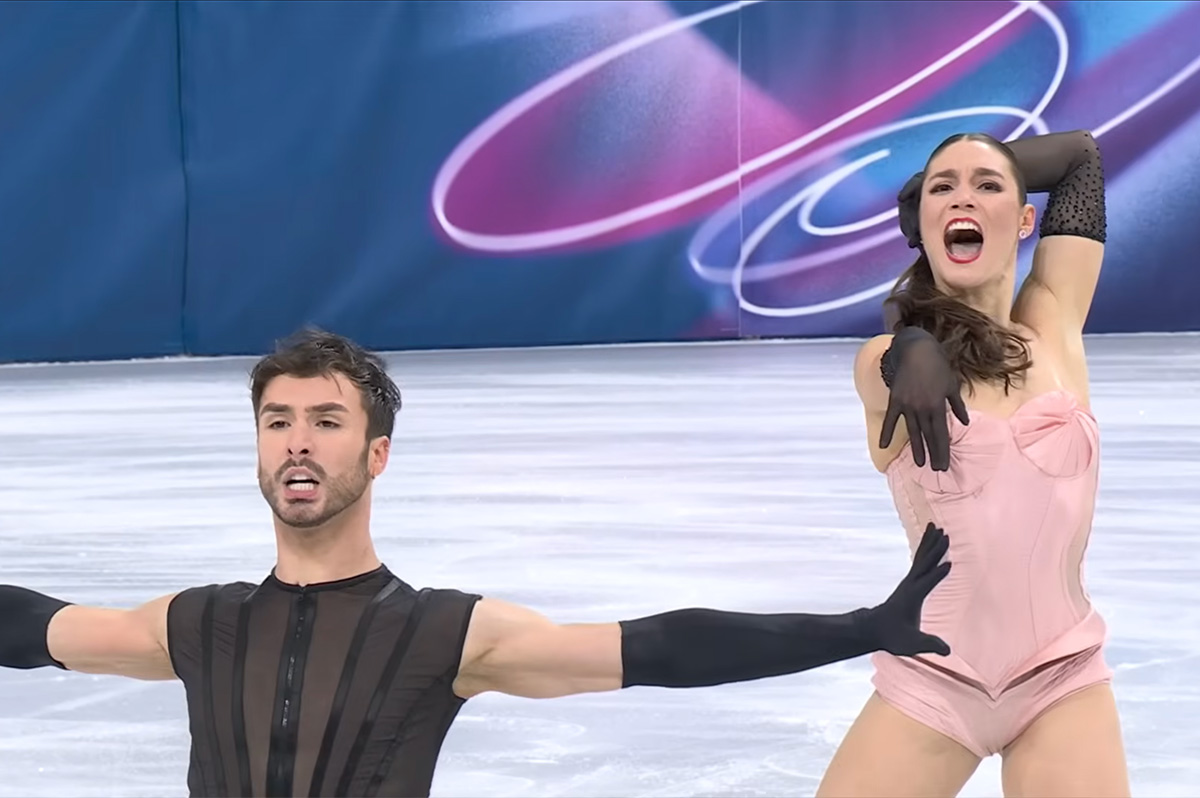
More than a dozen LGBTQ athletes won medals at the Milan Cortina Winter Olympics that ended on Sunday.
Cayla Barnes, Hilary Knight, and Alex Carpenter are LGBTQ members of the U.S. women’s hockey team that won a gold medal after they defeated Canada in overtime. Knight the day before the Feb. 19 match proposed to her girlfriend, Brittany Bowe, an Olympic speed skater.
French ice dancer Guillaume Cizeron, who is gay, and his partner Laurence Fournier Beaudry won gold. American alpine skier Breezy Johnson, who is bisexual, won gold in the women’s downhill. Amber Glenn, who identifies as bisexual and pansexual, was part of the American figure skating team that won gold in the team event.
Swiss freestyle skier Mathilde Gremaud, who is in a relationship with Vali Höll, an Austrian mountain biker, won gold in women’s freeski slopestyle.
Bruce Mouat, who is the captain of the British curling team that won a silver medal, is gay. Six members of the Canadian women’s hockey team — Emily Clark, Erin Ambrose, Emerance Maschmeyer, Brianne Jenner, Laura Stacey, and Marie-Philip Poulin — that won silver are LGBTQ.
Swedish freestyle skier Sandra Naeslund, who is a lesbian, won a bronze medal in ski cross.
Belgian speed skater Tineke den Dulk, who is bisexual, was part of her country’s mixed 2000-meter relay that won bronze. Canadian ice dancer Paul Poirier, who is gay, and his partner, Piper Gilles, won bronze.
Laura Zimmermann, who is queer, is a member of the Swiss women’s hockey team that won bronze when they defeated Sweden.
Outsports.com notes all of the LGBTQ Olympians who competed at the games and who medaled.
Sports
US wins Olympic gold medal in women’s hockey
Team captain Hilary Knight proposed to girlfriend on Wednesday
The U.S. women’s hockey team on Thursday won a gold medal at the Milan Cortina Winter Olympics.
Team USA defeated Canada 2-1 in overtime. The game took place a day after Team USA captain Hilary Knight proposed to her girlfriend, Brittany Bowe, an Olympic speed skater.
Cayla Barnes and Alex Carpenter — Knight’s teammates — are also LGBTQ. They are among the more than 40 openly LGBTQ athletes who are competing in the games.
The Olympics will end on Sunday.

Trump tells Fox News he won the ‘gay vote’ — but polls tell a different story

Anti-trans visa ruling echoes Nazi regime destroying trans documents

Japanese Supreme Court to consider marriage equality

The outrage economy is not the LGBTQ community

Calendar: March 27-April 2

Trans Day of Visibility events planned

Virginia General Assembly’s 2026 legislative session ends

Markwayne Mullin confirmed as next DHS secretary

Gay man murdered in Va.