Theater
A chat with Desmond Bing
Mosaic’s maiden outing inspires out actor to explore his roots


Desmond Bing, left, and Freddie Bennett. (Photo by Teddy Wolff; courtesy Mosaic Theater Company)
‘Unexplored Interior’
Through Nov. 29
Atlas Performing Arts Center
1333 H St., N.E.
$40-60
202-399-7993
For a long time out actor Desmond Bing tried to hide his African heritage, or at least not bring it to the forefront, he says.
However, since he began playing Raymond in Jay O. Sanders’ world premiere “Unexplored Interior,” the epic story of the 1994 Rwandan massacre seen mostly through the eyes of a burgeoning African filmmaker, all that has changed.
“At the open call audition, I was asked if I could do an African accent,” Bing says. “I spoke like my mother who is from Liberia in West African. I was born in Minnesota, but I guess it was my heritage that landed me the part. Since then, playing Raymond has prompted me to embrace my lineage and culture. I’ve developed a strong desire to visit Africa, something I’ve never done before.”
In “Unexplored Interior,” young filmmaker Raymond returns from New York to his native Rwanda in search of his beloved grandfather following 100 days of terror in which the majority Hutus murdered 800,000 of the minority Tutsis. The powerful drama interweaves stories of romance and friendship between members of the opposing tribes before, during and after the genocide. Ably staged by Derek Goldman and skillfully acted by a top-notch cast, this new work is the impressive inaugural production of Mosaic Theater Company.
“I was 10 when the genocide happened and can remember my parents taking about it and seeing it on the news. But I didn’t know a lot until after we started rehearsal,” Bing says. “Rwandan suffering is a long story. In the 1800s Belgian’s King Leopold II who exploited the regions slaughtered 10 million people. There’s a line in the play that says nobody cared because these people were black. During the 1994 massacre President Clinton was criticized for not intervening.”
Last season Bing played in another heavy work, Theater Alliance’s “Occupied Territories,” a Vietnam War play that questions how bodies, minds and souls are vast territories altered by relentless conflict.
“Too often we shy away from important stories that need to be told because they make us uncomfortable. Processes for both plays were uncomfortable,” Bing says. “But stories need to be told despite the discomfort. My goal was to help share the story the best way I could. … But at this point, I wouldn’t turn down a Shakespeare part, particularly a comedy.”
In first approaching the play, Bing says he saw the subject strictly in black and white, but as he became more immersed in the details, he began to see things more gray.
“Those who carried out the killing were told you’re with us or you die too. It was something they were to do to protect their country and their livelihoods. I was able to see things from a Hutu perspective more than before.”
At 15 his father (also Liberian) died and the family moved to Maryland where he became interested in acting. He pursued a theater degree at the well-regarded University of North Carolina School of the Arts.
“I was out in college. At that point I decided closets were for clothes, not me. Still when I’d do a show and friends would say, ‘Oh my god, I couldn’t even tell you were gay. You were so straight on stage.’ ‘It’s acting. I’m acting,’ I’d tell them.”
Sometimes art imitates life. In “Unexplored Interior,” Raymond’s closest friend Alphonse is played by Bing’s real life best friend Freddie Bennett. Also an openly gay actor, Bennett met Bing in college.
Both Bennett and Bing are part of an ever-widening pool of talented, openly gay African-American working actors. Bennett came from New York to D.C. to appear in the Shakespeare Theatre Company’s stunning production of “The Tempest” last season. Next, along with Bing, he was cast in “Occupied Territories,” and now “Unexplored Interior.”
“Acting with your best friend offers a lot,” Bennett says. “It’s nice when it’s easy and fun, but then we also find new layers of what’s beneath our friendship and what’s beneath the work that we both have to give.”





Theater
José Zayas brings ‘The House of Bernarda Alba’ to GALA Hispanic Theatre
Gay Spanish playwright Federico García Lorca wrote masterpiece before 1936 execution
‘The House of Bernarda Alba’
Through March 1
GALA Hispanic Theatre
3333 14th St., N.W.
$27-$52
Galatheatre.org
In Federico García Lorca’s “The House of Bernarda Alba,” now at GALA Hispanic Theatre in Columbia Heights, an impossibly oppressive domestic situation serves, in short, as an allegory for the repressive, patriarchal, and fascist atmosphere of 1930s Spain
The gay playwright completed his final and arguably best work in 1936, just months before he was executed by a right-wing firing squad. “Bernarda Alba” is set in the same year, sometime during a hot summer in rural Andalusia, the heart of “España profunda” (the deep Spain), where traditions are deeply rooted and mores seldom challenged.
At Bernarda’s house, the atmosphere, already stifling, is about to get worse.
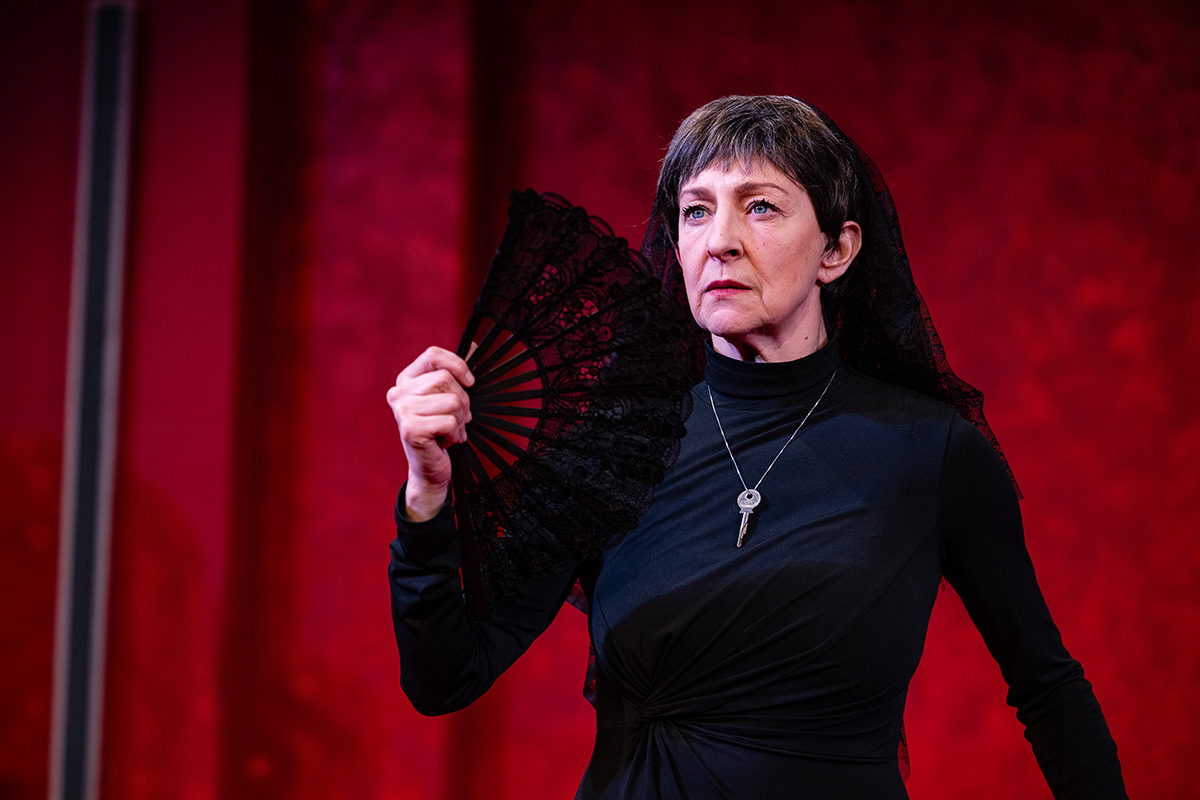
On the day of her second husband’s funeral, Bernarda Alba (superbly played by Luz Nicolás), a sixtyish woman accustomed to calling the shots, gathers her five unmarried daughters (ages ranging from 20 to 39) and matter-of-factly explain what’s to happen next.
She says, “Through the eight years of mourning not a breeze shall enter this house. Consider the doors and windows as sealed with bricks. That’s how it was in my father’s house and my grandfather’s. Meanwhile, you can embroider your trousseaux.”
It’s not an altogether sunny plan. While Angustias (María del Mar Rodríguez), Bernarda’s daughter from her first marriage and heiress to a fortune, is betrothed to a much younger catch, Pepe el Romano, who never appears on stage, the remaining four stand little chance of finding suitable matches. Not only are they dowry-less, but no men, eligible or otherwise, are admitted into their mother’s house.
Lorca is a literary hero known for his mastery of both lyrical poetry and visceral drama; still, “Bernarda Alba’s” plotline might suit a telenovela. Despotic mother heads a house of adult daughters. Said daughters are churning with passions and jealousies. When sneaky Martirio (Giselle Gonzáles) steals the photo of Angustias’s fiancé all heck kicks off. Lots of infighting and high drama ensue. There’s even a batty grandmother (Alicia Kaplan) in the wings for bleak comic relief.
At GALA, the modern classic is lovingly staged by José Zayas. The New York-based out director has assembled a committed cast and creative team who’ve manifested an extraordinarily timely 90-minute production performed in Spanish with English subtitles easily ready seen on multiple screens.
In Lorca’s stage directions, he describes the set as an inner room in Bernarda’s house; it’s bright white with thick walls. At GALA, scenic designer Grisele Gonzáles continues the one-color theme with bright red walls and floor and closed doors. There are no props.
In the airless room, women sit on straight back chairs sewing. They think of men, still. Two are fixated on their oldest siter’s hunky betrothed. Only Magdelena (Anna Malavé), the one sister who truly mourns their dead father, has given up on marriage entirely.
The severity of the place is alleviated by men’s distant voices, Koki Lortkipanidze’s original music, movement (stir crazy sisters scratching walls), and even a precisely executed beatdown choreographed by Lorraine Ressegger-Slone.
In a short yet telling scene, Bernarda’s youngest daughter Adela (María Coral) proves she will serve as the rebellion to Bernarda’s dictatorship. Reluctant to mourn, Adela admires her reflection. She has traded her black togs for a seafoam green party dress. It’s a dreamily lit moment (compliments of lighting designer Hailey Laroe.)
But there’s no mistaking who’s in charge. Dressed in unflattering widow weeds, her face locked in a disapproving sneer, Bernarda rules with an iron fist; and despite ramrod posture, she uses a cane (though mostly as a weapon during one of her frequent rages.)
Bernarda’s countenance softens only when sharing a bit of gossip with Poncia, her longtime servant convincingly played by Evelyn Rosario Vega.
Nicolás has appeared in “Bernarda Alba” before, first as daughter Martirio in Madrid, and recently as the mother in an English language production at Carnegie Melon University in Pittsburgh. And now in D.C. where her Bernarda is dictatorial, prone to violence, and scarily pro-patriarchy.
Words and phrases echo throughout Lorca’s play, all likely to signal a tightening oppression: “mourning,” “my house,” “honor,” and finally “silence.”
As a queer artist sympathetic to left wing causes, Lorca knew of what he wrote. He understood the provinces, the dangers of tyranny, and the dimming of democracy. Early in Spain’s Civil War, Lorca was dragged to the the woods and murdered by Franco’s thugs. Presumably buried in a mass grave, his remains have never been found.
Theater
Magic is happening for Round House’s out stage manager
Carrie Edick talks long hours, intricacies of ‘Nothing Up My Sleeve’

‘Nothing Up My Sleeve’
Through March 15
Round House Theatre
4545 East-West Highway
Bethesda, Md. 20814
Tickets start at $50
Roundhousetheatre.org
Magic is happening for out stage manager Carrie Edick.
Working on Round House Theatre’s production of “Nothing Up My Sleeve,” Edick quickly learned the ways of magicians, their tricks, and all about the code of honor among those who are privy to their secrets.
The trick-filled, one-man show starring master illusionist Dendy and staged by celebrated director Aaron Posner, is part exciting magic act and part deeply personal journey. The new work promises “captivating storytelling, audience interaction, jaw-dropping tricks, and mind-bending surprises.”
Early in rehearsals, there was talk of signing a non-disclosure agreement (NDA) for production assistants. It didn’t happen, and it wasn’t necessary, explains Edick, 26. “By not having an NDA, Dendy shows a lot of trust in us, and that makes me want to keep the secrets even more.
“Magic is Dendy’s livelihood. He’s sharing a lot and trusting a lot; in return we do the best we can to support him and a large part of that includes keeping his secrets.”
As a production assistant (think assistant stage manager), Edick strives to make things move as smoothly as possible. While she acknowledges perfection is impossible and theater is about storytelling, her pursuit of exactness involves countless checklists and triple checks, again and again. Six day weeks and long hours are common. Stage managers are the first to arrive and last to leave.
This season has been a lot about learning, adds Edick. With “The Inheritance” at Round House (a 22-week long contract), she learned how to do a show in rep which meant changing from Part One to Part Two very quickly; “In Clay” at Signature Theatre introduced her to pottery; and now with “Nothing Up My Sleeve,” she’s undergoing a crash course in magic.
She compares her career to a never-ending education: “Stage managers possess a broad skillset and that makes us that much more malleable and ready to attack the next project. With some productions it hurts my heart a little bit to let it go, but usually I’m ready for something new.”
For Edick, theater is community. (Growing up in Maryland, she was a shy kid whose parents signed her up for theater classes.) Now that community is the DMV theater scene and she considers Round House her artistic home. It’s where she works in different capacities, and it’s the venue in which she and actor/playwright Olivia Luzquinos chose to be married in 2024.
Edick came out in middle school around the time of her bat mitzvah. It’s also around the same time she began stage managing. Throughout high school she was the resident stage manager for student productions, and also successfully participated in county and statewide stage management competitions which led to a scholarship at the University of Maryland, Baltimore County (UMBC) where she focused on technical theater studies.
Edick has always been clear about what she wants. At an early age she mapped out a theater trajectory. Her first professional gig was “Tuesdays with Morrie” at Theatre J in 2021. She’s worked consistently ever since.
Stage managing pays the bills but her resume also includes directing and intimacy choreography (a creative and technical process for creating physical and emotional intimacy on stage). She names Pulitzer Prize winning lesbian playwright Paula Vogel among her favorite artists, and places intimacy choreographing Vogel’s “How I learned to Drive” high on the artistic bucket list.
“To me that play is heightened art that has to do with a lot of triggering content that can be made very beautiful while being built to make you feel uncomfortable; it’s what I love about theater.”
For now, “Nothing Up My Sleeve” keeps Edick more than busy: “For one magic trick, we have to set up 100 needles.”
Ultimately, she says “For stage managers, the show should stay the same each night. What changes are audiences and the energy they bring.”
Theater
‘Octet’ explores the depths of digital addiction
Habits not easily shaken in Studio Theatre chamber musical

‘Octet’
Through Feb. 26
Studio Theatre
1501 14th Street, N.W.
Tickets start at $55
Studiotheatre.org
David Malloy’s “Octet” delves deep into the depths of digital addiction.
Featuring a person ensemble, this extraordinary a capella chamber musical explores the lives of recovering internet addicts whose lives have been devastated by digital dependency; sharing what’s happened and how things have changed.
Dressed in casual street clothes, the “Friends of Saul” trickle into a church all-purpose room, check their cell phones in a basket, put away the bingo tables, and arrange folding chairs into a circle. Some may stop by a side table offering cookies, tea, and coffee before taking a seat.
The show opens with “The Forest,” a haunting hymn harking back to the good old days of an analog existence before glowing screens, incessant pings and texts.
“The forest was beautiful/ My head was clean and clear/Alone without fear/ The forest was safe/ I danced like a beautiful fool / One time some time.”
Mimicking an actual step meeting, there’s a preamble. And then the honest sharing begins, complete with accounts of sober time and slips.
Eager to share, Jessica (Chelsea Williams) painfully recalls being cancelled after the video of her public meltdown went viral. Henry (Angelo Harrington II) is a gay gamer with a Candy Crush problem. Toby (Adrian Joyce) a nihilist who needs to stay off the internet sings “So anyway/ I’m doing good/ Mostly/ Limiting my time/ Mostly.”
The group’s unseen founder Saul is absent, per usual.
In his stead Paula, a welcoming woman played with quiet compassion by Tracy Lynn Olivera, leads. She and her husband no longer connect. They bring screens to bed. In a love-lost ballad, she explains: “We don’t sleep well/ My husband I/ Our circadian rhythms corrupted/ By the sallow blue glow of a screen/ Sucking souls and melatonin/ All of my dreams have been stolen.”
After too much time spent arguing with strangers on the internet, Marvin, a brainy young father played by David Toshiro Crane, encounters the voice of a God.
Ed (Jimmy Kieffer) deals with a porn addiction. Karly (Ana Marcu) avoids dating apps, a compulsion compared to her mother’s addiction to slot machines.
Malloy, who not only wrote the music but also the smart lyrics, book, and inventive vocal arrangements, brilliantly joins isolation with live harmony. It’s really something.
And helmed by David Muse, “Octet” is a precisely, quietly, yet powerfully staged production, featuring a topnotch cast who (when not taking their moment in the spotlight) use their voices to make sounds and act as a sort of Greek chorus. Mostly on stage throughout all of the 100-minute one act, they demonstrate impressive stamina and concentration.
An immersive production, “Octet” invites audience members to feel a part of the meeting. Studio’s Shargai Theatre is configured, for the first, in the round. And like the characters, patrons must also unplug. Everyone is required to have their phones locked in a small pouch (that only ushers are able to open and close), so be prepared for a wee bit of separation anxiety.
At the end of the meeting, the group surrenders somnambulantly. They know they are powerless against internet addiction. But group newbie Velma (Amelia Aguilar) isn’t entirely convinced. She remembers the good tech times.
In a bittersweet moment, she shares of an online friendship with “a girl in Sainte Marie / Just like me.”
Habits aren’t easily shaken.

Dry January has isolated me from my friends

Activists push for better counting of transgender Indians in 2026 Census

Capital Pride board member resigns, alleges failure to address ‘sexual misconduct’

Transmission DC breathes new life into a storied sound space

Criteria for supporting a candidate in D.C.

US Embassy in Mexico issues shelter in place order for Puerto Vallarta

2026: prices, pace, and winter weather

José Zayas brings ‘The House of Bernarda Alba’ to GALA Hispanic Theatre

Rob Jetten becomes first gay Dutch prime minister

More than a dozen LGBTQ athletes medal at Olympics
-

 Mexico5 days ago
US Embassy in Mexico issues shelter in place order for Puerto Vallarta
-
Real Estate5 days ago
2026: prices, pace, and winter weather
-
Theater5 days ago
José Zayas brings ‘The House of Bernarda Alba’ to GALA Hispanic Theatre
-
Netherlands4 days ago
Rob Jetten becomes first gay Dutch prime minister