Opinions
Staying connected while on vacation
Grim realities intrude while sailing Atlantic with new friends


(Photo public domain)
When planning my recent vacation, one of the main decisions was whether to disconnect from the Internet or not. My days in Rome and a two-week transatlantic cruise on the Celebrity Silhouette were something I had looked forward to for nearly a year. As a news junkie my decision included whether disconnecting cold turkey would be stressful. It turns out choosing to stay connected was the right thing for me. It also meant that I wouldn’t have to go through 2,000 emails up my arrival home.
It was quickly apparent even had I disconnected plenty of people both in Rome and on-board ship were more than happy to discuss what was going on in the world. MSNBC and FAUX news were available on TV in the room. Neither of which I would watch at home but was drawn to them to find out about the elections in the U.S. and then the horrific ISIS attacks and massacre in Paris. Finding out whether my friends in Paris were OK was paramount. Facebook safe finder is a terrific tool, allowing people who had communicated with friends in Paris to let us all know they were OK.
Whether it was over a meal or at the pool, the world never totally stayed away. Two guys from Houston shared their concerns and disgust over the election results there. My new Australian friends wondered how soon their country would legalize gay marriage. The many foreign members of the crew shared concerns about their families in countries in turmoil and being bombed. My passion for Hillary Clinton was shared by Melinda Bates who lectured a number of times on-board regarding her experiences as head of the White House Visitor’s Office during the Clinton presidency. She met Bill at Georgetown, volunteered on his presidential campaign, and ended up spending nearly a decade in the White House. We had lunch and talked about Hillary’s campaign and how she wanted to get involved.
The first seven days of the cruise we stopped at five ports of call. Then there were seven days at sea. While I am great at doing nothing and met the greatest people to do it with, early mornings and late nights, when my friends continued drinking, I could connect, write and share my columns with the Blade and Huffington Post. Then go online to Facebook and see what the world was thinking, share my pictures and make more than a few comments. It was gratifying to see one of my columns tweeted by hundreds and liked by thousands knowing it was written somewhere in the middle of the Atlantic Ocean.
Being one of the oldest in the group of my new on-board friends my recollections on how we communicated before the Internet were sometimes humorous to them. Actually being on-board and meeting face-to-face from morning to night was a reminder of how we used to make friends before apps. There were people on board who take four or five cruises each year. Two new friends from Traverse City, Mich., who I hope to see again have been on 69 cruises and have two booked in 2016 and booked one while we were on-board for January 2017 from Australia to New Zealand. I said I would join them until it hit me that would have me away from D.C. on Jan. 20, 2017, a day on which I hope to be celebrating history with the inauguration of the first woman president of the United States.
I am writing this a day before we dock in Ft. Lauderdale and my flight back to reality. The Paris massacre brought back reality in a major way to all of us and we recognized how fortunate we were to be on this cruise and how our good fortune meant we had to do more for those not so fortunate.
We took group pictures and made commitments to stay in touch with new friends. Had dinner at the Lawn Club, a specialty restaurant on board. We danced to the music at the Martini Bar and strolled the ship in balmy weather. Again, we knew how fortunate we were.
Back in D.C. and readying this column for submission I am listening to President Obama speak from the G-20 meeting and talking about the threats to world peace we all need to deal with. Reality once again takes precedence over vacation.
Peter Rosenstein is a longtime LGBT rights and Democratic Party activist.



Opinions
‘Hidden in Plain Sight:’ The story of Odessa Madre
A queer U Street criminal, entrepreneur, and wealthy Black woman
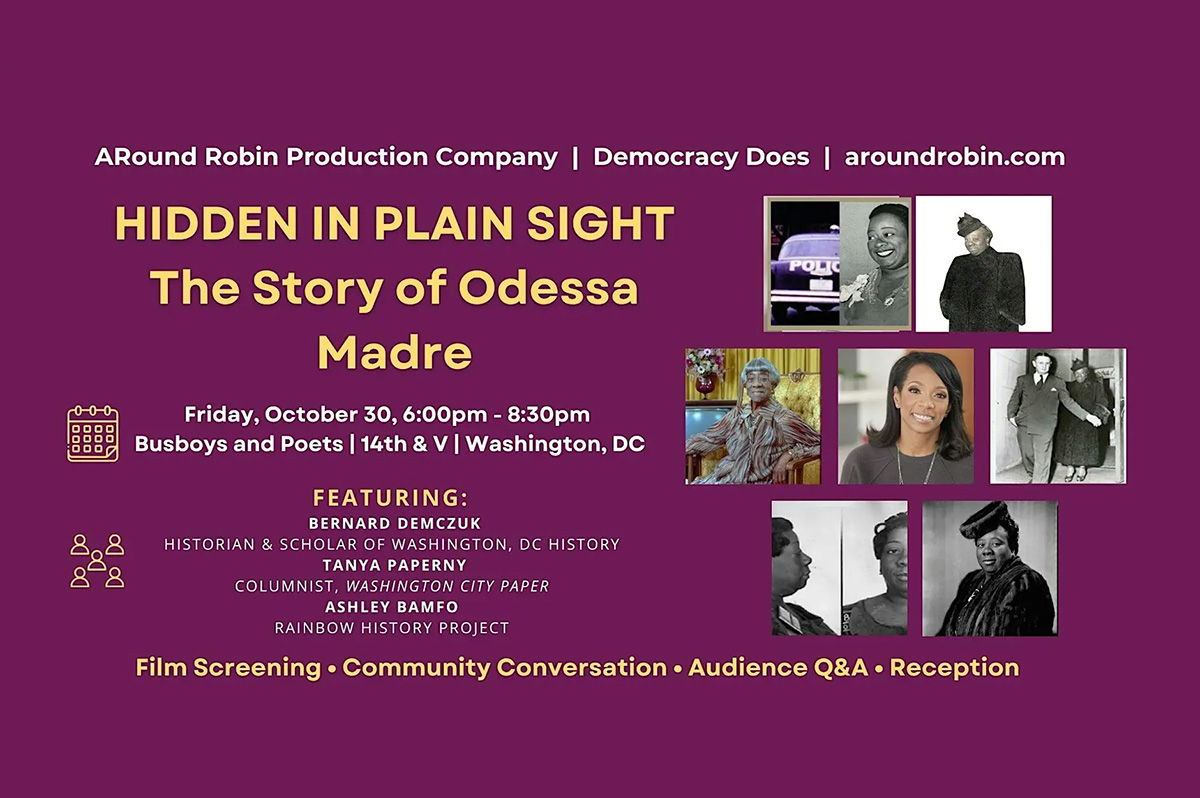
The liquor was flowing, the dice were rolling and the women were plentiful. Down on 14th Street in the U Street corridor in 1946, at Club Madre, your thirst could be quenched and your vices satisfied. At the center of it all was a large, dark-skinned woman whose taste for mink, money, and power made her larcenous — and legendary.
Look at photos of Odessa Madre, clothed head-to-toe in fur, hair freshly curled, and her eyes dared you to question her prowess. Her mischievous smile suggested she knew something you didn’t. Here was one of the most successful women in Washington, D.C. — and yet most Washingtonians have never heard of her. Why?
Madre was a big-time numbers runner during the 1930s, ‘40s, and ’50s, when the illegal lottery was booming. For Black Washingtonians, the underground lottery offered a chance to get ahead economically when segregation made legitimate financial advancement nearly impossible. Those who ran the game always seemed to be making money — and Madre was one of the most successful, with the hustle, resources and smarts to become one of the richest women in the city. Yet she nearly became a footnote in D.C. history, remembered mostly by a small plaque on U Street where her mugshot is captioned: “This was D.C.’s Al Capone.”
Why does someone like her nearly disappear from history? And when someone is erased — what is lost?
Madre graduated from Dunbar High School, the segregated school for African Americans renowned for producing students who went on to earn advanced degrees and returned to teach. The expectation was that if you looked and spoke the “right” way, a respectable job — teaching, civil service — awaited. Those jobs were also often reserved for women who fit a certain mold. As Professor Sharon Harley writes in “Sister Circle: Black Women and Work,” Madre’s turn to criminal life was fueled in part by “deep feelings of rejection by the Washington color-conscious Black middle class.” She didn’t fit the mold. So she built her own path.
She aligned herself with people she was never supposed to befriend — Italian and Irish men who ran the city’s underworld — and turned selling moonshine into a calling card. Childhood friends who became police officers looked out for her, and she looked out for them.
Madre never married and had no interest in men. She kept a steady crew of attractive women close, and accounts suggest she had relationships with women — relationships that would hardly have been acknowledged publicly at the time. Her rejection of the era’s social expectations meant she was never bound by a marriage that could have curbed her ambition, or a divorce that could have wrecked her financially. Her independence gave her a level of control over her life that few women of her era experienced.
Eventually, police stings, betrayals and a government eager to legalize the lottery for itself squeezed the life out of the underground game. Madre’s luck ran out. She died penniless — her funeral paid for by street friends and a detective or two who had quietly admired her hustle for years.
Why does any of this matter? Because it’s a clear-eyed look at what it takes to chase the American Dream when the front door is locked. History can be ugly — but sanitizing it doesn’t make it less true.
Odessa Madre was a criminal, entrepreneur, hustler, queer woman, Dunbar graduate, numbers runner, wealthy Black woman, friend to police, lawbreaker and product of segregation — all at once.
Her story is a reminder that the truth about Jim Crow, and who survived it and how, is more complicated — and more honest — than any diluted version of history could be.
My documentary, “Odessa’s Reign,” is an attempt to give her the fuller portrait she never received in her lifetime. Madre’s path challenges us to think about identity, place and memory: who gets remembered, and why their stories matter.
Robin Hamilton is a filmmaker and journalist and director of ‘Odessa’s Reign.’ There will be a screening and community conversation, ‘Hidden in Plain Sight: The Story of Odessa Madre,’ on Friday, Oct. 30 at Busboys and Poets at 14th and V streets, 6-8:30 p.m. Learn more at www.aroundrobin.com.
Opinions
Solidarity beyond the parade: the actual cost of Pride
Chandreyi Guharay spoke with activists at World Pride in Amsterdam

Editor’s note: Chandreyi Guharay is the global advocacy officer for Walking the Talk. She spoke with queer activists from around the world at World Pride 2026 in Amsterdam about the impact of shrinking aid.
Queer activists and Dutch NGOs gathered at Amsterdam City Hall as part of “Building Bridges,” a World Pride 2026 visitor program for LGBTIQ+ community leaders run by the Dutch Ministry of Foreign Affairs and COC Nederland.
Pride is every day, everywhere
Although we were in Amsterdam, the work back home never stops for activists. Enkhmaa Enkhbold, executive director of the LGBT Center in Mongolia, excused themself a couple of times to check their phone.
“We’re organizing Pride in Mongolia, and it’s happening in two weeks,” they explained.
Among many other things, their organization drives policy advocacy and movement building for LGBTIQ+ rights, and helps queer people facing persecution find a safe way out.
John Mathenge Mukaburu is also doing the daily work of resistance. His organization HOYMAS in Kenya runs clinics across three counties, serving almost 20,000 patients from key populations, including gay and bisexual men and sex workers. In Nigeria, Cosmas Osinachi Ihenacho-Herbert, program director at Obodo, shared how they are changing the narrative by elevating the leading role queer people play in shaping art and culture across the country and the African continent.
And in Vietnam, Nguyễn Diệu Anh co-founded Yêu-nữ (Women Living Wicked), a sapphic collective that hosts regular gatherings where women have a place to find joy and each other. Whether it’s healthcare, protection, culture or belonging, these efforts keep communities alive. Still, they have never been properly funded.
Less funding, more backlash
As an advocate for gender equality and a queer activist myself, I know how much LGBTIQ+ movements do with so little. Even before the dismantling of the U.S. Agency for International Development and the funding cuts across other major donor countries, just $.04 cents of every $100 in Official Development Assistance (ODA) went to queer communities. Now even that is rapidly disappearing. And what little there is doesn’t land evenly. As trans activist Marcela Morales from Asociación Lambda in Guatemala emphasized: “Most of the funding goes to gay men’s and trans women’s organizations. Very little reaches organizations of trans men and LBQ women.”
But this isn’t just about money. The same politics driving these cuts are shrinking civic space everywhere. Anti-rights actors are growing richer and bolder, finding new ways to target LGBTIQ+ people, as my colleague Jordan Dittmar has written. Queer and feminist activists defend the right to protest, to speak and love freely, to put care for people and the planet at the center and to decide over our own bodies and lives. And yet our rights are always the easiest target, and our funding the first to be cut. We are the canary in the coal mine, and everyone else’s freedoms are never far behind. That should worry all of us.
A lifeline built on solidarity
Bessy Ferrera was a trans activist from Honduras who fought for the rights of trans people, sex workers and people living with HIV, and whose life was violently cut short in 2019. A year later, Hivos established the Bessy Ferrera Emergency Fund in her name. It offers fast, practical help to LGBTIQ+ activists facing threats because of their work, from medical and legal costs to security and relocation. Since 2022, it has helped nearly 100 people and organizations around the world.
When I mentioned the fund to Ribal Maatouk, national chairperson of the LGBTIQ+ Task Force in Lebanon, he told me he already knew it well. Through Israel’s devastating invasion and war, the Task Force, alongside its member organizations, notably specialized local LGBTIQ+ CSOs, have continued to provide humanitarian support to queer people.
“From all the funding initiatives, the Bessy Ferrera Fund was the most easily accessible for our community, allowing for a faster deployment of emergency support than other organizations,” he said. “I need to give credit where it’s due.”
Hope for the long haul
Emergency funds provide a vital lifeline during a crisis, but activists and their movements also need lasting support. For Cosmas, the lesson is hopeful: governments change with elections, and funding changes with them, but movements can outlast both. For activists in the Global South, that has often been the reality.
“Maybe the question is not how we survive this crisis,” he said, “But how we build a movement infrastructure that’s strong enough for us to thrive through whatever comes next.”
He also sees an opening: with the U.S. stepping back, the Netherlands could once again be the champion of gender equality and LGBTIQ+ rights it used to be. With a new Dutch government in place, there are signs of greater political will, and now is the moment to turn it into funding.
What comes after the parade
The activists I met have been holding their communities together, standing alongside feminist and queer movements everywhere to defend rights and freedoms for all. As we often say in the gender equality movement, imagine what they could do with the right support. Solidarity beyond the parade means that governments, funders and allies invest in queer aspirations.
Chandreyi Guharay is a Nicaraguan-Indian gender justice specialist by training, and — in Sara Ahmed’s words — a feminist killjoy by political choice. She’s the Global Advocacy Officer at Walking the Talk/Hivos, weaving together strategic advocacy, policy analysis and coalition-building for gender equality financing. She’s previously worked with Oxfam, Plan International, She Decides, CIVICUS, and Share-Net on research, organizational development and political education. Outside of work, you’ll find her co-conspiring with Feministas en Holanda, a decolonial grassroots collective of Latin American people in the Netherlands, where she is a community organizer around anti-racist and migrant justice struggles.
Opinions
Trump, Netanyahu, and Putin are all war criminals
We are living in a world of chaos as a result

Today there are war criminals leading three major governments. President Trump here in the United States, Benjamin Netanyahu in Israel, and Vladimir Putin in Russia. The world would be a better place if they were thrown into a jail cell together, and the key tossed away.
We are living in a world of chaos. Although these three are not responsible for all of it, they have a major role. All three are carrying out wars that they can’t win. Wars that should have never been started. In the process they are not only killing their stated enemies, but they’re also causing the deaths of their own people.
Here in the United States, we have a felon in the White House, who has done nothing but create chaos in the world since he took office. He has broken every promise he made to get elected, and while many of us knew they were all lies, he won anyway. He promised lower rents, lower mortgage rates, lower inflation, lower gas prices, lower grocery prices, and importantly, no new wars. He has accomplished the exact opposite in each of those areas. He began a war with Iran and started by bombing a school, mistake or not, killing innocent children. This after declaring war on immigrants here at home using his ICE Gestapo. He apparently thinks if he creates chaos, and then gets things back to close to where they were before he acted, he can claim victory. But even that seems out of his reach.
Then there is Prime Minister Netanyahu in Israel. His actions have made things worse not only for his enemies, but for Israelis at home, and Jews around the world. He began a war against Iran that he can’t win. He has committed war crimes against the Palestinian people in Gaza, and the West Bank, and by his actions brought out more anti-Semitism around the world. For me personally, he has made it more difficult to explain to people when I say I am a Zionist, it means I support the existence of the State of Israel, not its war criminal leader, and his government. He should have heeded what President Biden said to him after the Oct. 7 attack on Israel by Hamas. While retribution and getting back the hostages Hamas took was crucial, Biden counseled not to go overboard in response, like the United States did after 9/11. Instead, Netanyahu has killed thousands of Palestinian women and children, and has not made Israel much safer. He then began the war with Iran, and sent troops to fight in Lebanon. Yes, the Iranian government funds Hezbollah and Hamas, but one must ask if anything is better after Netanyahu’s actions. Israelis continue living in a state of active war.
Then there is Putin in Russia. He believed he could attack Ukraine and walk away with pieces of their country, maybe even all of it. Instead, he has Russia embroiled in a four-year war, killing thousands of Ukrainians, including many women and children, destroying parts of their country, and losing thousands of his own troops in a war he can’t win. His own people are suffering, and now, four years later, Ukraine has shown it still has the ability to attack Moscow. All three of these men have managed to show the weaknesses of their own countries.
In his effort to bluster through his many failures, Trump has destroyed relationships with our allies. It will take years, if ever, for them to trust the United States again. He invaded Venezuela and stole their oil, is starving Cuba, and created unease with Canada and Mexico on our own borders. He thinks this makes him look like a strongman, when it really shows all of his weaknesses. People should remember the treaty he abrogated with Canada and Mexico, was one he negotiated in his first term. Now he invites Chinese President, Xi, to the United States, and gives him the same red-carpet welcome he previously gave to Putin in Alaska, and in both cases, received nothing in return. He tries to keep the press he doesn’t like from having access to him.
All three are facing crucial elections that could severely impact their futures. Only Putin, a true dictator, is assured of winning because he controls the process. Trump is trying to emulate him, to keep from losing the Nov. 3, mid-term elections. Thankfully the courts are trying to stop him. Netanyahu could face being thrown out on Oct. 27, if Israelis do the right thing.
Again, I truly believe putting the three of them in a jail cell together would make our troubled world a little safer, and a much better place.
Peter Rosenstein is a longtime LGBTQ rights and Democratic Party activist.

Center Arts Gallery celebration, auction to take place on Oct. 17

Comings & Goings

‘Hidden in Plain Sight:’ The story of Odessa Madre

‘Governments that attack LGBTQ+ rights learn from each other’

Horror genre has evolved into space to explore queer identity

ICC unseals arrest warrants for Taliban officials accused of persecuting LGBTQ people, women

Physician: addiction doesn’t always look the way you think it does

Calendar: October 9-15

Solidarity beyond the parade: the actual cost of Pride

Essential queer horror classics for Halloween
-

 Afghanistan5 days ago
ICC unseals arrest warrants for Taliban officials accused of persecuting LGBTQ people, women
-
District of Columbia5 days ago
Physician: addiction doesn’t always look the way you think it does
-
Calendar5 days ago
Calendar: October 9-15
-
Opinions4 days ago
Solidarity beyond the parade: the actual cost of Pride