
National
Judge orders S.C. to put lesbian moms’ names on birth certificate
Court determine state violated ruling for same-sex marriage nationwide


A federal judge has ruled in favor of a lesbian couple seeking their names on their child’s birth certificate.
In a six-page decision, U.S. District Judge Mary Geiger Lewis, an Obama appointee, ruled in favor of Casy and Jacqueline Carson, a lesbian couple who married in 2014 and recently had twins. The state placed the name of Jacqueline Carson, the birth mother, on their twins’ birth certificates, but refused to do so for Casy Carson.
“With the Order, the Court declares Defendant’s failure to treat same-sex spouses in the same manner she treats opposite-sex spouses in the issuance of birth certificates violates Plaintiffs’ rights under the Fourteenth Amendment to the United States Constitution,” Lewis wrote. “More specifically, this Court refuses to countenance Defendant’s refusal to name both Plaintiffs on their twins’ birth certificates. Defendant’s present practice is violative of Plaintiffs’ fundamental right to marriage and other protected liberties.”
The judge grants summary judgment in favor of the couple, but determined their request for injunctive relief is moot because the both couple and the state agreed to enter into a consent degree to obtain relief the couple sought.
A similar case may soon be heard by the U.S. Supreme Court. The National Center for Lesbian Rights and other legal groups have filed a petition for certiorari asking justices to reverse a decision by the Arkansas Supreme Court upholding a law directing a Arkansas place to the name of a birth mother, but not her spouse, on their child’s birth certificate.
Tara Borelli, counsel at Lambda Legal and attorney representing the lesbian couple in the case, said in a statement the decision on the South Carolina law affirms same-sex parents “are entitled to the critical safety and security that a birth certificate provides.”
“It is long past time that states acknowledge the marriages of same-sex couples just as they do different-sex parents – and this decision is an important step in that direction,” Borelli said. “An inaccurate birth certificate causes real trouble in a family’s day-to-day life – everything from a parent not being able to enroll a child in school to not being able to authorize basic medical care.”
The Washington Blade has placed request for comment on the decision in with South Carolina Gov. Henry McMaster and Attorney General Alan Wilson.



U.S. Supreme Court
Supreme Court faces new questions over trans rights and equal protection
One case sent back to lower court as SCOTUS considers taking up another
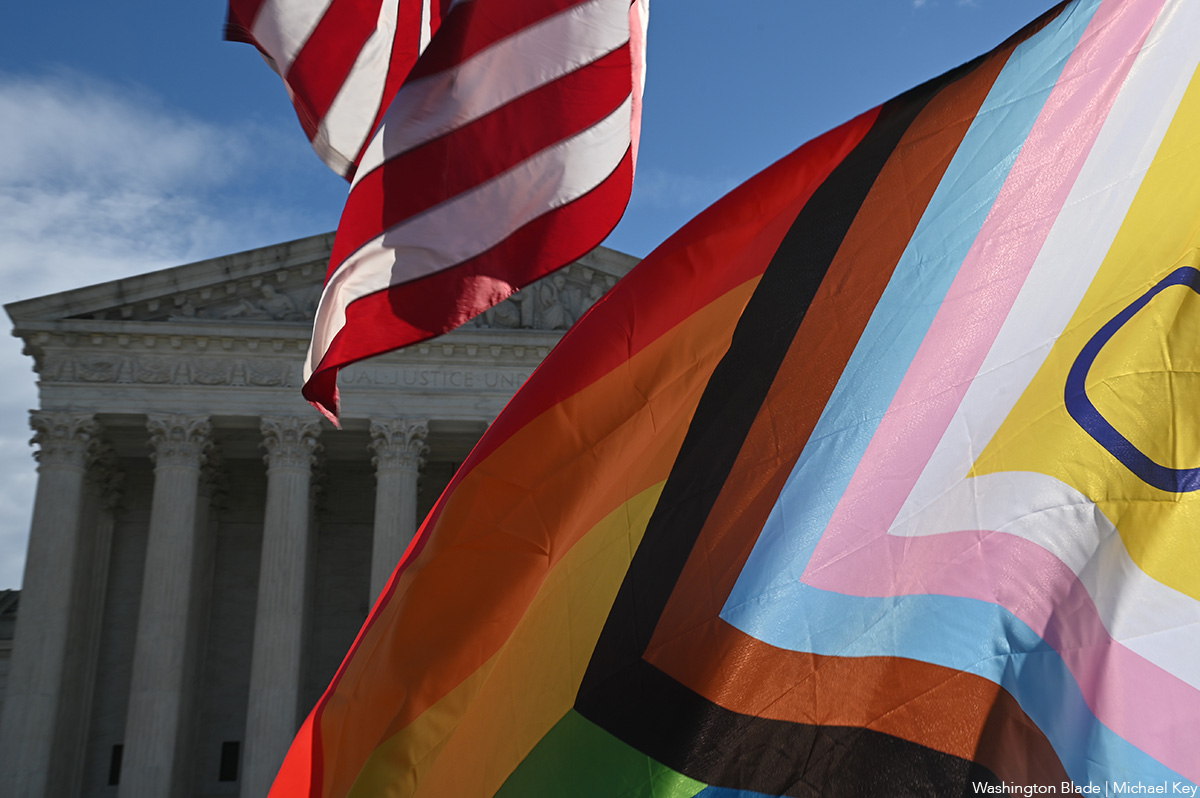
The U.S. Supreme Court has taken action in one case and is being asked to review another, two legal challenges that could have significant implications for transgender people in the United States, including those incarcerated in state prisons and serving in the U.S. military.
The cases, Roybal v. Griffith and Talbott v. USA, involve separate challenges to policies affecting trans people. Both raise questions about equal protection under the Constitution and the extent to which the government can impose restrictions based on trans identity.
Roybal v. Griffith
Roybal v. Griffith involves Darlene Griffith, a trans woman who was incarcerated in an El Paso County, Colo., prison in 2020.
Griffith, who was assigned male at birth, was forced to be held in a men’s prison despite identifying as a trans woman. She was also denied access to woman’s undergarments and strip-searched by a male officer, despite requesting a female officer.
On Nov. 9, 2026, the Supreme Court vacated the lower court’s judgment, or canceled what the lower court had argued, sending the case to the 10th U.S. Circuit Court of Appeals for further consideration following the recent decisions by the highest court in the land over West Virginia v. B.P.J. and United States v. Skrmetti. Both of those cases were considered a loss for the federal government stepping in to protect trans citizens.
These actions come directly after its June decision in West Virginia v. B.P.J., in which the justices addressed equal protection claims involving trans individuals and restrictions based on sex assigned at birth. The court sided with the exclusive policy holding that restricting female teams to biological females is substantially related to safety and competitive fairness.
In United States v. Skrmetti, the court held that policies restricting gender affirming care is on the basis of age — and not by sex (which has a higher standard to met) allowing the states to enact these laws, but not forcing them to do so.
Lawyers for the Trump-Vance administration, who submitted a brief supporting the Colorado prison, argued that the Supreme Court’s precedent on trans issues allows the government to separate biological males from female activities and spaces based on sex rather than gender identity.
“When a sex-based classification is justified as a constitutional matter’ – ‘for example,’ in ‘women’s and girls’ sports’ – then a state ‘may treat all biological males the same and treat all biological females the same’; it ‘is not constitutionally required to grant individualized exemptions to specific [persons] or subclasses,’” Solicitor General John Sauer wrote in a brief.
A lower federal court had previously found that Griffith’s equal protection rights were violated through her prison assignment and the prison’s failure to provide her with requested items. The court also disagreed with the prison’s strip-search policy.
Griffith’s attorneys pushed back against the administration’s arguments, saying the prison system already receives considerable deference from courts when making administrative decisions.
“The petition boils down to a plea for ‘administrative flexibility and deference,’ but prisons receive that regardless of the level of scrutiny applied to equal protection claims; deference in the unique context of prisons is baked into the analysis,” lawyers for Griffith wrote to the Supreme Court.
Talbott v. USA
Meanwhile, the Supreme Court is also being asked to take up Talbott v. USA, a case challenging the Trump-Vance administration’s categorical prohibition on trans military service.
President Donald Trump signed Executive Order 14183, titled “Prioritizing Military Excellence and Readiness,” on Jan. 27, 2025, directing the Department of Defense to adopt policies prohibiting trans, nonbinary, and gender-nonconforming people from serving in the military.
The administration’s policy asserts that trans people are inherently incapable of meeting the military’s “high standards of readiness, lethality, cohesion, honesty, humility, uniformity, and integrity,” citing a history or signs of gender dysphoria. According to the Defense Department, this creates “medical, surgical, and mental health constraints on [an] individual.”
Under the policy, trans applicants are considered less qualified than their cisgender peers, regardless of their physical or intellectual capabilities.
On Tuesday, the U.S. Court of Appeals for the D.C. Circuit denied the Trump-Vance administration’s request to halt a preliminary injunction blocking the military from discharging 27 trans service members who challenged the ban. The decision allows the injunction to take effect while the administration asks the Supreme Court to review the case.
Shannon Minter, legal director of the National Center for LGBTQ Rights, which represents the plaintiffs alongside GLAD Law and other law firms, said the ruling means the administration cannot enforce the ban against the 27 service members who brought the lawsuit.
“It immediately means that the Trump administration cannot enforce the ban against the plaintiffs in Talbott, against our 27 transgender service members who brought the case. They cannot be discharged from the military. They should be returned to active duty to their prior positions and, of course, permitted to adhere to the standards of their post-transition sex. They should be able to serve as themselves and be back at work.”
Minter said multiple federal courts have now found that the administration has failed to provide evidence justifying the ban, despite the government’s acknowledgment that the plaintiffs have served honorably and met military standards.
“We have had two federal district courts look at this issue and conclude that there is no evidence whatsoever to support a ban. The government concedes that the plaintiffs in these cases are serving honorably and meeting all standards. They’re doing, by any measure, an extraordinary job. There have been no issues with their service whatsoever.
“We’ve now had two federal appellate courts review those decisions and agree that the ban has no justification. The D.C. Circuit, for the second time, has looked at the evidence and concluded yet again that there’s no justification for the government to separate these individuals, who the government agrees have made our country safer.”
The Trump-Vance administration is still seeking Supreme Court intervention. Minter said the justices could consider the administration’s petition at their next conference in early December.
He argued that the administration’s legal strategy goes beyond trans military service and could establish a broader precedent giving the executive branch unchecked authority over military policy.
“The Trump administration is trying to get the Supreme Court to say that President Trump and the military can literally adopt any policies they wish, and that courts just have to defer to that. They’re betting that because this is a policy about a small, unpopular group, the Supreme Court is more likely to agree with that. But the impact of that would be much broader. It would be really devastating for our country if the Supreme Court held that Trump and Hegseth can literally impose any policy they wish on the military.”
Minter also disputed the administration’s characterization of the ban as a medical policy, arguing that it specifically targets trans people rather than evaluating service members individually based on their ability to perform their jobs.
“When you read the policy, it is very clear that the policy is targeted at transgender people because they are transgender. It has nothing to do with any medical condition.
“For every other medical condition, the military evaluates on an individual basis whether that has any bearing on someone’s ability to perform their job. One of the major goals of the military is to retain people once they’ve gone through the rigorous process of being screened and trained, as long as they can do the job.
“Gender dysphoria would be the only medical condition that results in immediate, automatic discharge, even for people who can continue to do the job. The policy is much broader than that, though. It says that everyone has to serve in their birth sex, which is just another way of saying you can’t be transgender.”
Nic Talbott, the trans service member whose name is attached to the military lawsuit, previously told the Washington Blade that being trans has never affected his ability to serve.
“Being transgender posed quite the obstacle to me achieving that dream,” Talbott told the Blade. “Not because it [being trans] had any bearing on my ability to become a soldier and meet the requirements of a United States soldier, but simply because of the policy changes that we’ve been facing as transgender service members throughout the course of the past decade … My being transgender had nothing to do with anything that I was doing as a soldier.”
Talbott also argued that having people with different backgrounds and experiences strengthens the military.
“I think the more diverse our military is, the stronger our military is … We need people from all different experiences and all different perspectives, because somebody is going to see that challenge or that problem in a way that I would never even think of … and that is what we need more of in the U.S. military.”
District of Columbia
Ruby Corado files motion for early release from prison
Former Casa Ruby director pleaded guilty to wire fraud

Ruby Corado, the founder and former executive director of the now closed LGBTQ community services organization Casa Ruby, has reported being raped and sexually abused or harassed at least 31 times since being sentenced to federal prison on Jan. 13, 2026, according to a motion seeking early release filed by her attorney.
The motion, filed Nov. 13 in U.S. District Court for D.C. by a federal public defender attorney, asks a federal judge to grant Corado an early release at this time rather than complete her sentence of 33 months of incarceration after pleading guilty to a charge of wire fraud.
The motion says concerns raised by Corado’s attorney at the time of her sentencing hearing in January that, as a transgender woman, she would be subjected to sexual abuse, has happened in a big way.
The motion notes that under the current federal prison policy set by the Trump-Vance administration’s Department of Justice, trans women are assigned to male prisons and male prison housing facilities. It points out that since her initial incarceration in January Corado has spent time in federal prisons in Oklahoma, Louisiana, and Texas.
“Ms. Corado signed a declaration under penalty of perjury detailing her experiences in Bureau of Prisons custody, including the 31 rapes and sexual assaults to which she has been subjected,” the motion states. “She has, for instance, woken up to men masturbating in her face; male officers have stripped her naked in front of 400 other inmates during processing; she has been forced to wear male clothing 32 years after transitioning; other inmates regularly jump into her shower aroused and expecting sex; and her cellmates slap her butt when she is trying to sleep,” her attorney’s court motion states.
The motion, filed by federal public defender attorney Joanna Muson Perales, notes that existing federal law and prison regulations allow for a court to grant a reduced sentence and early release from a prison if “extraordinary and compelling reasons warrant” an early release.
“Altogether with Ms. Corado’s deteriorating mental health, other health conditions, and rehabilitation, these bases are extraordinary and compelling reasons to reduce her sentence to time served,” the motion adds.
Online court records show that U.S. District Court Judge Trevor M. McFadden, who continues to preside over the case, has yet to issue a decision on the motion and has not said how long he may take to deliberate over the motion.
As of Nov. 16, the online court records show that prosecutors from the Office of the U.S. Attorney for D.C. had not yet responded to the motion. Perales couldn’t immediately be reached for comment.
Among other things, the motion includes a 16-page handwritten declaration by Corado describing in detail the instances of rape, sexual harassment, and alleged mistreatment she says she has experienced since being incarcerated in January. It says prison officials for the most part failed to take action against those she accused of sexually assaulting her, claiming, according to Corado, that her allegations were “unsubstantiated” after her attackers denied the allegations.
In January, McFadden sentenced Corado to 33 months of incarceration. He also sentenced her to 24 months of supervised release upon her completion of incarceration.
In addition to the incarceration, McFadden agreed to a request by federal prosecutors to hold Corado responsible for “restitution” and “forfeiture” in the amount of $956,215 that prosecutors said she illegally misappropriated from federal COVID-19 related federal loans obtained by Casa Ruby.
At the time she pleaded guilty to the wire fraud charge Corado admitted to allegations by prosecutors that she illegally transferred at least $180,000 of the COVID relief funds obtained by Casa Ruby to private bank accounts in El Salvador, where she is from. But Corado claimed her intent was to use the funds to start a Casa Ruby facility in El Salvador and not to use the funds for her personal benefit.
California
West Hollywood creates registry for polyamorous relationships
New legal rights for those with multiple partners

The West Hollywood City Council voted unanimously on Nov. 2 to create a registry for those in “multi-partner domestic relationships.”
The measure gives those in polyamorous relationships the same legal rights afforded to monogamous couples. Those include visitation rights in hospitals and jails in West Hollywood and certain tenant protections.
In 1985, West Hollywood became the first city in the nation to recognize domestic partnerships between same-sex couples. Within a few decades, legal recognition of same-sex couples extended to many cities and states and in 2015 marriage equality was legalized nationally. Now, advocates for polyamory say that WeHo is starting another trend toward recognizing other non-nuclear family structures.
“The new law not only gives polyamorous unions legal recognition, I think it also gives people permission to imagine a future together and to plan their lives openly,” said Christina Fialho, president of Rewrite the BiLine, a non-profit organization that works to expand queer media representation that advocated for the measure. She hopes that as time passes, more cities and states will pass legislation that legally recognizes those outside of traditional monogamous relationships. “This is the first of many more wins to come, and we hope to see more cities adopt similar ordinances,” Fialho said. A few cities in Massachusetts also currently recognize multi-partner relationships.
Fialho said the growing prevalence of non-monogamous relationships will help create demand for more legal recognition. “In the United States, consensual non-monogamy is actually as common as owning a cat,” Fialho said, which amounts to around 5 percent of the population. They are particularly prevalent among LGBTQ people, with around “50 percent of LGBTQ+ people” having been in “consensually non-monogamous relationships,” according to Fialho.
Megan Katz, a West Hollywood resident and librarian is part of that 50 percent. Katz has practiced polyamory for years and is currently in a committed marriage while also dating outside of it. She views the ordinance as a major victory. “It is one more step toward legitimizing nontraditional relationships and specifically polyamorous relationships,” Katz said.
Katz does not plan on immediately using the registry, as one of her relationships “is not established enough,” but she “very much appreciates that the city is taking these steps.”
Katz considers herself lucky that she has not experienced much personal discomfort or discrimination due to her polyamorous relationship. “With my personal, private communities, and even just my personal circles, I really have not had any problems,” she said. But she thinks the ordinance will help curb larger cultural stigmas around polyamory and non-monogamy.
“I am polyamorous and I am very comfortable with that, but it’s not a concept that’s very well known culturally and is sort of vilified or looked down upon,” she said. “There’s nothing wrong with it when you’re engaged in it ethically.”

Supreme Court faces new questions over trans rights and equal protection

VIDA Fitness to hold memorial at Logan Circle gym

Friends, family seek support for two victims of VIDA Fitness shooting

DMV to mark Transgender Day of Remembrance

Top Lebanese newspaper calls for decriminalization of homosexuality

Comings & Goings

‘Jellicle Ball’ projection designer’s next project is in D.C.

PHOTOS: Whitman-Walker Gala

‘You Can See Everything’ confronts an enigma by becoming one itself