Movies
LGBT content abounds in summer 2017 streaming, home video formats
‘Vegas Baby,’ ‘Flatbush Luck,’ ‘Before the Fall’ among current releases available to watch at home
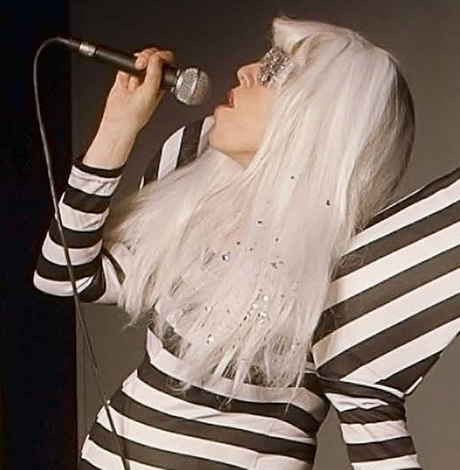
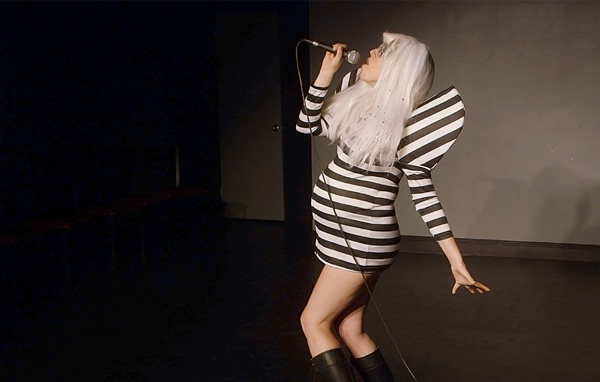
Lesbian performer and Lady Gaga impersonator Athena is one of the people profiled in ‘Vegas Baby.’ (Photo by Amanda Micheli)
Now that the dog days of summer are here, instead of slogging through the heat to a movie theater, you can have some of the hottest recent LGBT releases delivered right to your living room. Between DVDs and a wide variety of Video On Demand (VOD) streaming services, you don’t need to leave the house until awards season begins to heat up in the fall.
One of the most interesting new releases is “Vegas Baby,” which was an audience favorite at the 2016 AFI Docs Film Festival under its original title of “HaveABaby.” Inspired by her own experiences with the economic and emotional toll of infertility treatments, Academy Award-nominated director Amanda Micheli turns her lens on a controversial annual contest.
A Las Vegas doctor asks people seeking infertility treatments to submit a video to a YouTube contest; the most popular entrant gets a free round of treatments. One of the most fascinating contestants is Athena Reich, a single lesbian performer and Lady Gaga impersonator, who reveals it was harder to come out to her Catholic family as infertile that it was to come out as a lesbian.
Recently out on DVD is “Flatbush Luck,” the eighth feature film by writer/director Casper Andreas. A multiple award winner on the festival circuit, the film is a romantic comedy crime caper about two hunky cousins in Brooklyn who stumble upon an insider trading scheme. Things heat up when stock tips turn into murder plots and Jimmy and Max find themselves dealing with crooked businessmen, the police, sexual confusion and an impending wedding.
“Before the Fall” is a modern-day gay adaptation of Jane Austen’s classic novel “Pride and Prejudice” set in a small town in southern Virginia. Elisabeth Bennet has been reimagined as Ben Bennet, a wealthy lawyer, and the aristocratic Mr. Darcy has become Lee Darcy, a rough-hewn welder. Ben and Lee, of course, instantly dislike each other, but feelings, of course, begin to change in first-time director Byrum Geisler’s beautifully filmed, fresh take on an old tale.
Recently released on a variety of streaming platforms, the hard-hitting documentary “Returning Citizens” follows a group of Southeast D.C. residents as they strive to adjust to freedom after long-term incarceration and work to create new lives for themselves and their families. Directed by Toronto-based filmmaker Saffron Cassaday (Cyber-Seniors), the movie also shows community leaders working to end the ongoing cycle of crime and violence and illustrates the need for comprehensive prison reform.
“I Love You Both” is definitely a family affair. Kristin Archibald is the co-writer and co-star of the movie with her brother Doug, who also directed. They play Krystal and Donny, co-dependent twins and roommates. They are in deep denial about the fact that they are both dating the same man (Lucas Neff), but when he finally chooses one of them over the other, they’re forced to start leading separate lives.
Another recent streaming release is the charming Irish dramedy “Handsome Devil.” Writer/director John Butler sets his coming-of-age story in a repressive Irish boarding school dominated by the homophobic rugby coach. Ned, a music-loving rebel who’s bullied by the jocks, is forced to share a dorm room with Conor, a star athlete. Under the watchful eye of their English teacher Mr. Sherry (Andrew Scott from “Pride”), the two form an unlikely friendship. The stakes get raised when the rugby team starts winning and several characters are forced reveal their true selves.
As always, the gay owned and operated Wolfe Video is a great source for LGBT films, whether on DVD/Blu-ray or streaming. Two of their recent acquisitions were standouts in the 2016 festival circuit.
A favorite with both critics and audiences, and a late-night hit at D.C.’s Reel Affirmations Film Festival last year, “Paris 09:59 Théo & Hugo” starts out after midnight in a Paris sex club. After a passionate sexual encounter, Theo and Hugo wander the streets of Paris, drunk with the possibilities of love at first sight and sobered by the risks of their passion.
Directed by Maura Anderson, the award-winning “Heartland” tells the story of a young artist who returns to the family homestead after the sudden death of her lover. Although her mother (Beth Grant of “Sordid Lives”) expects her to return to the straight and narrow, Lauren embarks on a reckless affair with her brother’s girlfriend.
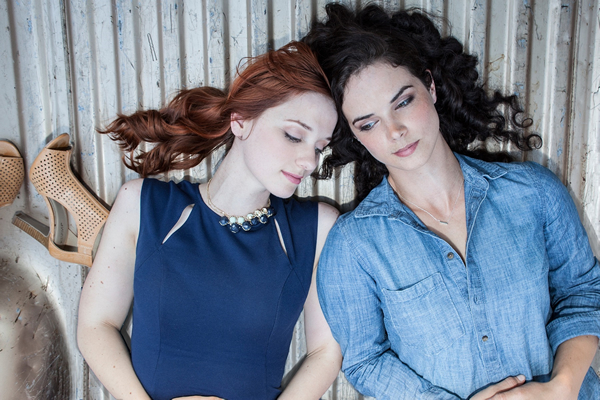
Laura Spencer and Velinda Godfrey in ‘Heartland.’ (Photo courtesy of Wolfe video)
Other new releases at Wolfe Video include the documentary “Kiki” about the contemporary New York underground ballroom scene; the backstage comedy “Opening Night” starring Topher Grace, Taye Diggs, J.C. Chasez and Anne Heche; and “I Am Not Your Negro,” the powerful documentary about black gay writer James Baldwin.
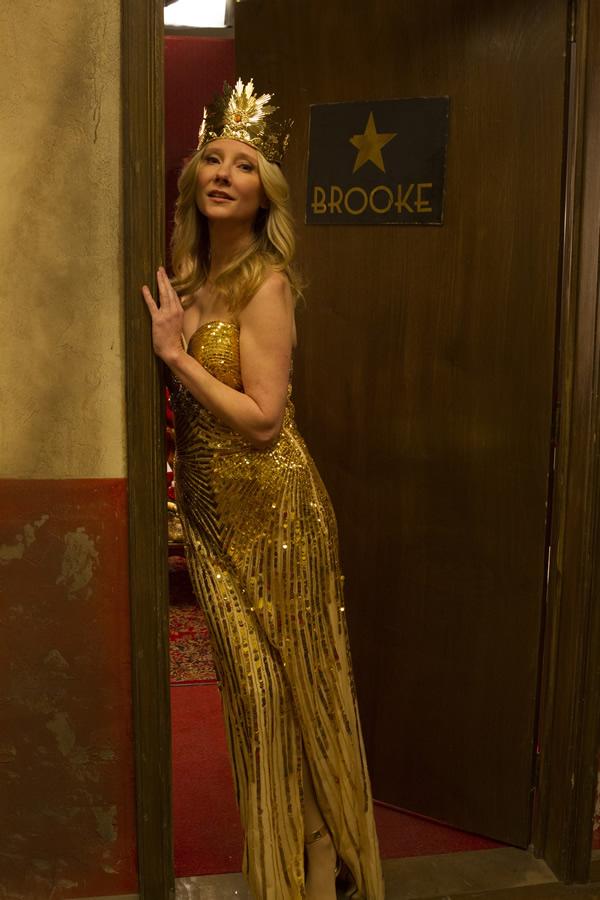
Anne Heche in ‘Opening Night.’ (Photo courtesy of Wolfe Video)



Movies
A Sondheim masterpiece ‘Merrily’ rolls onto Netflix
Embracing raw truth lurking just under the clever lyrics
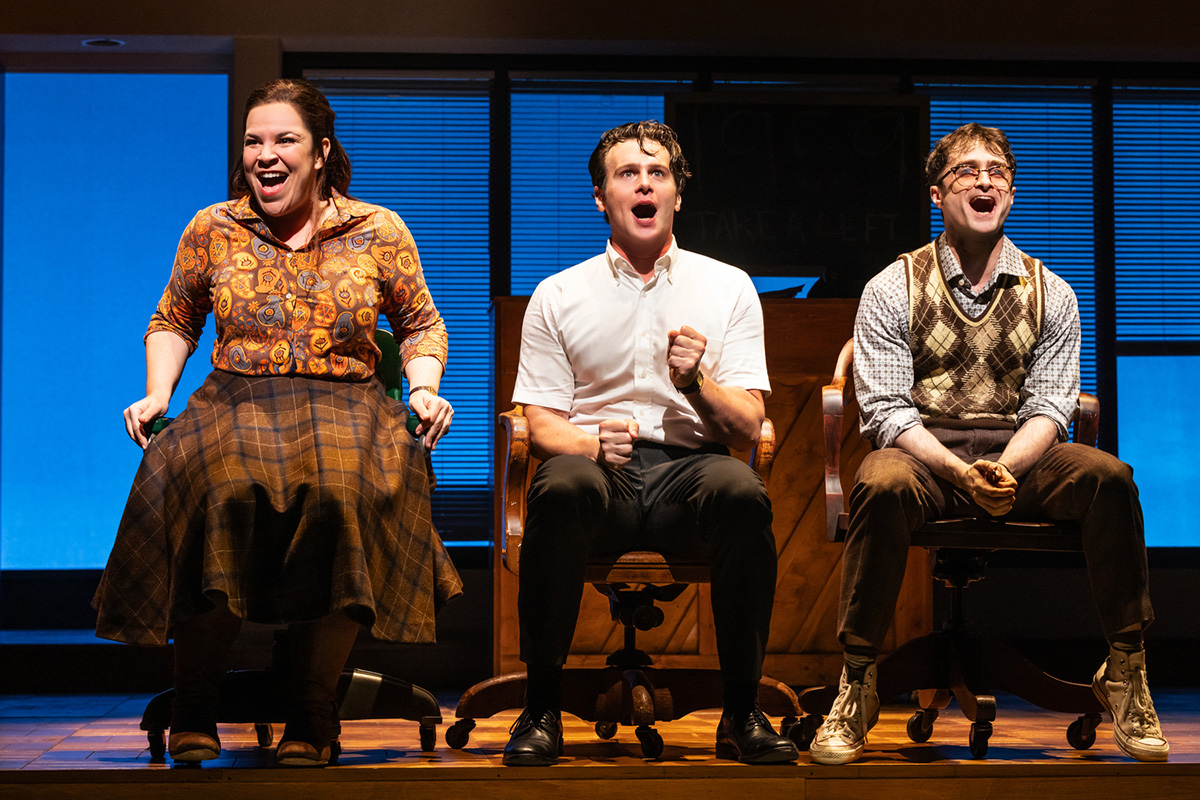
It’s been long lamented by fans of the late Stephen Sondheim – and they are legion – that Hollywood has hardly ever been successful in transposing his musicals onto the big screen.
Sure, his first Broadway show – “West Side Story,” on which he collaborated with the then-superstar composer Leonard Bernstein – was made into an Oscar-winning triumph in 1961, but after that, despite repeated attempts, even the most starry-eyed Sondheim aficionados would admit that the mainstream movie industry has mostly offered only watered-down versions of his works that were too popular to ignore: “A Little Night Music” was muddled into an ill-fitted star vehicle for Liz Taylor, “Sweeney Todd” became a middling entry in the Tim Burton/Johnny Depp canon, “Into the Woods” mutated into a too-literal all-star fantasy with most of its wolf-ish teeth removed, and we’re still waiting for a film version of “Company” – not that we would have high hopes for it anyway, given the track record.
Of course, most of those aficionados would also be able to tell you exactly why this has always been the case: erudite, sophisticated, and driven by an experimental boldness that would come to redefine American musical theater, Sondheim’s musicals were never about escapism; rather, they deconstructed the romanticized tropes and presentational glamour, turning them upside down to explore a more intellectual realm which favored psychological nuance and moral ambiguity over feel-good fantasy. Instead of pretty lovers and obvious villains, they showcased flawed, complicated, and uncomfortably relatable people who were just as messed-up as the people in the audience. Any attempt to bring them to the screen inevitably depended on changes to make them more appealing to the mainstream, because they were, at heart, the antithesis of what the Hollywood entertainment machine considers to be marketable.
To be fair, this often proved true on the stage as well as the screen. Few of Sondheim’s shows, even the most acclaimed ones, were bona fide “hits,” and at least half of them might be considered “failures” from a strictly commercial point of view – which makes it all the more ironic that perhaps the most purely “Sondheim” of the stage-to-screen Sondheim efforts stems from one of his most notorious “flops.”
“Merrily We Roll Along” was originally conceived and created more than 40 years ago, a reunion of Sondheim with “Company” book-writer George Furth and director Harold Prince, based on a 1934 play by George Kaufman and Moss Hart. Telling the 20-year story of three college friends who grow apart and become estranged as their lives and their goals diverge, it wasn’t ever going to be a feel-good musical; what made it even more of a “downer” was that it told that story in reverse, beginning with the unhappy ending and then going backward in time, step by step, to the youthful idealism and deep bonds of camaraderie that they shared in their first meeting. On one hand, getting the “bad news” first keeps the ending from becoming a crushing disappointment; but on the other hand, the irony that results from knowing how things play out becomes more and more painful with each and every scene.
The original production, mounted in 1981, compounded its challenging format with the additional conceit of casting mostly teen and young adult actors in roles that required them to age – backwards – across two decades; though the cast included future success stories (Jason Alexander and Giancarlo Esposito, among them), few young actors could be expected to convey the layered maturity required of such a task, and few audiences were capable of suspending their disbelief while watching a teenager play a disillusioned 40-year old. This, coupled with a minimalist presentation that left audiences feeling like they were watching their nephew’s high school play, turned “Merrily We Roll Along” into Sondheim’s most notorious Broadway flop – despite raves reviews for the show’s intricately woven score and the xtinging candor of its lyrics.
Fast forward to 2022, when renowned UK theater director Maria Friedman staged a new revival of the show in New York. In the interim, “Merrily” had undergone multiple rewrites and conceptual changes in an effort to “fix” its problems, abandoning the concept of using young performers and opting for a more “fleshed-out” approach to production design, and the show’s reputation, fueled by a love for its quintessentially “Sondheim-esque” score, had grown to the level of “underappreciated masterpiece.” Inspired by an earlier production she had helmed at home a decade earlier, Friedman mounted an Off-Broadway version of the show starring Jonathan Groff, Daniel Radcliffe, and Lindsay Mendez – and suddenly, as one critic observed, Sondheim’s biggest failure became “the flop that finally flew.” The production transferred to Broadway, winning Tony Awards for Groff and Radcliffe’s performances, as well as the prize for Best Revival of a Musical, in 2024.
Sondheim, who died at 91 in 2021, participated in the remount, though he did not live to see its premiere, nor the success that officially validated his most “problematic” work.
Fortunately, we DO get the chance to see it, thanks to a filmed record of the stage performance, directed by Friedman herself, which was released in limited theaters for a brief run last year, but which is now streaming on Netflix – allowing Sondheim fans to finally experience the show in the way it was designed to be seen: as a live performance.
Embracing the conventions of live theatre into its own cinematic ethos, this record of the show gives viewers the kind of up-close access to its performances that is impossible to experience even from the front-row of the theatre. The performances it gives us are impeccable: Groff’s raw and deeply deluded Frank Shepard, the ambitious composer who sells out his values and alienates his friends on the road to success and wealth; Radcliffe’s mawkishly loyal Charlie Kringas, who remains loyal to the dream he shared with his best friend until he can’t anymore; and Mendez’ heartbreaking perfection as Mary Flynn, the wisecracking good-time girl who rounds out their trio while concealing a secret passion of her own – each of them bring the kind of raw and vulnerable honesty to their roles that can, at last, reveal both the deep insights of Sondheim’s intricate lyrics and the discomforting emotional conflicts of Furth’s mercilessly brutal script.
Yes, it’s true that any filmed record of a live performance loses something in the translation; there’s a visceral connection to the players and a feeling of real-time experience that doesn’t quite come through; but thanks to unified vision that Friedman shepherded and instilled into her cast – including each and every one of the brilliant ensemble, who undertake the show’s supporting characters and embody “the blob” of show-biz hangers-on who are central to its cynical theme.
Honestly, we can’t think of another Sondheim screen adaptation that comes close to this one for embracing the raw truth that was always lurking just under the clever lyrics and creative rhyme schemes. For that reason alone, it’s essential viewing for any Sondheim fan – because it’s probably the closest we’ll ever get to having a “real” Sondheim film that lives up to the genius behind it.
Movies
Trans-driven ‘Serpent’s Skin’ delivers campy sapphic horror
Embracing classic tropes with a candid exploration of queer experience
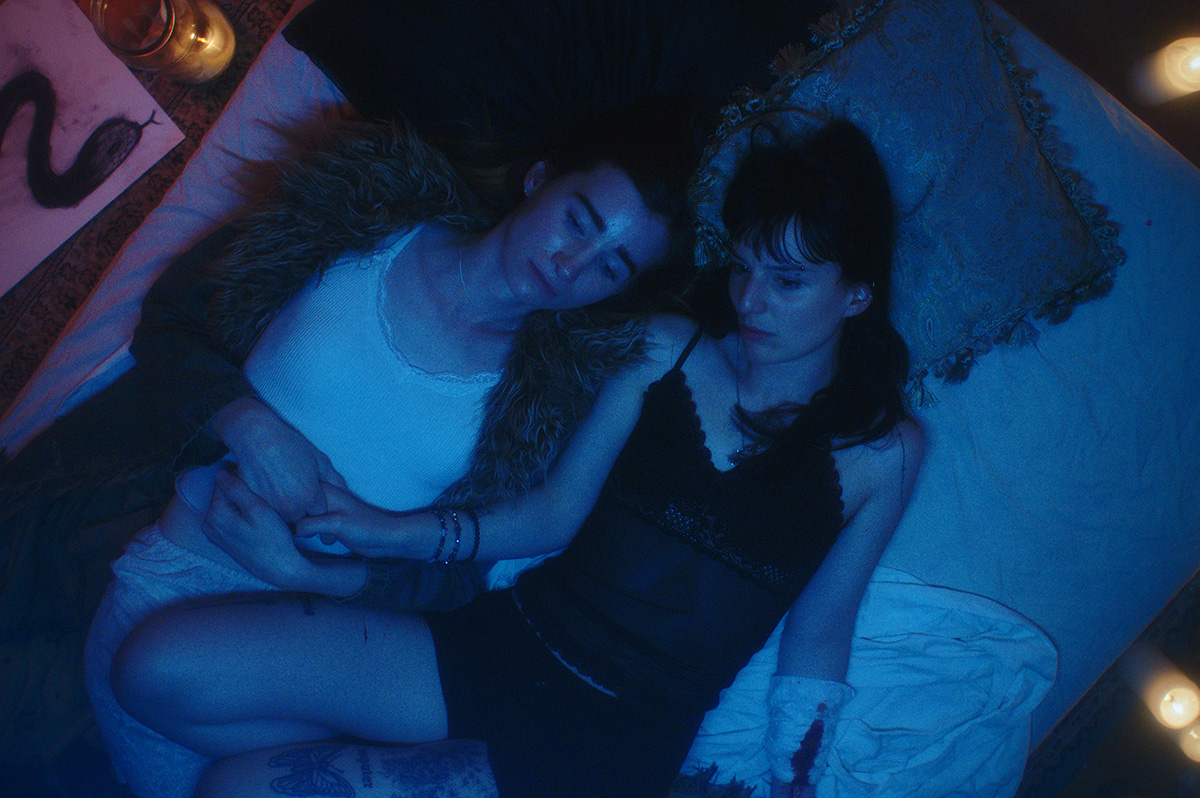
It’s probably no surprise that the last decade or so has seen a “renaissance” in horror cinema. Long underestimated and dismissed by critics and ignored by all the awards bodies as “lowbrow” genre films, horror movies were deemed for generations as unworthy of serious consideration; relegated into the realm of fandom, where generations of young movie fanatics were left to find deeper significance on their own, they there inspired countless future film artists whose creative vision would be shaped by their influence. Add to that the increasing state of existential anxiety that has us living like frogs in a slow-boiling pot, and it seems as if the evolution of horror into what might be our culture’s most resonant form of pop art expression was more or less inevitable all along.
Queer audiences, of course, have always understood that horror provides an ideal vehicle to express the “coded” themes that spring from existence as a stigmatized outsider, and while the rise of the genre as an art form has been fueled by filmmakers from every community, the transgressive influence of queerness – particularly when armed with “camp,” its most surefire means of subversion – has played an undeniable role in building a world where movies like “Sinners” and “Weapons” can finally be lauded at the Oscars for their artistic qualities as well as celebrated for their success at providing paying audiences with a healthy jolt of adrenaline.
Perhaps unsurprisingly, many of the boldest and most biting entries are coming from trans filmmakers like Jane Schoenbrun (“I Saw the TV Glow”) – and like Australian director Alice Maio Mackay, whose new film “The Serpent’s Skin” opened in New York last weekend and expands to Los Angeles this week.
Described in a review from RogerEbert.com as “a kind of ‘Scanners’ for the dolls,” it’s a movie that embraces classic horror tropes within a sensibility that blends candid exploration of trans experience with an obvious love for camp. It centers on twenty-something trans girl Anna (Alexandra McVicker), who escapes the toxic environment of both her dysfunctional household and her conservative hometown by running away to the “Big City” and moving in with her big sister (Charlotte Chimes). On her first night in town, she connects with Danny (Jordan Dulieu), a neighbor (the only “hottie” in the building, according to her sister) who plays guitar in a band and ticks off all her “edgy” boxes, and they have a one-night stand.
The very next day, she starts a new job at a record store, where she connects – through the shared experience of an intense and unexpected incident – with local tattoo artist Gen (Avalon Faust), a young woman she has seen in psychic visions, and who has been likewise drawn to her. The reason? They are both “witches,” born with abilities that give them a potentially deadly power over ordinary humans, and bound together in an ancient supernatural legacy.
It goes without saying that they fall in love; together, they teach and learn from each other as they try to master the mysterious magical gifts they both possess; but when Danny coincidentally books Gen for a tattoo inspired by his earlier “fling” with Anna, an ancient evil is unleashed, leading to a string of horrific attacks in their neighborhood – and forcing them to confront the dark influences within their own traumatic histories which may have conjured this malevolent spirit in the first place.
Confronting the theme of imposed trans “guilt” head on, “Serpent’s Skin” emanates from a softer, gentler place than most horror films, focusing less on scares than on the sense of responsibility which seems naturally to arise just from being “different.” Both McVicker and Faust bring a palpable feeling of weight to their roles, as if their characters are carrying not only their own fate upon their shoulders, but that of the world at large; their performances evoke both the haunted sense of emotional wariness and the heavy sense of responsibility that comes from sharing a layer of awareness that both elevates and isolates them. At the same time, they bring a tender-but-charged eroticism to the sapphic romance at the center of the film, echoing the transgressive and iconic “lesbian noir” genre while replacing the usual amoral cynicism with an imperative toward empathy and social responsibility.
All of this helps to make the film’s heroines relatable, and raises the stakes by investing us not just in the defeat of supernatural evil, but the triumph of love. Yet we can’t help but feel that there’s something lost – a certain edge, perhaps – that might have turned up the heat and given the horror a more palpable bite. Though there are moments of genuine fright, most of the “scary” stuff is campy enough to keep us from taking things too seriously – despite the best efforts of the charismatic Dulieu, who literally sinks his teeth into his portrayal of the possessed version of Danny.
More genuinely disturbing are the movie’s scenes of self-harm, which both underscore and indict the trope of trans “victimhood” while reminding us of the very real fear at the center of many trans lives, especially when lived under the oppression of a mindset that deplores their very existence.
Still, though Mackay’s film may touch on themes of queer and trans existence and build its premise on a kind of magical bond that makes us all “sisters under the skin,” it is mostly constructed as a stylish tribute to the classic thrillers of an earlier age, evoking the psychological edge of directors like Hitchcock and DePalma while embracing the lurid “shock value” of the B-movie horror that shaped the vision of a modern generation of filmmakers who grew up watching it – and even if it never quite delivers the kind of scares that linger in our minds as we try to go to sleep at night, it makes up for the shortfall with a smart, sensitive, and savvy script and a rare depiction of trans/lesbian love that wins us over with chemistry, emotional intelligence, and enviable solidarity.
What makes “The Serpent’s Skin” feel particularly remarkable is that it comes from a 21-year-old filmmaker. Mackey, who built the foundation of her career behind the camera with a series of low-budget horror shorts in her teens, has already made an impact with movies ranging from the vampire horror comedy “So Vam” (released when she was 16) to the horror musical “Satanic Panic” and the queer holiday shockfest “Carnage for Christmas.” With her latest effort, she deploys a confidence and a style that encompasses both the deep psychological nuance and guilty-pleasure thrills of the genre, rendered in an aesthetic that is grounded in intimate queer authenticity – yet remains daring enough to take detours into the surreal and psychedelic without apology.
It’s the kind of movie that feels like a breakthrough, especially in an era when it feels especially urgent for trans stories to be told.
Movies
The Oscar-losing performance that’s too good to miss
‘If I Had Legs I’d Kick You’ now streaming
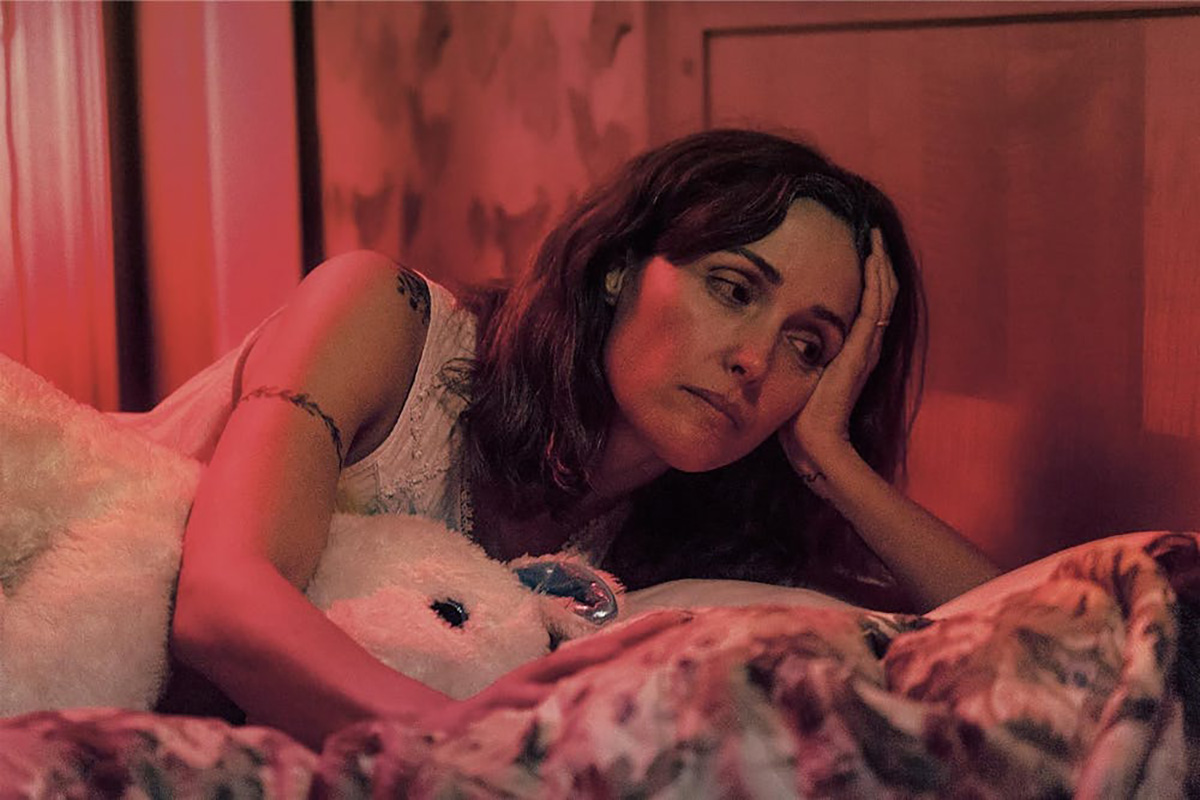
Now that Oscar season is officially over, most movie lovers are ready to move on and start looking ahead to the upcoming crop of films for the standouts that might be contenders for the 2026 awards race.
Even so, 2025 was a year with a particularly excellent slate of releases: Ryan Coogler’s “Sinners” and Paul Thomas Anderson’s “One Battle After Another,” which became rivals for the Best Picture slot as well as for total number of wins for the year, along with acclaimed odds-on favorites like “Hamnet,” with its showcase performance by Best Actress winner Jessie Buckley, and “Weapons,” with its instantly iconic turn by Best Supporting Actress Amy Madigan.
But while these high-profile titles may have garnered the most attention (and viewership), there were plenty of lesser-seen contenders that, for many audiences, might have slipped under the radar. So while we wait for the arrival of this summer’s hopeful blockbusters and the “prestige” cinema that tends to come in the last quarter of the year, it’s worth taking a look back at some of the movies that may have come up short in the quest for Oscar gold, but that nevertheless deserve a place on any film buff’s “must-see” list; one of the most essential among them is “If I Had Legs I’d Kick You,” which earned a Best Actress Oscar nod for Rose Byrne. A festival hit that premiered at Sundance and went on to win international honors – for both Byrne and filmmaker Jane Bronstein – from other film festivals and critics’ organizations (including the Dorian Awards, presented by GALECA, the queer critics association), it only received a brief theatrical release in October of last year, so it’s one of those Academy Award contenders that most people who weren’t voters on the “FYC” screener list for the Oscars had limited opportunity to see. Now, it’s streaming on HBO Max.
Written and directed by Bronstein, it’s not the kind of film that will ever be a “popular” success. Surreal, tense, disorienting, and loaded with trigger-point subject matter that evokes the divisive emotional biases inherent in its premise, it’s an unsettling experience at best, and more likely to be an alienating one for any viewer who comes to it unprepared.
Byrne stars as Linda, a psychotherapist who juggles a busy practice with the demands of being mother to a child with severe health issues; her daughter (Delaney Quinn) suffers from a pediatric feeding disorder and must take her nutrition through a tube, requiring constant supervision and ongoing medical therapy – and she’s not polite about it, either. Seemingly using her condition as an excuse to be coddled, the child is uncooperative with her treatment plan and makes excessive demands on her mother’s attention, and the girl’s father (Christian Slater) – who spends weeks away as captain of a cruise ship – expects Linda to manage the situation on the home front while offering little more than criticism and recriminations over the phone.
Things are made even more stressful when the ceiling collapses in their apartment, requiring mother and child to move to a seedy beachside motel. Understandably overwhelmed, Linda turns increasingly toward escape, mostly through avoidance and alcohol; she finds her own inner conflicts reflected by her clients – particularly a new mother (Danielle Macdonald) struggling with extreme postpartum anxiety – and her therapy sessions with a colleague (Conan O’Brien, in a brilliantly effective piece of against-type casting) threaten to cross ethical and professional boundaries. Growing ever more isolated, she eventually finds a thread of potential connection in the motel’s sympathetic superintendent (A$AP Rocky) – but with her own mental state growing ever more muddled and her daughter’s health challenges on the verge of becoming a lifelong burden, she finds herself drawn toward an unthinkable solution to her dilemma.
With its cryptic title – which sounds like the punchline to a macabre joke and evokes expectations of “body horror” creepiness – and its dreamlike, disjointed approach, “If I Had Legs I’d Kick You” feels like a dark comedic thriller from the outset, but few viewers are likely to get many laughs from it. Too raw to be campy and too cold to invite our compassion, it’s a film that dwells in an uncomfortable zone where we are too mortified to be moved and too appalled to look away. Though it’s technically a drama, Bronstein presents it as a horror story, of sorts, driven by psychological rather than supernatural forces, and builds it on an uneasy structure that teases us with the anticipation of grotesqueries to come while forcing us to identify with a character whose lack of (presumably) universal parental instinct feels transgressive in a way that is somehow even more disquieting than the gore and mutilation we imagine might be coming at any moment.
And we do imagine it, even expect it to come, which is as much to do with the near-oppressive claustrophobia that results from Bronstein’s heavy use of close-ups as it does with the hint of impending violence that pervades the psychological tension. It’s not just that our frame of vision is kept tight and limited; her tactic keeps us uncertain of what’s going on outside the edges, creating a sense of something unseen lurking just beyond our view. Yet it also helps to put us into Linda’s state of mind; for almost the entire film, we never see the face of her daughter – nor do we ever know the child’s name – and her husband is just a strident voice on the other end of a phone call. The effect keeps us feeling as trapped as she does, boxing us squarely into her dissociated, depressed, and desperate existence with nothing but resentment and dread on which to focus.
Anchoring it all, of course, is Byrne’s remarkable performance. Vivid, vulnerable, and painfully real, it’s the centerpiece of the film, the part that emerges as greater than the whole; and while Oscar may have passed her over, she delivers a star turn for the ages and gives profound voice to a dark side of feminine experience that is rarely allowed to be aired.
That, of course, is the key to Bronstein’s seeming purpose; inspired by her own struggles with postpartum depression, her film feels like both a confession and an exorcism, a parable in which the expectations of unconditional motherly love fall into question, and the burden placed on a woman to subjugate her own existence in service of a child – and a seemingly ungrateful one, at that – becomes a powerful exploration of feminist themes. It’s an exploration that might go too far, for some, but it expresses a truth that those of us who are not mothers (and many of us who are) might be loath to acknowledge.
Uncomfortable though it may be, Bronstein’s movie draws us in and persuades our emotional investment despite its difficult and unlikable characters, thanks to her star player and her layered, puzzle-like screenplay, which captures Linda’s scattered psyche and warped perceptions with an approach that creates structure through fragments, clues and suggestions; and while it may not land quite as squarely as we might hope, in the end, its bold and discomforting style – coupled with the career-topping performance at its center – are more than enough reason to catch this Oscar “also-ran” before putting this year’s award season behind you once and for all.

An effort to increase the number of psychiatrists of color

Calendar: April 10-16

BLUF leather social set for April 10 in Rehoboth

Celebrations of life planned for Sean Bartel

The ‘X’ returns to court

Trump budget would codify expanded global gag rule

Police mental health struggles gain growing attention

Man faces first S.C. ‘hate intimidation’ charge

Cuba under pressure and without answers