News
Senate Dems urge DOJ to reinstate trans protections under Title VII
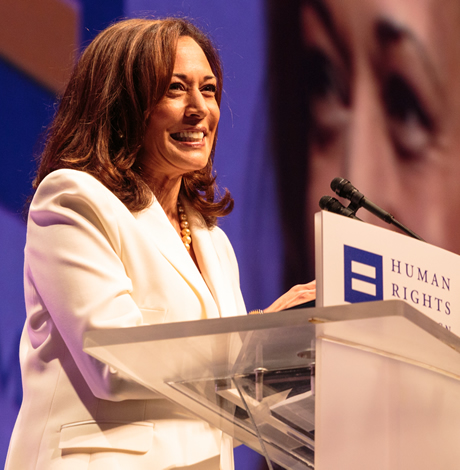
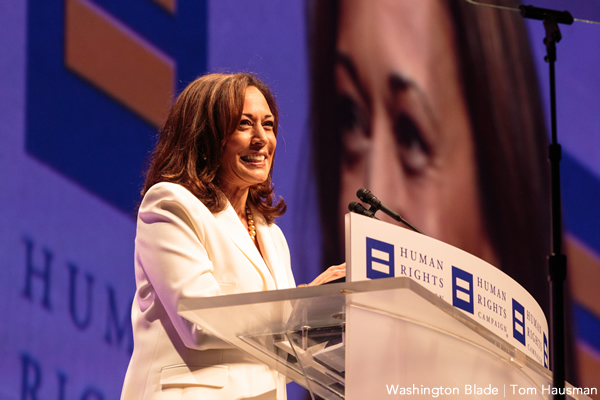
Sen. Kamala Harris is leading a group of 44 Senate Democrats in urging DOJ to reinstate trans protections under Title VII. (Washington Blade file photo by Tom Hausman)
A group of 44 Senate Democrats led by Sens. Kamala Harris (D-Calif.), Patty Murray (D-Wash.) and Al Franken (D-Minn.) urged the Justice Department on Thursday to reinstate its interpretation of existing civil rights law to prohibit anti-transgender discrimination.
In a letter dated Nov. 2, the Senate Democrats insist Title VII of the Civil Rights Act of 1964, which prohibits sex discrimination in the workplace, also applies to discrimination against transgender workers.
“The Civil Rights Division, charged with enforcement of Title VII of the Civil Rights Act of 1964, states its purpose is ‘to uphold the civil and constitutional rights of all Americans, particularly some of the most vulnerable members of our society,'” the letter says. “Transgender individuals are among the most vulnerable Americans. Your department would best serve its mission by clarifying that employees should be hired or fired based on their ability to do the job — not because of their gender identity.”
The letter urges reversal of an Oct. 4 memo signed by the U.S Attorney General Jeff Sessions asserting Title VII “does not prohibit discrimination based on gender identity per se.”
As the letter points out, the Sessions memo reverses an earlier memo former U.S. Attorney General Eric Holder issued in 2014 under the Obama administration affirming Title VII “encompasses discrimination based on gender identity, including transgender status.”
Also as noted in the letter, Sessions’ memo defies interpretations of Title VII by numerous courts and the U.S. Equal Employment Opportunity Commission. Four federal appellate courts — the First, Sixth, Ninth and Eleventh circuit courts of appeals — have determined employment discrimination against transgender people is barred under Title VII.
“This most recent action by the department to roll back protections for transgender persons is anathema to the Civil Rights Act’s purpose,” the letter says. “When President Johnson signed the act into law on July 2, 1964, he wisely observed, ‘those who founded our country knew that freedom would be secure only if each generation fought to renew and enlarge its meaning.’ Your department has repeatedly undermined those very words.”
In addition to seeking a reversal of the interpretation of the Title VII, the letter calls on the Justice Department to disclose a list of all complaints of gender identity discrimination it has investigated under the past year. As part of this list, the letter asks for the status of each cases whether the Justice Department intends to resolve or simply close those open investigations.
The U.S. Justice Department didn’t immediately respond to the Washington Blade’s request to comment on the letter.




Rehoboth Beach
BLUF leather social set for April 10 in Rehoboth
Attendees encouraged to wear appropriate gear

Diego’s in Rehoboth Beach hosts a monthly leather happy hour. April’s edition is scheduled for Friday, April 10, 5-7 p.m. Attendees are encouraged to wear appropriate gear. The event is billed as an official event of BLUF, the free community group for men interested in leather. After happy hour, the attendees are encouraged to reconvene at Local Bootlegging Company for dinner, which allows cigar smoking. There’s no cover charge for either event.
District of Columbia
Celebrations of life planned for Sean Bartel
Two memorial events scheduled in D.C.

Two celebrations of life are planned for Sean Christopher Bartel, 48, who was found deceased on a hiking trail in Argentina on or around March 15. Bartel began his career as a television news reporter and news anchor at stations in Louisville, Ky., and Evansville, Ind., before serving as Senior Video Producer for the D.C.-based International Brotherhood of Electrical Workers union from 2013 to 2024.
A memorial gathering is planned for Friday, April 10, 11:30 a.m.-1:30 p.m. at the IBEW International Office (900 7th St., N.W.), according to a statement by the DC Gay Flag Football League, where Bartel was a longtime member. A celebration of life is planned that same evening, 6-8 p.m. at Trade (1410 14th St., N.W.).
Puerto Rico
The ‘X’ returns to court
1st Circuit hears case over legal recognition of nonbinary Puerto Ricans

Eight months ago, I wrote about this issue at a time when it had not yet reached the judicial level it faces today. Back then, the conversation moved through administrative decisions, public debate, and political resistance. It was unresolved, but it had not yet reached this point.
That has now changed.
Lambda Legal appeared before the 1st U.S. Court of Appeals in Boston, urging the court to uphold a lower court ruling that requires the government of Puerto Rico to issue birth certificates that accurately reflect the identities of nonbinary individuals. The appeal follows a district court decision that found the denial of such recognition to be a violation of the U.S. Constitution.
This marks a turning point. The issue is no longer theoretical. A court has already determined that unequal treatment exists.
The argument presented by the plaintiffs is grounded in Puerto Rico’s own legal framework. Identity birth certificates are not static historical records. They are functional documents used in everyday life. They are required to access employment, education, and essential services. Their purpose is practical, not symbolic.
Within that framework, the exclusion of nonbinary individuals does not stem from a legal limitation. Puerto Rico already allows gender marker corrections on birth certificates for transgender individuals under the precedent established in Arroyo Gonzalez v. Rosselló Nevares. In addition, the current Civil Code recognizes the existence of identity documents that reflect a person’s lived identity beyond the original birth record.
The issue lies in how the law is applied.
Recognition is granted within specific categories, while those who do not identify within that binary structure remain excluded. That exclusion is now at the center of this case.
Lambda Legal’s position is straightforward. Requiring individuals to carry documents that do not reflect who they are forces them into misrepresentation in essential aspects of daily life. This creates practical barriers, exposes them to scrutiny, and places them in a constant state of vulnerability.
The plaintiffs, who were born in Puerto Rico, have made clear that access to accurate identification is not symbolic. It is a basic condition for moving through the world without contradiction imposed by the state.
The fact that this case is now being addressed in the federal court system adds another layer of significance. This is not a pending policy discussion or a legislative proposal. It is a constitutional question. The analysis is not about political preference, but about rights and equal protection under the law.
This case does not exist in isolation.
It unfolds within a broader context in which debates over identity and rights have increasingly been shaped by the growing influence of conservative perspectives in public policy, both in the United States and in Puerto Rico. At the local level, this influence has been reflected in legislative discussions where religious arguments have begun to intersect with decisions that should be grounded in constitutional principles. That intersection creates tension around the separation of church and state and has direct consequences for access to rights.
Recognizing this context is not an attack on faith or religious practice. It is an acknowledgment that when certain perspectives move into the realm of public authority, they can shape outcomes that affect specific communities.
From within Puerto Rico, this is not a distant debate. It is a lived reality. It is present in the difficulty of presenting identification that does not match one’s identity, and in the consequences that follow in workplaces, schools, and government spaces.
The progression of this case introduces the possibility of change within the applicable legal framework. Not because it resolves every tension surrounding the issue, but because it establishes a legal examination of a practice that has long operated under exclusion.
Eight months ago, the conversation centered on ongoing developments. Today, there is already a judicial finding that identifies a violation of rights. What remains is whether that finding will be upheld on appeal.
That process does not guarantee an immediate outcome, but it shifts the ground.
The debate is no longer theoretical.
It is now before the courts.

Calendar: April 10-16

BLUF leather social set for April 10 in Rehoboth

Celebrations of life planned for Sean Bartel

The ‘X’ returns to court

LGBTQ community explores arming up during heated political times

Risking it all for love during World War II

D.C. is the place for the Democratic Socialists of America

PHOTOS: The Bonnet Ball

Key lifestyle changes can help patients cope with diabetes