Movies
AFI Docs fest runs June 13-17 with strong LGBT content
Alexander McQueen doc, trans servicemembers piece on 2018 spate


A scene from ’Transmilitary’ shows servicemembers en route to the Pentagon. (Photo courtesy AFI Docs)
An Arkansas town with a passion play and a tight-knit gay community, a slam poetry team, a glimpse at the life of designer Alexander McQueen. These are just a few of the gay highlights and themes in this year’s AFI Docs Film Festival (June 13-17; venues vary).
“The 2018 slate of films showcases an exceptional diversity of perspectives,” Michael Lumpkin, the (gay) director of AFI Festivals, says. “This year’s festival takes us around and beyond the world, each film telling a story that shares a moment of the human experience.”
One of the most interesting LGBT-themed films in the festival (afi.com/afidocs) is “Alone in the Game,” which reveals how a new generation of queer and transgender athletes are scoring victories on and off the field by standing up for their rights.
In “Don’t Be Nice,” director Max Powers follows the diverse Bowery Slam Poetry Team as they mine their feelings and personal experiences about race, sexuality, gender and popular culture to craft poems for a national competition.
“The Gospel of Eureka” is an amazing portrait of a tiny town in Arkansas that is home to both an annual live-action Passion Play and a tight-knit gay community. By embracing the values of tolerance, love and inclusion, the residents maintain a peaceful coexistence between two divergent groups.
“McQueen” is a stunning and intimate portrait of the openly gay British fashion designer Alexander McQueen who was known for his exquisite and strikingly original clothes and his legendary runway shows — theatrical spectacles influenced by contemporary art, theater and photography.
The fascinating “This One’s for the Ladies” dives into an unusual subculture in Newark, N.J., where a group of African-American women throw weekly underground parties with male exotic dancers. The film boldly explores the sexual and social identity of contemporary black America through interviews with the women and men who find love and community in these weekly gatherings.
Directors Gabriel Silverman and Fiona Dawson make their feature documentary debut with “Transmilitary” which follows four servicemembers who come out as transgender to top officials at the Pentagon — a brave move that puts their military careers in jeopardy and shows that the struggle for equality that is more relevant than ever.
According to director Michael Sparaga, “United We Fan” follows the history and evolution of fan campaigns to save beloved TV shows from cancellation. The film includes interviews with fans, stars, creators and even network executives. One of the shows featured was about a young lesbian whose favorite character will killed off in a prime time show in what has become known as the “dead lesbian trope.”
Beyond these queer films, some of the other great documentaries that will screen include “Love Gilda” about the pioneering female comedian Gilda Radner (of “Roseanne Roseannadanna/SNL fame); “Studio 54” about the rise and fall of the infamous New York nightclub; “Charm City” about attempts to reduce the soaring rates of violence in Baltimore; “Hesburgh” about social justice activist Rev. Theodore Hesburgh; and “Bathtubs over Broadway” about the wacky productions commissioned by companies to celebrate their products at corporate conventions. In addition, “Dark Money” by transgender director Kimberly Reed explores the hidden role of big money in contemporary American politics.
The festival also includes the AFI DOCS Forum, a slate of networking and professional development events, and the VR Showcase, which allows viewers to immerse themselves in a wide-ranging selection of virtual reality experiences. On Saturday, June 16 there will also be a free “Conversation with Chuck Todd and Ann Hornaday” about whether documentaries are “Journalism or Art.”
AFI DOCS 2018 will feature 92 films exploring the remarkable people and complicated issues that are shaping our world. No matter how outrageous some of the stories may seem, it’s helpful to remember the festival’s tagline, “You can’t make this stuff up.”

Alexander McQueen as seen in ‘McQueen,’ a doc about the openly gay British fashion designer. (Photo by Ann Ray, courtesy Bleeker Street)





Movies
Epic ‘La bola negra’ delivers powerful romance for the ages
The must-see queer film of the year

It’s rare for a film reviewer to feel as if they’re being gifted – by the accidental fortune of being alive in a particular time and present in a particular place – the opportunity to see a future cinema classic before it becomes one.
I’ve certainly had the experience of seeing such movies; I’ve been around long enough to see a few of them embraced as classics as years went by, but I didn’t foresee it at the time. I may have had a feeling about a few of them, and occasionally I might even have been right, but never have I known, as I watched it, that it would become one.
Never, that is, until seeing “La bola negra.”
It’s not as if I went into it expecting it to be anything less than excellent. After its glowing premiere at Cannes in May, where it took the festival’s “Best Director” prize for Javier Ambrossi and Javier Calvo (known collaboratively as “Los Javis”), the buzz began to spread; it won further accolades throughout the festival circuit, the major studios had a bidding war over its American release rights, and by the time fall arrived there were already people in the cinematic web-osphere floating the possibility that it could win Oscars. Even so, I have learned from experience to be wary of “buzz,” and I approached the film with a touch of reserved skepticism.
I dropped that pose only a few minutes into the opening sequence. Immersed in a visceral experience of the Spanish Civil War and forced to confront the cold absurdities of war itself, I had no space available for such intellectual baggage. Instead, I found myself drawn – almost without noticing it – into a multi-generational saga constructed like a puzzle, expressed with passion and style, and executed with the kind of grandeur that conjures comparisons to some of cinema’s greatest epics.
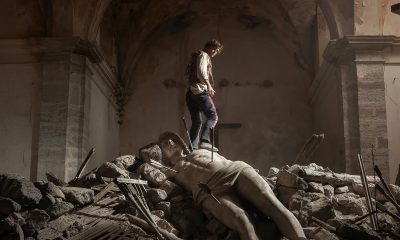
Inspired – and haunted – by an unfinished play from queer Spanish poet, playwright, theater artist, surrealist, and revolutionary Federico García Lorca, it tells a sweeping story that transverses three timelines – 1932, 1937, and 2017 – to intertwine the lives of three queer men into a fictional exploration of queer experience and its omission (or erasure) from history, where it can often be gleaned only through the hidden implications of secret lives that ended long ago.
In one of them, the young scion of a wealthy family (Milo Quifes) is “black-balled” (hence the title) from membership to a prestigious social club, rejected over rumors of his homosexuality, and is forced to choose between denying his own identity or leaving his family in disgrace for a life of free expression in the theater. In the second, Sebastián, a young Nationalist soldier (Guitarricadelafuente) falls in love with Rafael, a wounded Republican prisoner (Miguel Bernardeau) he has been assigned to guard, awakened to his own homosexual desires in an impossible scenario where the notion of a “happy ending” is all but unimaginable. In the third, a disillusioned queer historian (Carlos González) is informed of an inheritance from his estranged grandfather, leading him to discover a link in his family’s past that has been obscured by secrets, trauma, and resentment. In each of them, a grounded humanism becomes the connecting thread, and it’s impossible not to feel the pull of emotional resonance as the connections grow increasingly clear. Throughout these interwoven narratives, we confront the inevitable recognition that the history of queer experience is something that must be unearthed, whether in honor of the lives of those who came before us or in celebration of having survived in spite of it all.
Ambrossi and Calvo – along with Alberto Conejero, with whom they co-wrote the screenplay, expanding his play “La piedra oscura” into a larger narrative that merges it with the surviving fragments of Lorca’s play to create an imaginative work of speculative fiction – accomplish an inventive feat of cinema, building something that feels almost mystical in scope from a conceit built on the real-life mysteries surrounding Lorca’s death (he was reportedly assassinated by Nationalist forces in 1936 but his body was never found) and expanded into an unforgettable epic romance, which confronts the monstrosities of fascist oppression and the madness of warfare while celebrating the resilience of queer truth, which endures, somehow, “between the lines” and transcends the horror and tragedy that surround it. Combining a flowing, florid, and fantastical sensibility with an unvarnished realism that refuses to soften its sting for the sake of emotional comfort, one might almost call it “bittersweet” if that term were not inadequate to encompass the symphonic heights toward which it successfully aspires through its stubborn belief in the long-reaching arm of redemption.
They also create a visually stunning masterpiece of cinematic art, blending the harsh realities of life under the turmoil of militarily-enforced oppression with the elegant poetry of resilience to build a film that invites favorable comparison to the most beloved epic films in our history, from the expansive-but-intimate humanity of “Lawrence of Arabia” (also, by the way, a story of queer experience) to the surreal darkness of “Apocalypse Now,” with cinematographer Gris Jordana delivering a movie that feels “vintage” yet distinguishes itself as a distinctly modern – and anti-nostalgic – reinvention of stylistic imagery, filling its margins with echoes of the past while remaining firmly rooted in a contemporary mindset. Its disparate intertwined narratives are united by a passionate commitment to a heritage, both artistic and sociological, that exists as a generational lifeline built on imagery, association, and emotional wisdom.
Naturally, the ensemble cast provides a crucial element in making it all work. As the film’s romantic center, Guitarricadelafuente (an actor/musician who rose to Spanish fame by self-posting videos during Covid) and Bernardeau are heartbreakingly tender and infinitely relatable to any queer person who has ever had to navigate the difficulties of attraction in a circumstance of enforced distance, and Quifes captures the kind of fatalistic self-determination that has probably fueled queer rebellion since it first became “a thing.” Spanish superstar Penelope Cruz lends invaluable support as a” cupletista” performer who introduces Sebastián to the underground world of campy queer performance, and González delivers the perfect mix of resigned cynicism and reluctant hope as the modern historian, while Glenn Close provides stolid gravitas as an expert on Garcia Lorca who guides him toward a final revelation.
It’s worth mentioning that a handful of critics have been put off by the film’s romanticism, complained about its ”melodramatic” emotions, or quibbled about its historical re-imagination of Lorca and his legacy to brand it as disingenuous. Respectfully, I disagree. By the end of this remarkable film, I, as a queer man, felt not only as if I had been “seen” and acknowledged, but as if my own life was somehow part of its story.
I’m willing to wager that millions of other queer moviegoers will feel the same way, so I’m calling “La bola negra” the must-see queer film of the year – and yes, I could be wrong (I have been so many times before), but I’m fairly certain that you, like me, will recognize an instant classic when you see one.
Movies
‘Wicker’ delivers a delicious dish of macabre irony
Shrewd messaging under guise of fantasy makes us willing to believe
What if there were magic in the world, and it could give us the power to attain the things we long for in this life?
That’s the question we are asked to contemplate in “Wicker,” the new film from co-writer/directors Alex Huston Fischer and Eleanor Wilson, which adapts Ursula Witts’ short story “The Wicker Husband” into a feature-length fable; transporting us to the timeless “olden days” of fairy tales and fantasies, it’s a tale of longing, love, and the power of intention, set in a small village on the edge of the forest where an aging Fisherwoman (Olivia Colman) sells her daily catch to the townsfolk who ostracize her for her lowly trade and the fishy odors that go along with it.
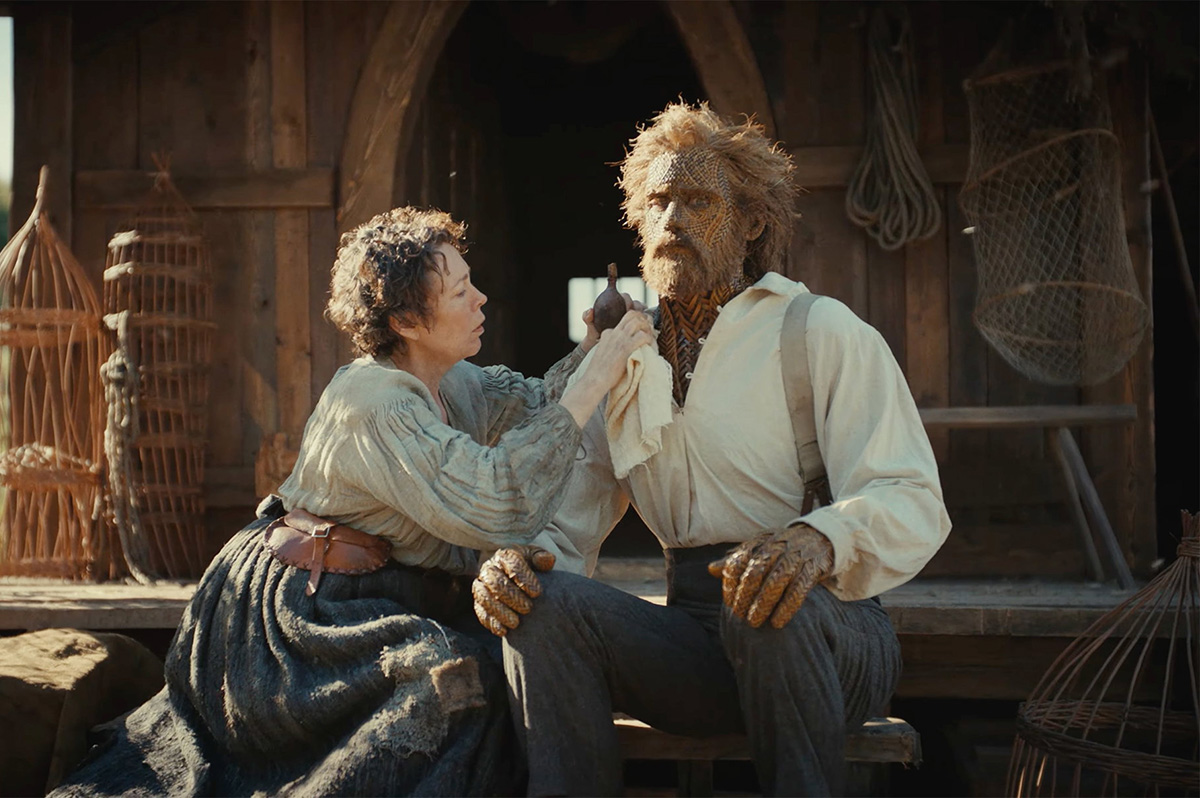
Tired of her lonely existence, the Fisherwoman goes to the town’s Basket Maker (Peter Dinklage) — another community outsider, known for his skill and for a certain “witchy” ability to endow his creations with purpose — and pays him to make her a husband. He delivers on the deal, providing her with a man made of wicker (Alexander Skarsgård) who claims that he exists solely to love her. The arrangement quickly turns out to be better than she imagined, bringing not just companionship but comfort and joy into her once-isolated life. When the townspeople meet the Wicker Husband, however, they are unsettled by his presence; his care and devotion to the Fisherwoman allows her to blossom, and their happiness begins to spark jealousy and dissatisfaction among the other wives and husbands in the town. Unhappy with the change in the status quo, the Tailor’s Wife (Elizabeth Debicki), the de facto keeper of the town’s social order, sets out to eliminate the problem, even though she is herself unhappy in her marriage. She sets about to correct the imbalance by sowing the seeds of mistrust.
Shot in a lush and evocative style by cinematographer Lol Crawley, “Wicker” succeeds in capturing the primal mysticism of nature that pervades in so many of the folk tales and forest myths of the pagan past, as well as satisfying more “sophisticated” modern tastes with a sense of self-aware irony — and a considerable amount of whimsical-yet-bawdy imagination. Yet the “weird” ways of a bygone age are granted new potency by tapping into contemporary awareness of gender and social inequality, while a subtle focus on the real-life “magical” power of words implies their ability to alter our perceptions and influence our actions.
Indeed, words (or rather, the power of words) are a key element in the story’s darkly humorous parable. Language — and the intention with which it is used — takes on a decidedly important role in the story; from the simple sincerity of the Wicker Husband’s stolid declarations of adoration toward his wife to the tactical deployment of misinformation in an effort to assert power over non-conformity, and even to the subtle conveyance of nuance between the lines to reveal key elements that otherwise go unspoken. Spoiler alert: queer audiences can score bonus points by counting the spoken clues that Dinklage’s Basket Maker — who, with his occult knowledge and mysterious talents, serves as the architect of the entire narrative — is gay.
None of which is to say that “Wicker” comes off as being “talky” or depends merely on words to convey its story; on the contrary, Fischer and Wilson provide an immersive, fully-realized world for the setting of their Brothers Grimm-ish fantasy, along with a strong sense of visual storytelling that conveys a great deal without relying on words at all. Sometimes, it’s an economy of language that makes the strongest impact, understatement that delivers the deepest meaning, and silence that speaks volumes, and this is a film that knows how to utilize all those approaches; the result is a “less is more” simplicity that governs the proceedings and relies on the skills of the performers, who convey unspoken complexities through dialogue that feels deceptively simple.
In fact, it could be argued that the greatest strength of “Wicker” comes from its cast, who from bottom to top capture the rarified combination of tones — the inscrutable wisdom, the fantastical whimsy, the earthy humor, and the observational candor — in its presentation of human social mechanisms, even through its fairy-tale lens, to provide a smart, winning, and unexpectedly profound piece of entertaining cinematic myth-making. Colman is, as always, endearing in her down-to-earth willingness to fully inhabit her character, giving the Fisherwoman’s transformation from curmudgeonly misanthrope to fully-actualized woman a tangibly authentic ring; Skarsgård, his hunky, handsome form coming through despite the crafty cinema magic that weaves it under a wooden skin, has never been more effective nor more romantically appealing; Dinklage manifests his charming trickster with a kind of droll integrity as the Basket Weaver, and the remainder of the cast embody the frailty and foibles of the various townspeople with as much compassion as possible in a story that is ultimately about the tendency of human society to conform with — and enforce — an unbalanced social “norm” over its own better nature.
In the end, “Wicker” resolves with the kind of darkly ironic “comeuppance” that feels apropos of the Halloween season, with sly magic giving the townsfolk getting exactly what they deserve in a deliciously ironic — and wickedly macabre — reversal of fortune, dictated by karma itself (with a little help from the Basket Maker). It becomes a cautionary tale about being careful what we wish for, tied up with a touch of modern savvy that drives the point home even more effectively.
It’s smart, infused with the kind of magic that feels natural instead of supernatural, and it reminds us that human society is never to be entirely trusted. For us, that makes “Wicker” one of the most delicious surprises of the film year so far, and earns it a hearty recommendation for anyone who enjoys a little Wiccan magic with their romantic fantasies, if only for the sake of feeling that there is an order to things that keeps us all in balance.
Whether or not that’s actually true, it’s the belief itself that makes it feel that way — and “Wicker,” with all its shrewd-and-subtle messaging, makes us willing to believe.
Movies
With exquisite 4K restoration, ‘The Devils’ finally gets its due
The only devils are those who want to ‘Make France Catholic Again’
It’s rare for a movie that was made over a half-century before to somehow become one of the most anticipated film releases of the year, but thanks to Ken Russell’s “The Devils,” we know that it does happen.
It’s true that Russell’s legendarily controversial 1971 period horror drama might not be a familiar title to most mainstream movie-goers these days, but to the cinephile crowd, it’s something approaching the Holy Grail. The dramatization of a real-life 1634 incident that took place in the French city of Loudun, it crossed boundaries and broke taboos with its depictions of grotesque violence, unfettered nudity, and “blasphemous” imagery – so much so that objections from UK censors led Warner Bros. (which had financed the British production of the film) to remove several of its most provocative scenes before release. Though Russell was riding the wave of a successful career that had resulted in worldwide renown, he was given no say in the matter, and the edited version – which was still widely banned in parts of the UK and other countries, and released in the U.S. with even further cuts – was lambasted by most critics as over-the-top, sensationalized, or even “obscene.”
Even so, there were many critics and viewers alike who recognized the daring vision behind all that on-screen depravity; through the years, calls for the un-edited “director’s cut” of the film began to grow as various other truncated versions continued to circulate, gaining new fans with each new generation of movie buffs. Russell himself, before his death in 2011, created a restored print of the version he had intended, but Warner Bros. refused to allow its distribution.
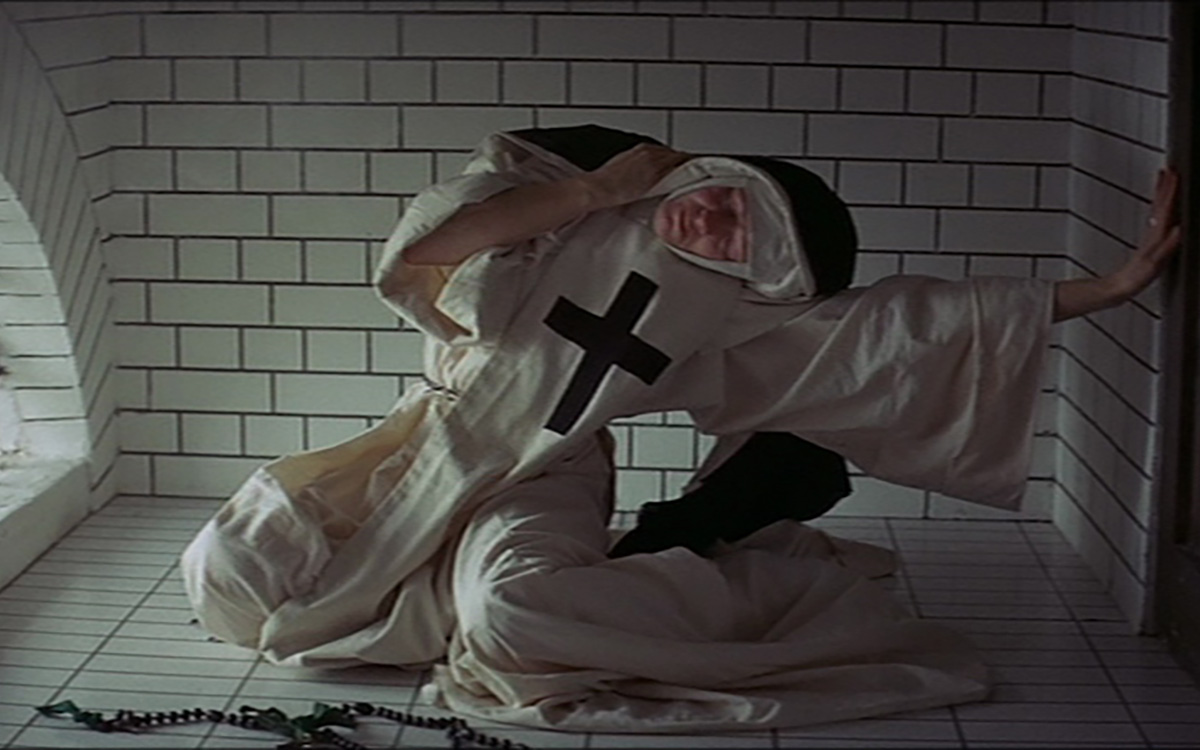
Now, the seemingly repentant studio – under the auspices of its newly branded Warner Clockwork label – has finally come around, and “The Devils” has returned with a newly restored 4K cut (created directly from the film’s original camera negatives) that not only rejuvenates its visuals – such as the brilliance of the visual design, dominated by the oppressively white architecture of Loudun as designed by future pioneering queer filmmaker Derek Jarman – but restores the material that was cut; it reveals the brilliance of a film that had, until now, felt disjointed despite its obvious promise – and the timing could not be more perfect, because it’s also a film that feels perfect for our time.
Full of superb performances and an immersive sense of period oppression, it tells the story of Urbain Grandier (played by Oliver Reed, here at the peak of his brooding-but-charismatic appeal after a series of high-profile hits), a high-ranking local priest who, as de facto leader of his town, stood up against the French government – then controlled by an alliance between aristocratic royalty and the powerful church – in its ongoing effort to purge the kingdom of Protestants and restore Catholic rule over France during the Huguenot Wars of the 17th century. Proud, rational, and heretical in his beliefs (especially around sex), Grandier is widely known for his affairs with noblewomen of the town, and rumors of his beauty and sexual prowess spread even into the cloistered halls of the town’s convent, where the Mother Superior, hunchbacked Sister Jeanne (Vanessa Redgrave), is overwhelmed with lustful thoughts about him. Consumed by jealousy when she learns of his secret (and technically illegal) marriage to another woman, she accuses him of making a pact with the Devil and causing the demonic possession of herself and many of her nuns – a claim which puts him in the crosshairs of his political enemies in the larger world, where ambitious Cardinal Richelieu (Christopher Logue) has dreams of imposing Catholic rule over France by consolidating the church with the government of frivolous King Louis XIII (Graham Armitage). Determined to stand firm with his conscience against the accusations against him, Grandier endures a “show trial” that becomes more public spectacle than justice, with the supposedly possessed nuns (and other opportunistic denizens of the town) indulging in orgiastic demonstrations of their afflictions before the court. Ultimately convicted and sentenced to be burned at the stake, he becomes (spoiler alert) a martyr for enlightenment in the most horrific way imaginable, and his young bride (Gemma Jones) is left to wander the macabre no-man’s land wrought by Theocratic Nationalism on her own as the final credits role.
It’s a pretty bleak picture, and that bleakness has nothing to do with the excesses we’ve seen before it — the performative histrionics of the possessed nuns or the feverish sexually repressed fantasies of Sister Jeanne, or even the callous brutality of the ruling authority – personified not only by Armitage’s brilliantly vapid Louis XIII, a fey and foppish hedonist who opens the film with a macabrely campy ballet depicting the birth of Venus (played by himself), but by the “enforcers” tasked with carrying out his will, like Dudley Sutton’s callously officious Baron de Laubardemont and Michael Gothard’s gleefully sadistic chief “witch hunter,” Father Pierre Barre, who might easily be a popular conservative influencer on TikTok today.
Nor does the film’s sense of ominous dread come from the trappings of excess and occultism that surround Grandier’s ordeal. Yes, the imagery is outrageous, and aggressively in-your-face; there are scenes of explicit nudity, and orgiastic sex, of rape, torture, the ravages of disease and sickening violence, all delivered with a blood-drenched relish that feels shocking even today, and it all culminates in a horrific finale that’s sure to leave you with nightmares for at least a few days afterward; the real horror comes from recognizing the patterns at work as Grandier attempts to protect his town and preserve its independence from the forces of theocratic autocracy, because at this point they have become all too shockingly familiar.
It’s a frank depiction of political corruption, a candid examination of the tactics of fascism (yes, THAT word) in a true story that takes place centuries before the term was ever coined. It explores the ease with which mass hysteria can be created among the ignorant, brainwashed, and attention-starved, and the cruelty of mankind upon itself under the flimsy pretense of ideology, all in the bald-faced pursuit of power and control. In 2026, all of that feels much more disturbing than any of the supposed “supernatural” horrors of which Grandier is accused. In the end, the only devils in “The Devils” are the human ones who want to “Make France Catholic Again.”

US funding cuts leave LGBTQ Indonesians with HIV more vulnerable

Quinnie Pérez becomes first openly transgender person elected in Fla.

LGBTQ advocates look to new Congress for path forward on federal protections

LGBTQ ally tapped to form new Israeli government

LGBTQ advocates among hundreds named to Lewis George transition committees

Comings & Goings

Out actor on his 25-year love affair with ‘Mamma Mia’

Epic ‘La bola negra’ delivers powerful romance for the ages

Kim Kardashian gets the bio treatment in new book