National
National LGBTQ Task Force welcomes new leadership
Mayra Hidalgo Salazar named deputy executive director
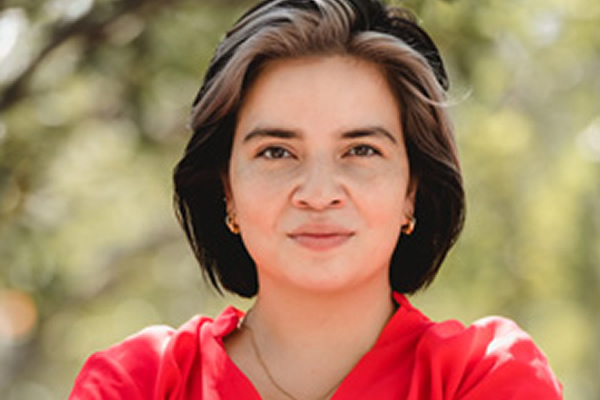
Earlier this month, the National LGBTQ Task Force named Mayra Hidalgo Salazar as its new Deputy Executive Director. Hidalgo Salazar joined the then newly appointed Executive Director Kierra Johnson as part of the Task Force’s new and growing leadership team that will continue to advocate for LGBTQ individuals across the country while paying close attention to intersectionality as a crucial component of LGBTQ activism.
As part of a statement released by the Task Force, Hidalgo Salazar said, “I am overjoyed to stand on the shoulders of the giants, elders in our movement who started the National LGBTQ Task Force over 40 years ago. The seeds that the Task Force has planted in training and developing LGBTQ+ leaders for nearly 5 decades are in full bloom.”
As Hidalgo Salazar embarks on this new journey, it is clearer for her that fighting for LGBTQ rights is important now more than ever.
Hidalgo Salazar was introduced to LGBTQ activism at age 17. She worked on the Trail of Dreams in 2010, a 1,500-mile walk from Miami to Washington, D.C., in support of immigrant rights. The Trail of Dreams’s goal, according to Amnesty International, was to “[raise] awareness about broken U.S. immigration laws and to demand fair and humane immigration law and policy.”
During her time working on this campaign, Hidalgo Salazar became more personally acquainted with the concept of intersectionality, in addition to her basic academic understanding of the concept.
“Before I could really understand what intersectionality meant…this campaign really showed me, in action, a great example of what it looks like to support people and support our community, which is not living single-issue lives,” said Hidalgo Salazar. “Two of the walkers [at the Trail of Dreams] were actually a queer couple: Isabel Sousa Rodriguez and Felipe Matos, and, it’s interesting because all of the demands that the campaign was making people really understood them as solely immigrant rights or immigrant justice issues.”
This realization, showed Hidalgo Salazar that to adequately advocate for the LGBTQ community, activists must recognize that LGBTQ individuals inhabit multiple identities, such as undocumented immigration status, that shape their realities as members of the queer community.
Being a young activist did not come without its challenges for Hidalgo Salazar. She acknowledges that while passionate about her work, she was not prepared for the emotional baggage that accompanies leadership.
“I will say that now at 29, I can recognize that I wasn’t emotionally prepared for a lot of things leadership would bring my way,” said Hidalgo Salazar. “I was part of the first generation of undocumented people in Florida that started coming out publicly, and it was a very different time for immigrant justice than it is now.”
Hidalgo Salazar further remarked, “There were so many people who were afraid and even outraged, people who said ‘No don’t do that; you can’t do that; you’re putting yourself at risk; you’re putting yourself and your family in danger’ and, I think so many of us were at a place where our current existence was unbearable.”
Hidalgo Salazar is grateful that she did not let those remarks cloud her vision and stand in the way of the work she was doing. Given this, her main advice to young and upcoming activists is to “actively listen and carve your own path” amid people whose relationship to risk will force them to impose their problems on young activists. Simultaneously, she also believes in practicing self-care as it establishes longevity within the activism world.
“I can’t tell you how many gifted, incredible organizers I know who have burned out before they were even 25. There’s environmental reasons for this and also, it’s about how we hold — or don’t — our boundaries. So, self-care is really important,” said Hidalgo Salazar.
Spearheading new era of leadership
As Hidalgo Salazar embarks on her new role with the LGBTQ Task Force, one of the goals at the forefront of her mind is to “level-up” the work that has already been done by her predecessors and existing leaders within the LGBTQ activism space.
“I think [that in] any role I undertake, it’s super important that I’m building a bench, that I am leveling up the existing leaders. That’s just important for me when I think about the longevity of this work and really building a culture of passing on the torch and normalizing it,” said Hidalgo Salazar.
Hidalgo Salazar will also support Kierra Johnson’s vision to build the Task Force’s organizing efforts, and better train, support, and defend local grassroots power. Having worked with undocumented youth at United We Dream as the development director, Hidalgo Salazar understands the importance of having an organized front of directly impacted people ready to mobilize and hold those in power accountable.
“The Task Force used to have a field organizing team that was in the double digits in the ‘80s and ‘90s. Right now, our organizing team is three people, and as we’ve seen these past four years, no one advancement and policy is actually ensured unless we have an organized base of grassroots leaders,” said Hidalgo Salazar. “So, part of what Kierra Johnson is wanting to settle down at the Task Force is really building out [our] local organizing arm.”
In addition to this, Hidalgo Salazar brings a deep understanding of America as it exists today and how integral youth are to mobilizing masses to demand change. She is aware of the power and fervor Generation Z possesses and how this passion has become one of the main driving forces of modern day activism.
“[Young people] are at the forefront of social change across so many different issues from climate change, to immigrant justice, to uprisings against police brutality, and so many more,” said Hidalgo Salazar. “We are forging a future for ourselves and we’re inviting people to come with us; and we’re going [in full force].”
Ultimately, Hidalgo Salazar’s work will be aimed at preserving and continuing the tradition at the Task Force of approaching LGBTQ activism and advocacy with a strong consciousness surrounding intersectionality, a tradition that she appreciates.
“I think the Task Force has done such an amazing job at really focusing not just on how different genders and sexualities are criminalized, but also working from this place of really innovating and creating a space where folks can enter a sex-positive framework really young,” said Hidalgo Salazar.
Hidalgo Salazar’s modus operandi will focus on participating in an exercise where LGBTQ individuals outline and work toward what they would like their liberation to look like.
“I think it’s about being able to articulate the alternative worlds we want to live in. And when I think about intersectionality at the Task Force, we have the first-ever Black bisexual woman and the first woman with an undocumented immigrant experience in leadership,” said Hidalgo Salazar. “So, there’s so much opportunity for us to really leverage our own stories so that more people that maybe didn’t see themselves as part of the LGBTQ movement per se, can see this work as relatable.”




U.S. Supreme Court
Trump asks Supreme Court to allow restrictions on gender-affirming care in prisons
SCOTUS could further restrict rights of trans inmates
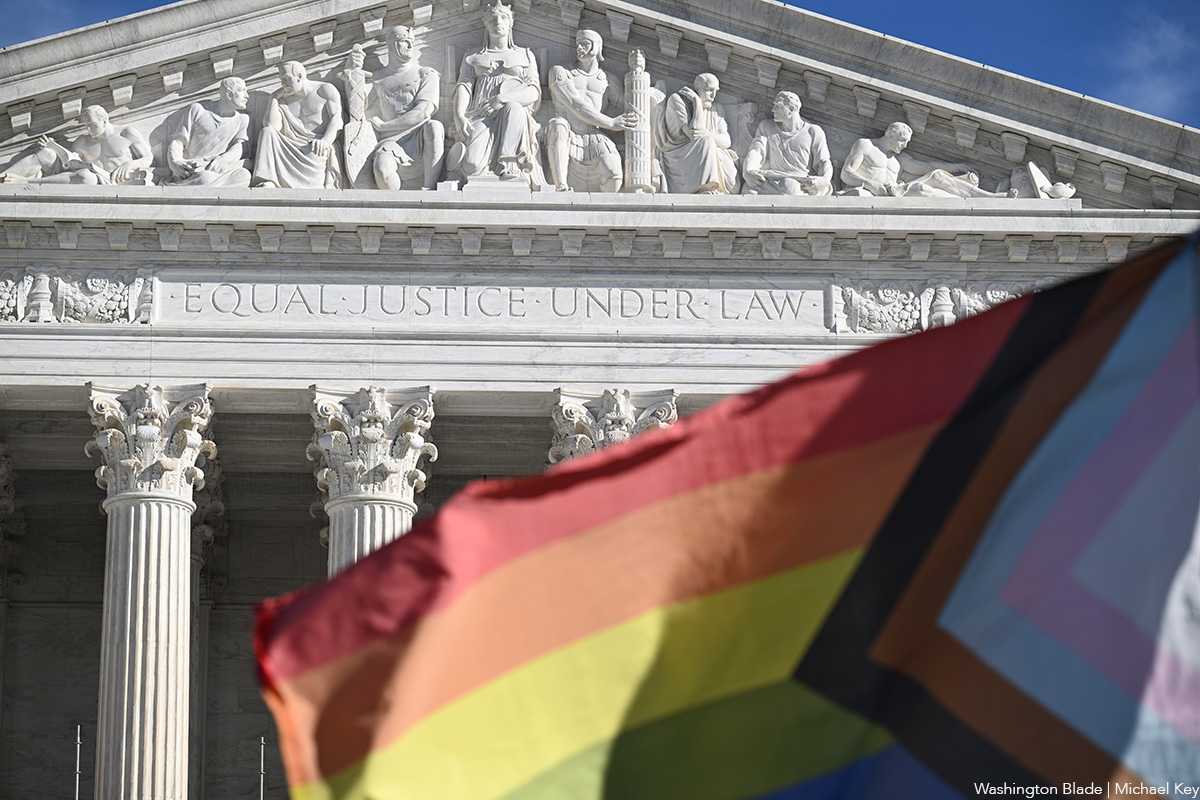
The Trump administration has asked the Supreme Court to allow its policy limiting gender-affirming treatment for federal inmates to take effect while a legal challenge plays out in court.
U.S. District Judge Royce Lamberth ordered the government to continue providing gender-affirming care, such as hormone therapy, which had become policy nearly a decade ago for inmates who were transitioning.
The Trump administration argues in its application that its policy restricting transgender rights was properly adopted and that the judge overstepped, posing nationwide “security and prison-administrative concerns.”
If allowed, the policy would halt surgeries, hormones and social accommodations such as wigs while allowing mental health therapy to continue as the legality of the policy reversal is litigated.
The government also argues in the application that the Bureau of Prisons had “determined that sex-trait-modification surgeries, hormone interventions in general, and social accommodations could no longer be justified as treatment for gender dysphoria.”
American Civil Liberties Union attorneys for the inmates said the policy is “a direct threat to the well-being of transgender people in federal custody and an open violation of their fundamental rights,” and said withholding necessary gender-affirming healthcare constitutes cruel and unusual punishment.
The Blade has covered the ongoing developments surrounding changes to Federal Bureau of Prisons transgender inmate policy that went into effect earlier in Trump’s term. The changes primarily focus on rolling back Biden-era protections for trans inmates.
Earlier this year, the Blade published a joint letter from multiple senators in response to the rollback of the policy. Multiple senators — including Edward Markey (D-Mass.), Jeffrey A. Merkley (D-Ore.) and Mazie K. Hirono (D-Hawaii) — sent a letter to Attorney General Todd Blanche and Federal Bureau of Prisons Director William Marshall III calling for them to reverse the policy change, saying it endangers inmates’ health and safety.
The senators described how the policy shift, along with President Trump’s Executive Order 14168, titled “Defending Women from Gender Ideology Extremism and Restoring Biological Truth to the Federal Government,” is forcing policy changes they argued are rooted more in political rhetoric than in medical research or evidence-based correctional practices.
Federal Bureau of Prisons responded to the Blade’s request for comment in May, declining to reconsider its transgender inmate policy.
The Blade reached out to the Federal Bureau of Prisons once again over the application to the Supreme Court, but did not hear back before publication.
Federal Government
Education Department rolls back protections for LGBTQ students under Title IX
The DoE policy rescinds Biden-era protections
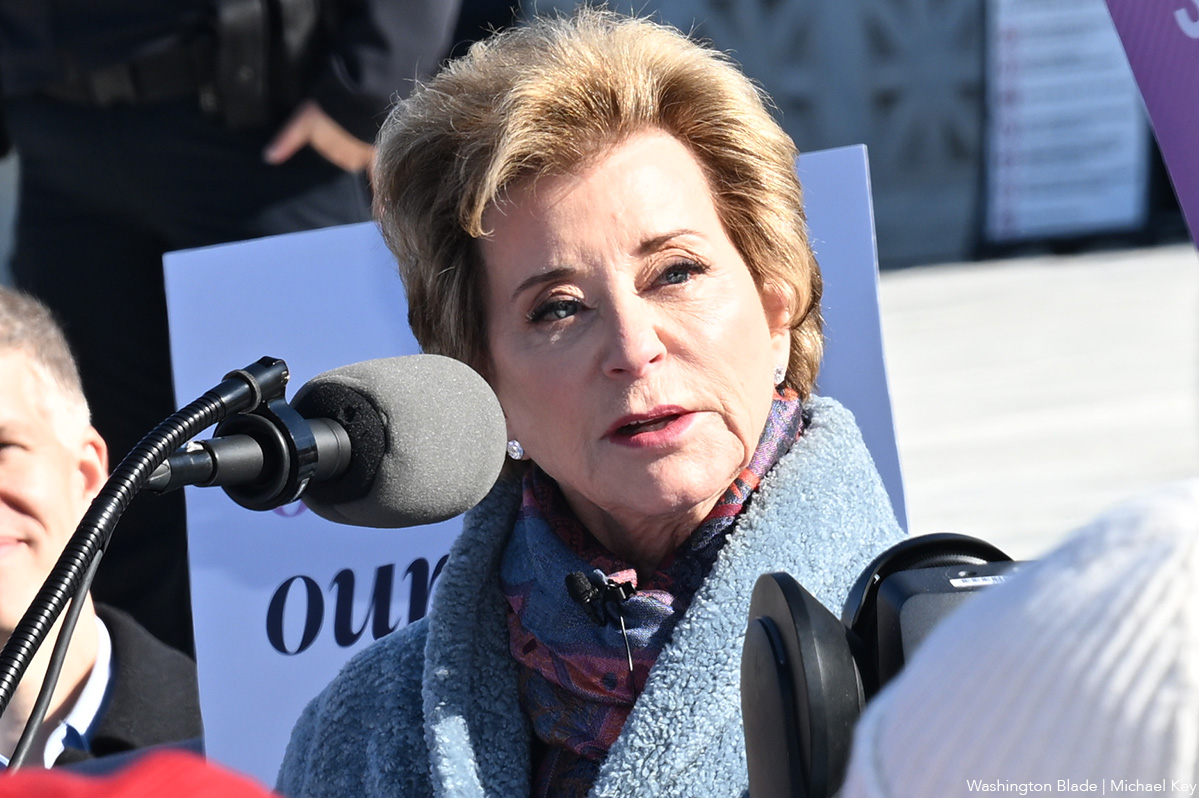
The Department of Education rolled back a Biden-era Title IX interpretation on Monday that secured sex-based discrimination protections for students on the basis of sexual orientation and gender identity.
Title IX was established in 1972 as landmark civil rights law. It prohibits sex-based discrimination in any school or any other education program that receives funding from the federal government.
Education Secretary Linda McMahon spoke about the revision of the policy, claiming the decision would explicitly help “women and girls.”
“Thanks to today’s action, the published Title IX regulations faithfully reflect court orders and congressional intent — reducing confusion for parents, students, and educational institutions. We will continue to relentlessly champion equal opportunity for all Americans and hold accountable any school or college that violates the rights, privacy, or athletic opportunities of our women and girls,” McMahon said via press release.
Prior to her work under the Trump-Vance administration, McMahon was a World Wrestling Federation/World Wrestling Entertainment executive before resigning to pursue a career in politics. She was appointed to the Connecticut State Board of Education by then-Gov. Jodi Rell in January 2009, but resigned from her role shortly afterward to run what ultimately became two failed campaigns for Connecticut’s U.S. Senate seat in 2010 and 2012.
A “fact sheet” provided by the Department of Education also called the inclusive sexual assault and gender identity protections expanded under the Biden-Harris unlawful, saying, “This change is necessary to provide clarity in the Code of Federal Regulations so that institutions, administrations, students, and families can see the rules that are actually in force and to help eliminate public confusion about the Biden administration’s unlawful attempt to stretch Title IX’s legal protections to cover ‘sexual orientation’ and ‘gender identity.’”
This is not the first time this policy has faced judicial hurdles. While Biden was still in office, the plan was struck down in multiple courts in Republican states.
Opponents of the move say it will harm transgender athletes and weaken protections for sexual assault victims.
“Sexual harassment and assault continue to be pervasive in schools and, to the fullest extent possible, we should be working to enforce the laws that protect student survivors of sexual violence. Yet, Education Secretary Linda McMahon and the Trump administration have decided to ignore what survivors need, instead weaponizing Title IX to attack trans students,” said Shiwali Patel, senior director of education justice at the National Women’s Law Center.
This is a return to a first Trump term policy after Biden issued an executive order to attempt to curb discrimination for all — especially those with different sexual orientations and gender identities — that had been given a pass during Trump’s first term. Much of Title IX’s policy has a narrow vision of what sex protections look like that often and enthusiastically leave gender-diverse and non-heterosexual people out.
In March 2021, President Joe Biden signed Executive Order 14021, “Guaranteeing an Educational Environment Free From Discrimination on the Basis of Sex, Including Sexual Orientation or Gender Identity,” to attempt to undo some of the flagrantly anti-LGBTQ policy the Trump-Pence administration had set forth relating to Title IX protections for LGBTQ students and sexual assault survivors.
The secretary focused this “win” for the administration as one more step toward restricting transgender students from competing in women’s sports, but the 2020 rule, completed under former Education Secretary Betsy DeVos, didn’t explicitly ban trans students from participating on sports teams consistent with their gender identity. It did limit the types of sexual harassment and assault complaints that schools had to investigate and required live hearings so male students could respond to accusations.
McMahon didn’t discuss those aspects in her statement or in requests for comment. The 2020 rule drew praise from conservatives and intense opposition from advocates who said it downplayed sexual abuse and left victims unprotected.
In a statement, U.S. Rep. Tim Walberg (R-Mich.), who chairs the House Education Committee, said, “Returning to the 2020 regulations restores longstanding protections for women and girls that the Biden-Harris administration attempted to dismantle and realigns Title IX policy with court precedents.”
LGBTQ activists have called this decision a direct attack on LGBTQ safety — particularly for trans students who continue to face a barrage of legislative, executive, and judicial attacks in recent years from the Trump-Vance administration.
Kelley Robinson, president of the Human Rights Campaign, the largest LGBTQ advocacy group in the world, released a statement following the DoE’s announcement.
“Title IX is, quite simply, about protecting students and ensuring that they are safe from abuse, harassment, and discrimination while they pursue their education. But Donald Trump and his cronies aren’t interested in any of that,” Robinson said. “Donald Trump’s Department of Education has completely lost sight of that mission. Instead of enforcing protections for students, they’re rescinding them. They don’t care if sexual harassment and assault go unaddressed. And they’re happy to strip funding away from school districts and states that are actually trying to keep students safe.
“We know who will be hurt: women, girls, and others who are vulnerable to sexual harassment, assault and abuse — including LGBTQ+ students. The fact that they’re dropping this rule into place abruptly, without a comment period, denying families, educators, loved ones, and the students themselves a say in how they should be treated, shows how little they care about the safety of our students.
“This is a monstrous injustice, and it drives home how essential it is that we take action at the polls this November to start bringing some accountability to an administration that has turned its back on the very students Title IX was written to protect,” she added.
The Washington Blade reached out to the DoE for comment and questions on whether Title IX protections still included LGBTQ students, and received this email response from Education Spokesman Sabin Sidney:
“Your questions indicate you are clearly missing the entire point of this Final Rule. The Biden Administration illegally rewrote Title IX to include ‘sexual orientation’ and ‘gender identification’ in the definition of sex-based discrimination. The Trump Administration is rescinding this rule—only after every federal court that heard legal challenges rejected it as unlawful.
“Since January 2025, the Department has been enforcing Title IX consistent with the President’s Executive Order grounded in biological truth that there are only two sexes. The Trump Administration is restoring the original promise of Title IX and providing clarity to students, parents, and educational institutions. We will vigorously defend equal opportunity consistent with the law’s intended purpose.”
National
Dr. Fauci ‘honored to be part of’ LGBTQ history
Equality Forum presents pioneering AIDS researcher with Int’l Role Model Award
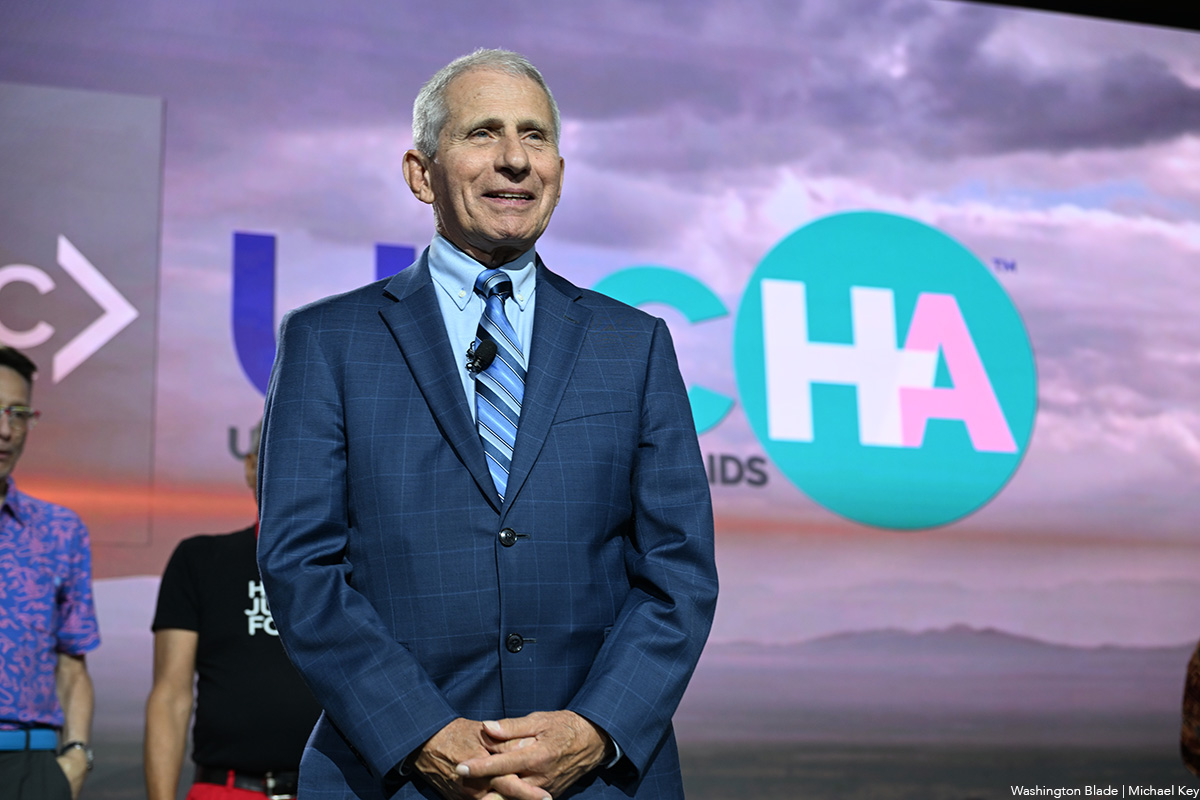
PHILADELPHIA — Dr. Anthony Fauci accepted an award from the Equality Forum on Sunday in which he told the audience that he is honored to be part of the LGBTQ community’s history.
“Over these many decades I have not simply admired the community — I have genuinely enjoyed being part of the conversation with it,” Fauci said. “I’ve enjoyed the arguments, debates, disagreements, the humor, the friendship and above all the extraordinary commitment to alleviate suffering and prevent premature death for persons living with HIV.”
Fauci continued, “I am grateful to the Equality Forum for this award. I am grateful to the LGBTQ community for allowing me throughout these many years to become part of your struggle and I am deeply honored to be part of your history.”
Fauci traveled to Philadelphia to accept the Equality Forum’s International Role Model Award. Longtime HIV/AIDS activist Peter Staley presented Fauci with the award, recalling the early days in the fight against the disease and that activists in the 1980s frequently clashed with Fauci, director of the National Institute of Allergy and Infectious Diseases at the time. In his remarks, Staley recalled the message on one sign from an ‘80s protest, “Fuck Fauci.” But activists warmed up to Fauci and he ultimately befriended his former gay critics, including Larry Kramer.
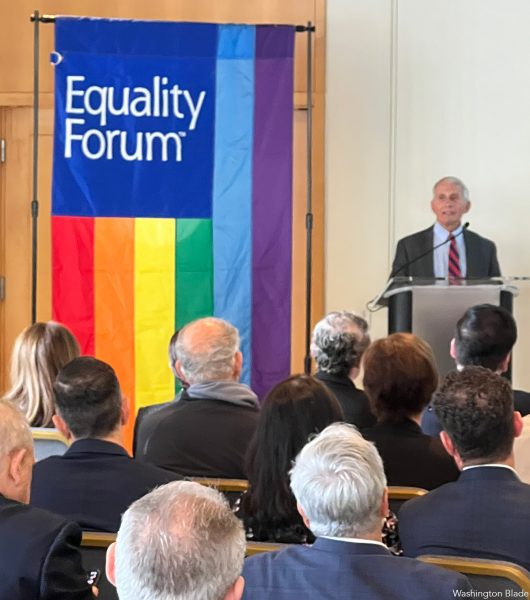
Also at Sunday’s event, the Equality Forum honored Erica Deuso, the first out transgender mayor in Pennsylvania; she was elected mayor of Downington, Pa., and sworn in last January. Ben Garcia, executive director of the American LGBTQ+ Museum in New York presented Deuso with the Frank Kameny Award.
The event also served as the kickoff of LGBT History Month, which Equality Forum honors by naming 31 LGBT Icons, one per day in October. Visit equalityforum.org for a full list of its more than 600 queer Icons. This year’s honorees include designer Calvin Klein, Rep. Chris Pappas, and President Abe Lincoln.

Trump asks Supreme Court to allow restrictions on gender-affirming care in prisons

Education Department rolls back protections for LGBTQ students under Title IX

Debbie Allen shares on loss, love, and the power of speaking out

Baltimore’s oldest gay bar to reopen this week

Dr. Fauci ‘honored to be part of’ LGBTQ history

Colombia withdraws from Equal Rights Coalition

Trump-appointed judge restores White House TV pool access

Writing a play about Lincoln leads down a rabbit hole to a closet

Philadelphia event to launch 2026 LGBT History Month

Being a female firefighter comes with unique risks, and rewards
-

 Colombia5 days ago
Colombia withdraws from Equal Rights Coalition
-
White House5 days ago
Trump-appointed judge restores White House TV pool access
-
a&e features5 days ago
Writing a play about Lincoln leads down a rabbit hole to a closet
-
National5 days ago
Philadelphia event to launch 2026 LGBT History Month