National
Fauci: Risk of monkeypox infection not high, but ‘numbers may increase’
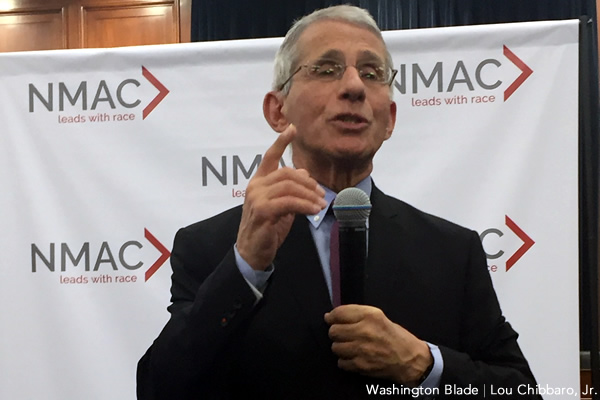
Dr. Anthony Fauci, the director of the National Institutes of Health who has been at the forefront of the battles against the HIV/AIDS and COVID-19 epidemics, downplayed Wednesday the idea gay and bisexual men are at high risk of contracting monkeypox as the outbreak begins to spread, but cautioned “the numbers may increase.”
“Given the numbers I would not say right now at this particular point, that it is a quote, high risk, but the numbers may increase, which means we just have got to be careful and pay attention,” Fauci said.
Fauci made the remarks in a conference call with reporters from LGBTQ news outlets on the heels of the Biden administration’s announcement that it would ramp up efforts to confront the emerging spread of monkeypox.
On Monday, the Department of Health & Human Services, announced a nationwide vaccination strategy against monkeypox, which consists of providing nearly 300,000 vaccines with priorities for individuals at risk and areas with high rates of infection. An estimated 750,000 vaccines are expected for delivery by the end of summer, according to HHS.
In response to a Blade question about the risk of gay and bisexual men contracting monkeypox, Fauci said that was difficult to quantify and he “wouldn’t say low, because then…that can be taken out of context,” but went on to express there’s a minimal risk of infection if precautions are taken.
“What we’re seeing given the number of cases and the rate in which they’ve accelerated, it’s clearly out there,” Fauci said. “But when you talk about the large number of gay and bisexual men who have sex with men, that on any given individual contact I think if one is careful, and make sure that both parties in a sexual interaction are aware of lesions that might go unnoticed, then you can go a long way in pure prevention to prevent that from happening, but I think it would be risky to classify it as low, medium or high.”
The U.S. has confirmed 306 monkeypox cases across 27 states and Washington, D.C., the Centers for Disease Control announced Tuesday. That represents a surge of 63 cases from the previous week.
Fauci said the current outbreak is predominantly among men who have sex with men among individuals who have had sexual contact. Monkeypox is technically not a sexually transmitted disease, Fauci said, because it’s spread through skin-to-skin contact, but “because of the close skin to skin interaction that occurs in sexual contact, that appears to be the modality spread.” Monkeypox, Fauci said, is “not fundamentally a lethal infection.”
Raj Panjabi, senior director for global health security and biodefense on the White House National Security Council, was also on the call and said the Biden administration’s monkeypox plan consists of “three pillars” of testing, vaccines, and outreach.
“In terms of outreach, there is no effective response to an outbreak without a community based response,” Panjabi said. “And so we’ve worked to ensure an open dialogue with leaders and stakeholders in the LGBTQIA+ community. What we’ve been doing is to try to understand from those most affected by this outbreak, learn from them, help them stay vigilant within the community to protect themselves from the disease and try to adjust our response according to the gaps that they’ve raised.”
The rise in monkeypox infections comes during Pride month, a time when LGBTQ community is engaged in celebrations and oftentimes in close contract and intimate settings, including sexual activity.
Asked by a reporter with NBC News whether this weekend’s Pride celebrations may have fueled the spread, Fauci said in theory “the risk is probably increased” in Pride activities “because people tend to get involved in sexual networking there,” but precautions at the end of the day would mitigate new infections.
“You don’t want to panic people but you want to get people to appreciate, particularly with the Pride activities that are going on now, to be aware and to just be careful,” Fauci said. “And being careful can be very practical, but making sure that you’re aware of things like skin lesions or lesions around areas of the body, particularly when you’re having a sexual encounter. Those are the things we’re trying to do.”





Hungary
Vance speaks at Orbán rally in Hungary
Anti-LGBTQ prime minister trailing ahead of April 12 vote
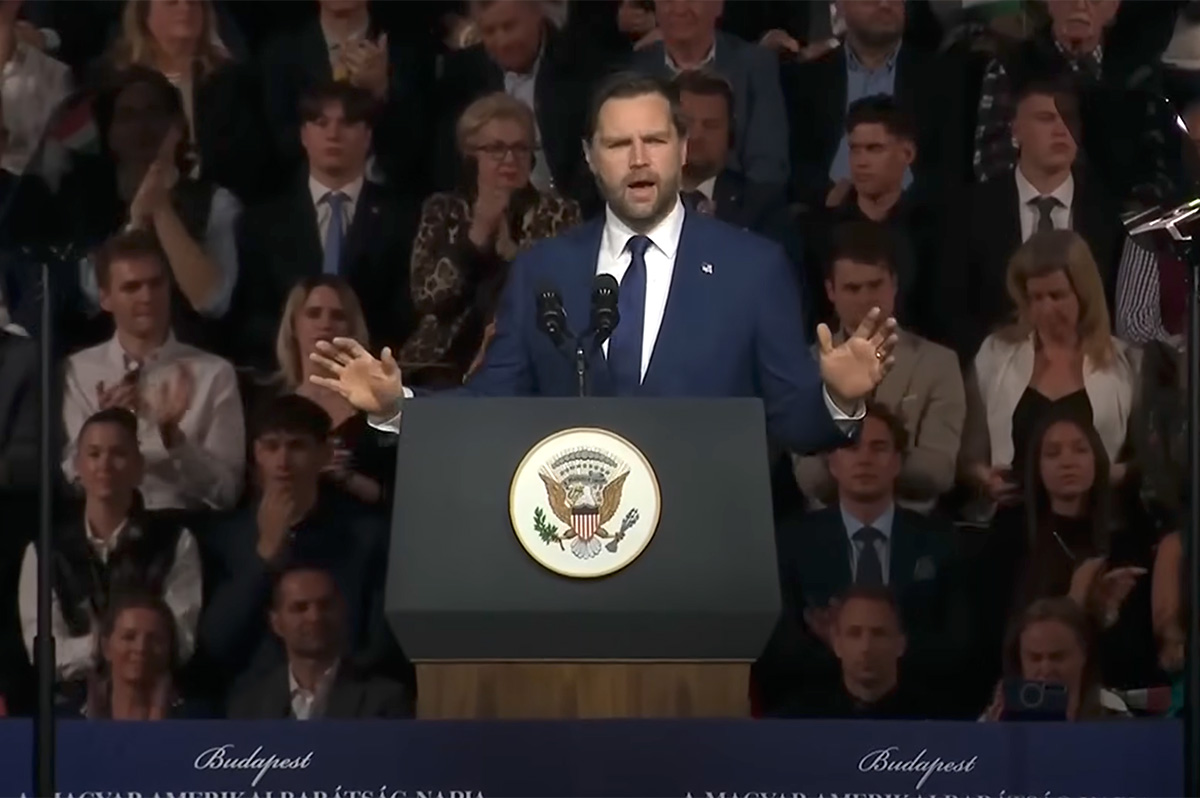
Vice President JD Vance on Tuesday urged Hungarians to support Prime Minister Viktor Orbán in the country’s April 12 elections.
“We have got to get Viktor Orbán re-elected as prime minister of Hungary,” Vance told Orbán supporters who gathered at Budapest’s MTK Sportpark.
Vance and Orbán on Tuesday met before they held a press conference in Budapest. Orbán also spoke at the rally.

The U.S. vice president after he took to the stage called President Donald Trump, who told the crowd he is “a big fan of Viktor” and is “with him all the way.” Vance, as he did during Tuesday’s press conference with Orbán, criticized the European Union.
“We want you to make a decision about your future with no outside forces pressuring you or telling you what to do. I’m not telling you exactly who to vote for, but what I am telling you is that the bureaucrats in Brussels, those people should not be listened to,” said Vance. “Listen to your hearts, listen to your souls, and listen to the sovereignty of the Hungarian people.”
Vance in his speech noted “across the West, we’ve got a small band of radicals” who, among other things, “condemn children to mutilization and sterilization in the name of gender care.” Vance also criticized a “far-left ideology given quarter in university circles, in the media, and in our entertainment industry, and increasingly among bureaucrats on both sides of the Atlantic.”
Vice President JD Vance speaks at MTK Sportpark in Budapest, Hungary, on April 7, 2026
Orbán has been in office since 2010. He and his Fidesz-KDNP coalition government have faced widespread criticism over its anti-LGBTQ crackdown.
A Hungarian activist with whom the Washington Blade previously spoke said it is “impossible to change your gender legally in Hungary” because of a 2020 law that “banned legal gender recognition of transgender and intersex people.” Hungarian MPs the same year effectively prohibited same-sex couples from adopting children and defined marriage in the country’s constitution as between a man and a woman.
The European Commission in 2022 sued Hungary, which is a member of the EU, over the country’s anti-LGBTQ propaganda law.
Hungarian lawmakers in March 2025 passed a bill that banned Pride events and allowed authorities to use facial recognition technology to identify those who participate in them. MPs later amended the Hungarian constitution to ban public LGBTQ events.
Upwards of 100,000 people last June defied the ban and marched in Budapest’s annual Pride parade.
Polls indicate Orbán is trailing Péter Magyar and his center-right Tisza party ahead of the April 12 election. Vance at Tuesday’s rally told Orbán supporters that he and Trump “want you to make a decision about your future with no outside forces pressuring you or telling you what to do.”
“I’m not telling you exactly who to vote for, but what I am telling you is that the bureaucrats in Brussels, those people should not be listened to,” said Vance. “Listen to your hearts, listen to your souls, and listen to the sovereignty of the Hungarian people.”
“Unlike some of the leadership of Brussels, I’m not threatening you or telling you that we’re going to withhold funds to which you’re legally entitled,” he added. “You will make the decision about Hungary’s future.”
Magyar on Tuesday appeared to dismiss Vance’s comments.
“No foreign country may interfere in Hungarian elections. This is our country. Hungarian history is not written in Washington, Moscow, or Brussels — it is written in Hungary’s streets and squares,” said Magyar on his X account.
A spokesperson for the Háttér Society, a Hungarian LGBTQ rights group, told the Blade that neither Magyar, nor his party have reached out to the organization.
The spokesperson said the group does not “campaign directly for them or for any other political party.” The Háttér Society, however, is encouraging LGBTQ Hungarians to vote.
“Ahead of election day, we will encourage everyone on our social media channels to go out and vote, as this is the only way we can act against a system that has been working against the LGBTQI community for many years,” said the spokesperson.
The White House
White House ends protections for trans students in multiple school districts
Cape Henlopen School District in Delaware among administration’s targets

The Department of Education has terminated agreements with five school districts and a college aimed at protecting the rights of transgender students, backtracking requirements made in prior administrations, according to the Associated Press.
Allowing the reversal of these federal obligations removes formerly mandatory measures, including faculty training on responding to a student’s preferred name and pronouns, and policies allowing trans children to use bathrooms that align with their gender identity.
This policy change is a major shift from past democratic-led administrations, and will impact Delaware Valley School District in Pennsylvania, Sacramento City Unified School District in California, Cape Henlopen School District in Delaware, Fife School District in Washington, and La Mesa-Spring Valley School District, as well as Taft College in California.
Delaware Valley School District received notice from the Trump-Vance administration in February and has since voted to roll back anti-discrimination protections. Other schools, like Sacramento City Unified School District, said the change in minimum protections a district must offer will not affect their policies because it “remains committed to the support of our LGBTQ+ students and staff.”
This is part of a wider wave of anti-trans actions taken by the Trump-Vance administration. This White House has penalized schools attempting to accommodate students’ gender identity, filed lawsuits in California and Minnesota over state policies allowing trans students to participate in interscholastic sports, and opened civil rights investigations into multiple schools and universities over their policies on trans students.
Kimberly Richey, the Department of Education’s Assistant Secretary for Civil Rights, said the action underscored the administration’s efforts to prevent trans students from participating in girls’ and women’s sports teams and accessing shared locker rooms.
“Today, the Trump administration is removing the unnecessary and unlawful burdens that prior administrations imposed on schools in its relentless pursuit of a radical transgender agenda,” she said in a written statement.
According to the AP, this is just one instance of the administration rescinding civil rights protections in education. Last year, the Department of Education terminated two agreements: one involving the removal of books from a school library in Georgia, and another addressing harsh discipline and unequal education opportunities for Native students in the Rapid City Area School District in South Dakota.
Shiwali Patel, the senior director of education justice at the National Women’s Law Center, issued a statement in response to the removal of protections for trans students, saying the rollback will negatively impact all students — not just trans ones.
“There is absolutely no basis for what the Department of Education is doing, and it is unimaginably cruel. Title IX exists to ensure that students are protected from discrimination and treated with dignity so that they can learn and thrive in our schools,” Patel said. “It’s what students, families, lawmakers, and advocates fought for when Title IX was passed decades ago. But the Trump administration’s Department of Education has spent its limited resources to strip Title IX of that very purpose.”
She continued, highlighting the issues that will arise from the agreement removals in schools.
“Real complaints of discrimination and sexual assault are going unanswered by the Department of Education while conservative lawmakers continue to escalate their attacks on a small minority of students,” the nationally recognized Title IX expert and advocacy leader for gender-based harassment added. “Parents, teachers, and students need the Department to focus on addressing real harms on campuses instead of rolling back policies that keep all students safe.”
The schools that had their agreements terminated vary, but stem from the same issue: treating trans students with the same protections from harassment as their cisgender peers.
In 2023, Taft College, a community college in California’s Central Valley, became one of the few schools to settle a case with the Department of Education’s Civil Rights Office after a student accused faculty of discrimination, including refusing to use the student’s preferred pronouns. The college agreed to faculty training on Title IX protections and revised its policies to clarify that refusing to use a person’s preferred name and pronoun can constitute harassment.
The now-canceled agreement with Sacramento City Unified School District stemmed from a 2022 complaint brought by a student after a teacher refused to use the student’s preferred pronouns and/or refused to allow the male-identifying student to work in a boys’ group for a class activity. The 2024 resolution agreement had mandated training for employees on civil rights law, sexual harassment, and how to handle formal complaints.
Under a settlement the Delaware Valley School District reached with the Obama-Biden administration, the district was required to permit students to use bathrooms aligned with their gender identity. In February, the Trump-Vance administration sent the district a letter rescinding the settlement and requiring the rollback of antidiscrimination protections for trans students. The school board voted in late March to change its policies accordingly.
This move is part of a broader pattern of anti-trans actions from the White House since Trump returned to office.
In addition to restricting protections in federally funded education spaces, the administration has attempted to end trans girls’ and women’s participation in sports competitions and has sued states that have not complied. It has also blocked trans and nonbinary people from choosing sex markers on passports and attempted to stop those under 19 from receiving gender-affirming medical care.
South Carolina
Man faces first S.C. ‘hate intimidation’ charge
Timothy Truett allegedly shot at gay club in Myrtle Beach on April 1

A South Carolina man remains in custody on a more than $300,000 bond after he allegedly opened fire at a Myrtle Beach nightclub on April 1, according to WMBF.
Reports say 37-year-old Timothy James Truett Jr., of Clover, S.C., was detained by the Myrtle Beach Police Department after the April 1 incident outside Pulse Ultra Club. He was later arrested and charged with possession of a weapon during a violent crime, discharging a firearm into a dwelling, discharging a firearm within city limits, malicious injury to real property valued over $5,000, and assault or intimidation due to political opinions or the exercise of civil rights.
At 10:57 a.m. on April 1, officers responded to a call about a possible shooting at Pulse Ultra Club, located in the 2700 block of South Kings Highway.
In an affidavit released later, the club’s owner, Ken Phillips, said he was doing paperwork that morning when he heard “five or six” gunshots. He went outside and found a window and the windshield of his SUV shattered by bullets. An SUV with blue plastic covering one window was left at the scene.
Police later reviewed footage that showed a silver vehicle stopping in the middle of the road. The video appeared to capture muzzle flashes coming from the passenger-side window.
According to the affidavit, an officer later pulled over a vehicle driven by Truett and found spent shell casings in the back seat, along with a gun.
Documents do not detail why Truett was ultimately charged under the state law covering assault or intimidation tied to political opinions or the exercise of civil rights.
As of April 1, records show Truett is being held in Horry County on a combined bond of more than $312,000.
WMBF spoke with Phillips after the incident and asked whether there was any prior conflict that might have led to the shooting.
“I don’t know if it’s personal, I don’t know if it’s related to being gay, I don’t know if it’s related to the bar issues,” Phillips told WMBF. “Anybody with a mindset of pulling out a weapon in broad daylight is not right.”
“My primary concern has and always will be the safety of my community and my customers,” he added. “It’s given me great concern … as to how far people will go.”
WMBF also spoke with Adam Hayes, vice chair of Myrtle Beach’s Human Rights Coalition, who was involved in pushing for the ordinance. He said that while the incident itself is troubling, it shows the policy is being put to use.
The ordinance is intended to deter “crimes that are motivated by bias or hate towards any person or persons, in whole or in part, because of the actual or perceived” identity, in the absence of a statewide hate crime law.
“It’s nice to see that something we put into policy is not just a piece of paper, that it’s actually being used,” said Hayes.
He said the shooting underscores the need for a statewide hate crime law in South Carolina and added that the incident has left the local LGBTQ community shaken.
South Carolina and Wyoming are the only two states in the U.S. without a comprehensive statewide hate crime law.
Truett remains in jail as of publication.

D.C. Council member honored by LGBTQ homeless youth group

Vance speaks at Orbán rally in Hungary

White House ends protections for trans students in multiple school districts

Amendments to India’s transgender rights law criticized

Cuba under pressure and without answers

Belarusian lawmakers approve bill to crackdown on LGBTQ rights

How new barriers to health care coverage are hitting D.C.

Kenyan advocacy groups launch LGBTQ voter mobilization campaign

Calendar: April 3-9