Minnesota
Catholic school shooting leaves 2 dead; leaders condemn anti-trans scapegoating
Gunman opened fire inside Annunciation Catholic Church in Minneapolis

Two children are dead and 17 others, including 14 children, were wounded after a gunman opened fire at a Catholic school in Minneapolis.
Authorities identified the shooter as 23-year-old Robin Westman, a transgender woman who began shooting inside Annunciation Catholic Church during morning Mass on Wednesday around 8:30 a.m. Westman killed two children, ages eight and 10, and injured three elderly parishioners in addition to the 14 children inside the church.
Police confirmed that Westman legally purchased the weapons used in the attack — a rifle, shotgun, and pistol — had no prior criminal history, and died at the scene from a self-inflicted gunshot wound.
According to a yearbook obtained by CNN, Westman graduated from Annunciation Catholic’s grade school in 2017. Fox News reported that their mother, Mary Grace Westman, worked at Annunciation Catholic School as a secretary until 2021.
The New York Post reported that Westman left behind a manifesto, suggesting the attack had been carefully planned.
On a YouTube channel under Westman’s name, several videos were scheduled to post around the time of the shooting. The clips showed Westman’s weapons and magazines, some inscribed with phrases such as “kill Donald Trump” and “for the children.” Other videos depicted Westman flipping through a notebook containing antisemitic writings, hand-drawn maps of the school, “defend equality” trans Pride stickers, and references to an admiration for mass shooters — particularly Adam Lanza, the Sandy Hook killer. The manifesto itself appears to be written in a code combining Cyrillic characters and English phonetics.
“It’s my strongest desire that no state, no community, no school ever experiences a day like this,” Minnesota Gov. Tim Walz said.
“This was a deliberate act of violence against innocent children and other people worshipping. The sheer cruelty and cowardice of firing into a church full of children is absolutely incomprehensible,” Minneapolis Police Chief Brian O’Hara said.
O’Hara noted that the surviving victims are expected to recover, though they sustained a range of injuries.
Minneapolis Mayor Jacob Frey also addressed the tragedy, stressing that meaningful changes are needed to prevent another senseless act of violence.
“It can’t just be words — there needs to be action. We’ve seen school shooting after school shooting. We’ve seen church shootings carried out by horrible actors,” Frey said.
He also condemned attempts to exploit the tragedy to target marginalized groups, particularly trans people.
“Anybody who is using this as an opportunity to villainize our trans community, or any other community out there, has lost their sense of common humanity. We should not be operating out of a place of hate for anyone.”
National LGBTQ rights organizations echoed the call for compassion for the trans community, while condemning scapegoating.
“We are heartbroken by the devastating shooting in Minneapolis. Our deepest sympathies go out to the families who lost loved ones, the survivors, and the entire community now forced to grieve the unimaginable,” said Brandon Wolf, the Human Rights Campaign’s National Press Secretary and a survivor of the Pulse nightclub shooting. “Too many communities have had to live this nightmare too many times. Grief is not enough. For far too long, our nation has endured an avalanche of gun violence — tragedies that could have been prevented with lifesaving, common-sense gun laws that certain lawmakers block at every chance. No child should go to school fearing for their life. And while we don’t yet know all the facts, one thing is clear: scapegoating an entire marginalized community in a moment of national grief is wrong, dangerous, and dehumanizing. This tragedy is part of a devastating and preventable epidemic of gun violence. Enough is enough.”
Kierra Johnson, president of the National LGBTQ Task Force, emphasized unity over division:
“The mass shooting at Annunciation Catholic School deserves more than the platitude of ‘thoughts and prayers.’ Predictably, those who rush to say ‘don’t politicize mass shootings’ while the gun is still warm are also quick to demonize transgender people and indict an entire community for the actions of one person. This is a time for compassion — for supporting those grieving — not for fueling division. While many in the LGBTQ community have experienced friction with some religious groups, we must come together to create dialogue and understanding, not further wedges.”






Minnesota
Flanagan beats Craig in Minn. Senate primary after winning key LGBTQ endorsements
The race highlights a growing ideological shift within the Democratic Party, as Democrats increasingly seek a more robust pushback against Trump.
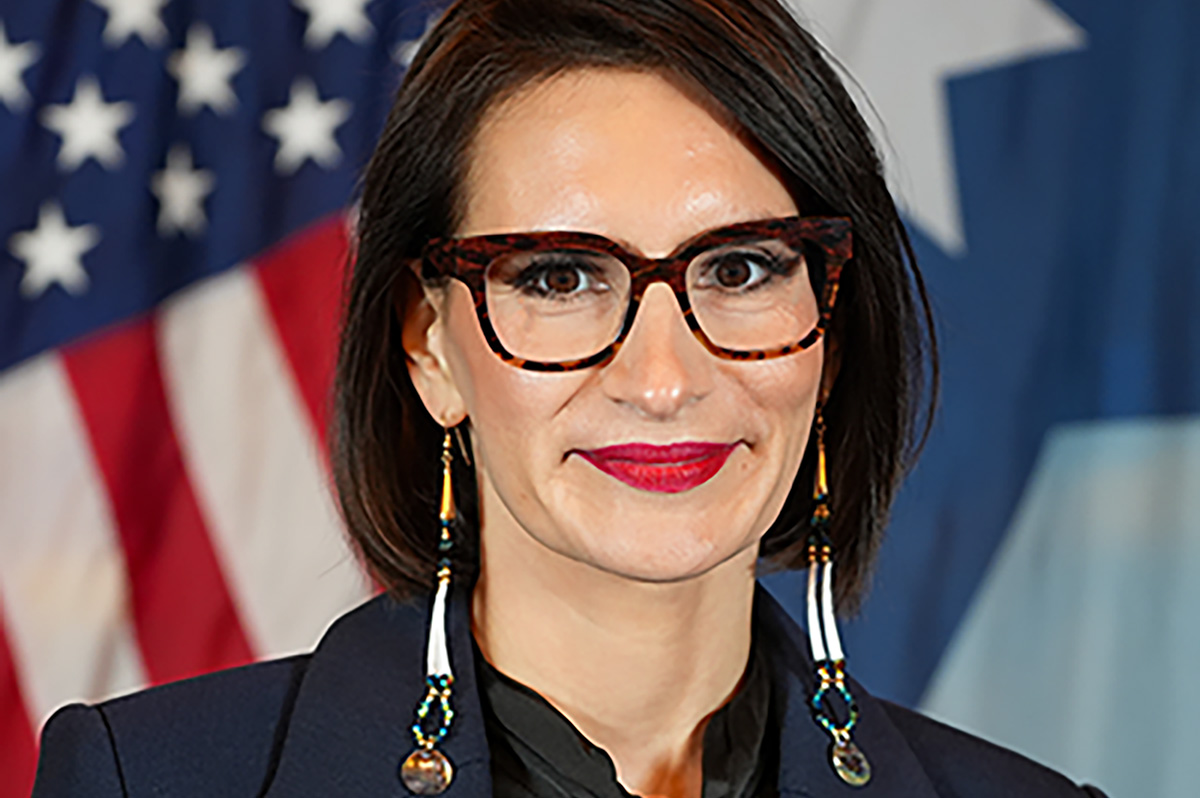
Lt. Gov. Peggy Flanagan won the Democratic primary for the Senate in Minnesota, as progressive Democrats continue to clinch nominations across the country.
On Tuesday night, NBC News called the race for Flanagan, who received 59.0% of the state’s Democratic primary vote, while her opponent, Rep. Angie Craig, received 39.4%. Flanagan ran against Craig for retiring Sen. Tina Smith’s seat.
Smith, along with Sens. Bernie Sanders, I-Vt., and Elizabeth Warren, D-Mass., endorsed Flanagan, while House Minority Leader Hakeem Jeffries, D-N.Y., and former House Speaker Nancy Pelosi, D-Calif., backed Craig.
Flanagan also received the endorsement of the Christopher Street Project, a transgender rights organization that has been at the center of efforts to counter the Republican Party’s push against transgender rights. The group chose Flanagan over Craig in part because Craig has not co-sponsored the Trans Bill of Rights, legislation that has been introduced multiple times in Congress and seeks to establish federal protections for transgender Americans.
The endorsement underscored a key difference between the two Democrats on LGBTQ issues. While Craig is the first openly lesbian mother in Congress, the Christopher Street Project said LGBTQ identity alone is not enough without a strong commitment to transgender rights as they are increasingly debated in legislative offices around the country.
In 2022, the Human Rights Campaign, the largest LGBTQ advocacy organization in the U.S., endorsed Flanagan’s re-election campaign for lieutenant governor alongside Tim Walz, calling the duo “Champions of Equality.”
Flanagan called the race an expensive fight of the “many versus the money,” Flanagan told NBC News’ “Meet the Press Now.” Craig and her allies combined to spend nearly $20 million on the airwaves, while Flanagan and her allies spent $4.7 million, according to AdImpact and NBC.
“I’m running to make sure that people can afford the lives they want to live,” Flanagan said. “I want to get big money out of our politics, and I want to fight for things like ‘Medicare for All’ so that people aren’t just paying for health insurance but actually have access to health care.”
Flanagan criticized Craig, who is in her fourth term, for not standing up enough to President Donald Trump’s administration, a characterization Craig disputed. Craig flipped a competitive House seat in the Twin Cities metro area and had argued that she was the best candidate to win in November.
Craig faced criticism for voting for the Laken Riley Act, an immigration detention measure that Trump signed into law shortly after he started his second term in January 2025. Craig said she later regretted that vote.
Flanagan has been vocal about her stance on abolishing U.S. Immigration and Customs Enforcement. In a recent Minnesota Public Radio debate she said that ICE “has to be ripped apart.” Flanagan said she does support immigration enforcement to ensure secure borders.
Immigration and ICE debates are especially pertinent in the Twin Cities, as ICE agents fatally shot two U.S. citizens, Renee Good and Alex Pretti, in Minneapolis during an enforcement crackdown at the behest of President Trump.
Despite the contested race, Craig made it clear that Democrats are committed to unifying.
“We have an existential crisis in our nation with Trump and Republicans, and so I would be right by the lieutenant governor’s side asking my supporters to support her,” Craig said. “The most important thing in this election is that we beat Republicans. That’s what matters.”
On the Republican side, former NFL sideline reporter Michele Tafoya won the Senate primary. Considered an outsider to the Republican Party structure, she did not win the state GOP’s endorsement at the May convention, where delegates instead backed retired Navy SEAL Adam Schwarze.
She has run her campaign on a slew of issues Republicans have deemed worthy — including transgender sports participation, corruption, and minimizing illegal immigrants in the area.
This recent pattern of moderate and centrist Democrats raising huge funds — in many instances backed by major PACs — only to lose to more progressive and less experienced candidates is growing as more people grow disillusioned with the Democratic Party’s inability to push back against Trump and Republicans. A similar outcome happened in Michigan’s Democratic primary last week when progressive physician Abdul El-Sayed won over incumbent U.S. Rep. Haley Stevens (D-Mich.).
Democratic Gov. Tim Walz, who decided not to run for re-election, stayed neutral in the Senate primary but his wife, Gwen, backed Craig over Flanagan, the governor’s ticketmate.
The Senate seat will be determined in the election on Tuesday, November 3, later this year.
Congress
Political drama in Angie Craig’s Minn. Senate race heats up
Lesbian lawmaker running to succeed retiring U.S. Sen. Tina Smith

After an historic and expensive July 4th fireworks display capped Donald Trump’s self-indulgent commemoration of America’s 250th birthday, voters are now watching state races explode into political pyrotechnics as Democrats fight to win majorities in Congress and Republicans plan to keep buying power.
With the midterm elections just over three months away and several primary races still undecided, most pundits predict the decline in Trump’s approval ratings will result in Democrats winning the House, if infighting doesn’t turn off voters.
Democrats’ dream of taking the U.S. Senate, however, turned into a nightmare with the scandalous Graham Platner debacle in must-win Maine. Energized party leaders hope to put on a master class in democracy as they pick a new candidate before July 27.
The hike to Senate victory is still steep. Republicans have a 53-47 advantage — meaning Democrats must win eight of 11 competitive races, including defending seats currently held in Minnesota, Michigan, New Hampshire, and Georgia, for a net gain of four seats.
LGBTQ people intent on reversing Project 2025’s prolific erasure might focus on lesbian U.S. Rep. Angie Craig’s race in Minnesota.
With the retirement of Democratic U.S. Sen. Tina Smith, The Cook Political Report’s out guru Amy Walter labeled the open seat “likely” Democrat but with only a +3-point advantage.
New York Times Polling data reporter Alex Lemonides notes that “Trump lost Minnesota by four percentage points in 2024, and Minnesotans have not sent a Republican to the Senate since the 2002 midterms, so a Republican win in the general election would buck the trend.”
But this whole election cycle is about bucking trends. With so many Democratic Socialists defeating establishment candidates, “socialist” is no longer a slur, forcing Trump to switch to the old Cold War charge of Communist!
In Minnesota, U.S. Sen. Bernie Sanders (I-Vt.)-backed candidate Lt. Gov. Peggy Flanagan is out-polling Craig, a more centrist Democrat who flipped a battleground House seat in 2018. Their primary is on Aug. 11.
Republicans are salivating over challenging Flanagan for her administrative role in the scandal that forced Gov. Tim Walz to forgo a third term and deal with widespread fraud in social programs.
Former NBC’s Sunday Night Football sideline reporter and current political podcaster Michele Tafoya has a built-in “bro” audience. The announcement of her Republican candidacy was featured on ESPN.com.
“As Minnesota’s senator, I will clean up the system, fighting corruption, ending the fraud, and protecting your tax dollars,” Tafoya said. “I will protect what’s fair and safe, standing with our law enforcement officers, deporting dangerous criminals, and keeping female sports for female athletes.”
Craig responded quickly. “Trump’s hand-picked candidate just jumped in the race for U.S. Senate,” she said on social media. “Minnesota needs a Senator who will stand up and fight for our state – and we know it won’t be MAGA Michele.”
Craig tells LGBTQ+ Freedom Fighters that she has been happy to represent Minnesota’s Second Congressional District in the U.S. House of Representatives since 2019. Now she wants to represent the entire state as a U.S. senator.
“The state of Minnesota has been so good to me and my family,” says Craig, who chose to move to the state because it would accept her family.
Craig grew up in a mobile home park in Arkansas, one of three children of a single mother. She worked her way through the University of Memphis, earning a degree in journalism, and became a reporter with the Memphis Commercial Appeal.
She has a long history of fighting for LGBTQ rights, including her own. In the late 1990s, while living in Tennessee, Craig and her then-partner, Debra Langston, adopted their first son, Joshua. Under Tennessee law at the time, only one of them could be recognized as an adoptive parent; Craig was listed as Langston’s roommate.
The birth mother wanted the couple to have Joshua, but her parents intervened, seeking to adopt him. The courts had to decide if Langston and Craig were “fit” parents. One appellate court judge objected to the boy being raised by “open, practicing lesbians,” but his two colleagues disagreed, and Langston and Craig won the precedent-setting case in 2000, albeit with lots of caveats.
“The issue in this case is not whether the members of this court approve the homosexual lifestyle or the adoption of children by homosexuals, but rather whether the adoption of this child by this prospective parent is in the child’s best interest. As in any adoption case, the determinative issue was and remains what is in the child’s best interest,” wrote Judge Alan E. Highers in his opinion concurring with the majority in ruling In re: ADOPTION OF M.J.S. in the Tennessee Court of Appeals.
By then, Craig was working in corporate communications for Smith & Nephew, a multinational maker of medical equipment, and the couple had another son, Jacob, born to Craig through alternative insemination. She and her family moved to London, where the company was based, in the early 2000s. They returned to the U.S. in 2005; Craig went to work for another medical equipment company, St. Jude Medical, in the suburbs of Minneapolis. She later said it was the least lucrative job offer she had, but she took it because she knew the area was welcoming to LGBTQ people.
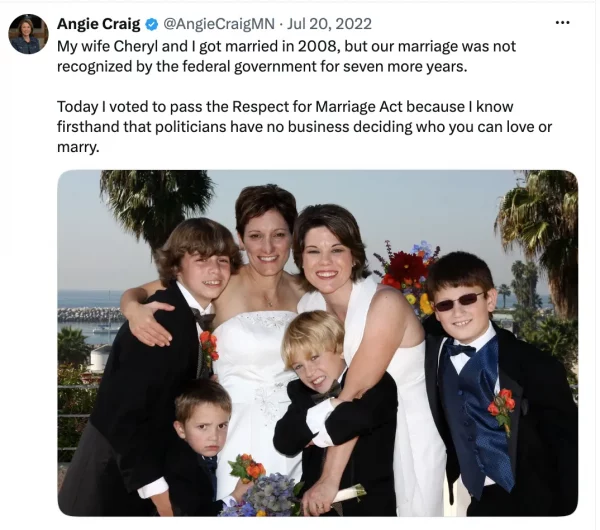
Craig and Langston separated in 2006, and Craig married Cheryl Greene in California in 2008. They have four sons and three grandsons, with a fourth on the way. Greene is a former middle school teacher still involved with youth programming.
Craig worked for LGBTQ equality within her company and for statewide marriage equality in Minnesota. She also fought against an anti-marriage equality constitutional amendment in 2012, which voters rejected. The state legislature passed a marriage equality bill the following year that Gov. Mark Dayton signed into law.
In 2016, when she ran for Congress in Minnesota’s 2nd District, a Republican stronghold for more than a decade, she told the Twin Cities Pioneer Press that the fight for custody of Joshua gave her strength.
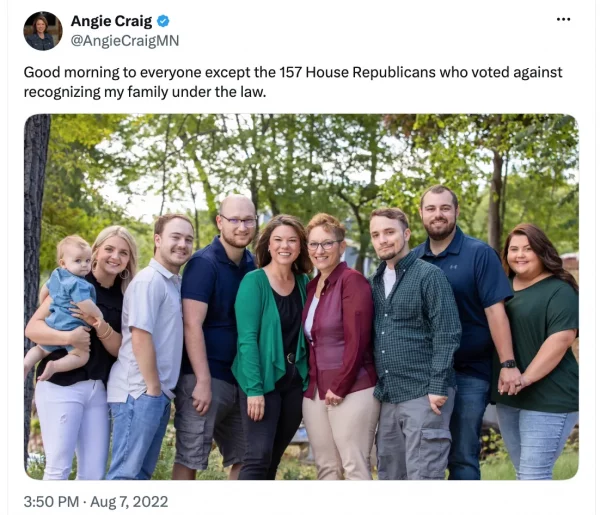
“Whether I win or lose on Election Day, I know that that won’t be the hardest thing or the biggest challenge that I’ve ever faced,” said Craig, then 44. “When you get up every day and wonder, ‘Am I going to (still) have my child the next day?’ you get pretty good at being focused on the big picture.”
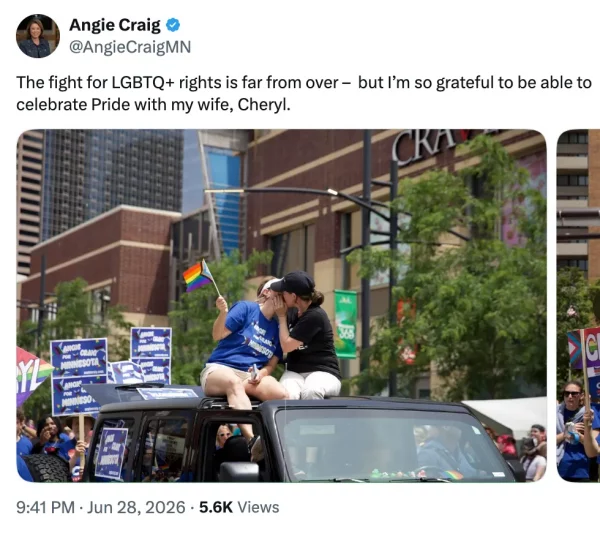
“I’ve always talked about my family openly” on the campaign trail and in office, Craig, co-chair of the Congressional Equality Caucus, tells LGBTQ+ Freedom Fighters. Often at events in her district and around the state, she’ll meet someone who mentions they have an LGBTQ family member, she notes. She finds that if she listens to constituents and addresses what’s important to them, her identity isn’t an issue.
What Craig has addressed for constituents includes health care costs, such as capping the out-of-pocket cost of insulin and limiting overall out-of-pocket drug costs for people on Medicare. These came from a bill introduced by Craig and became provisions of the Inflation Reduction Act, signed into law by President Joe Biden in 2022. She also wants a public option for health insurance, an increased child tax credit, and she introduced a bill to eliminate federal taxes on Social Security benefits.

In a June 19 SurveyUSA poll, Minnesotans say their single most important issue is inflation (39%) and cost of living, followed by health care, immigration, gas prices, and the war in Iran.
But immigration may soon jump to the front as more information leaks out about U.S. Immigration and Customs Enforcement agents shooting and killing Lorenzo Salgado Araujo during a traffic stop in Houston on Tuesday morning, July 9. Homeland Security says the father, with no criminal record, driving to work, ignored verbal instructions and tried to ram their vehicle. ICE shot him in self-defense — the same excuse ICE used on Jan. 7, 2026, when an ICE agent killed nonviolent protester Renee Good. In both instances, video footage proved ICE lied.
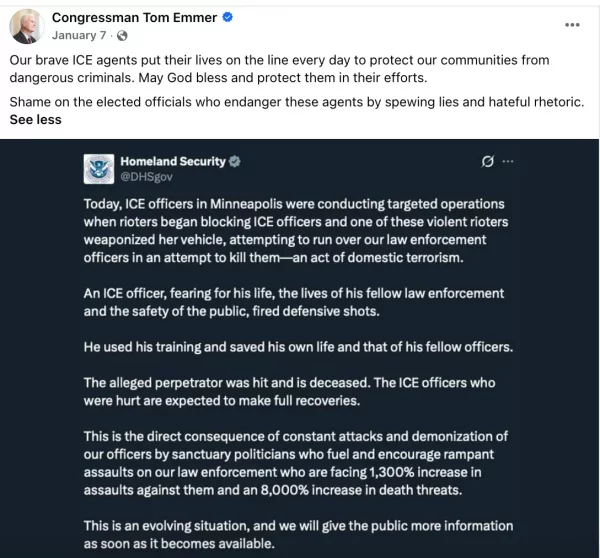
Also caught on tape was Craig’s angry confrontation with Republican Majority Whip Tom Emmer (R-Minn.) on the House floor the day Good was killed after Emmer supported ICE on social media. The story and her response went viral.
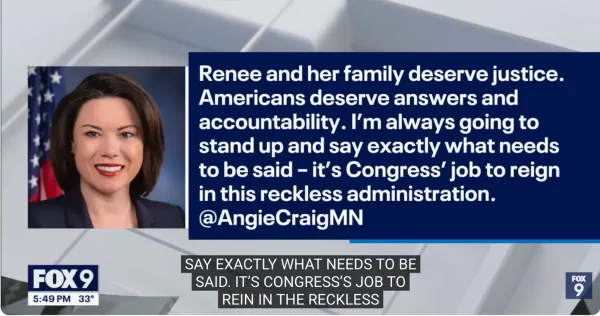
But Craig continues to be criticized for voting for the Laken Riley Act, named for a woman who was killed by an undocumented immigrant. It allows for undocumented immigrants to be detained or deported if they are simply accused of crimes, even nonviolent ones. Critics say she has never apologized — but she has.
In a commentary for The Minnesota Star Tribune in May, Craig wrote, in part:
“The text of the bill did not include the word deportation. I made the difficult decision to vote for it. Democrats like Sens. Mark Kelly and Ruben Gallego, Raphael Warnock and Jon Ossoff — leaders I deeply respect — all came to the same conclusion.
But as I stood side by side with protesters on the streets of Minneapolis and opposite dozens of armed Immigration and Customs Enforcement agents at the Whipple Federal Building after Renee Good’s killing — and again after the killing of Alex Pretti — I couldn’t help but question whether I made the right call last year … It’s also become clear that supporting any bill that gives ICE new authority in this administration was the wrong decision. And I regret my vote.”
“What happened under Operation Metro Surge was horrific,” Craig tells LGBTQ+ Freedom Fighters. The U.S. can secure its borders in a humane fashion while providing a path to citizenship for undocumented people, those brought here as children, and others, she adds.
On LGBTQ rights, Craig says the Equality Act has been a huge priority of hers in the House and would remain so in the Senate.
Since 2019, Craig has introduced the John Lewis Every Child Deserves a Family Act that “would ban discrimination based on sexual orientation, gender identity, religion or marital status in those programs, prohibit the use of federal funds for so-called ‘conversion therapy’ and create a resource center for LGBTQ+ foster and adoptive youth within the Department of Health and Human Services’ Administration for Children and Families,” according to a press release.
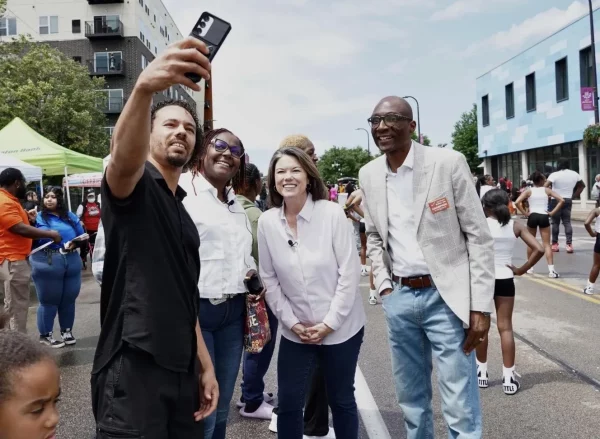
Another priority is passage of the John R. Lewis Voting Rights Advancement Act, named for the late civil rights activist and longtime congressman. “I was lucky enough to serve with John Lewis,” she says.
Additionally, Craig supports campaign finance reform. The recent U.S. Supreme Court ruling that further loosened restrictions was “just another blow to our democracy,” she says. She supports limits on Supreme Court terms.
On foreign policy, she condemns Trump’s war of choice in Iran. “The administration has had zero strategic objectives,” she says, adding that the war has caused “tremendous economic damage,” such as the spike in gas prices.
And though Craig supports a two-state solution to the ongoing Israel-Palestinian conflict, with Palestinians having their own state, her campaign does not accept direct donations from AIPAC’s political action committee — the pro-Israel group held fundraisers for her before her Senate announcement — another point exploited by primary opponent Flanagan.
On gender-affirming care for transgender youth, Craig says politicians should not interfere with decisions made by young people and their parents. Regarding trans girls and women in sports, she says the matter is best handled locally — and that local conversations can foster understanding.
But Craig has had a strong public reaction to federal transphobia. After that, then-U.S. Reps. Tulsi Gabbard (D-Hawaii) and Markwayne Mullin (R-Okla.) introduced the Protect Women’s Sports Act in December 2020. Craig released the following statement:
“As a lesbian woman, I am no stranger to prejudice and intolerance — but this legislation is beyond the pale. Plain and simple, the Protect Women’s Sports Act is transphobic — and this type of discrimination has no place in the halls of Congress. Especially at a time when the transgender community is suffering from a tragic rise in suicide rates and experiencing a surge of transphobic violence, such a bigoted and appalling effort is simply unacceptable. Queer and transgender women must stand together in the face of intolerance — and I am proud to do so today by emphatically denouncing this narrow-minded and hateful legislation, which is harmful not only to transgender women but to the LGBTQ community at-large.”

Craig has been endorsed by prominent LGBTQ groups, including the LGBTQ+ Victory Fund, the Human Rights Campaign PAC, Equality PAC, and LPAC. She has also been endorsed by Minneapolis Mayor Jacob Frey and St. Paul Mayor Kaohly Her, plus many nationally known political figures, such as former Transportation Secretary Pete Buttigieg, U.S. Sen. Tammy Baldwin (D-Wis.), House Speaker Emerita Nancy Pelosi (D-Calif.), and House Democratic Leader Hakeem Jeffries (D-N.Y.).
Flanagan has the endorsement of Smith and her predecessor, Al Franken, Minnesota Attorney General Keith Ellison, and, from outside the state, U.S. Sen. Elizabeth Warren (D-Mass.) and Sanders, among others. U.S. Sen. Amy Klobuchar of Minnesota and the state’s governor, Tim Walz, so far haven’t made endorsements.
“I’m ready on day one” to serve in the Senate, says Craig, noting her four terms in the House, her substantial career before going into politics, and her two votes to impeach Trump. “If we can take the House and Senate, we can put a cap on this administration.”
This is a cross-post from Karen Ocamb’s LGBTQ+ Freedom Fighters Substack.
Health
Too afraid to leave home: ICE’s toll on Latino HIV care
Heightened immigration enforcement in Minneapolis is disrupting treatment
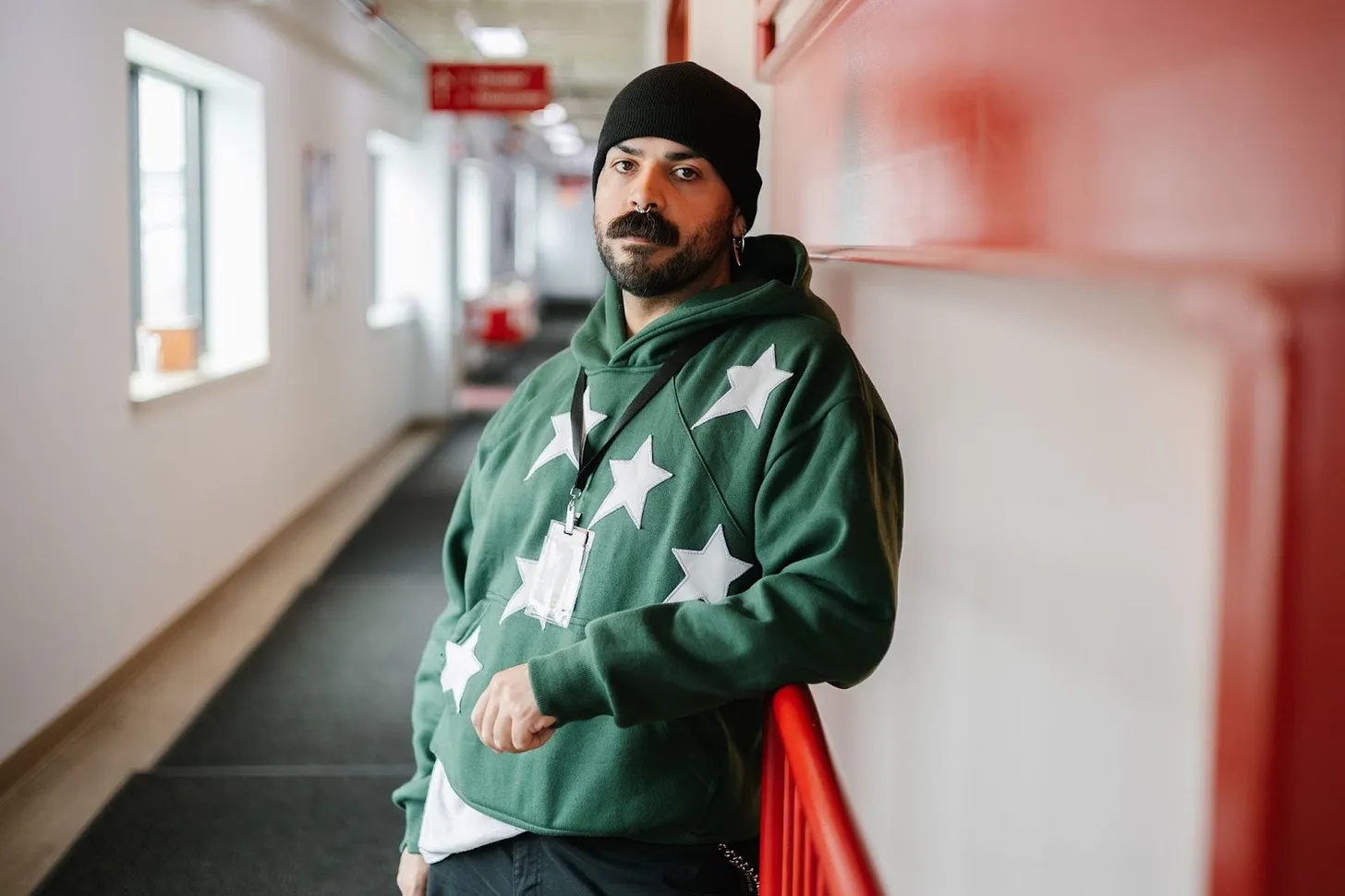
Uncloseted Media published this article on March 3.
This story was produced in collaboration with Rewire News Group, a nonprofit publication reporting on reproductive and sexual health, rights and justice.
This story was produced with the support of MISTR, a telehealth platform offering free online access to PrEP, DoxyPEP, STI testing, Hepatitis C testing and treatment and long-term HIV care across the U.S. MISTR did not have any editorial input into the content of this story.
By SAM DONNDELINGER and CAMERON OAKES | For two weeks, Albé Sanchez didn’t leave their house in South Minneapolis.
“[I was] forced into survival mode,” Sanchez told Uncloseted Media and Rewire News Group (RNG). “I felt like there was an invisible wall [to the outside world] that I couldn’t cross unless I really wanted to put myself in a place where there was a chance that I might not be able to come back.”
Queer and Mexican American, Sanchez was afraid of being targeted by the Immigration and Customs Enforcement presence in their neighborhood, even though they are a U.S. citizen.
“Every day is a risk,” they say, adding that even if they have paperwork, if they fit the profile, they are a target, making it scary to go even to work or the grocery store.
Sanchez, a 30-year-old sexual health care educator, has been taking oral PrEP, the daily preventive medication for HIV, for over a decade. But the mounting stress of ICE raids has made it harder to keep up with dosing.
“A missed dose here and there pushed me to make the appointment [for something more sustainable],” they say.
Sanchez says they felt like somebody would have their back at their local clinic. It was only a 10-minute drive from where they worked, they knew its staff from previous visits and community outreach, and they could count on finding Spanish-speaking staff and providers of Latino heritage. But not everybody has had that same experience accessing care.
Since ICE’s Operation Metro Surge began in early December, an increasing number of Latino patients in Minnesota are delaying or canceling what can be lifesaving care for the prevention and treatment of HIV.
These findings are particularly alarming for Latino communities, who, as of 2023, are 72 percent more likely than the general U.S. population to be diagnosed with HIV. And while overall infections have decreased, cases among Latinos increased by 24 percent between 2010 and 2022.
“I’m very concerned that there is going to be a sharp uptick in transmission,” says Alex Palacios, a community health specialist in the Minneapolis area.
In a January 2026 declaration as part of a lawsuit seeking to end Operation Metro Surge in the days following Renee Nicole Good’s killing, the commissioner of the Minnesota Department of Health said HIV testing among Latino populations has “dropped dramatically” and that “although grantee staff continue to go into the community to promote and provide testing, people are not showing up.”
Local clinics are reporting the same thing. The Aliveness Project, a community wellness center in Minneapolis specializing in HIV care, told Uncloseted Media and RNG they have seen more than a 50 percent decrease in new clients. The clinic serves a large number of Latino and undocumented clients, and while it usually sees 750 people walk through their door each week, according to providers, it reported seeing 100 fewer people each week since December.
Red Door, Minnesota’s largest STI and HIV clinic, has had a “modest uptick” in no-shows and missed appointments since December.
What happens when treatment stops
Today, there are multiple medications available that work to prevent HIV and dozens that treat it once a person tests positive. Many people who consistently take their medication have such low levels of the virus that they can’t transmit it through sex. But becoming undetectable requires patients to stay on their medication; otherwise, the virus replicates and mutates, weakening the immune system and increasing the risk of life-threatening infections.
“If patients aren’t on their medicines consistently, HIV can learn about the medication and become resistant to them. When this happens, the medicine will not work for the patient, and the new resistant virus could potentially be passed on to others,” says George Froehle, a physician assistant and provider at Aliveness Project. “Medication adherence is one of the most important aspects of HIV care.”
To maintain care and prevent dangerous, untreatable strains from spreading in Minnesota, providers at Aliveness Project have begun delivering medication to patients when possible, offering telehealth when they can, and pausing routine lab work to limit in-person appointments.
“The most important thing we can do from a public health perspective is to keep people undetectable so they don’t transmit HIV,” Froehle says, adding that providers in other cities targeted by ICE will need to make plans for missed injection visits, pivot to telehealth and prepare their teams for the “trauma that can occur.”
Sanchez understands the risks of inconsistent treatment, which is why they opted for the injectable preventative medication.
“I have a lot of risk [to HIV in my community],” Sanchez says. “With so much uncertainty about the future and whether HIV care will remain stable, I realized I couldn’t let this opportunity pass.”
But injectable HIV treatments are commonly dosed at two weeks to six months apart, and the medication must be administered in a clinic — a setting many patients are avoiding, according to providers.
“They have a two-week window” to get their shots, according to Froehle, who added that because patients are afraid to come in person, they have had to transition people off of their injectable HIV treatments. This has caused patients to return to oral HIV treatments without the testing they would normally receive had ICE not been in Minneapolis. “[Oral treatments] weren’t super successful [for these patients] to begin with and that’s why they were on injectables.”
Oral HIV medications, too, must be taken consistently to work. In response, providers have urged patients to have their pills with them at all times in case they get deported or detained.
The caution is not unfounded. Federal immigration facilities have a history of denying adequate medical care to people living with HIV, despite internal standards that require them to comply. Since 2025, at least two men living with HIV have been denied access to their medication in a Brooklyn jail, according to lawsuits obtained by THE CITY. One man said he was only given his medication after his lips broke open and he developed an open pustule on his leg. And in January 2025, another man died of HIV complications while in ICE custody in Arizona.
Beyond being detained without proper medication, patients are at risk of being deported to countries with limited access to HIV care, like Honduras and Venezuela, experts say.
“A lot of men [from Venezuela] told me they left because it wasn’t safe to be gay there and because they struggled to access HIV care,” says Froehle. “It’s a little heartbreaking to see new folks not only face the threat of deportation, but to places where they didn’t feel safe medically or identity-wise.”
“Some of these patients will die in their home country,” says Anna Person, the chair of the HIV Medicine Association. “It’s a death sentence.”
A ‘cascading disaster’
While ICE’s presence is threatening the infrastructure of HIV care that Minneapolis has built over decades, experts say there has always been a blind spot in HIV care for the city’s Latino community.
Vincent Guilamo-Ramos, executive director of the Institute for Policy Solutions at the Johns Hopkins University of Nursing, describes HIV in Latino communities as a “cascading disaster,” the result of years of compounding inequities.
“There’s been an invisible crisis among Latinos that hasn’t gotten traction,” he says. “The numbers have consistently gone up in terms of new infections, while nationally they’ve gone down. … That should be a big alarm.”
Numbers are rising because structural barriers and stigma are preventing Latinos from receiving care. A 2022 report from the Centers for Disease Control and Prevention found that between 2018 and 2020, nearly 1 in 4 Hispanic people living with HIV reported experiencing discrimination in health care settings. Lack of representation among providers, language barriers and deep-rooted medical mistrust further complicate access to care, according to Guilamo-Ramos.
Beyond the medical system, stigma within Latino communities can be equally damaging. According to Human Rights Campaign data, more than 78 percent of Latino LGBTQ youth reported experiencing homophobia or transphobia within the Latino community in 2024.
Sanchez agrees that stigma and bias are already massive barriers to care, citing the strict gender norms and Catholic beliefs many Latino communities hold. They say ICE’s presence is threatening already delicate access to HIV care.
“This has caused so much damage to people,” Sanchez says. “Not being able to access your health care appointments is such a stab in the side. … Being able to navigate any of these things in normal circumstances already has so much difficulty to it.”
Palacios, who is Afro-Latine and living with HIV, says the heightened ICE presence is worsening barriers that have long undermined the Latino community’s access to HIV care.
“The horizon has always been stark and dim,” they say. “And this just feels like one more thing to address and to fight back against.”
Sliding backwards
Navigating HIV care is becoming more difficult across the board, as the federal government has decimated HIV funding, compromising decades of progress made in the fight against the virus since Donald Trump retook office just over a year ago.
In February 2026, three months into Operation Metro Surge, the Trump-Vance administration proposed slashing $600 million in HIV-related grants, targeting four blue states, including $42 million for Minnesota programs. A federal judge has temporarily blocked the cuts.
“This would completely decimate and gut all of our HIV prevention,” says Dylan Boyer, director of development at Aliveness Project. “That’s the reality that we live in.”
“We have all the tools, and yet we are staring down this rollback of infrastructure and research dollars, prevention efforts, treatment efforts, that are going to put us squarely back in the 1980s,” says Person, a national HIV expert who grew up in Minnesota. “[There] seems to be no other rationale for that besides cruelty, to be quite frank, since there’s no scientific reason for it.”
Repair and representation
Jenny Harding, director of advancement at a Minneapolis-area supportive housing program for people living with HIV, says that while ICE’s presence is lessening in the Twin Cities, the “damage is done.”
Person says that this mending will take time, especially between the medical community and patients, since HIV providers can have a “very fragile” relationship with their clients.
“It takes, sometimes, years to build that level of trust. And I do worry that folks are just going to say, ‘I don’t feel safe here anymore. The system does not have my best interest at heart, and I’m not coming back,’” she says. “This is not something that you can flip a switch and everything will go back to normal.”
“We need to hold our federal government accountable, particularly HHS, [and] we need to ensure that HIV funding remains intact,” Guilamo-Ramos says, adding that in order to lower rates of HIV in the Latino community, there should be more specialized efforts: such as bilingual and culturally aligned health care providers, community-based outreach programs co-located where risk is highest, trust-building initiatives to address medical mistrust, mobile clinics, and targeted programs to re-engage patients who have fallen out of care.
Aliveness Project’s patient numbers have increased in the last few weeks as the ICE operation has waned, but the clinic staff is keeping “a watchful eye” and is having “difficulty reaching folks who are understandably scared.”
“Our biggest focus right now is reconnecting with people through our outreach so no one has a lapse in their HIV medications or prevention care,” Boyer, of Aliveness Project, says.
For Sanchez, seeing providers who speak Spanish and are of Latin heritage at Aliveness Project built enough trust for them to reach out and make an appointment despite the risks. Sanchez feels optimistic about their new injectable prevention strategy with the support of their clinic.
“There’s many places where you can receive care here in the Twin Cities where you might not see your skin tone. … There’s still a lot of health care professionals that unfortunately carry bias. … Aliveness is the opposite of that,” they say. “Seeing that representation and knowing someone has that cultural context of how to meet you in moments of sensitivity, it’s crucial.”

In ‘The Lost Brontë,’ a complicated lie can lead to danger

CAMP Rehoboth Block Party returns Oct. 18

Essential queer horror classics for Halloween

Solidarity beyond the parade: the actual cost of Pride

Physician: addiction doesn’t always look the way you think it does

10 years later, we still can’t shake Barry Jenkins’s ‘Moonlight’

Bessent says Trump chose him for his qualifications, not his sexuality

‘Some Like It Hot’ a wild ride at renovated Bernard Family Theatre

D.C.’s LGBTQ homeless facilities face possible hit from Trump funding cuts

Trump uses anti-trans slur against Democratic Senate candidate
-

 Movies4 days ago
10 years later, we still can’t shake Barry Jenkins’s ‘Moonlight’
-
Federal Government5 days ago
Bessent says Trump chose him for his qualifications, not his sexuality
-
Theater4 days ago
‘Some Like It Hot’ a wild ride at renovated Bernard Family Theatre
-
District of Columbia4 days ago
D.C.’s LGBTQ homeless facilities face possible hit from Trump funding cuts