Federal Government
41 days and counting: Arizona’s Adelita Grijalva says ‘this has gone way too far’
Representative Adelita Grijalva sits down with the Blade to discuss the Epstein files, transgender rights, and her fight to represent Arizona.
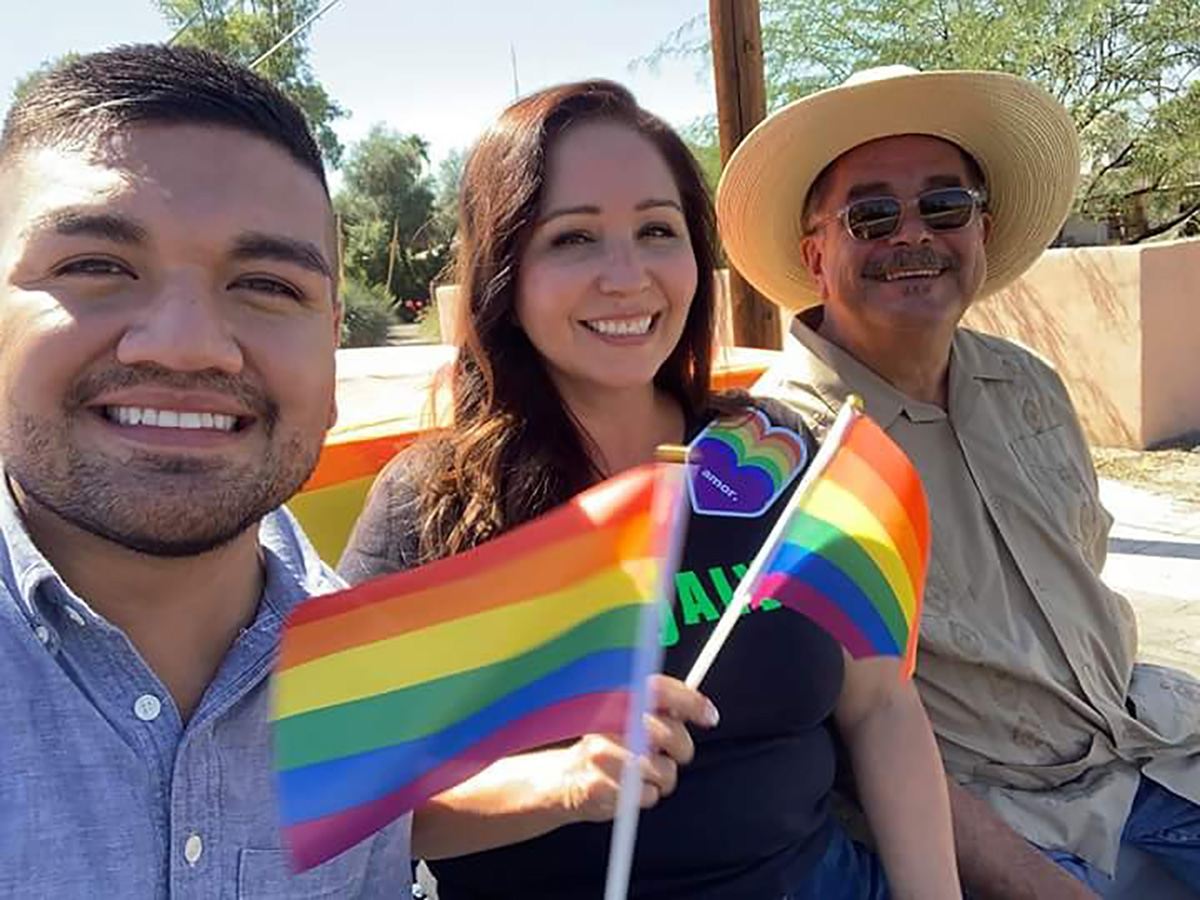
Adelita Grijalva, the recently elected representative from Arizona’s Seventh Congressional District, has already begun making history—without having stepped foot into the Capitol. Grijalva is now officially the longest-delayed member of the House to be sworn in—41 days and counting.
She was elected in a special election on Sept. 23 by a two-to-one margin over her Republican opponent, following the death of her father, Raúl Grijalva, who had represented the district from 2003 until early 2025. The district includes a large portion of Arizona’s southern border with Mexico.
Despite being elected more than 40 days ago, Grijalva has not been given the opportunity to begin her work representing Arizona in the House of Representatives.
Mike Johnson, the Speaker of the House and a representative from Louisiana, has offered several explanations for the delay in swearing in Grijalva—ranging from waiting until all votes were certified in the special election (despite not requiring Republicans who also won special elections to wait) to claiming the House needed to return from recess (despite precedent showing new members are typically sworn in the day after their election, regardless of whether the House is in session). Most recently, Johnson has said Grijalva will not be sworn in until the government reopens.
The Washington Blade sat down with Grijalva to discuss the historic delay in her swearing-in, the importance of protecting transgender rights, book bans, environmental issues, and much more.
While Speaker Johnson has given many explanations for the delay, Grijalva said one stands out above the rest—the Epstein files. She ran on a promise to sign a discharge petition to force a vote for the release of the complete Epstein files, a hypothesized document containing the names of high-profile clients to whom the American financier and convicted child sex offender Jeffrey Epstein trafficked young girls. Her signature on the petition would be the 218th, the minimum number required to force a vote.
“I’ve now broken all the records for speaker obstruction. Nobody else has ever had to wait this long just to represent their constituents… I never received one communication directly from his office,” Grijalva said of Speaker Johnson’s lack of reasoning for the delay. “It seems to me they’re doing everything they can to stop the release of the Epstein files, and I just don’t know what else it could be.”
She added that Johnson’s obstruction isn’t just about her—it’s about the people she was elected to serve.
“We have 812,000 people here in Congressional District 7, and my problem is there’s so much we can’t do,” she said. “So when Speaker Johnson has little side comments to say about what I should and shouldn’t be doing, it’s like—why don’t you do your job so I can do mine?”
For Grijalva, the issue isn’t partisan—it’s about principle. “It shouldn’t matter my party. I won my election fairly and legally, and there’s no reason why my voters should be punished because the Speaker doesn’t like what I stand for,” she said.
She also pointed out the irony that her call for transparency on the Epstein files mirrors one made by Donald Trump himself during his presidential campaign.
“Trump ran on day one, ‘I’m going to release those files,’ and I think he got into office, saw what was in them, and said, ‘Maybe we wait on that,’” she explained. “That’s what I feel is happening now—they’re trying to delay and distract from something that’s going to make a lot of powerful people look bad.”
Still, Grijalva said not all Republicans support Johnson’s decision to keep her from being sworn in. “A couple Republicans have said, ‘Yeah, she should be sworn in. This is crazy.’ I appreciate that—it shouldn’t matter my party. I should be sworn in, period. I think some people on their side know this has gone way too far.”
As the government shutdown drags on, Grijalva said the consequences of congressional inaction are becoming increasingly dire for ordinary Americans.
“Who’s really suffering are the federal workers—people on federal grants, SNAP benefits—who don’t know when they’ll get their next paycheck or how they’ll feed their families,” she said. “These are real-life consequences while they play political games.”
Her frustration over the Epstein files remains steadfast. Grijalva said accountability and transparency must come before politics.
“I don’t care who’s implicated. I don’t care what party they are. If you committed a crime—if you raped children and women—you deserve legal consequences. Survivors deserve transparency and justice so they can begin healing.”
Beyond political accountability, Grijalva also emphasized the urgent need to address environmental degradation—a crisis that hits especially close to home.
“Trump doesn’t care about our environment. If there’s a dollar to be made, he’s going to do it, and he’s not thinking about the long-term consequences for people who actually have to live with the damage,” she said.
The Trump-Vance administration has rolled back a slew of Biden-era environmental policies, from pulling the U.S. out of the Paris Climate Accords to weakening pollution standards and expanding drilling for fossil fuels. For Grijalva, these choices have real, human consequences.
“My dad lived in a Superfund site and drank poisoned water for 15 years. Cancer is now part of our family because of that. These policies aren’t abstract—they hurt real people.”
Her father, the late Raúl Grijalva, passed away from lung cancer earlier this year. The Environmental Working Group estimates that between 100,000 and 122,000 cancer cases in the U.S. may stem from contaminated water—something Grijalva said her family understand all too well.
She also pointed out how allowing environmental destruction by repealing laws meant to protect natural resources threatens Arizona’s economy and identity.
“Arizona is an ecotourism hotspot—there are thousands of jobs tied to protecting our lands. When you destroy it, you can’t put it back together,” she said. “The mining laws are so old that we don’t even get any proceeds for years. It’s like someone digging in your backyard, taking your gold, and then telling you to buy it back later.”
“When people say environmental protection isn’t a priority, I just think of my dad and of our state,” she added. “You don’t gamble with people’s health for a quick profit.”
Shifting to social issues, Grijalva spoke at length about protecting transgender rights during a time when many—particularly on the right—continue to villainize the community.
“Trans rights are human rights. That’s it,” she said firmly. “When I say I’ll speak up for those who don’t feel they have a voice, I mean everybody—especially people who’ve been pushed to the margins.”
She didn’t shy away from calling out members of her own party who, in her view, haven’t done enough. “It’s disappointing that some Democrats are willing to stay silent as a whole community is being attacked,” she said. “Maybe they’ve never known what it’s like to be targeted, but once you have, you stand up for those who need more support.”
“I believe gender-affirming care is life-saving care,” she continued. “We have to push back against these anti-LGBTQ laws and fight for the Equality Act because the federal government has a responsibility to protect people, not erase them.”
“It’s not the government’s business who you love or who you are,” she added. “You should have the autonomy to be whoever you want to be—that is America.”
The congresswoman also spoke passionately about the growing movement to ban books and target libraries—something she called “deeply personal.”
“I’m not only the wife—I’m the daughter and sister of librarians,” Grijalva said with a laugh. “So if I’m not an advocate for our libraries, I’m in a lot of trouble. There should not be banned books. Those stories are a lifeline for students who don’t have support at home.”
She recalled a conversation that underscored her frustration with the movement. “A woman once showed me a book and said, ‘Do you think this should be available to children?’ I said, ‘Are the pictures anatomically inaccurate? Because if they’re correct, why do you care?’ We shouldn’t be policing truth or reality just because it makes some adults uncomfortable.”
Public service, for Grijalva, has always been personal. She was the youngest woman ever elected to the Tucson Unified School District Governing Board in 2002 and served in that role for 20 years—making her one of the longest-serving board members in history.
“I’ve been in elected office for 22 years,” she reflected. “People from high school tell me I’m the same person—and that’s what I want. You don’t let the environment change you; you change the environment.”
“I always have to look my kids in the eye at the end of the day,” she added. “If I have to explain a vote too much, then it’s wrong. That’s the standard I hold myself to.”
Even amid the uncertainty of her delayed swearing-in, Grijalva said she remains focused on the people she was elected to serve.
“The privilege of being able to speak for 812,000 people—it’s overwhelming, but it’s such an honor,” she said. “I’m excited to get sworn in and finally start doing the work my community sent me to do.”

Federal Government
Protesters say SAVE Act targets voters, transgender youth
Bill described as ‘Jim Crow 2.0’
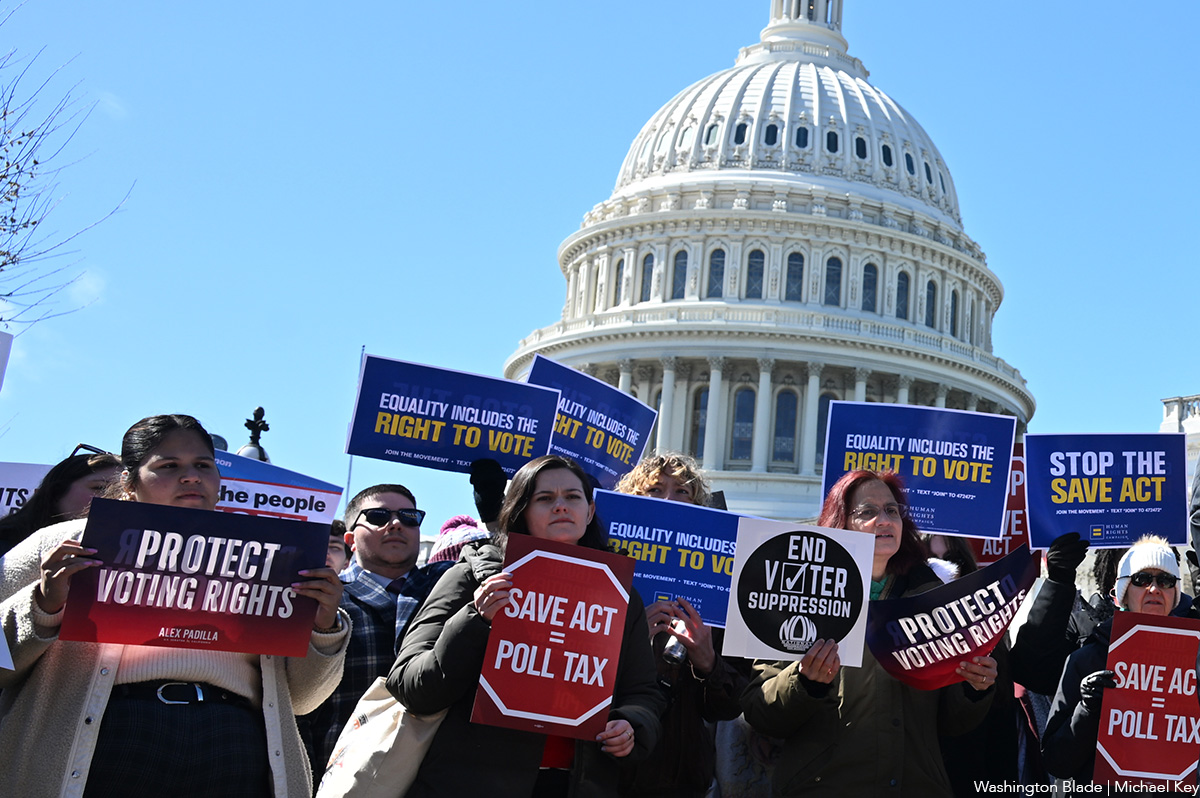
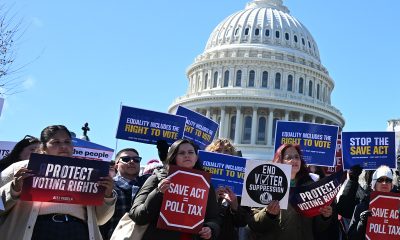
Members of Congress, advocates, and people from across the country gathered outside the U.S. Capitol on Tuesday to protest proposed federal legislation that voting rights activists have deemed “Jim Crow 2.0.”
The Safeguard American Voter Eligibility (SAVE) Act would amend the National Voter Registration Act of 1993 to require in-person proof of citizenship for anyone seeking to vote in U.S. elections.
President Donald Trump has also pushed for the proposed legislation to include a section that would ban gender-affirming medical care for transgender minors, even with parental consent, and prohibit trans people from participating in school or professional sports consistent with their gender identity rather than their sex assigned at birth.
In addition to changing voter registration requirements, the bill would limit acceptable forms of identification to documents such as a birth certificate or passport — records that the Brennan Center for Justice estimates more than 21 million Americans do not have — effectively restricting access to the ballot. It would also ban online voter registration, DMV voter registration efforts, and mail-in voter registration.
A 2021 investigation by the Associated Press found that fewer than 475 people voted illegally or improperly, a tiny fraction of the estimated 160 million Americans who voted in the 2020 election.
Senate Minority Leader Chuck Schumer (D-N.Y.) spoke at the event.
“It will kick millions of American citizens off the rolls. And they don’t even require you to be told,” the highest-ranking Democrat in the Senate told protesters and reporters outside the Capitol. “If this law passes — and it won’t — you’re gonna show up in November … and they’ll say… sorry, you’re no longer on the voting rolls.”
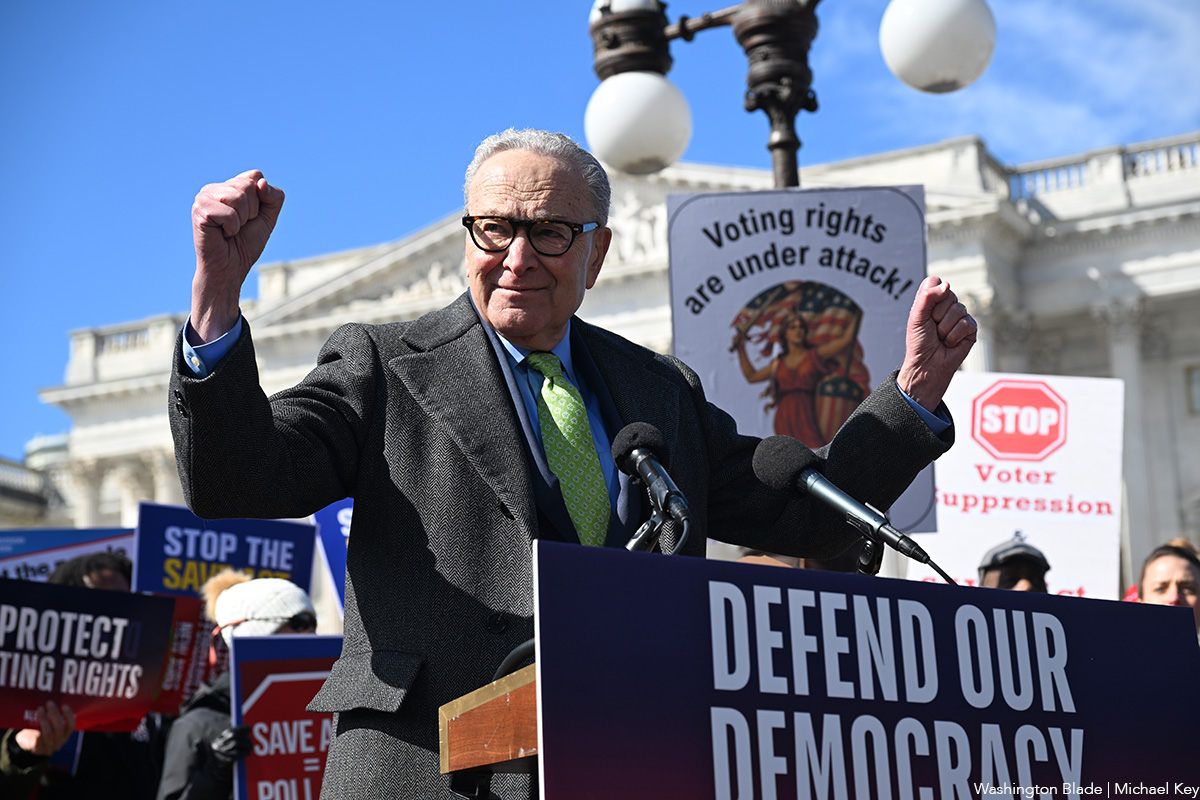
He, like many other speakers, emphasized the bill in the context of American history, pointing to what he described as its racist roots and its impact on Black and brown Americans.
“I have called this act, over and over again, Jim Crow 2.0 … because they know it’s the truth.”
U.S. Sen. Alex Padilla (D-Calif.) was one of the lawmakers leading opposition to the legislation and spoke at the rally.
“It’s not just voting rights that are on the line — our democracy is on the line,” the California lawmaker said. “It’s not a voter I.D. bill. It’s a bait and switch bill.”
He added historical context, noting the significance of voting rights legislation passed more than 60 years ago. In 1965, Alabama civil rights activists marched to protest barriers to voter registration. Alabama state troopers violently attacked peaceful demonstrators at the Edmund Pettus Bridge in Selma, using tear gas, clubs, and whips against more than 500 — mostly Black — protesters.
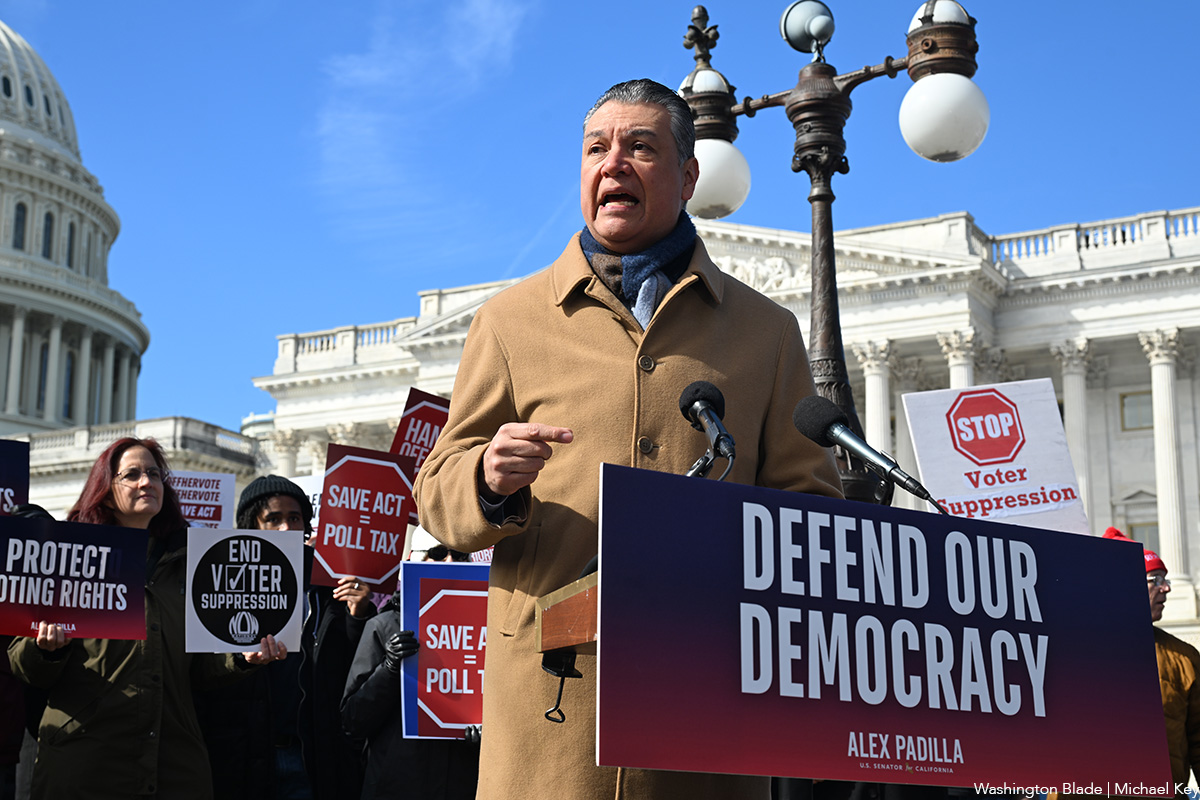
“61 years ago — not to the day — but this week, President Lyndon Johnson came to the Capitol and addressed a joint session of Congress in the wake of Bloody Sunday and pushed Congress to pass the Voting Rights Act,” Padilla said. “61 years later, Donald Trump and this Republican majority wants to take us backwards. We’re not gonna let that happen.”
U.S. Sen. Ben Ray Luján (D-N.M.) also spoke, emphasizing that he views the effort as a Republican-led and Trump-backed attempt to restrict voting access, particularly among Black, brown, and predominantly Democratic communities.
“President Trump told Republicans when they were meeting behind closed doors that ‘The SAVE Act will guarantee Republicans win the midterms and ensure they do not lose an election for 50 years,’” Luján said. “The first time I think Donald Trump’s been honest … This voter suppression bill is only that. Taking away vote by mail? I hope my Republican colleagues from states that voted for Donald Trump or where vote by mail is popular have the courage and the backbone to stand up and say no to this nonsense, because their constituents are going to push back.”
U.S. Sen. Lisa Blunt Rochester (D-Del.) also spoke.
“Our Republican colleagues have already cut Medicaid, Medicare, people don’t know how they’re gonna be able to afford energy,” she said, providing context for the broader political moment. “We’re in the middle of a war that they can’t even get straight while we’re in it and don’t have a way to get out of it. And we are now faced with defending our democracy?”
She then showed the crowd something that she said has been with her throughout her political journey in Washington.
“I brought with me something that I carried on the day that I was sworn into the House of Representatives when I was elected in 2016, and I carried it with me on the day that I was sworn in as United States senator. And I also carried it with me when I was trapped up in the gallery on Jan. 6 and all I could think to do was pray … This document allowed my great great great grandfather, who had been enslaved in Georgia, to have the right to vote. We took this and turned it into a scarf. It is the returns of qualified voters and reconstruction code from 1867. This is my proof of what we’ve been through. This is also our inspiration.”
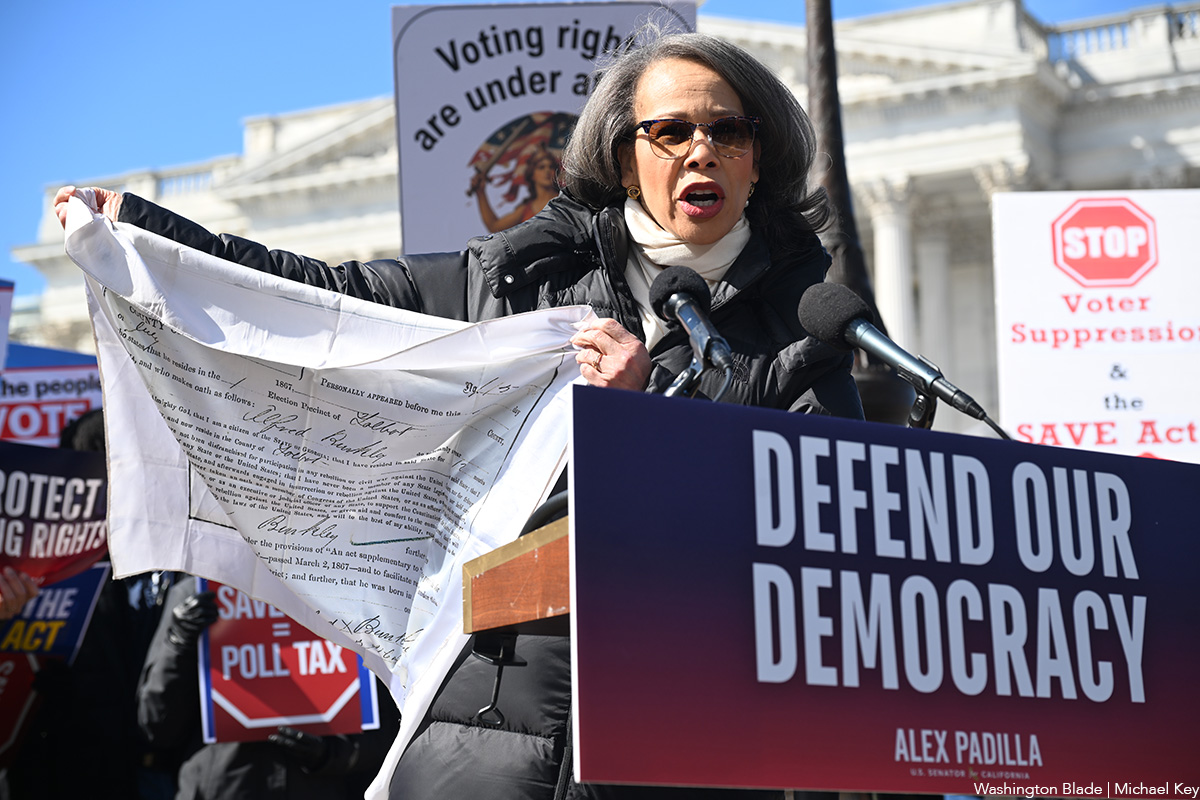
“I got to travel between the Edmund Pettus Bridge two times. And even as I thought about this moment, I recognized that while we wish we weren’t in it, while we don’t know why we’re in it, I do know we were made for it … So I came today to tell you that, um, just like the leader said, that he calls it Jim Crow 2.0. I call it Jim Crow 2.NO.”
Kelley Robinson, president of the Human Rights Campaign, the largest LGBTQ advocacy organization in the U.S., also spoke, highlighting the impact of the bill’s proposed provisions affecting trans people.
“This bill is not about saving America. This bill is about stealing an election. This bill is about suppressing voters,” Robinson said. “This bill not only tries to disenfranchise voters that deserve their right to vote, it also tries to criminalize trans kids and their families … It tries to criminalize doctors providing medically necessary care for our trans youth.”
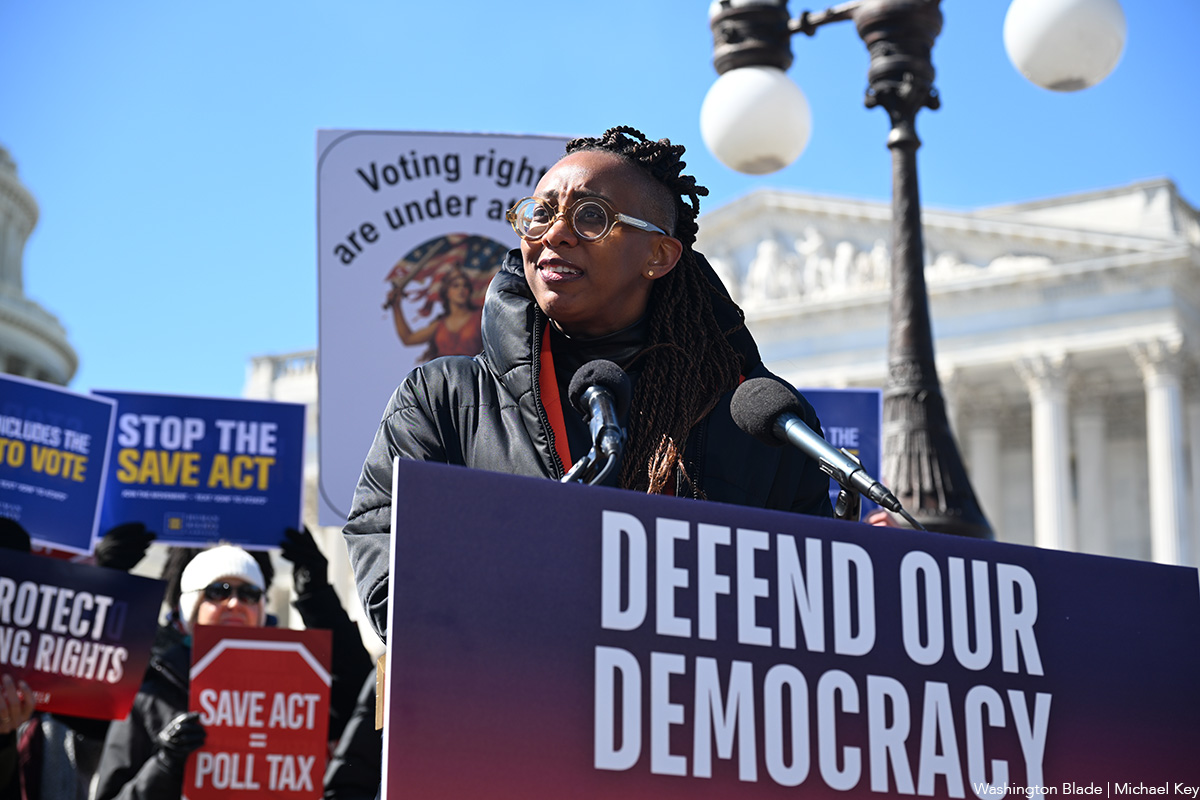
The SAVE Act passed the U.S. House of Representatives on Feb. 11 but has not yet been considered in the U.S. Senate.
Federal Government
Gay Venezuelan man ‘forcibly disappeared’ to El Salvador files claim against White House
Andry Hernández Romero had asked for asylum in US

A gay Venezuelan asylum seeker who the U.S. “forcibly disappeared” to El Salvador has filed a claim against the federal government.
Immigrant Defenders Law Center, who represents Andry Hernández Romero, on Friday announced their client and five other Venezuelans who the Trump-Vance administration “forcibly removed” to El Salvador under the Alien Enemies Act of 1798, filed “administrative claims” under the Federal Tort Claims Act.
The White House on Feb. 20, 2025, designated Tren de Aragua, a Venezuelan gang, as an “international terrorist organization.”
President Donald Trump less than a month later invoked the Alien Enemies Act of 1798, which the Associated Press notes allows the U.S. to deport “noncitizens without any legal recourse.” The White House then “forcibly removed” Hernández, who had been pursuing his asylum case in the U.S., and more than 250 other Venezuelans to El Salvador.
Immigrant Defenders Law Center disputed claims that Hernández is a Tren de Aragua member.
Hernández was held at El Salvador’s Terrorism Confinement Center, a maximum-security prison known by the Spanish acronym CECOT, until his release on July 18, 2025. Hernández, who is back in Venezuela, claims he suffered physical and sexual abuse while at CECOT.
“As a Venezuelan citizen with no criminal record anywhere in the world, I would like to tell not only the government of the United States but governments everywhere that no human being is illegal,” said Hernández in the Immigrant Defenders Law Center press release. “The practice of judging whole communities for the wrongdoing of a single individual must end. Governments should use their power to help every person in the nation become more aware and informed, to strengthen our cultures and build a stronger generation with principles and values — one that multiplies the positive instead of destroying unfulfilled dreams and opportunities.”
Immigrant Defenders Law Center filed claims on behalf of Hernández and the five other Venezuelans less than three months after American forces seized then-Venezuelan President Nicolás Maduro and his wife, Cilia Flores, at their home in Caracas, the Venezuelan capital.
Maduro and Flores have pleaded not guilty to federal drug charges. Delcy Rodríguez, who was Maduro’s vice president, is Venezuela’s acting president.
‘Due process and accountability cannot be optional’
Immigrant Defenders Law Center on Friday also made the following demands:
- The Trump administration must officially release the names of all people the United States sent to CECOT to ensure that everyone has been or will be released.
- The federal government must clear the names of the 252 men wrongfully labeled as criminal gang members of Tren de Aragua.
- DHS (Department of Homeland Security) must end the practice of outsourcing torture through third‑country removals, restore humanitarian parole, and rebuild a functioning, humane asylum system.
- DHS must reinstate Temporary Protected Status for all individuals who cannot safely return to their home countries, halt mass deportations and unlawful raids and arrests, and guarantee due process for everyone navigating the immigration system.
- Congress must pass the Neighbors Not Enemies Act, which would repeal the Alien Enemies Act.
“In all my years as an immigration attorney, I have never seen a client simply vanish in the middle of their case with no explanation,” said Immigration Defenders Legal Fund Legal Services Director Melissa Shepard. “In court, the government couldn’t even explain where he was — he had been disappeared.”
“When the government detains and transfers people in secrecy, without transparency or access to the courts, it tears at the basic protections a democracy is supposed to guarantee,” added Shepard. “What this experience makes painfully clear is that due process and accountability cannot be optional. They are the only safeguards standing between people and the kind of lawlessness our clients suffered. We must end third country transfers, restore the asylum system, and humanitarian parole, and reinstate temporary protective status so this nightmare never happens again.”
Federal Government
Two very different views of the State of the Union
As Trump delivered his SOTU address inside the Capitol, Democratic lawmakers gathered outside in protest, condemning the administration’s harmful policies.
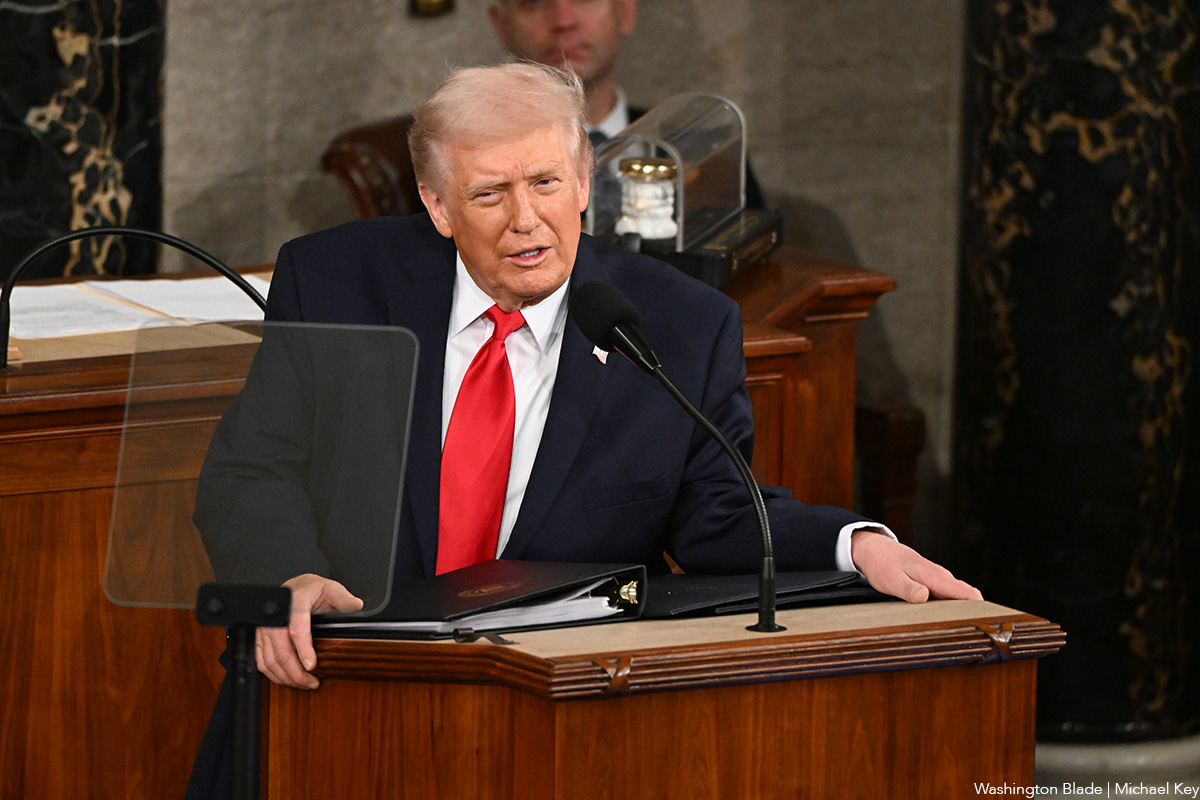
As President Donald Trump delivered his State of the Union address inside the U.S. Capitol — touting his achievements and targeting political enemies — progressive members of Congress gathered just outside in protest.
Their message was blunt: For many Americans, particularly LGBTQ people, the country is not better off.
Each year, as required by Article II, Section 3 of the Constitution, the president must “give to the Congress Information of the State of the Union.” The annual address is meant to outline accomplishments and preview the year ahead. This year, Trump delivered the longest State of the Union in U.S. history, clocking in at one hour and 48 minutes. He spoke about immigration, his “law and order” domestic agenda, his “peace through strength” foreign policy doctrine, and what he framed as the left’s ‘culture wars’ — especially those involving transgender youth and Christian values.
But one year into what he has called the “Trump 2.0” era, the picture painted outside the Capitol stood in stark contrast to the one described inside.
Transgender youth
In one of the most pointed moments of his speech, Trump spotlighted Sage Blair, using her story to portray gender-affirming care as coercive and dangerous. Framing the issue as one of parental rights and government overreach, he told lawmakers and viewers:
“In the gallery tonight are Sage Blair and her mother, Michelle. In 2021, Sage was 14 when school officials in Virginia sought to socially transition her to a new gender, treating her as a boy and hiding it from her parents. Hard to believe, isn’t it? Before long, a confused Sage ran away from home.
“After she was found in a horrific situation in Maryland, a left-wing judge refused to return Sage to her parents because they did not immediately state that their daughter was their son. Sage was thrown into an all-boys state home and suffered terribly for a long time. But today, all of that is behind them because Sage is a proud and wonderful young woman with a full ride scholarship to Liberty University.
“Sage and Michelle, please stand up. And thank you for your great bravery and who can believe that we’re even speaking about things like this. Fifteen years ago, if somebody was up here and said that, they’d say, what’s wrong with him? But now we have to say it because it’s going on all over, numerous states, without even telling the parents.
“But surely, we can all agree no state can be allowed to rip children from their parents’ arms and transition them to a new gender against the parents’ will. Who would believe that we’ve been talking about that? We must ban it and we must ban it immediately. Look, nobody stands up. These people are crazy. I’m telling you, they’re crazy.”
The story, presented as encapsulation of a national crisis, became the foundation for Trump’s renewed call to ban gender-affirming care. LGBTQ advocates — and those familiar with Blair’s story — argue that the situation was far more complex than described and that using a single anecdote to justify sweeping federal restrictions places transgender people, particularly youth, at greater risk.
Equality Virginia said the president’s remarks were part of a broader effort to strip transgender Americans of access to care. In a statement to the Blade, the group said:
“Tonight, the president is choosing to double down on efforts to disrupt access to evidence-based, lifesaving care.
“Rather than allowing families and doctors to navigate deeply personal medical decisions free from federal interference — or allowing schools to respond with nuance and compassion without putting marginalized children at risk — the president is instead advocating for reckless, one-size-fits-all political control.
“At a time when Virginians are worried about rising costs, economic uncertainty, and aggressive immigration enforcement actions disrupting communities and families, attacking transgender young people is a blatant political distraction from the real challenges facing our nation. Virginia families and health care providers do not need Donald Trump telling them what care they do or do not need.”
For many in the LGBTQ community, the rhetoric inside the chamber echoed actions already taken by the administration.
Earlier this month, the Pride flag was removed from the Stonewall National Monument under a National Park Service directive that came from the top. Community members returned to the site, raised the flag again, and filed suit, arguing the removal violated federal law. To advocates, the move was symbolic — a signal that even the legacy of LGBTQ resistance was not immune.
Immigration and fear
Immigration dominated both events as well.
Inside the chamber, Trump boasted about the hundreds of thousands of immigrants detained in makeshift facilities. Outside, Democratic lawmakers described those same facilities as concentration camps and detailed what they characterized as the human toll of the administration’s enforcement policies.
Sen. Ed Markey (D-Mass.), speaking to the crowd, painted a grim picture of communities living in fear:
“People are vanishing into thin air. Quiet mornings are punctuated by jarring violence. Students are assaulted by ICE agents sitting outside the high school, hard working residents are torn from their vehicles in front of their children. Families, hopelessly search for signs of their loved ones who have stopped answering their phones, stop replying to text… This is un-American, it is illegal, it is unconstitutional, and the people are going to rise up and fight for Gladys Vega and all of those poor people who today need to know that the people’s State of the Union is the beginning of a long fight that is going to result in the end of Republican control of the House of Representatives and the Senate in the United States of America in 2026.”
Speakers emphasized that LGBTQ immigrants are often especially vulnerable — fleeing persecution abroad only to face detention and uncertainty in the United States. For them, the immigration crackdown and the attacks on transgender health care are not separate battles but intertwined fronts in a broader cultural and political war.
Queer leadership
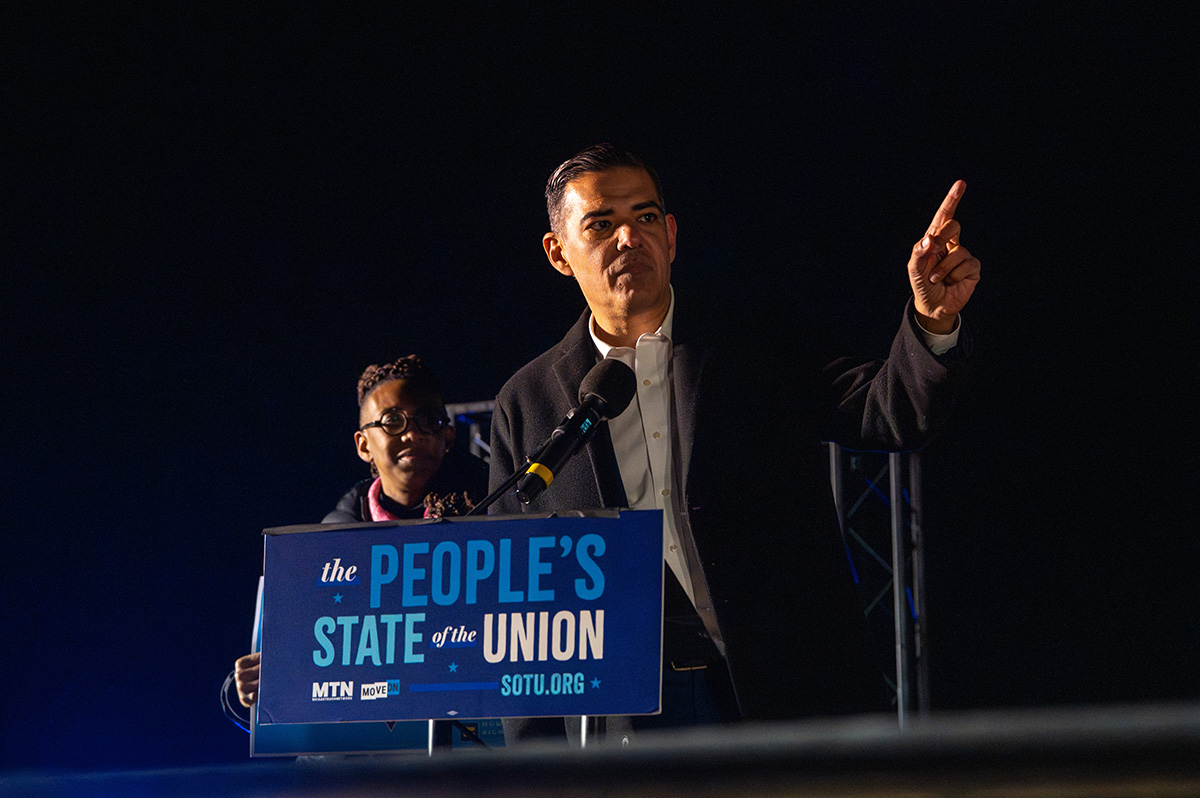
After delivering remarks alongside Robert Garcia, Kelley Robinson, president of the Human Rights Campaign, took the stage and transformed the freezing crowd’s anger into resolve.
Garcia later told the Blade that visibility matters in moments like this — especially when LGBTQ rights are under direct attack.
“We should be crystal clear about right now what is happening in our country,” Garcia said. “We have a president who is leading the single largest government cover up in modern history, we have the single largest sex trafficking ring in modern history right now being covered up by Donald Trump and Pam Bondi In the Department of Justice. Why are we protecting powerful, wealthy men who have abused and raped women and children in this country? Why is our government protecting these men at this very moment? In my place at the Capitol is a woman named Annie farmer. Annie and her sister Maria, both endured horrific abuse by Jeffrey Epstein and Ghislaine Maxwell. As we move forward in this investigation, always center the survivors; we are going to get justice for the survivors. And Donald Trump may call this investigation a hoax. He may try to deflect our work, but our message to him is very clear that our investigation is just getting started, and we will we will get justice for these survivors.”
He told the Blade afterwards that having queer leaders front and center is itself an act of resistance.
“I obviously was very honored to speak with Kelley,” the California representative said. Kelley is doing a great job…it’s important that there are queer voices, trans voices, gay voices, in protest, and I think she’s a great example of that. It’s important to remind the country that the rights of our community continue to be attacked, and then we’ve got to stand up. Got to stand up for this as well.”
Robinson echoed that call, urging LGBTQ Americans — especially young people — not to lose hope despite the administration’s escalating rhetoric.
“There are hundreds of thousands of people that are standing up for you every single day that will not relent and will not give an inch until every member of our community is protected, especially our kids, especially our trans and queer kids. I just hope that the power of millions of voices drowns out that one loud one, because that’s really what I want folks to see at HRC. We’ve got 3.6 million members that are mobilizing to support our community every single day, 75 million equality voters, people that decide who they’re going to vote for based on issues related to our community. Our job is to make sure that all those people stand up so that those kids can see us and hear our voices, because we’re going to be what stands in the way.”
A boycott — and a warning
The list of Democratic lawmakers who boycotted the State of the Union included Sens. Ruben Gallego, Ed Markey, Jeff Merkley, Chris Murphy, Adam Schiff, Tina Smith, and Chris Van Hollen, along with dozens of House members.
For those gathered outside — and for viewers watching the livestream hosted by MoveOn — the counter-programming was not merely symbolic. It was a warning.
While the president spoke of strength and success inside the chamber, LGBTQ Americans — particularly transgender youth — were once again cast as political targets. And outside the Capitol, lawmakers and advocates made clear that the fight over their rights is far from over.

Queer American in Israel discusses Iran war’s impact

Housewives take Capitol Hill by storm

Protesters say SAVE Act targets voters, transgender youth

‘It’s Dorothy’ traces lasting influence of a cultural icon
SAVE Act could silence millions of trans voters

PHOTOS: Awesome Con

Kennedy Center leadership changes as Trump ally Grenell departs

Russian neocolonial politics promote anti-LGBTQ imperialistic values

Man charged with carjacking, kidnapping after having sex in D.C. park pleads guilty

Protecting D.C.’s promise: why Kenyan McDuffie deserves our support
-

 Photos5 days ago
PHOTOS: Awesome Con
-
The White House4 days ago
Kennedy Center leadership changes as Trump ally Grenell departs
-
Russia4 days ago
Russian neocolonial politics promote anti-LGBTQ imperialistic values
-
District of Columbia3 days ago
Man charged with carjacking, kidnapping after having sex in D.C. park pleads guilty