Movies
Superb direction, performances create a ‘Day’ to remember
A rich cinematic tapestry with deep observations about art, life, friendship

According to writer/director Ira Sachs, “Peter Hujar’s Day” is “a film about what it is to be an artist among artists in a city where no one was making any money.” At least, that’s what Sachs – an Indie filmmaker who has been exploring his identities as both a gay and Jewish man onscreen since his 1997 debut effort, “The Delta” – told IndieWire, with tongue no doubt firmly planted in cheek, in an interview last year.
Certainly, money is a concern in his latest effort – which re-enacts a 1974 interview between photographer Peter Hujar (Ben Whishaw) and writer Linda Rosenkrantz (Rebecca Hall), as part of an intended book documenting artists over a single 24-hour period in their lives – and is much on the mind of its titular character as he dutifully (and with meticulous detail) recounts the events of his previous day during the course of the movie. To say it is the whole point, though, is clearly an overstatement. Indeed, hearing discussions today of prices from 1974 – when the notion of paying more than $7 for Chinese takeout in New York City seemed outrageous – might almost be described as little more than comic relief.
Adapted from a real-life interview with Hujar, which Rosenkrantz published as a stand-alone piece in 2021 (her intended book had been abandoned) after a transcript was discovered in the late photographer’s archives, “Peter Hujar’s Day” inevitably delivers insights on its subject – a deeply influential figure in New York culture of the seventies and eighties, who would go on to document the scourge of AIDS until he died from it himself, in 1987. There’s no plot, really, except for the recalled narrative itself, which involves an early meeting with a French journalist (who is picking up Hujar’s images of model Lauren Hutton), an afternoon photo shoot with iconic queer “Beat Generation” poet/activist Allen Ginsburg, and an evening of mundane social interaction over the aforementioned Chinese food. Yet it’s through this formalized structure – the agreed-upon relation of a sequence of events, with the thoughts, observations, and reflections that come with them – that the true substance shines through.
In relaying his narrative, Hujar exhibits the kind of uncompromising – and slavishly precise – devotion to detail that also informed his work as a photographer; a mundane chronology of events reveals a universe of thought, perception, and philosophy of which most of us might be unaware while they were happening. Yet he and Rosenkrantz (at least in Sachs’ reconstruction of their conversation) are both artists who are keenly aware of such things; after all, it’s this glimpse of an “inner life,” of which we are rarely cognizant in the moment, that was/is their stock-in-trade. It’s the stuff we don’t think of while we’re living our lives: the associations, the judgments, the selective importance with which we assign each aspect of our experiences, that later become a window into our souls – if we take the opportunity to look through it. And while the revelations that come may occasionally paint them in a less-than-idealized light (especially Hujar, whose preoccupations with status, reputation, appearances, and yes, money, often emerge as he discusses the encounter with Ginsberg and his other interactions), they never feel like definitive interpretations of character; rather, they’re just fleeting moments among all the others, temporary reflections in the ever-ongoing evolution of a lifetime.
Needless to say, perhaps, “Peter Hujar’s Day” is not the kind of movie that will be a crowd-pleaser for everyone. Like Louis Malle’s equally acclaimed-and-notorious “My Dinner With Andre” from 1981, it’s essentially an action-free narrative comprised entirely of a conversation between two people; nothing really happens, per se, except for what we hear described in Hujar’s description of his day, and even that is more or less devoid of any real dramatic weight. But for those with the taste for such an intellectual exercise, it’s a rich and complex cinematic tapestry that rewards our patience with a trove of deep observations about art, life, and friendship – indeed, while its focus is ostensibly on Hujar’s “day,” the deep and intimate love between he and Rosenkrantz underscores everything that we see, arguably landing with a much deeper resonance than anything that is ever spoken out loud during the course of the film – and never permits our attention to flag for even a moment.
Shooting his movie in a deliberately self-referential style, Sachs weaves the cinematic process of recreating the interview into the recreation itself, bridging mediums and blurring lines of reality to create a filmed meditation that mirrors the inherent artifice of Rosenkrantz’s original concept, yet honors the material’s nearly slavish devotion to the mundane minutiae that makes up daily life, even for artists. This is especially true for both Hujar and Rosenkrantz, whose work hinges so directly to the experience of the moment – in photography, the entire end product is tied to the immediacy of a single, captured fragment of existence, and it is no less so for a writer attempting to create a portrait (of sorts) composed entirely of fleeting words and memories. Such intangibles can often feel remote or even superficial without further reflection, and the fact that Sachs is able to reveal a deeper world beyond that surface speaks volumes to his own abilities as an artist, which he deploys with a sure hand to turn a potentially stagnant 75 minutes of film into something hypnotic.
Of course, he could not accomplish that feat without his actors. Whishaw, who has proven his gifts and versatility in an array of film work including not only “art films” like this one but roles from the voice of Paddington Bear to “Q” in the Daniel Craig-led “James Bond” films, delivers a stunning performance, carrying at least 75% of the film’s dialogue with the same kind of casual, in-the-moment authenticity as one might expect at a dinner party with friends; and though Hall has less speaking to do, she makes up for it in sheer presence, lending a palpable sense of respect, love, and adoration to Rosenkrantz’s relationship with Hujar.
In fact, by the time the final credits role, it’s that relationship that arguably leaves the deepest impression on us; though these two people converse about the “hoi polloi” of New York, dropping legendary names and reminding us with every word of their importance in the interwoven cultural landscape – evoked with the casual air of everyday routine before it becomes cemented as history – of their era, it’s the tangible, intimate friendship they share that sticks with us, and ultimately feels more important than any of the rest of it. For all its trappings of artistic style, form, and retrospective cultural commentary, it’s this simple, deeply human element that seems to matter the most – and that’s why it all works, in the end. None of its insights or observations would land without that simple-but-crucial link to humanity.
Fortunately, its director and stars understand this perfectly, and that’s why “Peter Hujar’s Day” has an appeal that transcends its rarified portrait of time, place, and personality. It recognizes that it’s what can be read between the lines of our lives that matters, and that’s an insight that’s often lost in the whirlwind of our quotidian existence.





Movies
Trans-driven ‘Serpent’s Skin’ delivers campy sapphic horror
Embracing classic tropes with a candid exploration of queer experience
It’s probably no surprise that the last decade or so has seen a “renaissance” in horror cinema. Long underestimated and dismissed by critics and ignored by all the awards bodies as “lowbrow” genre films, horror movies were deemed for generations as unworthy of serious consideration; relegated into the realm of fandom, where generations of young movie fanatics were left to find deeper significance on their own, they there inspired countless future film artists whose creative vision would be shaped by their influence. Add to that the increasing state of existential anxiety that has us living like frogs in a slow-boiling pot, and it seems as if the evolution of horror into what might be our culture’s most resonant form of pop art expression was more or less inevitable all along.
Queer audiences, of course, have always understood that horror provides an ideal vehicle to express the “coded” themes that spring from existence as a stigmatized outsider, and while the rise of the genre as an art form has been fueled by filmmakers from every community, the transgressive influence of queerness – particularly when armed with “camp,” its most surefire means of subversion – has played an undeniable role in building a world where movies like “Sinners” and “Weapons” can finally be lauded at the Oscars for their artistic qualities as well as celebrated for their success at providing paying audiences with a healthy jolt of adrenaline.
Perhaps unsurprisingly, many of the boldest and most biting entries are coming from trans filmmakers like Jane Schoenbrun (“I Saw the TV Glow”) – and like Australian director Alice Maio Mackay, whose new film “The Serpent’s Skin” opened in New York last weekend and expands to Los Angeles this week.
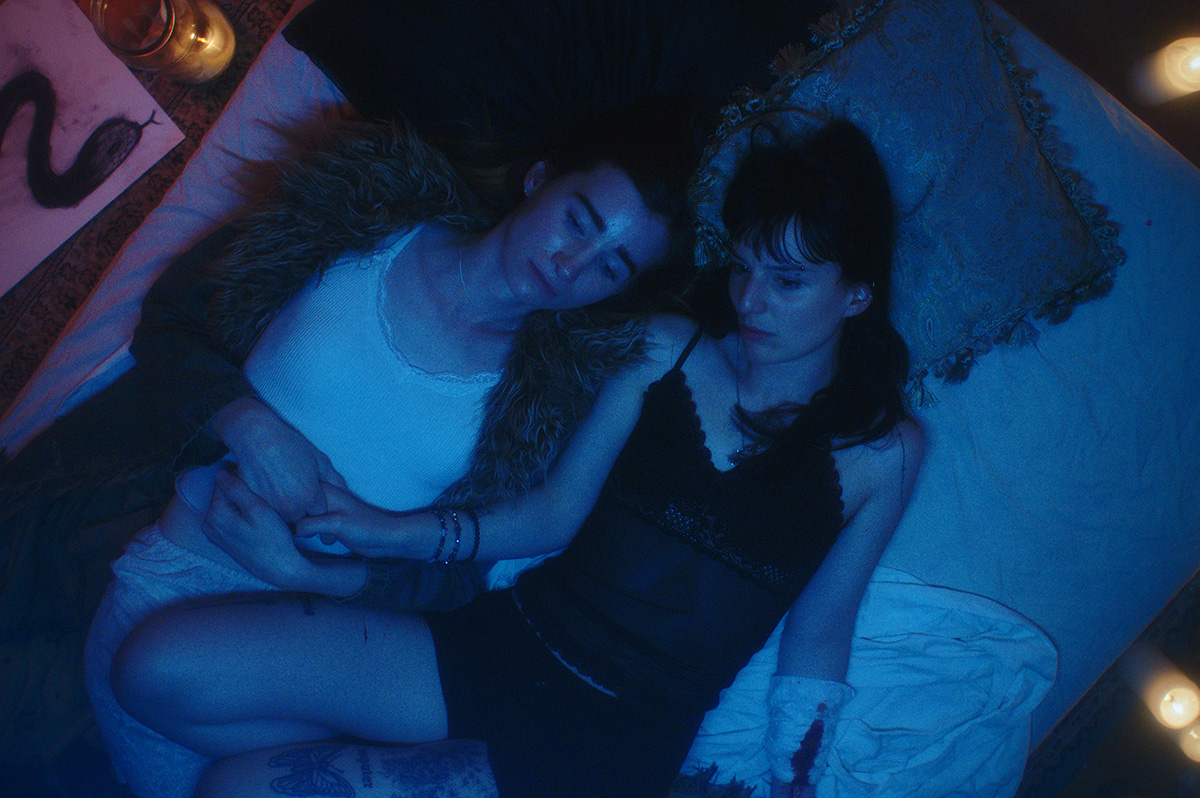
Described in a review from RogerEbert.com as “a kind of ‘Scanners’ for the dolls,” it’s a movie that embraces classic horror tropes within a sensibility that blends candid exploration of trans experience with an obvious love for camp. It centers on twenty-something trans girl Anna (Alexandra McVicker), who escapes the toxic environment of both her dysfunctional household and her conservative hometown by running away to the “Big City” and moving in with her big sister (Charlotte Chimes). On her first night in town, she connects with Danny (Jordan Dulieu), a neighbor (the only “hottie” in the building, according to her sister) who plays guitar in a band and ticks off all her “edgy” boxes, and they have a one-night stand.
The very next day, she starts a new job at a record store, where she connects – through the shared experience of an intense and unexpected incident – with local tattoo artist Gen (Avalon Faust), a young woman she has seen in psychic visions, and who has been likewise drawn to her. The reason? They are both “witches,” born with abilities that give them a potentially deadly power over ordinary humans, and bound together in an ancient supernatural legacy.
It goes without saying that they fall in love; together, they teach and learn from each other as they try to master the mysterious magical gifts they both possess; but when Danny coincidentally books Gen for a tattoo inspired by his earlier “fling” with Anna, an ancient evil is unleashed, leading to a string of horrific attacks in their neighborhood – and forcing them to confront the dark influences within their own traumatic histories which may have conjured this malevolent spirit in the first place.
Confronting the theme of imposed trans “guilt” head on, “Serpent’s Skin” emanates from a softer, gentler place than most horror films, focusing less on scares than on the sense of responsibility which seems naturally to arise just from being “different.” Both McVicker and Faust bring a palpable feeling of weight to their roles, as if their characters are carrying not only their own fate upon their shoulders, but that of the world at large; their performances evoke both the haunted sense of emotional wariness and the heavy sense of responsibility that comes from sharing a layer of awareness that both elevates and isolates them. At the same time, they bring a tender-but-charged eroticism to the sapphic romance at the center of the film, echoing the transgressive and iconic “lesbian noir” genre while replacing the usual amoral cynicism with an imperative toward empathy and social responsibility.
All of this helps to make the film’s heroines relatable, and raises the stakes by investing us not just in the defeat of supernatural evil, but the triumph of love. Yet we can’t help but feel that there’s something lost – a certain edge, perhaps – that might have turned up the heat and given the horror a more palpable bite. Though there are moments of genuine fright, most of the “scary” stuff is campy enough to keep us from taking things too seriously – despite the best efforts of the charismatic Dulieu, who literally sinks his teeth into his portrayal of the possessed version of Danny.
More genuinely disturbing are the movie’s scenes of self-harm, which both underscore and indict the trope of trans “victimhood” while reminding us of the very real fear at the center of many trans lives, especially when lived under the oppression of a mindset that deplores their very existence.
Still, though Mackay’s film may touch on themes of queer and trans existence and build its premise on a kind of magical bond that makes us all “sisters under the skin,” it is mostly constructed as a stylish tribute to the classic thrillers of an earlier age, evoking the psychological edge of directors like Hitchcock and DePalma while embracing the lurid “shock value” of the B-movie horror that shaped the vision of a modern generation of filmmakers who grew up watching it – and even if it never quite delivers the kind of scares that linger in our minds as we try to go to sleep at night, it makes up for the shortfall with a smart, sensitive, and savvy script and a rare depiction of trans/lesbian love that wins us over with chemistry, emotional intelligence, and enviable solidarity.
What makes “The Serpent’s Skin” feel particularly remarkable is that it comes from a 21-year-old filmmaker. Mackey, who built the foundation of her career behind the camera with a series of low-budget horror shorts in her teens, has already made an impact with movies ranging from the vampire horror comedy “So Vam” (released when she was 16) to the horror musical “Satanic Panic” and the queer holiday shockfest “Carnage for Christmas.” With her latest effort, she deploys a confidence and a style that encompasses both the deep psychological nuance and guilty-pleasure thrills of the genre, rendered in an aesthetic that is grounded in intimate queer authenticity – yet remains daring enough to take detours into the surreal and psychedelic without apology.
It’s the kind of movie that feels like a breakthrough, especially in an era when it feels especially urgent for trans stories to be told.
Movies
The Oscar-losing performance that’s too good to miss
‘If I Had Legs I’d Kick You’ now streaming
Now that Oscar season is officially over, most movie lovers are ready to move on and start looking ahead to the upcoming crop of films for the standouts that might be contenders for the 2026 awards race.
Even so, 2025 was a year with a particularly excellent slate of releases: Ryan Coogler’s “Sinners” and Paul Thomas Anderson’s “One Battle After Another,” which became rivals for the Best Picture slot as well as for total number of wins for the year, along with acclaimed odds-on favorites like “Hamnet,” with its showcase performance by Best Actress winner Jessie Buckley, and “Weapons,” with its instantly iconic turn by Best Supporting Actress Amy Madigan.
But while these high-profile titles may have garnered the most attention (and viewership), there were plenty of lesser-seen contenders that, for many audiences, might have slipped under the radar. So while we wait for the arrival of this summer’s hopeful blockbusters and the “prestige” cinema that tends to come in the last quarter of the year, it’s worth taking a look back at some of the movies that may have come up short in the quest for Oscar gold, but that nevertheless deserve a place on any film buff’s “must-see” list; one of the most essential among them is “If I Had Legs I’d Kick You,” which earned a Best Actress Oscar nod for Rose Byrne. A festival hit that premiered at Sundance and went on to win international honors – for both Byrne and filmmaker Jane Bronstein – from other film festivals and critics’ organizations (including the Dorian Awards, presented by GALECA, the queer critics association), it only received a brief theatrical release in October of last year, so it’s one of those Academy Award contenders that most people who weren’t voters on the “FYC” screener list for the Oscars had limited opportunity to see. Now, it’s streaming on HBO Max.
Written and directed by Bronstein, it’s not the kind of film that will ever be a “popular” success. Surreal, tense, disorienting, and loaded with trigger-point subject matter that evokes the divisive emotional biases inherent in its premise, it’s an unsettling experience at best, and more likely to be an alienating one for any viewer who comes to it unprepared.
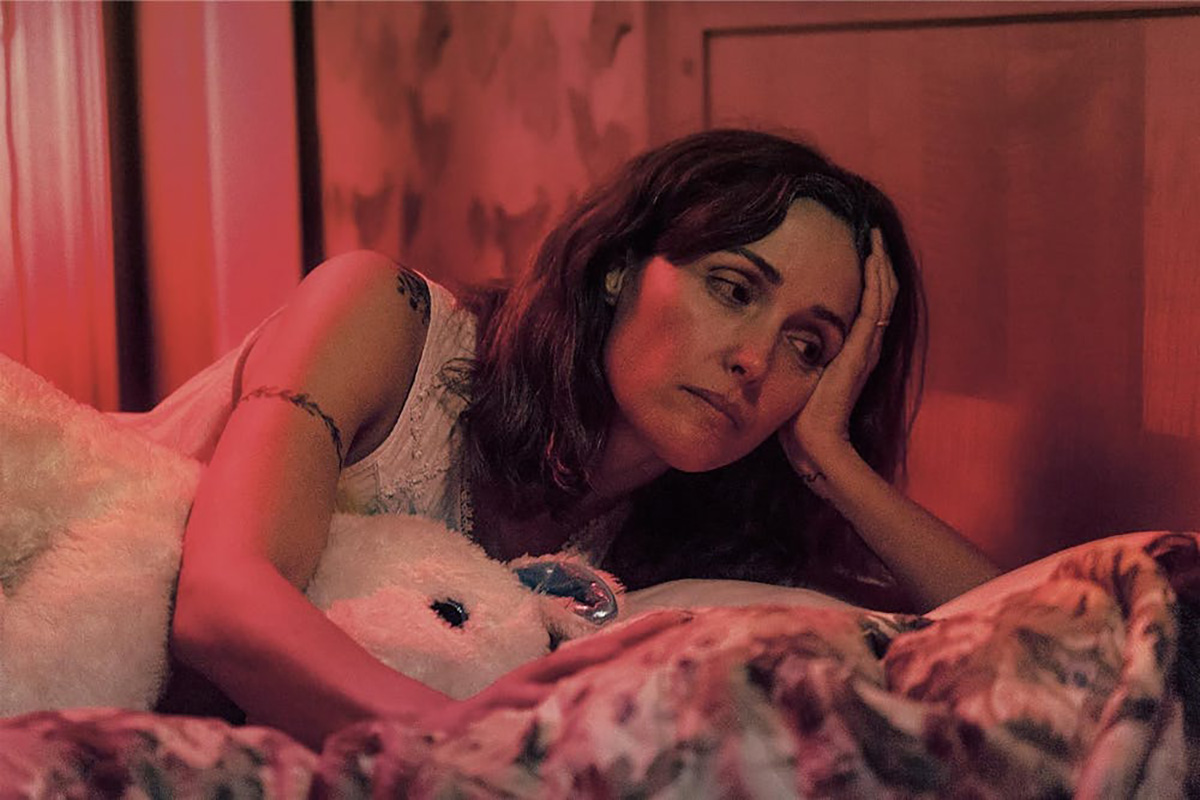
Byrne stars as Linda, a psychotherapist who juggles a busy practice with the demands of being mother to a child with severe health issues; her daughter (Delaney Quinn) suffers from a pediatric feeding disorder and must take her nutrition through a tube, requiring constant supervision and ongoing medical therapy – and she’s not polite about it, either. Seemingly using her condition as an excuse to be coddled, the child is uncooperative with her treatment plan and makes excessive demands on her mother’s attention, and the girl’s father (Christian Slater) – who spends weeks away as captain of a cruise ship – expects Linda to manage the situation on the home front while offering little more than criticism and recriminations over the phone.
Things are made even more stressful when the ceiling collapses in their apartment, requiring mother and child to move to a seedy beachside motel. Understandably overwhelmed, Linda turns increasingly toward escape, mostly through avoidance and alcohol; she finds her own inner conflicts reflected by her clients – particularly a new mother (Danielle Macdonald) struggling with extreme postpartum anxiety – and her therapy sessions with a colleague (Conan O’Brien, in a brilliantly effective piece of against-type casting) threaten to cross ethical and professional boundaries. Growing ever more isolated, she eventually finds a thread of potential connection in the motel’s sympathetic superintendent (A$AP Rocky) – but with her own mental state growing ever more muddled and her daughter’s health challenges on the verge of becoming a lifelong burden, she finds herself drawn toward an unthinkable solution to her dilemma.
With its cryptic title – which sounds like the punchline to a macabre joke and evokes expectations of “body horror” creepiness – and its dreamlike, disjointed approach, “If I Had Legs I’d Kick You” feels like a dark comedic thriller from the outset, but few viewers are likely to get many laughs from it. Too raw to be campy and too cold to invite our compassion, it’s a film that dwells in an uncomfortable zone where we are too mortified to be moved and too appalled to look away. Though it’s technically a drama, Bronstein presents it as a horror story, of sorts, driven by psychological rather than supernatural forces, and builds it on an uneasy structure that teases us with the anticipation of grotesqueries to come while forcing us to identify with a character whose lack of (presumably) universal parental instinct feels transgressive in a way that is somehow even more disquieting than the gore and mutilation we imagine might be coming at any moment.
And we do imagine it, even expect it to come, which is as much to do with the near-oppressive claustrophobia that results from Bronstein’s heavy use of close-ups as it does with the hint of impending violence that pervades the psychological tension. It’s not just that our frame of vision is kept tight and limited; her tactic keeps us uncertain of what’s going on outside the edges, creating a sense of something unseen lurking just beyond our view. Yet it also helps to put us into Linda’s state of mind; for almost the entire film, we never see the face of her daughter – nor do we ever know the child’s name – and her husband is just a strident voice on the other end of a phone call. The effect keeps us feeling as trapped as she does, boxing us squarely into her dissociated, depressed, and desperate existence with nothing but resentment and dread on which to focus.
Anchoring it all, of course, is Byrne’s remarkable performance. Vivid, vulnerable, and painfully real, it’s the centerpiece of the film, the part that emerges as greater than the whole; and while Oscar may have passed her over, she delivers a star turn for the ages and gives profound voice to a dark side of feminine experience that is rarely allowed to be aired.
That, of course, is the key to Bronstein’s seeming purpose; inspired by her own struggles with postpartum depression, her film feels like both a confession and an exorcism, a parable in which the expectations of unconditional motherly love fall into question, and the burden placed on a woman to subjugate her own existence in service of a child – and a seemingly ungrateful one, at that – becomes a powerful exploration of feminist themes. It’s an exploration that might go too far, for some, but it expresses a truth that those of us who are not mothers (and many of us who are) might be loath to acknowledge.
Uncomfortable though it may be, Bronstein’s movie draws us in and persuades our emotional investment despite its difficult and unlikable characters, thanks to her star player and her layered, puzzle-like screenplay, which captures Linda’s scattered psyche and warped perceptions with an approach that creates structure through fragments, clues and suggestions; and while it may not land quite as squarely as we might hope, in the end, its bold and discomforting style – coupled with the career-topping performance at its center – are more than enough reason to catch this Oscar “also-ran” before putting this year’s award season behind you once and for all.
Movies
‘It’s Dorothy’ traces lasting influence of a cultural icon
Thoughtful and scholarly with a celebratory tribute to the character
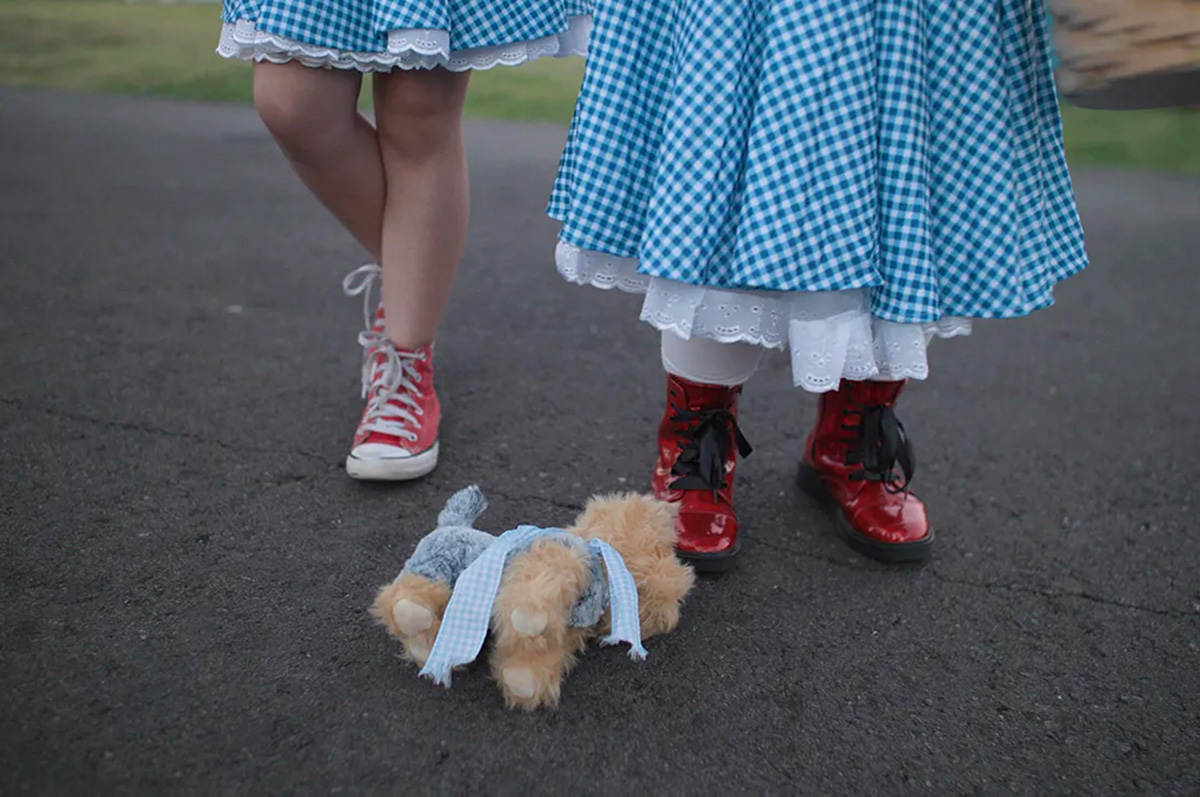
There was a time, according to queer lore, when gay men referred to themselves as a “Friend of Dorothy” as a coded way of communicating their sexual orientation to each other without fear of “the straights” catching on. The reference, of course, is a winking nod to the love and affinity felt by the community toward the main character of L. Frank Baum’s 1900 novel “The Wonderful Wizard of Oz” – especially as personified by Judy Garland in the classic 1939 big screen musical version from MGM.
It may be that the origins of this phrase have been mythologized, exaggerated and/or retro-fitted to convey the underground nature of the queer community – as, indeed, is suggested in “It’s Dorothy!” (the new documentary from filmmaker Jeffrey McHale, now streaming on Peacock), which concerns itself with the enduring cultural legacy of this quintessentially American fictional heroine. But regardless of whether it truly served as a sort of “secret password,” it has come to be embraced as a part of the LGBTQ lexicon. As “campy” as the reference may be, being a “Friend of Dorothy” is now a proudly held communal watchword not just for gay men, but for an entire rainbow community – and McHale’s fizzy-yet-reverential exploration taps into all the reasons how and why this fictional Kansas farm girl has come to be a touchstone for so many by tracking her journey across popular culture over the 125 years since she first sprung to life in the pages of Baum’s timeless literary fantasy.
It gives particular attention to the commentary of cultural figures – writers, performers, and other artists whose paths have become associated with Dorothy’s legacy across pop culture, as well as scholars and historians – to provide insight on the appeal that has made her into a sort of avatar for anyone who feels marginalized in a wild and self-contradictory world; enriched by a plentiful trove of clips from the myriad incarnations through which she has become embedded into the American pop culture imagination, it’s a documentary that leans heavily into the notion that Baum’s timeless heroine remains relevant through her universal relatability. Given a minimum of descriptors by the author who created her, and portrayed in the public imagination through a widely divergent array of perspectives, she represents a kind of “blank page” on which we can imprint ourselves; but at the same time, there is something about her – perhaps her nebulous status as presumed orphan, raised by an aunt and uncle who don’t quite understand her and thrust without warning into a world of contradictory rules, nonsensical beliefs, and unfair expectations – that gives her a particularly personal appeal to anyone who feels like an outsider, and who dreams of freedom, acceptance, and personal agency beyond the proverbial rainbow.
Naturally, McHale imprints on Dorothy’s most iconic incarnation off the pages of Baum’s books; the cultural legacy of Dorothy cannot be separated from that of her most iconic representative (Garland, of course), and his documentary easily makes the case that the beloved actress – who was frequently judged and stigmatized through a career marked by both public success and personal heartbreak, all while living under the scrutiny of Hollywood’s publicity-and-propaganda machine – somehow came to “merge” identites with her most famous character. Judy was Dorothy, but Dorothy was Judy, too. “It’s Dorothy” takes advantage of this almost mystical transfiguration to reflect on the qualities that make this pairing of actress and character so deeply complementary, while also using it to illuminate why the empathy which binds both Garland and Dorothy with LGBTQ people is so tightly connected to the shared qualities they seemed to personify, and which have made both into undisputed icons of the queer community.
As famous as Garland’s Dorothy is, however, it’s not the end-and-be-all of Baum’s beloved heroine, and much of McHale’s movie is devoted to the numerous other performers who have taken on the role throughout the decades, in various incarnations of the “Wizard of Oz” mythos – particularly through “The Wiz,” the 1974 Broadway musical that reframes and remolds the story (and Dorothy) through the lens of Black culture, but also in other iterations that have emerged from pop culture as a testament to her enduring appeal. Indeed, the movie brings illumination to the way that Dorothy – and the “Oz” mythos in general – has become a touchstone within the Black community as well, and how artists (like musician Rufus Wainwright, gay counterculture icon John Waters, comedian/actor Margaret Cho, comedian/writer/director Lena Waithe, and “Wicked” author Gregory Maguire, all of whom participate in the film’s conversation) have found inspiration in the character and her story that has helped to shape their own creative lives.
Thoughtful and scholarly while also delivering a celebratory tribute to the character, “It’s Dorothy” provides a well-rounded examination of Baum’s iconic character (and the world he created around her), and of her impact on the American popular imagination. It’s an entertaining journey through cultural history, connecting the dots to give us insight on why Dorothy and her adventures continue to speak to us with such profound resonance. It’s also entertaining in a way that feels like a “guilty pleasure,” but is validated by the reverence it exudes for its subject; loaded with memorably evocative clips from movies, shows, and performances from across the decades, it gives us glimpses of less-famous appearances of the character and reminds us of just how enmeshed in our imaginations she has come to be; and while it may begin to feel a bit repetitive, at points, as it profiles the various actresses who have played Dorothy over the years (most of whom share the same or similar stories about their personal connections to the role), it nevertheless maintains a sincerity of feeling that keeps us invested.
And just in case you might feel like the times are too somber for a nostalgic stroll down the “yellow brick road” of cultural memories, be aware that McHale also explores the ominous presence of the Wizard himself in these tales, a phony who pretends at power while hiding behind a benevolent mask to maintain it.
As if the “Wicked” movies didn’t make the point clearly enough, we’re in a world that’s a lot more Oz-like than we would like to imagine, and it’s hard not to wish we had the ability to go “home” simply by tapping our heels together in fabulous footwear. “It’s Dorothy!” conveys that longing in a way that feels light-hearted and joyful, and reminds us why being a “friend of Dorothy” has been and continues to be a resonant way of identifying ourselves in a world full of wizards, witches, and “twisters” that can carry us far away from home.
And if you want to follow it up with an impromptu rewatch of the 1939 classic, we wouldn’t blame you. It’s a movie that, for so many of us, conjures the very feeling of “home” itself – and there’s no place like it.

Police mental health struggles gain growing attention

Man faces first S.C. ‘hate intimidation’ charge

Trump budget would codify expanded global gag rule

D.C. is the place for the Democratic Socialists of America

Key lifestyle changes can help patients cope with diabetes

VIDEO: Gay journalist detained for booing Trumps at ‘Chicago’ opening night

Trans-driven ‘Serpent’s Skin’ delivers campy sapphic horror

D.C. not the place for antisemitic Democratic Socialists of America

Pam Bondi ousted as attorney general

Award-winning D.C. chef reaching new culinary heights
-

 The White House4 days ago
VIDEO: Gay journalist detained for booing Trumps at ‘Chicago’ opening night
-
Movies5 days ago
Trans-driven ‘Serpent’s Skin’ delivers campy sapphic horror
-
Opinions5 days ago
D.C. not the place for antisemitic Democratic Socialists of America
-
The White House4 days ago
Pam Bondi ousted as attorney general