The White House
White House halts World AIDS Day recognition amid HIV funding cuts
Trump-Vance administration under increased criticism over policies
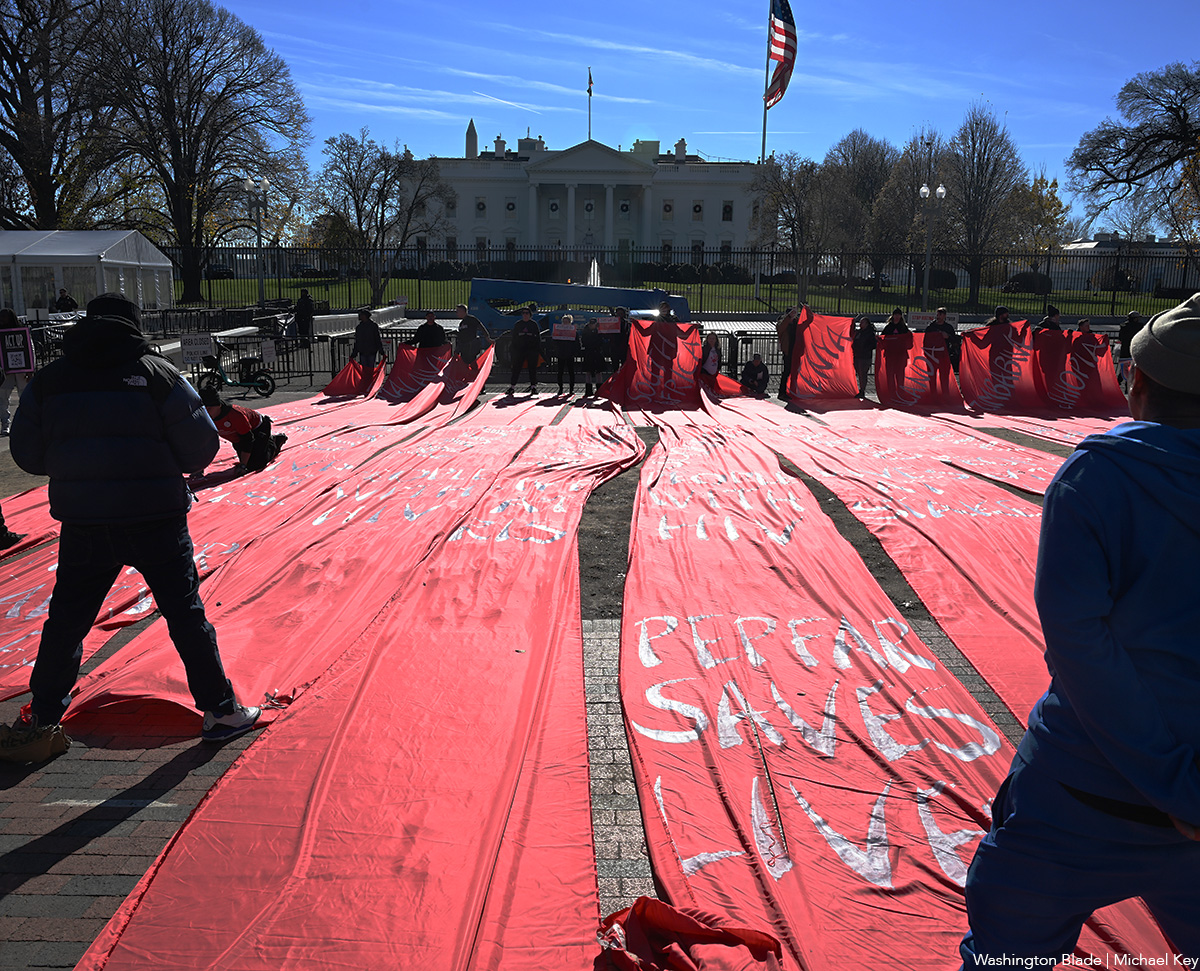
For the first time since the global observance began, the U.S. government did not commemorate World AIDS Day on Monday.
World AIDS Day, first marked in 1988, has long served as an annual reminder of the ongoing effort to end an epidemic that has killed more than 44.1 million people worldwide and continues to disproportionately impact LGBTQ people, communities of color, and those in the American South. Yet the Trump-Vance administration declined to acknowledge the day this year, severing a symbolic but consistent tradition upheld by every president since Ronald Reagan.
The move comes despite the scale of the epidemic today. Approximately 1.2 million people in the U.S. are living with HIV, according to federal estimates, and about 13 percent — 158,249 people — do not know their status. Globally, the World Health Organization reports 40.8 million people were living with HIV at the end of 2024.
Presidents of both parties have historically used World AIDS Day to highlight progress, remember lives lost, and recommit to reducing disparities in prevention and treatment. Past administrations have also commemorated the day through displays of the AIDS Memorial Quilt — first created in 1987 and later spread across the National Mall and White House lawn. Today, the quilt includes the names of more than 94,000 people lost to AIDS on more than 47,000 panels.

This year’s silence from the White House follows several sweeping foreign aid rollbacks instituted by President Donald Trump after his 2025 inauguration. According to an October report by KFF, the administration enacted a “90-day review of foreign aid; a subsequent ‘stop-work order’ that froze all payments and services for work already underway; the dissolution of USAID, including the reduction of most staff and contractors; and the cancellation of most foreign assistance awards.”
These cuts have created significant funding gaps for nongovernmental organizations around the world — many of which work directly to prevent HIV transmission and expand access to lifesaving treatment.
The State Department dismissed criticism of the administration’s decision not to acknowledge World AIDS Day.
“An awareness day is not a strategy. Under the leadership of President Trump, the State Department is working directly with foreign governments to save lives and increase their responsibility and burden sharing,” deputy spokesperson Tommy Pigott said in a statement CNN first reported. “Earlier this year, we released a global health strategy aimed at streamlining America’s foreign assistance and modernizing our approach to countering infectious diseases.”
The U.S. historically played a central role in the global HIV response. Since 2003, the United States has been the largest financial supporter of HIV/AIDS programs — primarily through President George W. Bush’s PEPFAR initiative, which has invested more than $110 billion into the fight to end the epidemic.
Despite overall declines in transmission, HIV continues to disproportionately affect racial and ethnic minorities, LGBTQ people, and men who have sex with men. More than half of new HIV diagnoses occur in the South.
The Centers for Disease Control and Prevention’s Ending the HIV Epidemic in the U.S. initiative focuses on the 48 counties, D.C., San Juan, Puerto Rico, and seven rural states that accounted for more than half of all new diagnoses in 2016 and 2017.
Advocates say the administration’s withdrawal from World AIDS Day — combined with its cuts to foreign and domestic health programs — risks reversing hard-won gains.
“Though new HIV infections declined 12 percent from 2018 to 2022, progress is uneven with Black people accounting for 38 percent of new diagnoses, Latino people accounting for 32 percent of new diagnoses and more than half (52 percent) of new HIV diagnoses were among people living in the South,” Jarred Keller, senior press secretary at the Human Rights Campaign, told the Washington Blade via email. “Cuts to CDC funding have driven HIV prevention resources to historic lows, stripping support from HIV-focused programs.”
Legal and public health experts echoed that concern, saying that there is a possibility to stop HIV/AIDS, but only if efforts are taken gradually over time.
“HIV is a preventable and treatable condition, but only if the research, organization, and effort continue to be a priority to those looking out for the health of Americans and people worldwide,” said Lambda Legal HIV Project Director Jose Abrigo.



The White House
Trump proclamation targets trans rights as State Dept. shifts visa policy
Recent policy actions from the White House limit transgender rights in sports, immigration visas, and overarching federal policy.

In a proclamation issued by the Trump White House Thursday night, the president said he would, among other things, “restore public safety” and continue “upholding the rule of law,” while promoting policies that restrict the rights of transgender people.
“We are keeping men out of women’s sports, enforcing Title IX as it was originally written, and ensuring colleges preserve — and, where possible, expand — scholarships and roster opportunities for female athletes,” the proclamation reads. “At the same time, we are restoring public safety and upholding the rule of law in every city so women, children, and families can feel safe and secure.”
The statement comes amid a broader series of actions by the Trump administration targeting transgender people across multiple federal policy areas, including education, health care, and immigration. A nearly complete list of policies the current administration has put forward can be found on KFF.org.
One day before the proclamation was issued, the U.S. State Department announced changes to visa regulations that could impact transgender and gender-nonconforming people seeking entry into the United States.
The policy, published March 11 and scheduled to take effect April 10, introduces changes to the Diversity Immigrant Visa Program, commonly known as the “DV Program.” The rule is framed by the department as an effort to strengthen oversight and prevent fraud within the visa lottery system, which allocates a limited number of immigrant visas annually to applicants from countries with historically low rates of immigration to the United States.
However, the updated language also standardizes the use of the term “sex” in federal regulations in place of “gender,” a change that LGBTQ advocates say could create additional barriers for transgender and gender-diverse applicants.
The policy states: “The Department of State (‘Department’) is amending regulations governing the Diversity Immigrant Visa Program (‘DV Program’) to improve the integrity of, and combat fraud in, the program. These amendments require a petitioner to the DV Program to provide valid, unexpired passport information and to upload a scan of the biographic and signature page in the electronic entry form or otherwise indicate that he or she is exempt from this requirement. Additionally, the Department is standardizing and amending its regulations to add the word ‘shall’ to simplify guidance for consular officers; ensure the use of the term ‘sex’ in lieu of ‘gender’; and replace the term ‘age’ in the DV Program regulations with the phrase ‘date of birth’ to accurately reflect the information collected and maintained by the Department during the immigrant visa process.”
Advocates say the shift toward using “sex” rather than “gender” in federal immigration rules reflects a broader push by the administration to roll back recognition of transgender identities in federal policy.
According to the National Center for Transgender Equality, an estimated 15,000 to 50,000 undocumented transgender immigrants currently live in the United States, with many entering the country to seek refuge from persecution and hostile governments in their home countries.
The White House
Trump will refuse to sign voting bill without anti-trans provisions
Measure described as ‘Jim Crow 2.0’
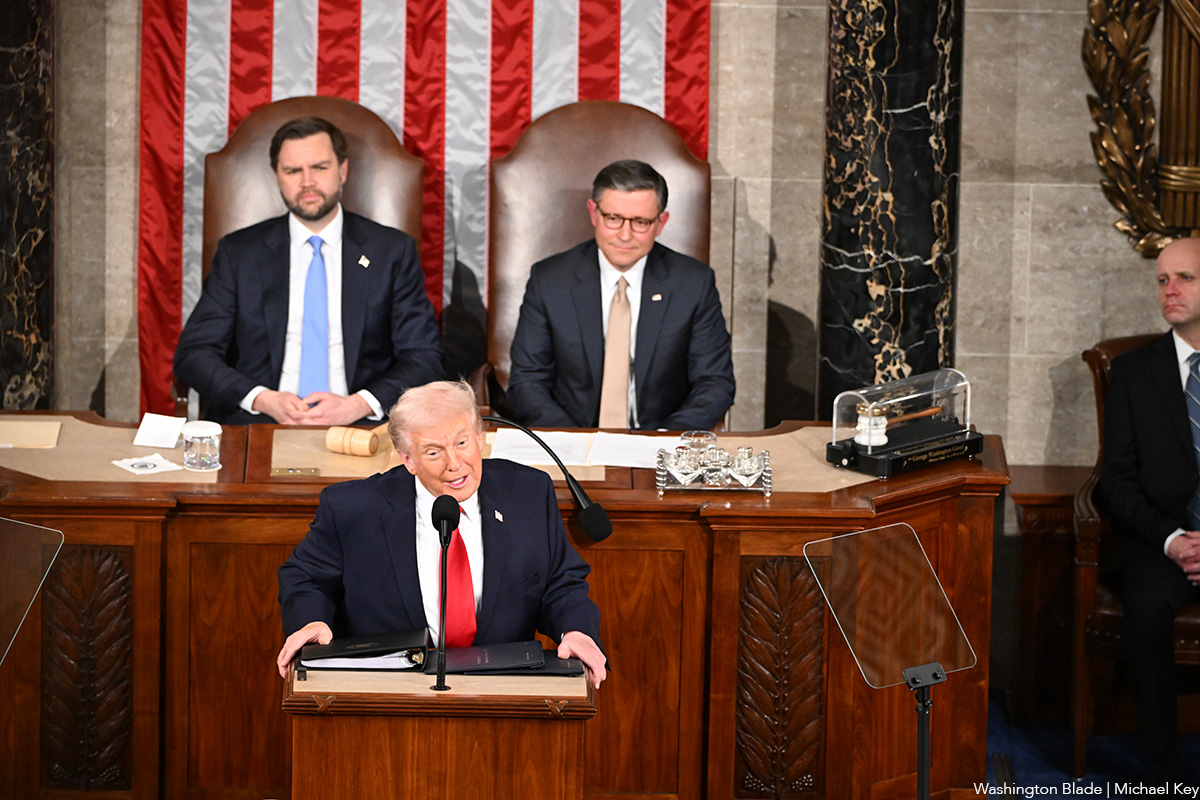
President Donald Trump said he will refuse to sign any legislation into law unless Congress passes the “SAVE Act,” pressuring lawmakers to move forward with the controversial voting bill.
In posts on Truth Social and other social media platforms, the 47th president emphasized the importance of Republican lawmakers pushing the legislation through while also using the opportunity to denounce gender-affirming care.
“I, as President, will not sign other Bills until this is passed, AND NOT THE WATERED DOWN VERSION — GO FOR THE GOLD,” Trump posted. “MUST SHOW VOTER I.D. & PROOF OF CITIZENSHIP: NO MAIL-IN BALLOTS EXCEPT FOR MILITARY — ILLNESS, DISABILITY, TRAVEL: NO MEN IN WOMEN’S SPORTS: NO TRANSGENDER MUTILIZATION FOR CHILDREN! DO NOT FAIL!!!”
The proposed Safeguard American Voter Eligibility (SAVE) Act would amend the National Voter Registration Act of 1993 to require in-person proof of citizenship for anyone seeking to vote in U.S. elections. Trump has also called for the legislation to include a ban on gender-affirming medical care for transgender minors, even with parental consent.
“This is a huge priority for the president. He added on some priorities to the SAVE America Act in recent days, namely, no transgender transition surgeries for minors. We are not gonna tolerate the mutilation of young children in this country. No men in women’s sports,” White House Press Secretary Karoline Leavitt said. “The president putting all of these priorities together speaks to how common sense they are.”
The comments mark the first time the White House has publicly confirmed that Trump is pushing to attach anti-trans policies to the SAVE Act.
The bill would also require the removal of undocumented immigrants from existing voter rolls and allow election officials who fail to enforce the proof-of-citizenship requirement to be sued.
It is already illegal for noncitizens to vote in federal elections. Current safeguards include requirements such as providing a Social Security number when registering to vote, cross-checking voter rolls with federal data and, in some states, requiring identification at the polls.
Trump began pushing for the legislation during his State of the Union address last month, where he singled out Senate Majority Leader John Thune (R-S.D.) by name while criticizing the lack of movement on the bill.
Senate Minority Leader Chuck Schumer (D-N.Y.) has denounced the legislation as “Jim Crow 2.0” and said it has little chance of advancing through the Senate, calling it “dead on arrival.”
In remarks on the Senate floor, Schumer said “the SAVE Act includes such extreme voter registration requirements that, if enacted, could disenfranchise 21 million American citizens.”
Trump has repeatedly used political messaging around trans youth and gender-affirming care as part of broader cultural and policy debates during his presidency — most recently during his State of the Union address, where he cited the case of Sage Blair, a Virginia teenager whose school allegedly encouraged her to transition without her parents’ consent.
LGBTQ advocates — including those familiar with Blair’s story — say the situation was far more complex than described and argue that using a single anecdote to justify sweeping federal restrictions could place trans people, particularly youth, at greater risk.
The White House
Expanded global gag rule to ban US foreign aid to groups that promote ‘gender ideology’
Activists, officials say new regulation will limit access to gender-affirming care
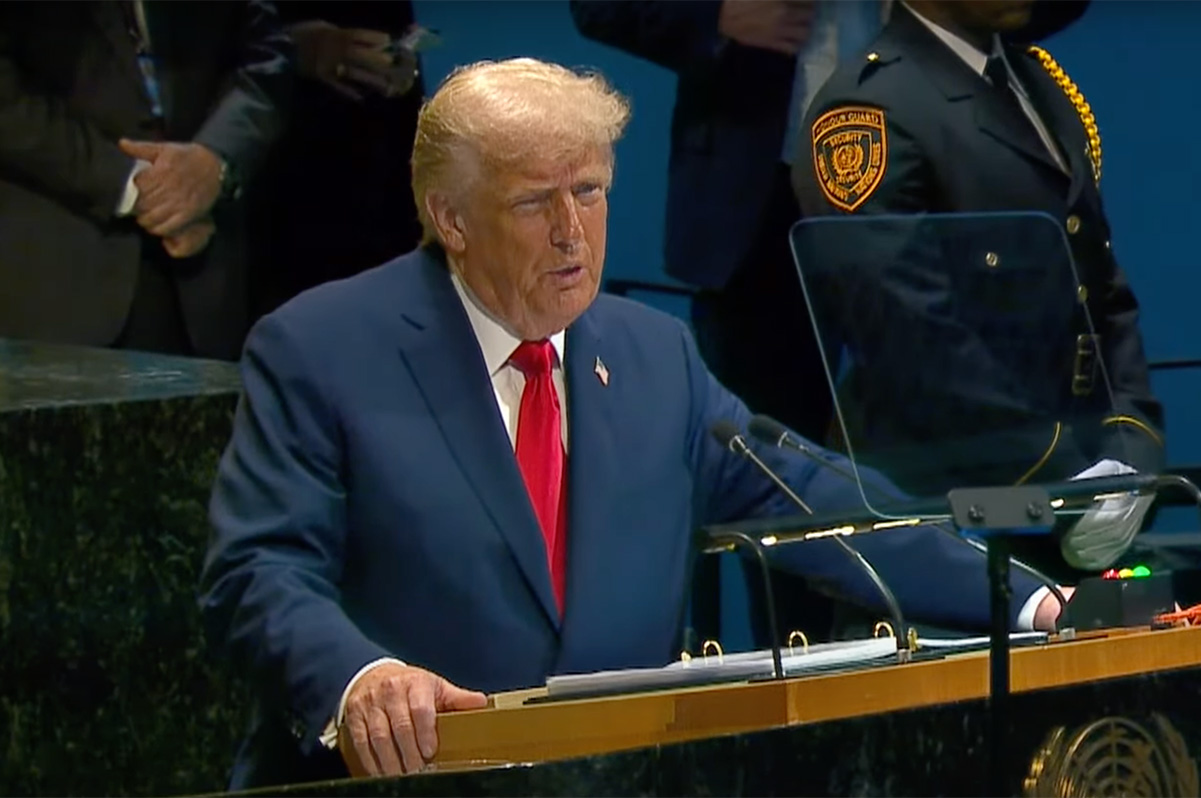
The Trump-Vance administration has announced it will expand the global gag rule to ban U.S. foreign aid for groups that promote “gender ideology.”
Deputy Secretary of State Christopher Landau in a memo, titled Combating Gender Ideology in Foreign Assistance, the Federal Register published on Jan. 27 notes “previous administrations … used” U.S. foreign assistance “to fund the denial of the biological reality of sex, promoting a radical ideology that permits men to self-identify as women, indoctrinate children with radical gender ideology, and allow men to gain access to intimate single-sex spaces and activities designed for women.”
“Efforts to eradicate the biological reality of sex fundamentally attack women by depriving them of their dignity, safety, and well-being. It also threatens the wellbeing of children by encouraging them to undergo life-altering surgical and chemical interventions that carry serious risks of lifelong harms like infertility,” reads the memo. “The erasure of sex in language and policy has a corrosive impact not just on women and children but, as an attack on truth and human nature, it harms every nation. It is the purpose of this rule to prohibit the use of foreign assistance to support radical gender ideology, including by ending support for international organizations and multilateral organizations that pressure nations to embrace radical gender ideology, or otherwise promote gender ideology.”
President Donald Trump on Jan. 28, 2025, issued an executive order — Protecting Children from Chemical and Surgical Mutilation — that banned federal funding for gender-affirming care for minors.
President Ronald Reagan in 1985 implemented the global gag rule, also known as the “Mexico City” policy, which bans U.S. foreign aid for groups that support abortion and/or offer abortion-related services.
Trump reinstated the rule during his first administration. The White House this week expanded the ban to include groups that support gender-affirming care and diversity, equity, and inclusion programs.
The expanded global gag rule will take effect on Feb. 26.
“None of the funds made available by this act or any other Act may be made available in contravention of Executive Order 14187, relating to Protecting Children From Chemical and Surgical Mutilation, or shall be used or transferred to another federal agency, board, or commission to fund any domestic or international non-governmental organization or any other program, organization, or association coordinated or operated by such non-governmental organization that either offers counseling regarding sex change surgeries, promotes sex change surgeries for any reason as an option, conducts or subsidizes sex change surgeries, promotes the use of medications or other substances to halt the onset of puberty or sexual development of minors, or otherwise promotes transgenderism,” wrote Landau in his memo.
Landau wrote the State Department “does not believe taxpayer dollars should support sex-rejecting procedures, directly or indirectly for individuals of any age.”
“A person’s body (including its organs, organ systems, and processes natural to human development like puberty) are either healthy or unhealthy based on whether they are operating according to their biological functions,” reads his memo. “Organs or organ systems do not become unhealthy simply because the individual may experience psychological distress relating to his or her sexed body. For this reason, removing a patient’s breasts as a treatment for breast cancer is fundamentally different from performing the same procedure solely to alleviate mental distress arising from gender dysphoria. The former procedure aims to restore bodily health and to remove cancerous tissue. In contrast, removing healthy breasts or interrupting normally occurring puberty to ‘affirm’ one’s ‘gender identity’ involves the intentional destruction of healthy biological functions.”
Landau added there “is also lack of clarity about what sex-rejecting procedures’ fundamental aims are, unlike the broad consensus about the purpose of medical treatments for conditions like appendicitis, diabetes, or severe depression.”
“These procedures lack strong evidentiary foundations, and our understanding of long-term health impacts is limited and needs to be better understood,” he wrote. “Imposing restrictions, as this rule proposes, on sex-rejecting procedures for individuals of any age is necessary for the (State) Department to protect taxpayer dollars from abuse in support of radical ideological aims.”
Landau added the State Department “has determined that applying this rule to non-military foreign assistance broadly is necessary to ensure that its foreign assistance programs do not support foreign NGOs and IOs (international organizations) that promote gender ideology, and U.S. NGOs that provide sex-rejecting procedures, and to ensure the integrity of programs such as humanitarian assistance, gender-related programs, and more, do not promote gender ideology.”
“This rule will also allow for more foreign assistance funds to support organizations that promote biological truth in their foreign assistance programs and help the (State) Department to establish new partnerships,” he wrote.
The full memo can be found here.
Council for Global Equality Senior Policy Fellow Beirne Roose-Snyder on Wednesday said the expansion of the so-called global gag rule will “absolutely impact HIV services where we know we need to target services, to that there are non-stigmatizing, safe spaces for people to talk through all of their medical needs, and being trans is really important to be able to disclose to your health care provider so that you can get ARVs, so you can get PrEP in the right ways.” Roose-Snyder added the expanded ban will also impact access to gender-affirming health care, food assistance programs and humanitarian aid around the world.
“This rule is not about gender-affirming care at all,” she said during a virtual press conference the Universal Access Project organized.
“It is about really saying that if you want to take U.S. funds — and it’s certainly not about gender-affirming care for children — it is if you want to take U.S. funds, you cannot have programs or materials or offer counseling or referrals to people who may be struggling with their gender identity,” added Roose-Snyder. “You cannot advocate to maintain your country’s own nondiscrimination laws around gender identity. It is the first place that we’ve ever seen the U.S. government define gender-affirming care, except they call it something a lot different than that.”
The Congressional Equality Caucus, the Democratic Women’s Caucus, the Congressional Hispanic Caucus, the Congressional Asian and Pacific American Caucus, and the Congressional Black Caucus also condemned the global gag rule’s expansion.
“We strongly condemn this weaponization of U.S. foreign assistance to undermine human rights and global health,” said the caucuses in a statement. “We will not rest until we ensure that our foreign aid dollars can never be used as a weapon against women, people of color, or LGBTQI+ people ever again.”

PHOTOS: Awesome Con

A season of renewal for D.C. theater

Ensuring safer drinking water

BMA celebrates enduring influence of Henri Matisse

Gay Venezuelan man ‘forcibly disappeared’ to El Salvador files claim against White House

Capital Stonewall Democrats set to celebrate 50th anniversary

Trump proclamation targets trans rights as State Dept. shifts visa policy

Fla. House passes ‘Anti-Diversity’ bill

Housewives head to Capitol Hill to promote PrEP coverage

Far-right Chilean President José Antonio Kast takes office
-

 District of Columbia5 days ago
Capital Stonewall Democrats set to celebrate 50th anniversary
-
The White House3 days ago
Trump proclamation targets trans rights as State Dept. shifts visa policy
-
Florida5 days ago
Fla. House passes ‘Anti-Diversity’ bill
-
Health5 days ago
Housewives head to Capitol Hill to promote PrEP coverage