The White House
White House ends protections for trans students in multiple school districts
Cape Henlopen School District in Delaware among administration’s targets

The Department of Education has terminated agreements with five school districts and a college aimed at protecting the rights of transgender students, backtracking requirements made in prior administrations, according to the Associated Press.
Allowing the reversal of these federal obligations removes formerly mandatory measures, including faculty training on responding to a student’s preferred name and pronouns, and policies allowing trans children to use bathrooms that align with their gender identity.
This policy change is a major shift from past democratic-led administrations, and will impact Delaware Valley School District in Pennsylvania, Sacramento City Unified School District in California, Cape Henlopen School District in Delaware, Fife School District in Washington, and La Mesa-Spring Valley School District, as well as Taft College in California.
Delaware Valley School District received notice from the Trump-Vance administration in February and has since voted to roll back anti-discrimination protections. Other schools, like Sacramento City Unified School District, said the change in minimum protections a district must offer will not affect their policies because it “remains committed to the support of our LGBTQ+ students and staff.”
This is part of a wider wave of anti-trans actions taken by the Trump-Vance administration. This White House has penalized schools attempting to accommodate students’ gender identity, filed lawsuits in California and Minnesota over state policies allowing trans students to participate in interscholastic sports, and opened civil rights investigations into multiple schools and universities over their policies on trans students.
Kimberly Richey, the Department of Education’s Assistant Secretary for Civil Rights, said the action underscored the administration’s efforts to prevent trans students from participating in girls’ and women’s sports teams and accessing shared locker rooms.
“Today, the Trump administration is removing the unnecessary and unlawful burdens that prior administrations imposed on schools in its relentless pursuit of a radical transgender agenda,” she said in a written statement.
According to the AP, this is just one instance of the administration rescinding civil rights protections in education. Last year, the Department of Education terminated two agreements: one involving the removal of books from a school library in Georgia, and another addressing harsh discipline and unequal education opportunities for Native students in the Rapid City Area School District in South Dakota.
Shiwali Patel, the senior director of education justice at the National Women’s Law Center, issued a statement in response to the removal of protections for trans students, saying the rollback will negatively impact all students — not just trans ones.
“There is absolutely no basis for what the Department of Education is doing, and it is unimaginably cruel. Title IX exists to ensure that students are protected from discrimination and treated with dignity so that they can learn and thrive in our schools,” Patel said. “It’s what students, families, lawmakers, and advocates fought for when Title IX was passed decades ago. But the Trump administration’s Department of Education has spent its limited resources to strip Title IX of that very purpose.”
She continued, highlighting the issues that will arise from the agreement removals in schools.
“Real complaints of discrimination and sexual assault are going unanswered by the Department of Education while conservative lawmakers continue to escalate their attacks on a small minority of students,” the nationally recognized Title IX expert and advocacy leader for gender-based harassment added. “Parents, teachers, and students need the Department to focus on addressing real harms on campuses instead of rolling back policies that keep all students safe.”
The schools that had their agreements terminated vary, but stem from the same issue: treating trans students with the same protections from harassment as their cisgender peers.
In 2023, Taft College, a community college in California’s Central Valley, became one of the few schools to settle a case with the Department of Education’s Civil Rights Office after a student accused faculty of discrimination, including refusing to use the student’s preferred pronouns. The college agreed to faculty training on Title IX protections and revised its policies to clarify that refusing to use a person’s preferred name and pronoun can constitute harassment.
The now-canceled agreement with Sacramento City Unified School District stemmed from a 2022 complaint brought by a student after a teacher refused to use the student’s preferred pronouns and/or refused to allow the male-identifying student to work in a boys’ group for a class activity. The 2024 resolution agreement had mandated training for employees on civil rights law, sexual harassment, and how to handle formal complaints.
Under a settlement the Delaware Valley School District reached with the Obama-Biden administration, the district was required to permit students to use bathrooms aligned with their gender identity. In February, the Trump-Vance administration sent the district a letter rescinding the settlement and requiring the rollback of antidiscrimination protections for trans students. The school board voted in late March to change its policies accordingly.
This move is part of a broader pattern of anti-trans actions from the White House since Trump returned to office.
In addition to restricting protections in federally funded education spaces, the administration has attempted to end trans girls’ and women’s participation in sports competitions and has sued states that have not complied. It has also blocked trans and nonbinary people from choosing sex markers on passports and attempted to stop those under 19 from receiving gender-affirming medical care.




The White House
Trump budget would codify expanded global gag rule
Funding for LGBTQ health programs around the world would also be cut

The Trump-Vance administration’s fiscal year 2027 budget would codify the expanded global gag rule and eliminate funding for LGBTQ-specific programs in global health initiatives.
“The budget would ensure no funding supports abortion, unfettered access to birth control, and also eliminates funding for circumcision and lesbian, gay, bisexual, transgender, and queer services to better focus funds on life-saving assistance,” reads the proposed budget the White House released on April 3. “The United States should not pay for the world’s birth control and therapy.”
The proposed budget includes four examples of “eliminated activities.”
- In the last administration, PEPFAR funded health workers who performed over 21 abortions in Mozambique
- Promoting reproductive health education and access to birth control and other harmful programs couched under ‘family planning’ in Ghana
- A supply chain “control tower” to provide a “holistic commercial of the shelf solution” on the Office of Population and Reproductive Health (PRH)
- Promoting health equity and providing condoms and contraception in Kenya.
President Ronald Reagan in 1985 implemented the global gag rule, also known as the “Mexico City” policy, which bans U.S. foreign aid for groups that support abortion and/or offer abortion-related services.
Trump reinstated the rule during his first administration. The Biden-Harris administration shortly after it took office in January 2021 rescinded it.
The Trump-Vance White House earlier this year expanded the global gag rule to ban U.S. foreign aid for groups that promote “gender ideology.” The expansion took effect on Feb. 26.
US funding cuts have devastated global LGBTQ rights movement
The Trump-Vance administration after it took office in January 2025 moved to dismantle the U.S. Agency for International Development, which funded LGBTQ and intersex rights groups around the world. USAID officially shut down on July 1, 2025.
Secretary of State Marco Rubio in March 2025 announced the State Department would administer the 17 percent of USAID contracts that had not been cancelled. Rubio issued a waiver that allowed PEPFAR and other “life-saving humanitarian assistance” programs to continue to operate during the U.S. foreign aid freeze the White House announced shortly after it took office.
The global LGBTQ and intersex rights movement has lost more than an estimated $50 million in funding because of these cuts. The Washington Blade has previously reported PEPFAR-funded programs in Kenya and other African countries have been forced to suspend services and even shut down.
The Trump-Vance administration has signed healthcare-specific agreements with Kenya, Uganda, and other African countries through its American First Global Health Strategy. Advocacy groups with whom the Blade has spoken have expressed concern these partnerships will result in further exclusion and government-sanctioned discrimination based on sexual orientation or gender identity.
The proposed fiscal year 2027 budget includes $5.1 billion for “global health to end the previous administration’s abuse of these programs and to execute (the State Department’s) newly released America First Global Health Strategy.” This figure represents a $4.3 billion cut from the previous year.
“The president’s new vision of bilateral health assistance eliminates bloated Beltway Bandit contracts, does more with fewer dollars, and transitions recipient countries to self-reliance,” reads the proposed budget. “The budget would also eliminate disease-specific accounts and provide the department crucial agility to address the actual needs of each recipient country — across HIV/AIDS and other infectious diseases such as malaria, tuberculosis, and polio — to strengthen global health security and protect Americans from disease.”
“The budget would focus on new compacts that unify funding, achieving economies of scale in both implementation and oversight,” it adds. “Under the prior administration, only about 40 percent of PEPFAR funds supported actual service delivery, including medications, testing, commodities, and health workers, with the remaining 60 percent wasted on duplicative administrative costs, unwieldy supply chains, and layers of endless bureaucracy. The new AFGHS (America First Global Health Strategy) compacts would improve efficiency, cut red tape, and dismantle the bloated ecosystem of foreign assistance profiteers.”
The Council for Global Equality on April 3 reiterated its criticism of the expanded global gag rule, and urged Congress to reject the proposed budget.
“We won’t mince words: people are dying because of this policy,” said the Council for Global Equality in a statement. “Making this policy permanent will only ensure that U.S. foreign assistance discriminates against those who need services the most, all while forcing people around the world to adhere to the Trump administration’s extremist, ideological agenda that denies the very existence of transgender, nonbinary, and intersex persons.”
“We will not be silent as Trump threatens to upend decades of bipartisan foreign assistance programs to appease his extremist base,” added the group. “We call on Congress to immediately reject this budget and block implementation of the expanded global gag rules.”
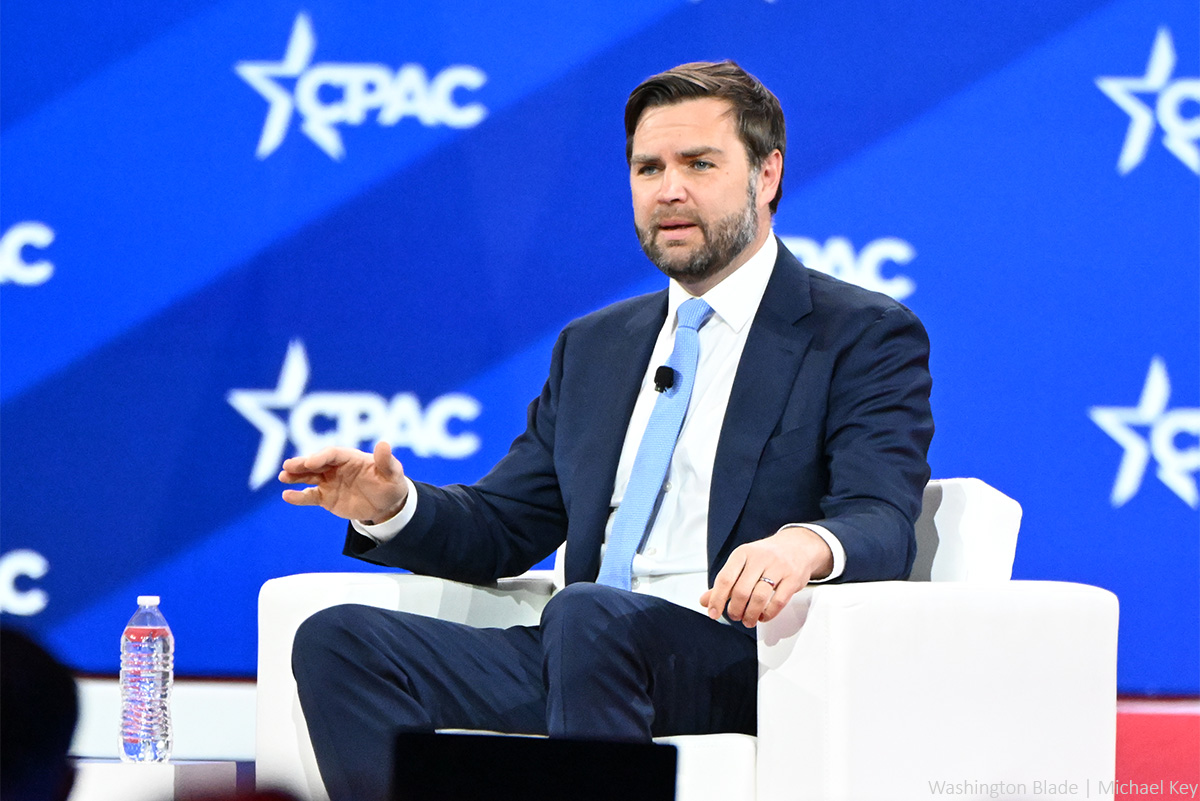
Vice President JD Vance and his wife, second lady Usha Vance, will visit Hungary next week.
An announcement the White House released on Thursday said the Vances will be in Budapest, the Hungarian capital, from April 7-8.
JD Vance “will hold bilateral meetings with” Hungarian Prime Minister Viktor Orbán. The announcement further indicates the vice president “will also deliver remarks on the rich partnership between the United States and Hungary.”
The Vances will travel to Hungary less than a week before the country’s parliamentary elections take place on April 12.
Orbán, who has been in office since 2010, and his Fidesz-KDNP coalition government have faced widespread criticism over its anti-LGBTQ crackdown.
The Associated Press notes polls indicate Orbán is trailing Péter Magyar and his center-right Tisza party.

President Donald Trump removed Attorney General Pam Bondi from her post Thursday, following growing criticism over how she and the Department of Justice handled a range of issues, including matters related to sex offender and Trump ally Jeffrey Epstein.
Trump announced Bondi’s removal on Truth Social, where he also said Todd Blanche will serve as acting head of the Justice Department.
“Pam Bondi is a great American patriot and a loyal friend, who faithfully served as my attorney general over the past year,” Trump wrote on the platform. “Pam did a tremendous job overseeing a massive crackdown on crime across our country, with murders plummeting to their lowest level since 1900.”
Trump was seen as recently as Wednesday with the now-former attorney general at a Supreme Court hearing on citizenship.
The decision contrasts with Trump’s previous public praise of Bondi, the 87th U.S. attorney general and former 37th attorney general of Florida, who served in that role from 2011-2019 before joining the Trump-Vance administration. He has frequently lauded her loyalty and said he speaks with her often. Bondi was also one of president’s defense lawyers during his first impeachment trial.
Privately, however, Trump had grown frustrated that Bondi was not “moving quickly enough” to prosecute critics and political adversaries he wanted to face criminal charges, according to multiple sources. The New York Times reported that her inability to charge former FBI Director James B. Comey and New York Attorney General Letitia James with any crimes is a large factor in the president’s choice to fire her from the government’s primary law enforcement agency.
The move comes as Trump has sought to minimize public turmoil within his administration, avoiding the perception of a revolving-door Cabinet that defined his first term.
Lee Zeldin, a former Republican congressman from New York who unsuccessfully ran for governor, has emerged as a leading contender to lead the Justice Department. He has been one of Trump’s most reliable allies.
“He’s our secret weapon,” Trump said of Zeldin in February during a White House event promoting the coal industry, adding, “He’s getting those approvals done in record-setting time.”
Bondi has also growing faced scrutiny from Congress.
The House Oversight Committee recently subpoenaed her to testify about the department’s handling of certain files, where she declined to answer key questions during a contentious House Judiciary Committee hearing in February.
The Tampa native has a long history of opposing LGBTQ rights through her roles in government. As Florida attorney general, she fought against the legalization of same-sex marriage, arguing it would cause “serious public harm,” pushing forward a legal battle that cost taxpayers nearly half a million dollars. She also asked the Florida Supreme Court to overturn a lower court ruling that found the state’s same-sex marriage ban unconstitutional.
More recently, Bondi established a “Title IX Special Investigations Team” within the Justice Department focused on restricting transgender women and girls from participating in women’s and girls’ sports teams and accessing facilities aligned with their gender identity. She also told Children’s Hospital of Philadelphia to turn over the medical records of anyone under 19 who received gender-affirming care.
Her removal follows Trump’s decision last month to oust another controversial female Cabinet figure, Kristi Noem.

White House ends protections for trans students in multiple school districts

Amendments to India’s transgender rights law criticized

Cuba under pressure and without answers

Police mental health struggles gain growing attention

Man faces first S.C. ‘hate intimidation’ charge

JD Vance to travel to Hungary next week

Mayor Bowser signs bill requiring insurers to cover PrEP

Belarusian lawmakers approve bill to crackdown on LGBTQ rights

How new barriers to health care coverage are hitting D.C.

Kenyan advocacy groups launch LGBTQ voter mobilization campaign
-

 Hungary5 days ago
JD Vance to travel to Hungary next week
-
District of Columbia5 days ago
Mayor Bowser signs bill requiring insurers to cover PrEP
-
Belarus4 days ago
Belarusian lawmakers approve bill to crackdown on LGBTQ rights
-
District of Columbia4 days ago
How new barriers to health care coverage are hitting D.C.