Theater
Out choreographer calls Chamber Dance Project ‘contemporary dance at its finest’
In an airy white rehearsal studio in Northwest Washington, Luis R. Torres smiles through the sweat. He laughs as he easily switches from Spanish to …
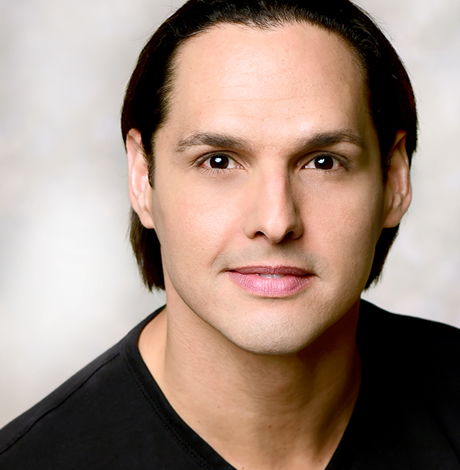
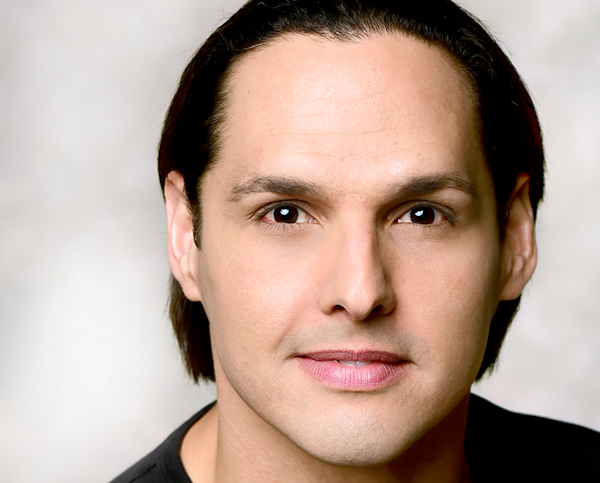
Luis Torres says being gay informs his artistic endeavors as a dancer and choreographer. (Photo courtesy CDP)
‘Ballet, Brass & Song’
June 22-24
Chamber Dance Project
Sidney Harman Hall
610 F St., N.W.
$30-45
In an airy white rehearsal studio in Northwest Washington, Luis R. Torres smiles through the sweat. He laughs as he easily switches from Spanish to English teaching two young male dancers their parts for a piece in Chamber Dance Project’s upcoming fourth-season program “Ballet, Brass & Songs.”
“It’s work but there’s a lot of joy in the process,” says Torres, 42. He first danced with the company and now is its ballet master. His duties include restaging choreography, rehearsing the dancers and ensuring pieces have the right count, musicality and style. Today he’s restaging the New Orleans-inspired “Rue Noir” by New York choreographer Jennifer Archibald.
Founded by choreographer Diane Coburn Bruning, Chamber Dance Project is a company of professional artists dedicated to redefining contemporary ballet in partnership with live music played by visible musicians sharing the stage. Their upcoming performance takes place at Shakespeare Theatre Company’s vast Sidney Harman Hall, giving the ingenious and thrilling company the opportunity to perform for their largest audience to date.
Torres, who is gay, first connected with the company’s artistic director Bruning when he was completing a master’s degree at George Mason University. He restaged some of her choreography after having seen the piece on video. Bruning was mightily impressed. Soon after, she asked Torres to dance in her male duet “Exit Wounds,” a piece first performed early in Chamber Dance Project’s meteoric four-year tenure, and then hired him as the company’s ballet master.
“Luis is brilliant at what he does,” Bruning says. “He allows me to focus on the choreography while he takes care of the mechanics. He’s the master of all things related to dancers partnering. He’s the skeleton behind my ideas. It’s been a great collaboration.”
“Ballet Brass & Song” features the premiere of “Songs by Cole”, a ballet with a live jazz trio performing the beloved music of Cole Porter; sultry tangos of Sur by Argentinean choreographer Jorge Amarante; and the soaring athleticism of the poignant male duet “Exit Wounds” by Diane Coburn Bruning; and the aforementioned “Rue Noir.” The onstage music includes the company’s string quartet, Mosche Brass Band and a jazz trio led by acclaimed singer Lena Seikaly.
“The Cole Porter piece is a reaction to a contemporary driving work I did last season,” Bruning says. “It was time for me to do something on the lighter side. But I also wanted to include his wit and incisive intelligence.”
For Torres, Chamber Dance Project is a month of intense rehearsal leading up to its annual program, but the job also entails promotions and the various events throughout the year. Torres is also an adjunct professor at George Mason University and a guest teacher and choreographer in many locations around town, and he is a company member and ballet master at the Washington Ballet. Before the Washington Ballet, he was a soloist with Ballet Theatre of Maryland in Annapolis, Md., and performed soloist and principal roles with Ballet Arizona.
He says restaging other choreographers’ work never gets old.
“To keep it fresh I go to the music. I love music. It’s the main reason I dance and I want to translate that excitement. Chamber Dance Project is contemporary dance at its finest. We invite dancers with top-notch classical training who are interested in exploring space and movement to the next dimension with live music. Our dancers may be on point or wearing sneakers or cowboy boots. It’s my time to think outside the box and to create a new image or feeling. I’m explaining to dancers how to approach the work and break through despite misgivings they have.”
Torres began ballet training in his native Puerto Rico under the direction of Elizabeth Calero when he 16. After a several years he was awarded a scholarship to Point Park University in Pittsburgh where he trained under Roberto Munoz who was to become Torres’ longtime mentor
“When I first dancing I was teased. Kids said I was gay. I’d say ,‘Tell me something I don’t know.’ My family was accepting of my sexuality so it wasn’t a big deal,” he says. “I think the stigma associated with boys dancing grows less and less.”
He says his identity informs his work.
“I create from my experience, my hurt, my judgments, and from who I love. Like all artists my work definitely reflects my life. I’m also influenced by the gay community’s struggles which are increasing under the Trump administration.”
Dance is hard on the body. Over the years Torres suffered myriad injuries including fractures and two hip surgeries.
“The body is like a car. It doesn’t go as fast as it used to. But this allows me to focus on other things like how you move and what you’re saying with your body. And while a dancer’s time is limited, I can be ballet master so long as I have memory and a voice.”




Theater
Actress takes on bisexual ‘Ma’ Rainey in new Round House production
Haskins relishes playing ‘impassioned Black woman who sticks to her guns’

‘Ma Rainey’s Black Bottom’
Sept. 9-Oct. 11
Round House Theatre
4545 East-West Highway
Bethesda, MD 20814
$50 and up
Roundhousetheatre.org
Among the Black blues women of the 1920s and 1930s, being “in the life” wasn’t uncommon. Self-supporting and often on the road, they followed the Great Northern Migration to places like Chicago and Harlem, where they lived independent lives, made music, enjoyed same-sex relationships, and partied with like-minded ladies.
Gertrude “Ma” Rainey, best known as the “mother of the blues,” fit the bill. A big star, Ma toured the country and sold hit records nationwide. She lived an openly bisexual life.
In 1925, hosting an “indecent” all-female party at a Chicago apartment, landed Ma in jail, but blues singer Bessie Smith, Ma’s protégée and erstwhile girlfriend, promptly bailed her out. Three years later, Ma released a popular track whose lyrics included “Went out last night with a crowd of my friends / They must’ve been women, ’cause I don’t like no men.”
She was also a woman who knew her value. Ma’s voice was a powerful passport.
Ma Rainey is the ultimate force of strength and resistance in August Wilson’s 1982 play, “Ma Rainey’s Black Bottom,” the first of the late playwright’s brilliant Century Cyle, a collection of mostly Pittsburgh-set plays that chronicle the 20th century African-American experience.
Poised to kick off a month-long run at Round House (Sept. 9-Oct. 11), the production (co-produced with Olney Theatre Center) is directed by Lili-Anne Brown and features out actor and powerhouse vocalist Nicole Michelle Haskins making her Round House debut as Ma Rainey.
Set in a Chicago recording studio in 1927, the drama follows Ma, her Black band members and white producers as they try to record a new album of her sons. Tensions over artistic control, racial exploitation, and personal ambitions come to the fore. Amid the difficulties and a fair bit of humor, arises a serious clash involving hotheaded young trumpet player Levee (Yao Dogbe) who wants to alter musical arrangements on the titular song.
Playing blues icon Ma Rainey wasn’t on Haskins’s radar. Because the bulk of her work is in musical theater, Haskins never foresaw being tapped to do a Wilson play.
“It’s kind of like Shakespeare. Not restrictive but respected; not everyone gets a ticket to the party. So, I figured that I just wouldn’t pursue that,” she says matter-of-factly.
However, fate would dictate differently. Haskins and director Brown are longtime friends and collaborators. They recently worked together on “The Color Purple” at Chicago’s prestigious Goodman Theatre where Haskins played Sofia, another powerful Black woman who, not unlike Ma, is navigating life in a patriarchal white world.
When the opportunity came up to play Ma at Round House, Brown encouraged Haskins to audition. She did and got the part. “I’m so grateful to be working with a wonderful director like Lili-Anne, especially during my introduction to Wilson’s work. He is a theater god, and I’m swept every day.”
And is it special to be queer and playing queer? “For me, it’s special to play any role where there is an impassioned Black woman who sticks to her guns and fights for the things she deserves. Her sexuality is the icing on the cake.”
The production adheres to Wilson’s text and the text describes a woman who is in a relationship with another woman. Though her sexuality is provocative, it’s not the only thing about her that’s compelling. She’s also portrayed as an artist, businesswoman, and a loving aunt.
Haskins, a New York-based actor who made her name on the Chicago theater scene, grew up in Detroit. At 12, she became involved with the Mosaic Youth Theatre of Detroit; after high school she went on to earn a BFA at Detroit’s Wayne State University. Detroit is also where Haskins learned storytelling: “It’s very natural for a Detroit native to greet people on the street. There’s an expectation to be open to someone else’s story and to share your own. I’ve done this many times.”
Queer characters are famously underrepresented in Wilson’s work. “I see that, but do we really know for sure? After the first day’s read through of the play, some of the actors, for different reasons, wondered if in addition to Ma, perhaps one or two of the other characters might be queer too. Now wouldn’t that be interesting? That’s something I’d like to see.”
Theater
Immersive ‘Nation-State’ imagines a society free of authoritarianism
Queer duo brings unique theater experience to Dupont Underground
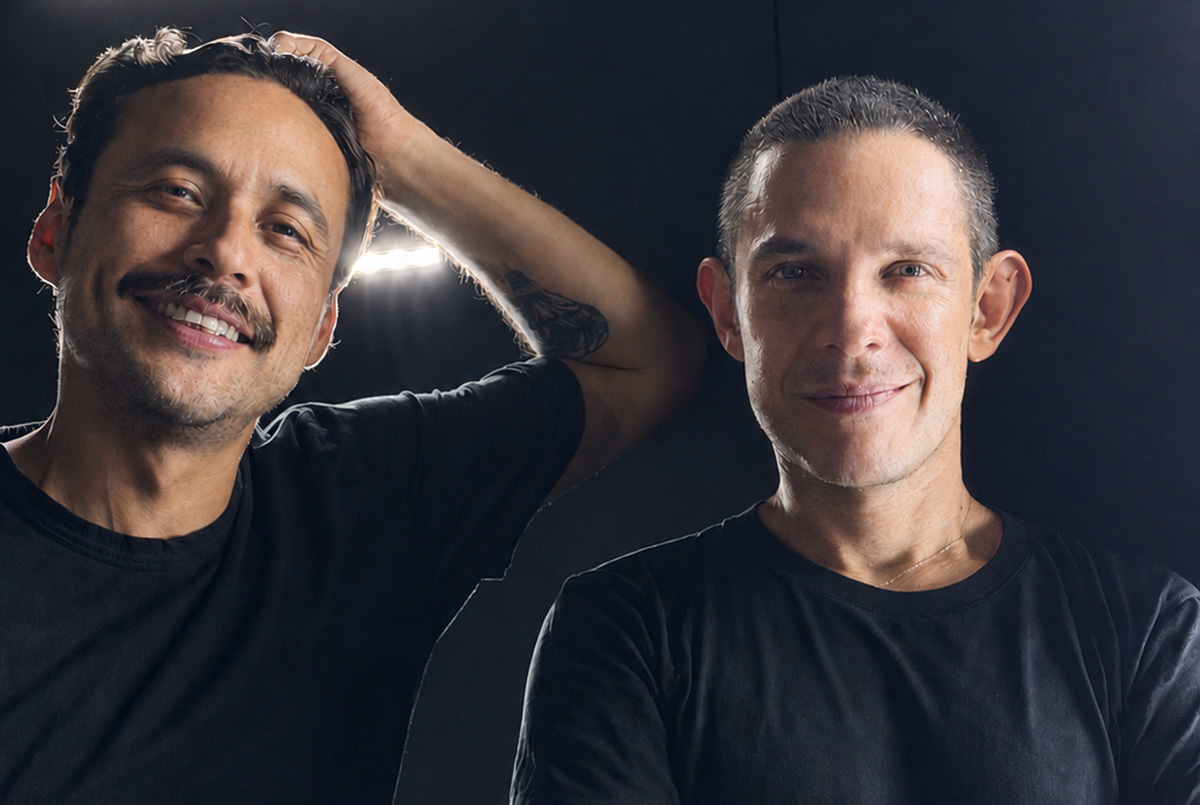
‘Nation-State: A Live Experiment’
Sept. 2-13
La Pluma Theatre
Dupont Underground
19 Dupont Circle, N.W.
$25-40
Dupontunderground.org
Industry Night: September 7. Free for all theater makers
A relevant piece replete with borders and passports, La Pluma Theatre’s “Nation-State: A Live Experiment”is immersive, site-specific, and testimonial.
With the production, the company’s queer co-founders Victor Salinas and Gabriel de la Cruz pose unique situations and experiences. In lieu of tickets, audience members get passports. What follows are questions and tests, and whether they gain entrance into a nation built to protect its citizens from authoritarianism, resource theft, and colonization remains to be seen.
Originally from Mexico and Peru, respectively, Salinas and de la Cruz met at a birthday party in D.C. and instantly clicked as theater makers, sharing outlook and ambition. Reluctant to go it alone, both had been searching for artistic and producing collaboration. That all changed.
And while their enterprise is primarily Latino and queer, these professional partners refused to be confined to a box, choosing rather to amplify the voices of all of D.C.’s diverse communities. In line with their plans, “Nation-State” is open to serving many points of view.
As director of “Nation-State,” de la Cruz mostly guides the questioning. He’s the right man for the job. Since arriving in the U.S. six years ago, he has been consistently curious about certain things. Who belongs here? How do you make this your home? And who is creating the rules?
“But the writing process is shared,” de la Cruz corrects. “I come up with questions. I provide Victor the topic and he goes from there. We’re both writing what happens next.”
He adds, “the most exciting moment for people is when they share something unique. As a questioner, you need to find the confidence and the right moment to ask the question. If you provide the space for that, the actor or audience member will give you something singular.”
Since before La Pluma opened in November 2025, its creators have agreed that “the most beautiful thing is when you use theater to fashion something innovative. Theater is the place where you can create new frameworks and rehearse new ways to live.”
At just an hour, “Nation-State” is performed in English at Dupont Underground – the company’s historic residence, a once subterranean street car barn located beneath Dupont Circle. For the production, the tunnels serve as boundaries, and its different curved spaces make up a micro nation and welcome different guest actors who will come to share their stories.
At certain times, Salinas plays Officer Salinas, Director of N.I.C.E. (Non-Discriminatory, Inclusive Customs Enforcement), a humorous social critic of the system and border patrol. Other times, it’s Salinas as himself telling his real-life stories. He says, “it’s a level of vulnerability that I’ve never experienced. The script is my personal life with zero censorship. But I think, if not now in a play that we are pouring our souls into, then when?
“As a kid I dreamed of being TV show host and now I am. I will sing and tell my stories. I feel comfortable and ready to do it.”
In Spanish, “pluma” means both pen and feather. For the company, it’s the latter, and comes with lively associations. Salinas explains. In mysticism, feathers serve as a portal between the real and spiritual worlds, like that between fact and fiction. And in Spanish and Latin American slang “showing feathers” (in other words, showing queerness). La Pluma encourages a good display of authenticity.
And specifically for Salinas, there’s a personal story involving his beloved grandmother with whom he was extremely close. After she died, he has regularly found feathers as if she’s making contact. “A bit romantic, I know. But I think if you’re open you can see these things,” he says.
“Nation-State” is challenging but fun. It’s unmistakably La Pluma. In the end, the company wants to build a world where everyone feels safe to tell their own stories, as individuals and performers.
Theater
New GALA show about WWII spy full of conflict, intrigue
‘GARBO: The Actor Who Saved the World’ an inspired true story
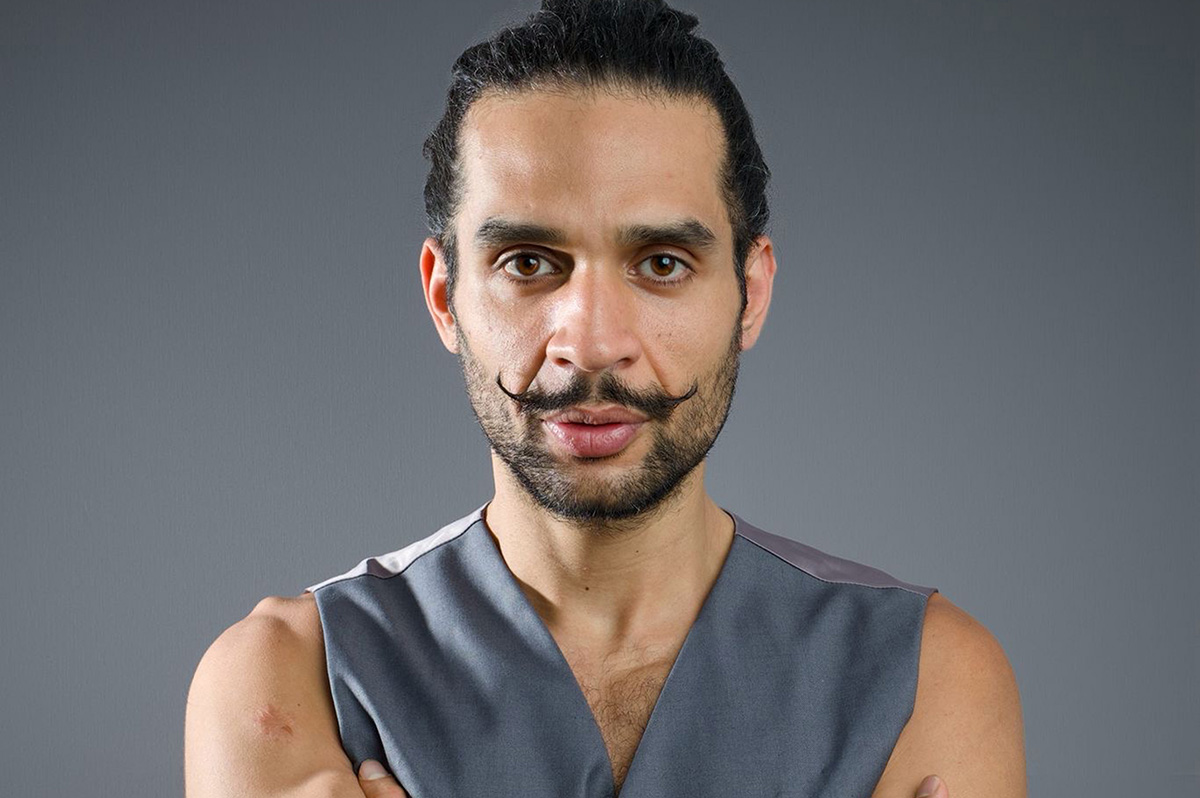
‘Garbo: The Actor Who Saved the World’
Sept. 3-27
GALA Hispanic Theatre
3333 14th St., NW
$25-$50
galatheatre.org
Conflict, intrigue, and abundant imagination – all the elements for an extraordinary story. Add real-life Spanish spy Juan Pujol García who worked as a double agent loyal to the United Kingdom against Nazi Germany during World War II to the mix and it’s truly inspired.
Code-named “Garbo” by the British (a nod to his acting prowess), the anti-fascist’s mission took him from Madrid to Lisbon and later a London suburb where he created fictitious reports while unassumingly blending in with middle-class commuters.
By inventing a phony spy network of 27 agents with intricate backstories and tales of espionage worthy of Balzac’s pen, Garbo convinced Hitler’s generals that the D-Day invasion would hit Calais instead of Normandy, saving thousands of lives along the way.
And now the tale unfolds on stage in “GARBO: The Actor Who Saved the World,” a premiere thriller at GALA Hispanic penned by GALA artistic director Gustavo Ott, staged by Cuban director Carlos Celdrán, and starring out actor Kevin Jorges in the title role.
When Jorges was tapped to play Garbo, he (like the rest of the cast) was utterly unfamiliar with the play’s cunning protagonist.
But that changed quickly. Jorges, 37, has immersed himself in the biography and become increasingly interested and somewhat enamored with the character.
Charismatic with an easy smile and rich, warm voice, Jorges says he had to put aside his sensibility as a gay man in order to portray Garbo, who was a straight, patriarchal figure. But he also embraced similarities with the spy, like their shared aversion to physical violence.
And Jorges cites what he finds a pivotal moment: Garbo says to his British MI5 case officer and handler Thomas Harris (played by gay GALA veteran Carlos Castillo) that after what they’ve been through, neither will be what they once wanted to be. They are changed. They’ll never be the same.
Performed at 90 minutes in Spanish with user friendly English surtitles, “Garbo” is about imagination as resistance. “It’s also about a theatrical vocation that went unfulfilled,” says Ott. “That is perhaps the greatest disappointment of modernity: the insurmountable obstacles a vocation faces.
“Through his imagination, Garbo attempts to reclaim his lost calling—that of being an artist—and in his new trade as a spy, he uses it as a lifeline.”
Ott adds, “Walt Whitman viewed imagination as a traveling companion. He could rely on it when he was alone, when he lost hope, and when life slammed every door shut.”
Jorges was was attracted to acting at an early age, but the murder of his father in Caracas in 1999, made it more than an interest, theater became a refuge that saved him from tragedy. Today, he believes that theater is a refuge for many Venezuelan artists, it’s a way for them to contribute to society despite difficult circumstances.
Despite enjoying a successful early career in Caracas with many roles and accolades, Jorges had no choice but to seek new horizons. Political turmoil and economic collapse prompted him to leave Caracas in 2019 for Spain where he worked outside of his profession for a few years.
The actor credits “migrant persistence” for his return to the stage. On New Year’s Eve in 2022, Jorges made a pilgrimage to the famous monument to Cervantes at Plaza de España in Madrid where he made a heartfelt wish to act again.
Soon after, Jorges was collaborating with playwright and director Elio Palencia on “Timón Of(f) Caracas,” a personal one-man adaptation of Shakespeare’s “Timon of Athens, reframing the universal themes of betrayal, excess, and misanthropy to mirror the sociopolitical realities of Venezuela. To much success and acclaim, the production toured important cities throughout Spain.
It was Palencia who suggested to GALA’s Ott that Jorges hop the pond to play Garbo in D.C.
While he once viewed each acting job as an opportunity, Jorges now sees them as gifts. And, he says, the part of Garbo is a gift filled with possibilities: “It’s wonderful performing in Spanish with English translation. I love the interaction of culture. I really enjoy seeing the way things are done at GALA. Maybe sometime I’ll be performing in English too.”

‘Thelma and Louise’ remains landmark of unspoken queer rebellion

Comings & Goings

LGBTQ Military Happy Hour set for Sept. 15

Calendar: September 11-17

Multi-billion-dollar 9/11 Victim Compensation Fund to continue until 2090

Iceland implements gender-neutral blood donor rules

Anti-science, anti-LGBTQ movements go hand in hand

Everton Blair makes history as first openly gay congressman from Ga.

Chris Pappas wins NH Democratic Senate primary

Mujer trans salvadoreña es encontrada sin vida
-

 Iceland4 days ago
Iceland implements gender-neutral blood donor rules
-
Commentary4 days ago
Anti-science, anti-LGBTQ movements go hand in hand
-
Georgia4 days ago
Everton Blair makes history as first openly gay congressman from Ga.
-
2026 Midterm Elections4 days ago
Chris Pappas wins NH Democratic Senate primary