National
Griffin says LGBT youth will motivate him at HRC
Activist wants Obama to endorse marriage equality, issue ENDA exec order

Chad Griffin has an image in mind as he prepares for his role to become the new president of the Human Rights Campaign: young LGBT Americans who lie awake in bed at night worrying about their future.
Griffin, a Los Angeles-based activist who has a long career in progressive advocacy and roots on both the East and West Coast, said growing up in a small town in Arkansas he identified as that young person who couldn’t acknowledge or be open about who he was.
“Some people know me as a guy who lives in L.A. and used to live in Washington, but my entire childhood was in Arkansas, and it’s where my entire family lives today,” Griffin said.
Griffin said his motivation over the next few years at HRC will be to impact the lives of “that young kid, the young student, who lives in Fresno or Bakersfield or Arkansas, or Washington, D.C., for that matter.”
“The fact that every single night, where we all have very lucky lives and live in places where we’re accepted, there are thousands, if not millions, of kids who go to bed every night staring at the ceiling — something that so many of us all did — not being able to go to sleep out of fear of waking up the next day and facing that next day,” Griffin said.
Griffin spoke with the Washington Blade over the phone from Dulles Airport as he awaited his flight back to Los Angeles. He was on his way to attend on Saturday Dustin Lance Black’s play ‘8,’ which is about the enactment of Proposition 8 in California.
The new HRC president, who’s set to take on his role in June, comes to the organization after having started and served as board president for the American Foundation for Equal Rights. The group, founded in 2009, is responsible for the ongoing litigation against California’s marriage ban.
During the interview, Griffin was hesitant to talk about specific policies he’d like to pursue, noting Joe Solmonese is still running HRC, but said he wants to continue the positive change the LGBT community has seen over the past few years.
“It means changes in the workplaces, changes at the state and local level, and, obviously, it means significant policy changes at the federal level,” Griffin said. “So much has been accomplished over the past several years, but we’re not finished. And that kid is still waking up staring at the ceiling because he or she lives in a country where their government directly and intentionally discriminates against them.”
Griffin said his sense of urgency will be his top challenge at the helm of HRC, saying, “If in fact patience is a virtue, it’s a virtue I do not possess. I voice frustration consistently at the pace at which we make progress.”
“If you were to talk to anyone who knows me, I think that they would describe first and foremost my lack of patience and how self-critical I am when I can’t achieve what we need to achieve,” Griffin said.
When he comes to HRC in June, the race for the White House will be well underway, as well as the race for control of Congress. The LGBT community will see measures on marriage in Minnesota and Maine, and possibly Washington State and Maryland. (The anti-gay ballot measure in North Carolina is set for a vote in May prior to when Griffin will take over HRC.)
Griffin said he has a background as a political strategist and is used to working behind-the-scenes, developing campaign plans and executing them.
“If you’re going to win the war, you’ve got to fight the battle on every single front,” Griffin said. “So that’s at the federal level. It’s on the state and local level. With any campaign, with limited resources, you have to be smart about your investments and about your plan, but I am not one who believes we should forego any avenues of victory.”
The incoming HRC president also comes into the role as many critics contend HRC has been too cozy with the Obama administration and too afraid to criticize Democratic lawmakers.
Griffin said observers should look to his previous work to discover that he’s “not one who’s shy about disagreeing with friends and colleagues” when he believes they’re wrong.
“I have a long record in that and think that’s the best way to judge how I will act,” Griffin said. “I’m not one who is thought to be shy or easily intimidated, and you typically will always know what I’m thinking and how I feel.”
Asked about criticism that HRC caters too much to more affluent members of the LGBT community by hosting black-tie dinners while others in the community feel left behind, Griffin said the organization’s outreach will be inclusive.
“LGBT people comes in all ages, all religions, all political affiliations, all colors,” Griffin said. “They are all part of the inclusion strategy and they are my motivation.”
Griffin said he’s on board with two major asks for President Obama from the LGBT community: an endorsement of same-sex marriage and an executive order requiring federal contractors to have LGBT-inclusive non-discrimination policies.
“I fundamentally believe that not only the president but our members of Congress and all of our leaders should support marriage equality, and we should do everything in our power to get them to that position,” Griffin said.
Griffin called the proposed directive for federal contractors “something that should happen, and should happen as quickly as possible,” but said it’s only the first step and passage of the Employment Non-Discrimination Act is necessary.
“It’s so frustrating that we’re in a country where we still don’t have an inclusive ENDA,” Griffin said. “That is something that has to remain a priority, but I would think that the executive order that has been discussed and proposed and pushed forward is a good step and should happen.”
As Griffin takes on his new role, he said the work at AFER against Proposition 8 will continue. The only change, he said, will be that he’s stepping down as board president, although he’ll continue to serve on the board. Griffin said there are no plans to absorb AFER into HRC.



National
Philadelphia event to launch 2026 LGBT History Month
Dr. Fauci to be honored as 31 LGBT ‘Icons’ are announced

Equality Forum, the Philadelphia-based group that organizes the nation’s annual LGBT History Month in October, is scheduled to launch the 2026 LGBT History Month at a VIP Reception on Sept. 27.
The event, to be held at Philadelphia’s Independence Visitor Center, will honor Dr. Anthony Fauci, the former director of the U.S. National Institute of Allergies and Infectious Diseases who is credited with playing a leading role in the fight against HIV/AIDS and COVID-19. Equality Forum was to present Fauci with its International Role Model Award.
The Equality Forum, which operates programs focusing on LGBT history and the people who play a leading role in historic undertakings, will also present its Frank Kameny Award to Erica Deuso, who in 2025 won election as the first openly transgender mayor in the state of Pennsylvania as mayor of the town of Downington, Pa.
A statement released by the Equality Forum points out that LGBT History Month, held each year, celebrates the achievements of 31 lesbian, gay, bisexual, or transgender icons throughout the month of October. “Each day in October, a new LGBT icon is featured with a video, bio, bibliography, downloadable images, and other resources,” the statement says.
Although the statement releases the name and a short background description of each of this year’s 31 LGBT icons, the icons were scheduled to be officially announced and honored at the Sept. 27 event.
“The LGBT community is the only community worldwide that is not taught its history at home, in public schools or in religious institutions,” the statement says. “LGBT History Month provides role models, builds community and makes the civil rights statement about our extraordinary national and international contributions,” it says.
This year’s Icons include designer Calvin Klein, media mogul Barry Diller, U.S. Senate hopeful Chris Pappas, and perhaps most notably President Abe Lincoln.
Additional information about the event and a list of the 2026 LGBT Icons can be accessed at lgbthistorymonth.com.
Netherlands
Dutch prime minister visits Stonewall Inn
Rob Jetten is the Netherlands’ first openly gay prime minister
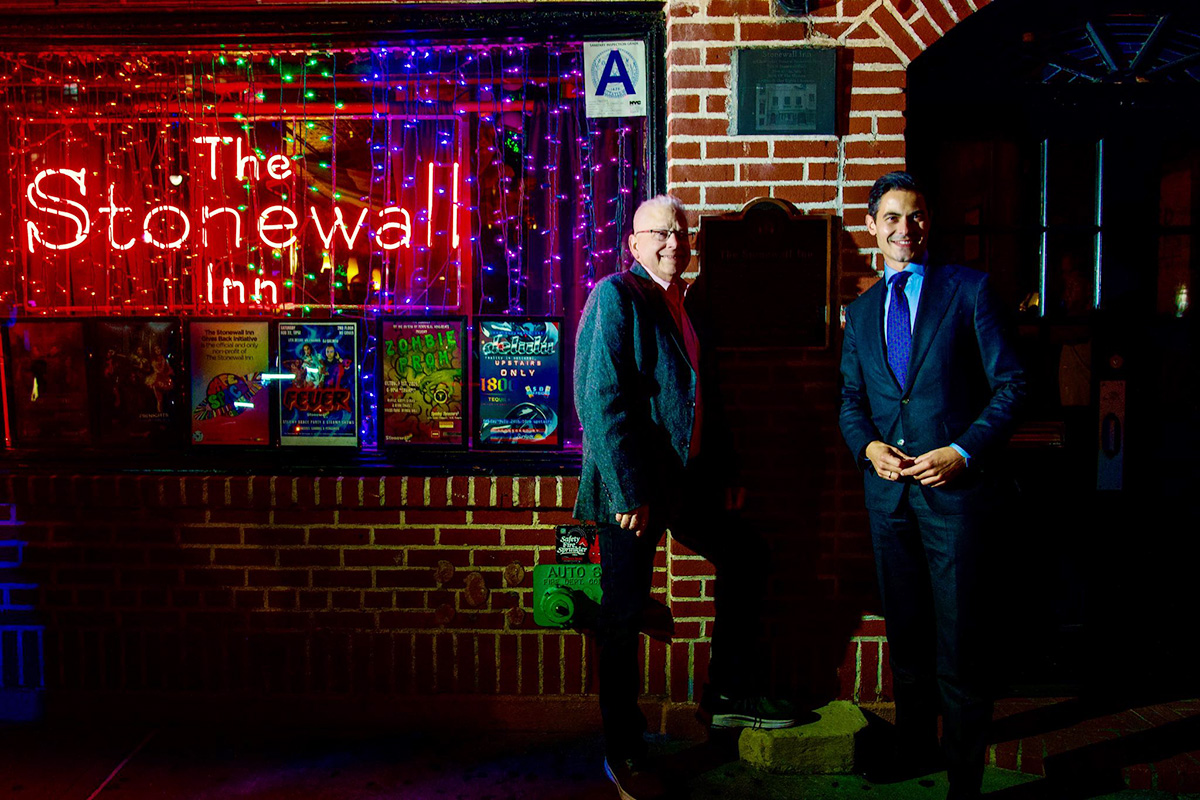
Dutch Prime Minister Rob Jetten on Monday visited the Stonewall Inn in New York.
“The Stonewall Inn is not just a gay bar in New York, but the place where in 1969 riots took place as a reaction to years of discrimination and police violence,” wrote Jetten on X. “This is seen as the starting point of the global LGBTIQ+ emancipation and activism. Nowadays, the bar is a national monument, dedicated to the LGBTIQ+ rights movement.”
“For me, it is impressive and moving to be here tonight. And also fitting, because the defense of human rights is an important part of our foreign policy,” he added. “The Netherlands stands alongside the Stonewall Inn community when it comes to everyone’s right to live openly, safely, and with pride, no matter who you are or who you love.”
De Stonewall Inn is niet zomaar een gay bar in New York, maar de plaats waar in 1969 rellen plaatsvonden als reactie op jarenlange discriminatie en geweld van de politie. Dit wordt gezien als startpunt van de wereldwijde lhbtiq+-emancipatie en activisme. Tegenwoordig is de bar… pic.twitter.com/hJmFYjF91Z
— Rob Jetten (@MinPres) September 23, 2026
Jetten in February became the Netherlands’s first openly gay prime minister.
He opened last month’s World Pride Human Rights Conference in Amsterdam. Jetten also participated in a panel with former Irish Prime Minister Leo Varadkar, former San Marino Captain Regent Paolo Rondelli, and other current and former heads of government who are gay or lesbian.
Jetten is scheduled to speak to the U.N. General Assembly on Thursday.
National
For lesbian victims of domestic violence, competent care is scare
Heteronormative assumptions, funding cuts contribute to lack of resources for survivors

Uncloseted Media published this story on Sept. 22.
By EMMA PAIDRA | Claire, a 25-year-old Los Angeles resident, distinctly remembers the night she and her ex-girlfriend broke up.
“She was strangling me in a CVS parking lot,” Claire recalls, adding how she was gasping for air as bystanders looked on. “I made eye contact with one man who just kept walking, and we were right behind a car that was trying to reverse out of a parking spot. No one got out of the car. They didn’t honk; they didn’t do anything.”
Claire, who asked to use a pseudonym due to safety concerns regarding her ex, says she managed to fight her way out of her then-girlfriend’s grasp. It was at this moment in 2024 she realized things had reached a breaking point.
While research on intimate-partner violence has traditionally focused on opposite-sex couples, two recent reports found that queer women, like Claire, are not immune to this type of abuse. An international research review published last year in the Journal of Media Critiques found “IPV rates in same-sex relationships are comparable to or exceed those in heterosexual relationships,” with up to 46 percent of lesbians encountering such abuse, compared to 36 percent of straight women. A separate review published earlier this year found that nearly 27 percent of lesbians surveyed had experienced IPV.
Despite the prevalence of IPV in lesbian relationships, heteronormative and outdated assumptions have left many queer women feeling like they have nowhere to turn for competent services and support, according to experts, advocates and victims interviewed by Uncloseted Media.
“Queer folks are joining the conversation to say, ‘This is happening in our communities, too, and we need the same resources and support services that straight women are offered,’” Tori Stranges, a professor of women’s studies at the University of British Columbia, told Uncloseted Media.
A frequently overlooked problem
Stranges says the false notion that only men are domestic abusers can result in violent same-sex relationships not being taken seriously.
“People assume that violence is perpetrated by men against women,” she says, adding that this “has left queer people out of the conversation.”
“If it was a man that was doing all these things, and people heard and saw it, I’m sure I would have been taken seriously,” says Claire. “People saw a 5-foot-7 woman who didn’t look that strong — and above all, she was a woman. Men, especially, don’t really see that as a threat. So they’re like, ‘If I’m not threatened, then I’m sure it’s not a big deal.’”
Outdated assumptions about IPV can even result in victims themselves overlooking their abuse.
“When it comes to abuse in heterosexual relationships, there are national campaigns, there are resources that you can access,” Stranges says. “There are people coming into the school systems to talk about relationship violence. We don’t have similar recognition and the same conversations about queer people.”
Claire says the violence she was subjected to was paired with moments of intense affection, which made it harder for her to recognize the abuse.
“We would get into a fight, and she would physically abuse me, and then apologize. She was actually also very gentle with me sometimes,” Claire recalls. “That kind of cycle can be really addicting. I would always wait for the good parts.”
The role of mental illness
K.P., a 47-year-old lesbian living in Maine, was with her abusive ex-girlfriend for five years before ending the relationship in 2023. During their time together, K.P. says her ex, who struggled with panic disorders, ADHD and depression, experienced a decline in her mental health, which contributed to more frequent outbursts of rage. When it comes to the link between rage and violence, one 2022 meta-analysis found that “anger was a significantly stronger correlate of IPV perpetration for women than men.”
K.P., who was working from home at the time and felt like she had no escape, says her ex’s verbal abuse spiraled into physical violence.
“I was on the couch with my laptop, trying to work, and she was just being belligerent,” recalls K.P., who asked to be identified by only her initials because of safety concerns. “I tuned her out, but when she realized I wasn’t giving her the attention that she expected, she went to the kitchen, grabbed two knives and started coming at me.”
K.P. ran outside, trying to get away. Her ex ran after her and then chased her back inside to avoid being seen by neighbors.
Once inside, her partner hid her phone. K.P. used this brief window to message a co-worker on her laptop, asking him to call the police.
“I was confused and afraid,” K.P. told Uncloseted Media. “I’d never been chased with a knife before, let alone by someone who I cared about.”
Research shows LGBTQ people have higher rates of mental health conditions than their non-LGBTQ peers. A study published last year in JAMA Network Open found sexual and gender minorities had “significantly higher odds of at least four of 10 commonly diagnosed mental health conditions,” including post-traumatic stress disorder and bipolar disorder.
IPV may also contribute to negative mental health effects, with research finding that victims experience an increase in depression, anxiety and PTSD and a reduction in life satisfaction.
“After we broke up, I was messed up,” K.P. says. “It took me a good six or eight months to feel like I could breathe again.”
Trapped in a ‘double closet’
In addition to mental health, the stigma of being queer may affect a victim’s response to being in an abusive relationship. When Claire first came out to her family, she says they kicked her out of their home until she returned to the proverbial closet. They eventually accepted her sexuality, but Claire says the residual shame she carried afterwards led her to avoid the added stigma she feared she’d experience if she admitted to being in an abusive relationship.
“All of that combined made me feel so trapped. I just thought, ‘Oh my god, I’m being judged from every single angle,’” she says. “There was just nowhere to go.”
Letícia Yuki de Araujo Furukawa, a clinical psychologist specializing in supporting survivors of IPV, says this kind of thinking is not uncommon among queer women in abusive relationships.
“Sometimes lesbian women who are experiencing IPV relationships start to isolate themselves, to prevent themselves from the shame and judgment they think they are going to suffer,” she says.
Furukawa says this impulse is rooted in the layers of stigma queer women face.
“It comes down to two things that make it like a double closet: We have the closet of being a lesbian, and you have the other one that comes from being in a violent relationship.”
According to Furukawa, having a supportive family can decrease the risk of entering an abusive relationship. Unfortunately, strained familial relationships are common among queer people: A 2022 study in the Journal of Marriage and Family found that 32 percent of gay and lesbian adult children — compared to 22 percent of their heterosexual counterparts — were estranged from their fathers.
Because of the shame Claire faced from her family when she came out, she was reluctant to admit there was a problem in her relationship when her mother and sister expressed concern. She worried that if her family knew her lesbian relationship was abusive, they would stop accepting her queer identity.
“My mom and sister would say to me during the relationship that they thought my ex looked evil, and that I changed so much. I used to be such a bubbly girl, and my personality made a complete 180,” she remembers. “In my head, I was like, ‘I can’t admit that it’s true.’”
‘Gaps in, policy, care, and services’
When queer women have the courage to report IPV, some don’t receive the response they’re hoping for. When police arrived at K.P.’s home following the knife-wielding incident, she says they opened a case file and wrote an incident report but said there was nothing else they could do because her ex had fled the scene.
“It was a little frustrating that since my ex-girlfriend drove away, the police couldn’t do anything,” K.P. explains.
Laura Elizabeth, an assistant professor of criminal justice at Virginia Union University who researches IPV, says there may have been additional steps police could have taken to support K.P., including connecting her with resources for domestic-violence survivors.
“It is vital that [police] make the proper referrals, and that it not just be limited to handing the victim a brochure,” she says. “There needs to be an active discussion with victims about what their options are in terms of who they can reach out to, who can offer what services.”
Kimberley Jackson, an associate professor at the Arthur Labatt Family School of Nursing at Western University, says lack of research on same-sex domestic violence also impacts the support services available to lesbian victims.
“The intersection of IPV and the LGBTQ community is really not well understood,” Jackson told Uncloseted Media. “What we can tell you based on really limited evidence, is that there are huge gaps in policy, care and services. And with respect to shelters, we haven’t really moved the needle very far.”
One area in which shelters may be failing lesbian victims has to do with both the perpetrator and the victim being able to access the same shelter.
“This issue is further compounded in rural areas, where there’s likely only one shelter,” Jackson says. “There’s a chance they won’t be able to turn someone away, even if they’re the perpetrator.”
Jackson says queer victims of domestic violence who aren’t open about their sexuality may face additional obstacles.
“With respect to anonymity, in a lot of rural places, you’re going to know people in the community,” she says. “There are issues with accessing help if you’re worried about outing yourself.”
Calls for change
Experts and victims say LGBTQ training for shelter workers and law enforcement, as well as funding for research, could help prevent same-sex IPV and address the damage done by such abuse.
But under the Trump-Vance administration, these funding resources are slipping away. In March of last year, the administration canceled at least 68 grants, totaling nearly $40 million, that were focused on LGBTQ health. A second round of cuts followed two months later, during which $800 million worth of grants dedicated to researching LGBTQ health were terminated.
Rebecca Hobbs, co-executive director of Through These Doors, a domestic violence resource and advocacy center in Portland, Maine, says LGBTQ training materials are essential to ensuring shelters can support lesbian victims.
“LGBTQ people will not come to us unless they see themselves reflected in our materials,” Hobbs says. “We want our advocates to be well versed in understanding the additional barriers and challenges that LGBTQ people might experience.”
Advocates say police departments could also benefit from LGBTQ-awareness training.
The state of California and a number of large cities — including Atlanta, Chicago, Los Angeles, Houston, New Orleans, New York, Philadelphia and D.C. — have implemented some form of LGBTQ-sensitivity training.
But Greg Miraglia, founder and CEO of Out to Protect, a national organization supporting LGBTQ police officers and equipping all officers to serve queer people, says these programs are the exception, not the rule.
“Most other states do not require any type of LGBT awareness training,” Miraglia, a retired police officer who is based in California., told Uncloseted Media “There are over 18,000 law enforcement agencies out there, and I don’t think we’ve scratched the surface.”
“The problem comes about when law enforcement goes into a domestic violence incident with a same-sex couple without any training, carrying a lot of stereotypes that are common,” Miraglia adds. “They’re not picking up the fact that this is a couple that’s involved in an intimate relationship, and therefore domestic violence laws in that state apply.”
Claire says she wishes someone had intervened when her ex abused in the CVS parking lot and on her college campus. “The police had the biggest missed opportunity to intervene, as well as campus security,” she says. “A lot of our fights were in public, and she would get very loud. I made a promise to myself that if I ever saw anything like that in public, I would say something, because that’s all I needed at the time.”

Trump-appointed judge restores White House TV pool access

Philadelphia event to launch 2026 LGBT History Month

Colombia withdraws from Equal Rights Coalition

Caso Karlina: Una sentencia histórica contra las terapias de «conversión»

Washington Blade responds to concerns over White House pool duties

Over 2,000 turn out for Hands Around the Kennedy Center protest

PHOTOS: Wanda Alston Foundation Fall Reception

PHOTOS: Walk and 5K to End HIV

What LGBTQ veterans are building after ‘Don’t Ask, Don’t Tell’