Politics
Russian activists have mixed reactions to Obama meeting
U.S. ‘cannot approach relations through prism of human rights alone’
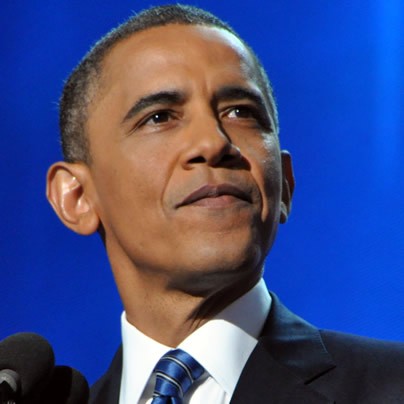
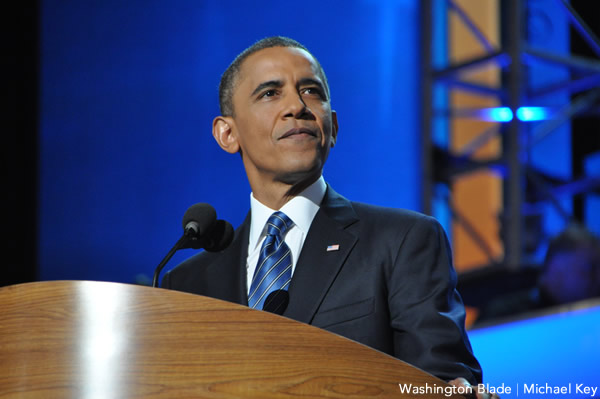
Russian activists have mixed reactions to their meeting with President Obama.(Washington Blade file photo by Michael Key).
Russian activists who attended a meeting last week with President Obama in St. Petersburg came away with mixed feelings about the event, with one claiming Obama told them he couldn’t make human rights the lone priority in U.S.-Russia relations.
Both LGBT activists who attended the meeting with Obama on Friday spoke to the Washington Blade and said they were pleased the meeting took place, but disagreed with some of what Obama said. They were among nine civil society representatives who took part in a roundtable discussion with Obama as part of his visit to Russia for the G-20 summit.
Igor Kochetkov, director of the LGBT Network in Russia, spoke with the Blade in a phone interview through a translator from Human Rights First and said Obama told activists he had to prioritize issues other than human rights.
“Obama said that his agenda is quite extensive and he cannot approach U.S.-Russia relations through the prism of human rights alone,” Kochetkov said. “He said there’s economic partnerships, military/strategic cooperation, and in order to achieve consensus on those subject areas, he has to compromise and find a balance in discussions about human rights.”
Kochetkov said he disagrees with Obama on this view of human rights issues.
“I think this approach does not have a future because in Russia, racist and homophobic attitudes are proportional to the growth of anti-Americanism and anti-Western attitudes,” Kochetkov said. “And the West won’t be able to get what it wants in the economic or military realm while being silenced on human rights.”
Still, Kochetkov said he wouldn’t characterize himself as disappointed in Obama’s remarks and noted he was “pleased” the meeting took place.
“I think it’s very important that Obama invited human rights activists, including specifically LGBT activists from Russia,” Kochetkov said. “It was a serious signal to the global community, a signal that it’s impossible to discuss human rights in today’s world without a conversation about the status of gay rights. Not everyone, especially in Russia, understands that.”
Olga Lenkova, communications director for the St. Petersburg-based LGBT group Coming Out, told the Washington Blade via email she was also satisfied with the experience.
“We did not have any particular expectations from the meeting, other than hoping for a good exchange of ideas, which has in fact taken place,” Lenkova said.
Lenkova said the focus of the meeting was on human rights in general, and the “complicated situation” for civil society leaders in Russia in addition to global challenges such as the “relative ineffectiveness” of the United Nations and global warming.
“President Obama tried to respond to all questions raised despite our obvious disagreements on Syria for example,” Lenkova said. “He mostly talked about the U.S., highlighting that there are many challenges and problems, the ones we mentioned — death penalty, Guantanamo, surveillance, etc. — and others that can’t be easily overcome by a president, but where the active civil society plays the key role.”
According to Lenkova, Obama concluded the session by saying, “Any state has to guard itself from protecting itself instead of its citizens. You’ve challenged me to do more and I will. And sometimes I will succeed and sometimes not.”
Which LGBT issues came up during the meeting? Kochetkov said he urged Obama to be more open and vocal in his criticism of what’s happening in Russia. He also urged Obama to build international awareness of LGBT issues.
“I also asked President Obama to consider ways of monitoring hate crime incidents through the international community,” Kochetkov said. “Hate crimes motivated by sexual orientation or gender identity bias are not totally investigated or investigated at all sometimes, so we need an international mechanism to look into those cases as well.”
Amid growing international attention, the activists said they also raised concerns with Obama about a controversial anti-gay law that prohibits pro-gay propaganda to minors in Russia.
Dmitri Makarov, a member of the Russia-based International Youth Human Rights Movement who was a non-LGBT participant at the meeting, told the Blade via email the anti-gay law took up a significant part of the discussion.
“The Russian anti-gay laws were brought up and were a significant part of the discussion,” Makarov said. “There was a press briefing also at the end of the meeting by LGBT Network.”
Kochetkov said he raised the anti-propaganda law with Obama, but the president declined to comment on it.
“He made no comment, but he was there to listen to the situation in Russia,” Kochetkov said.
Lenkova said the measure did come up during the discussion, but LGBT rights weren’t the main topic of the meeting.
“Regarding LGBT issues he said that he had already been quite explicit about what he thinks about discrimination against LGBT people,” Lenkova said. “He also referred to the changes that took place in the U.S. in this regard within the last 10 to 15 years, when he was saying that though problems in the U.S. are still many, the system is capable of change.”
Some LGBT activists said prior to the meeting they hoped Obama would take his opposition to the anti-gay law directly to the Russian government and media during his trip to St. Petersburg.
A video report on Saturday from European television station Euronews claimed gay activists left the meeting with Obama feeling “disappointed.” It based that conclusion on an interview with Kochetkov, who talked through a translator.
Kochetkov responded to the report by reiterating he wasn’t disappointed in the meeting, but said he disagrees with Obama on some issues.
“It’s more nuanced,” Kochetkov said. “I’m not disappointed. I said that I disagree with President Obama on certain things.”
Nonetheless, International Youth Human Rights Movement’s Makarov said he thinks the report is “quite accurate” — or at least “as much as a one-minute report focusing on just one aspect can be accurate.”
“I would have liked to hear a more decisive stance, but I do understand the argument that there are other issues that the president has to care about,” Makarov said. “Yet, as a human rights defender I would push for human rights to be prioritized in relations with Russia in particular.”
The White House didn’t respond to a request for comment on the report or reactions from the activists.
According to a transcript of remarks provided by the White House after the event, Obama talked about freedom of the press and assembly with activists.
“I think it is important for us to remember that in every country — here in Russia, in the United States, around the globe — that part of good government is making sure that we’re creating a space for civil society to function effectively: freedom of the press, freedom of assembly, making sure that people can join together and make common cause around the issues that they care deeply about,” Obama said.



2026 Midterm Elections
Markey’s primary win deemed success for LGBTQ activists
Mass. lawmaker champions transgender rights
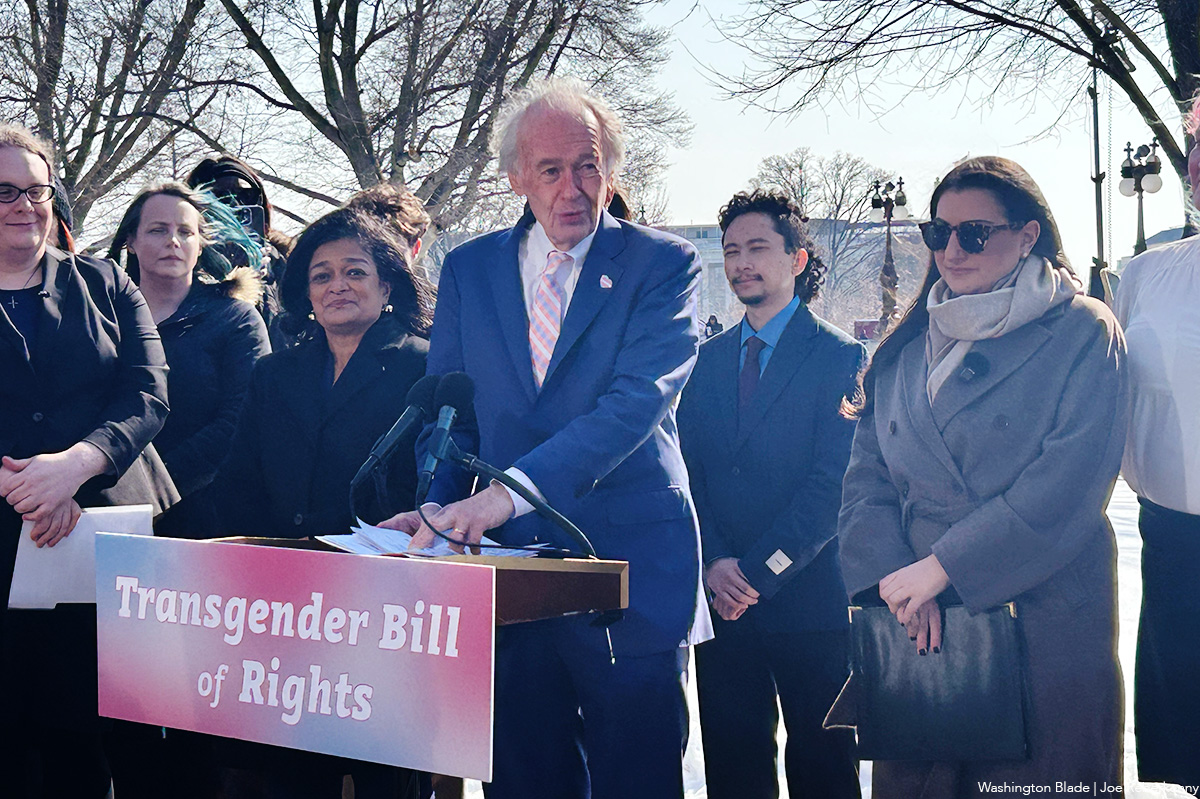
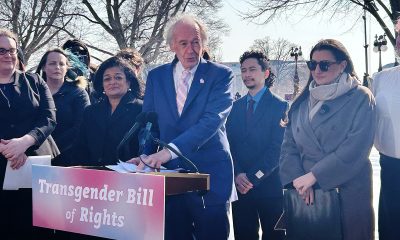
U.S. Sen. Ed Markey (D-Mass.) clinched the Democratic seat for his reelection campaign in Massachusetts’s primary election on Tuesday.
Markey won the deep-blue state with 64.8 percent of the vote, according to NBC News, triumphing over Marine Corps combat veteran and Congressman Seth Moulton, who received 35.2 percent of the vote.
Massachusetts’s primary election, which determined which Democratic candidate will head to the polls to face off against the Republican challenger in November, is being considered a victory for LGBTQ-inclusive policy, as well as for a divisive pro-transgender rights candidate — both things Markey has become an outspoken champion of.
Markey has experience at multiple levels of government, from the state level, where he served three terms in the state House of Representatives, to his federal tenure, including 20 terms in the U.S. House of Representatives and is now serving his second term as a senator. He has become a fixture of a changing Democratic Party in one of the most consistently blue places in the U.S.
This primary — and much of the national discussion surrounding the Senate seat — focused a lot of campaigning power on fighting the growing sentiment, led mostly by Republicans, that the frustration many Americans feel lends itself to an anti-establishment and anti-incumbent attitude.
Markey ran his campaign using his past as a reflection of his commitment to constantly putting his best foot forward for Bay Staters — particularly with apprehension for issues younger and more progressive democrats have been righting for — including Green New Deal and “Medicare for All” while Moulton — who was also elected to federal office prior to this run — campaigned on being younger than Markey, arguing that he was not the same type of established politician.
Moulton also faced backlash for negative comments about trans athletes, sparking criticism for those who did want younger candidate but want for trans rights to be protected.
Markey’s track record of supporting the LGBTQ community is one of the most clear in federal politics, one that has garnered a “100 percent lifetime voting record” on the Human Rights Campaign’s PAC politician review scorecard.
That list of Markey’s actions includes being a cosponsor of the Equality Act, driving landmark legislation to ensure federal protections for LGBTQ Americans, and being one of the most vocal proponents for trans rights in the federal government — specifically in multiple appropriations bills and in the National Defense Authorization Act. He was also the lead sponsor of the Transgender Health Care Access Act and the Transgender Bill of Rights resolution.
Markey first introduced the Transgender Bill of Rights in the Senate in 2023, where it ultimately failed to be brought to law. He reintroduced the legislation this year once again. This was a direct response to the attitude pushed by many conservatives after 2021, when the push to minimize trans rights started to become a key part of their cause and has been constantly propped up by the Trump-Vance administration.
“Massachusetts needs a senator who stands up and fights back, a senator who never forgets who they are fighting for,” Markey said during his victory speech. “That has been the mission of my life, and it always will be.”
Following the calling of the primary, a slew of LGBTQ organizations rallied behind Markey, many pushing his past as an asset that puts his money where his mouth is through advocating for legislation specifically protecting the LGBTQ community.
Tyler Hack, the executive director of the Christopher Street Project, an organization dedicated to pushing for legal protections for trans americans, released a statement following Markey’s win. Hack argued that putting forward such a staunchly pro-trans candidate is a win for the community, especially after endorsing him earlier this year.
“Tonight, anti-trans politics lost. Massachusetts rejected the idea that attacking transgender people is a shortcut to political power. Voters chose a different path: one where equality is not negotiable, cruelty is not courage, and transgender people do not have to disappear for Democrats to succeed.”
The Human Rights Campaign also endorsed him as a candidate earlier this year and issued a statement via its president, Kelley Robinson.
“Ed Markey has spent decades fighting for LGBTQ+ equality, for working people, and for a more livable world,” Robinson said. “He knows why equality matters. He’s stood with us no matter what. We were proud to endorse him this year, and when a pro-equality majority takes back the Senate this fall, we will continue to count on him as a champion for our community.”
Markey is running for reelection against Republican John Deaton in November, where he is expected to win.
Congress
HRC president campaigns for Chris Pappas in NH
Gay congressman running to succeed retiring U.S. Sen. Jeanne Shaheen

Human Rights Campaign President Kelley Robinson on Sunday campaigned for U.S. Rep. Chris Pappas (D-N.H.) in New Hampshire.
Robinson traveled to Manchester, the state’s largest city, nine days before the Sept. 8 primary that will determine who will vie for retiring U.S. Sen. Jeanne Shaheen (D-N.H.)’s seat.
We’re hitting the pavement across New Hampshire to fight for a freer, fairer future for everyone.
Glad to have Human Rights Campaign President @KelleyJRobinson join us for a canvass launch in Manchester today. pic.twitter.com/XWCEaQxy4o
— Chris Pappas (@ChrisPappasNH) August 30, 2026
Former U.S. Sen. John E. Sununu, who represented New Hampshire in the U.S. Senate from 2003-2009, will face off against former U.S. Sen. Scott Brown, who represented Massachusetts in the U.S. Senate from 2010-2013, in the Republican primary.
Karishma Manzur is among the Democrats challenging Pappas.
A poll the University of New Hampshire Survey Center released on Aug. 26 shows Sununu is ahead of Brown. The same survey shows Pappas ahead of Manzur and his other Democratic challengers.
The UNH Survey Center poll shows Sununu ahead of Pappas by a 45-43 percent margin if they were to face off in the general election. The margin of error is +/-2.1 percent.
Pappas would become the first openly gay man elected to the U.S. Senate if he were to win in November.
Congress
Chris Van Hollen says the Democratic Party needs change. Is he the one to lead it?
Senator is backing anti-establishment Democrats across the country
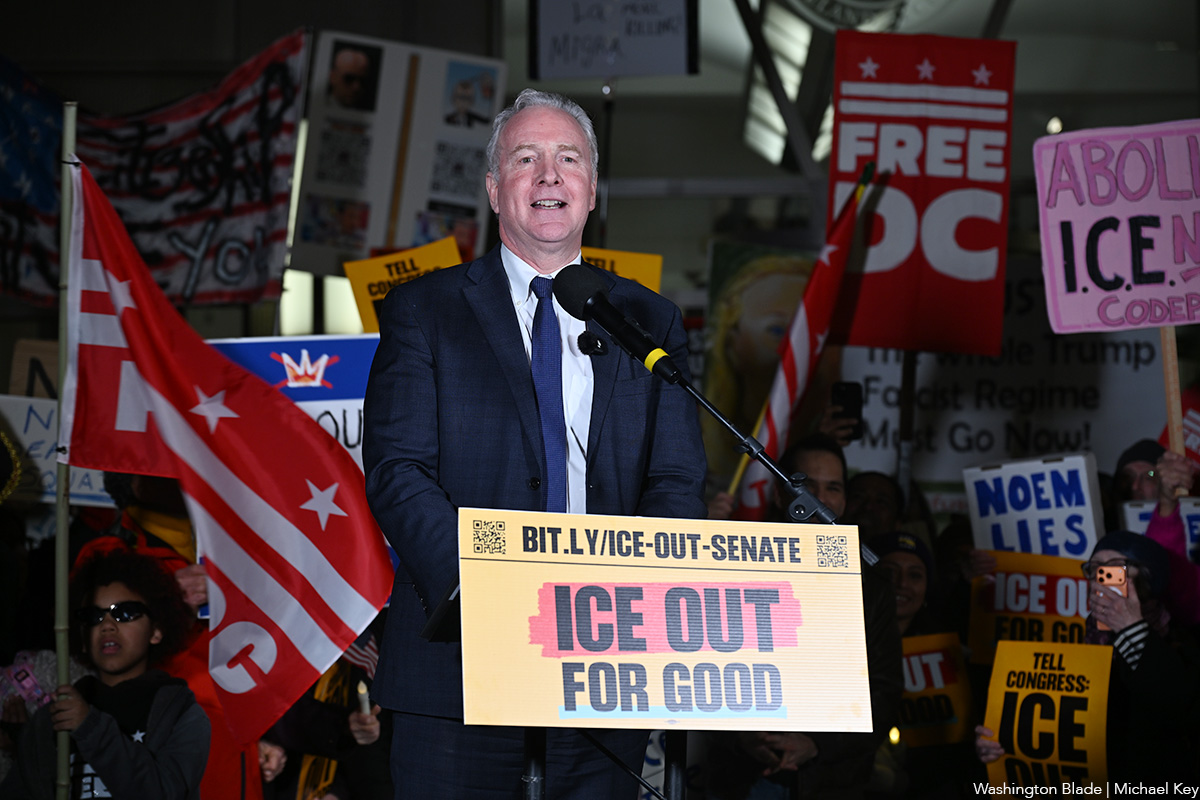
By LEE O. SANDERLIN | The Democratic Party is having something of an identity crisis — losing to President Donald Trump twice in three elections will do that.
Should the party embrace anti-establishment figures who espouse progressive policy ideas like Medicare for all and rhetoric about unrigging the economy for the 1 percent? Or should Democrats try to appeal to moderates who want to return to semi-normalcy in a time of political upheaval?
Although he’s been in Congress since 2002, with key leadership roles throughout his tenure, Maryland Sen. Chris Van Hollen, 67, counts himself firmly in the anti-establishment camp.
The rest of this article can be found on the Baltimore Banner’s website.

Markey’s primary win deemed success for LGBTQ activists

Top Bulgarian court rules government must legally recognize trans people

Lou Chibbaro Jr. documentary wins award from NLGJA

Beloved D.C. ‘Old Catholic’ Bishop Charles Braun dies at 86

Blade welcomes fall intern

San Francisco, long a queer safe haven, remains competitive for homebuyers

E-INFOSOL leaders encourage youth to pursue tech careers

Milo Yiannopoulos deported to UK

New book examines Trump cuts to LGBTQ healthcare