Theater
‘Lights Rise’ for budding playwright
Straight writer explores gay themes in love triangle drama


Chad Beckim, right, with the cast of ‘Lights Rise on Grace.’ From left are Ryan Barry, Michael John Garces, Jeena Yi and DeLance Minefee. (Photo courtesy Woolly Mammoth)
‘Lights Rise on Grace’
Through April 26
Woolly Mammoth Theatre Company
641 D Street, N.W.
$35-68
202-393-3939
Playwright Chad Beckim dreads the poseur label. In his work, he writes about the personal lives of minorities and down-low lovers. Things a straight white boy from Maine might not know about. But through firsthand experience and research, Beckim has learned a lot and does his best to get it right.
In his gritty chamber play “Lights Rise on Grace,” now at Woolly Mammoth, Beckim tells the story of Grace, a shy Asian girl, who falls in love with Large, an extroverted African-American classmate. But their happiness is interrupted when Large is sent to prison. While locked up, he falls into a relationship with white inmate Riece. Six years later, a released Large reunites with Grace but continues his relationship with Riece.
“Inside prison Large and Riece are definitely lovers — intensely physically and emotionally paired off. When they return to their outside lives they don’t cut that off. They still see each other. And from what I’ve read, this happens a lot,” says Beckim, 41. “Had they grown up in a different more supportive environment, Large and Riece would have been gay men in a same-sex relationship, I think.”
What’s Beckim’s way into these gay characters? “I’m in theater. I’m surrounded by gay people and have always frank discussions with them. Also my uncle is gay.”
The Brooklyn-based playwright and co-artistic director of Partial Comfort Productions, a small but respected New York theater company recalls a particular family vacation. “My uncle and I were out on the lake drinking boxed wine when I asked him about being gay, to tell me what it’s like. That following Christmas when I came home from New York, my mom said, ‘If you’re gay I’ll always love.’ I was confused because I had a serious girlfriend at the time. Turns out my uncle had told my mom that I seemed gay curious and might be afraid to come out. My brother laughed a lot.”
Despite his familiarity with gays, treading in LGBT territory continues to be where Beckim feels the most “interloper-esque.” “When writing, I persistently ask questions to my gay friends: Does this track? Does this pan out? I don’t enter into this lightly, believe me. I take it very seriously and want to get it right.”
“Grace” first ran at the New York International Fringe Festival in 2007 where it was singled out for top prizes, and the revised Woolly production is part of a National New Play Network rolling premiere. This version is the result of a major rewrite (40 out of 51 pages rewritten). It’s directed by Michael John Garcés and features DeLance Minefee as Large, Ryan Barry as Riece and Jeena Yi in the title part.
Beckim’s inspiration for “Grace” was Dael Orlandersmith’s “Yellowman,” a two hander examination of race and sexuality “I read it on a 6 a.m. bus ride home to Maine and was blown away,” he says. “I’m from the whitest state in the country but I’ve always been interested in culture, race, ethnicity and sexuality. I think growing up where everyone looks the same fueled my interest and desire to examine other cultures.”
As an undergrad at Syracuse University where he did a lot of theater, Beckim pledged a black frat. After college, he continued acting and moved New York City where he lived with a Dominican friend’s extended family in rough, pre-gentrified Washington Heights. When he taught in New York City public schools as a teaching artist, his students were mostly minorities. His mentor is celebrated African-American gay playwright Robert O’Hara (“Bootycandy”) who encouraged Beckim to become a serious writer and introduced him to Woolly Mammoth.
For a time he lived in a housing project in Spanish Harlem where “Grace” is set. He remembers walking by a family-run Chinese restaurant where the young daughter was always seated in the window doing her homework, and wondering what her life would be. How would she get along with the black and Spanish kids at school? What kind of life she’d have. That’s where the play started.”
Now focused on writing, Beckim is eager to continue exploring subjects meaningful to him and the varied people to which he’s drawn. There’s nothing poseur about him.






Theater
Actress takes on bisexual ‘Ma’ Rainey in new Round House production
Haskins relishes playing ‘impassioned Black woman who sticks to her guns’

‘Ma Rainey’s Black Bottom’
Sept. 9-Oct. 11
Round House Theatre
4545 East-West Highway
Bethesda, MD 20814
$50 and up
Roundhousetheatre.org
Among the Black blues women of the 1920s and 1930s, being “in the life” wasn’t uncommon. Self-supporting and often on the road, they followed the Great Northern Migration to places like Chicago and Harlem, where they lived independent lives, made music, enjoyed same-sex relationships, and partied with like-minded ladies.
Gertrude “Ma” Rainey, best known as the “mother of the blues,” fit the bill. A big star, Ma toured the country and sold hit records nationwide. She lived an openly bisexual life.
In 1925, hosting an “indecent” all-female party at a Chicago apartment, landed Ma in jail, but blues singer Bessie Smith, Ma’s protégée and erstwhile girlfriend, promptly bailed her out. Three years later, Ma released a popular track whose lyrics included “Went out last night with a crowd of my friends / They must’ve been women, ’cause I don’t like no men.”
She was also a woman who knew her value. Ma’s voice was a powerful passport.
Ma Rainey is the ultimate force of strength and resistance in August Wilson’s 1982 play, “Ma Rainey’s Black Bottom,” the first of the late playwright’s brilliant Century Cyle, a collection of mostly Pittsburgh-set plays that chronicle the 20th century African-American experience.
Poised to kick off a month-long run at Round House (Sept. 9-Oct. 11), the production (co-produced with Olney Theatre Center) is directed by Lili-Anne Brown and features out actor and powerhouse vocalist Nicole Michelle Haskins making her Round House debut as Ma Rainey.
Set in a Chicago recording studio in 1927, the drama follows Ma, her Black band members and white producers as they try to record a new album of her sons. Tensions over artistic control, racial exploitation, and personal ambitions come to the fore. Amid the difficulties and a fair bit of humor, arises a serious clash involving hotheaded young trumpet player Levee (Yao Dogbe) who wants to alter musical arrangements on the titular song.
Playing blues icon Ma Rainey wasn’t on Haskins’s radar. Because the bulk of her work is in musical theater, Haskins never foresaw being tapped to do a Wilson play.
“It’s kind of like Shakespeare. Not restrictive but respected; not everyone gets a ticket to the party. So, I figured that I just wouldn’t pursue that,” she says matter-of-factly.
However, fate would dictate differently. Haskins and director Brown are longtime friends and collaborators. They recently worked together on “The Color Purple” at Chicago’s prestigious Goodman Theatre where Haskins played Sofia, another powerful Black woman who, not unlike Ma, is navigating life in a patriarchal white world.
When the opportunity came up to play Ma at Round House, Brown encouraged Haskins to audition. She did and got the part. “I’m so grateful to be working with a wonderful director like Lili-Anne, especially during my introduction to Wilson’s work. He is a theater god, and I’m swept every day.”
And is it special to be queer and playing queer? “For me, it’s special to play any role where there is an impassioned Black woman who sticks to her guns and fights for the things she deserves. Her sexuality is the icing on the cake.”
The production adheres to Wilson’s text and the text describes a woman who is in a relationship with another woman. Though her sexuality is provocative, it’s not the only thing about her that’s compelling. She’s also portrayed as an artist, businesswoman, and a loving aunt.
Haskins, a New York-based actor who made her name on the Chicago theater scene, grew up in Detroit. At 12, she became involved with the Mosaic Youth Theatre of Detroit; after high school she went on to earn a BFA at Detroit’s Wayne State University. Detroit is also where Haskins learned storytelling: “It’s very natural for a Detroit native to greet people on the street. There’s an expectation to be open to someone else’s story and to share your own. I’ve done this many times.”
Queer characters are famously underrepresented in Wilson’s work. “I see that, but do we really know for sure? After the first day’s read through of the play, some of the actors, for different reasons, wondered if in addition to Ma, perhaps one or two of the other characters might be queer too. Now wouldn’t that be interesting? That’s something I’d like to see.”
Theater
Immersive ‘Nation-State’ imagines a society free of authoritarianism
Queer duo brings unique theater experience to Dupont Underground
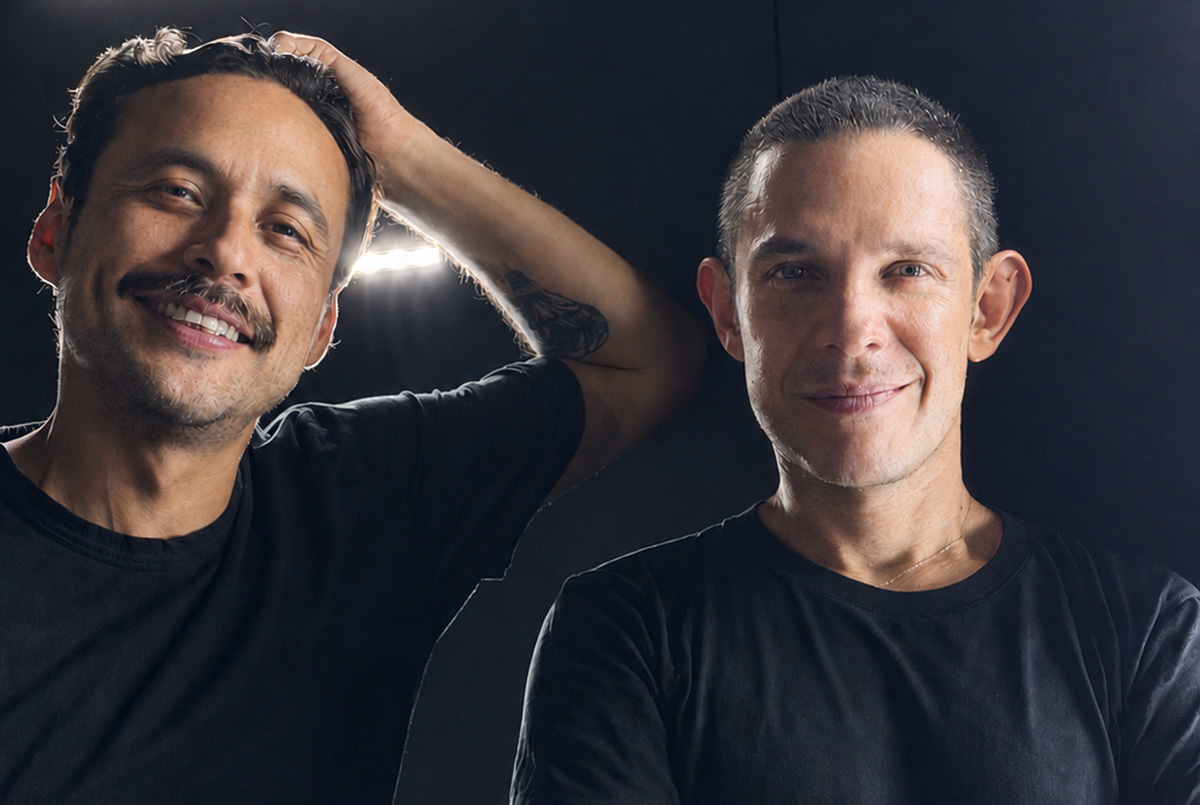
‘Nation-State: A Live Experiment’
Sept. 2-13
La Pluma Theatre
Dupont Underground
19 Dupont Circle, N.W.
$25-40
Dupontunderground.org
Industry Night: September 7. Free for all theater makers
A relevant piece replete with borders and passports, La Pluma Theatre’s “Nation-State: A Live Experiment”is immersive, site-specific, and testimonial.
With the production, the company’s queer co-founders Victor Salinas and Gabriel de la Cruz pose unique situations and experiences. In lieu of tickets, audience members get passports. What follows are questions and tests, and whether they gain entrance into a nation built to protect its citizens from authoritarianism, resource theft, and colonization remains to be seen.
Originally from Mexico and Peru, respectively, Salinas and de la Cruz met at a birthday party in D.C. and instantly clicked as theater makers, sharing outlook and ambition. Reluctant to go it alone, both had been searching for artistic and producing collaboration. That all changed.
And while their enterprise is primarily Latino and queer, these professional partners refused to be confined to a box, choosing rather to amplify the voices of all of D.C.’s diverse communities. In line with their plans, “Nation-State” is open to serving many points of view.
As director of “Nation-State,” de la Cruz mostly guides the questioning. He’s the right man for the job. Since arriving in the U.S. six years ago, he has been consistently curious about certain things. Who belongs here? How do you make this your home? And who is creating the rules?
“But the writing process is shared,” de la Cruz corrects. “I come up with questions. I provide Victor the topic and he goes from there. We’re both writing what happens next.”
He adds, “the most exciting moment for people is when they share something unique. As a questioner, you need to find the confidence and the right moment to ask the question. If you provide the space for that, the actor or audience member will give you something singular.”
Since before La Pluma opened in November 2025, its creators have agreed that “the most beautiful thing is when you use theater to fashion something innovative. Theater is the place where you can create new frameworks and rehearse new ways to live.”
At just an hour, “Nation-State” is performed in English at Dupont Underground – the company’s historic residence, a once subterranean street car barn located beneath Dupont Circle. For the production, the tunnels serve as boundaries, and its different curved spaces make up a micro nation and welcome different guest actors who will come to share their stories.
At certain times, Salinas plays Officer Salinas, Director of N.I.C.E. (Non-Discriminatory, Inclusive Customs Enforcement), a humorous social critic of the system and border patrol. Other times, it’s Salinas as himself telling his real-life stories. He says, “it’s a level of vulnerability that I’ve never experienced. The script is my personal life with zero censorship. But I think, if not now in a play that we are pouring our souls into, then when?
“As a kid I dreamed of being TV show host and now I am. I will sing and tell my stories. I feel comfortable and ready to do it.”
In Spanish, “pluma” means both pen and feather. For the company, it’s the latter, and comes with lively associations. Salinas explains. In mysticism, feathers serve as a portal between the real and spiritual worlds, like that between fact and fiction. And in Spanish and Latin American slang “showing feathers” (in other words, showing queerness). La Pluma encourages a good display of authenticity.
And specifically for Salinas, there’s a personal story involving his beloved grandmother with whom he was extremely close. After she died, he has regularly found feathers as if she’s making contact. “A bit romantic, I know. But I think if you’re open you can see these things,” he says.
“Nation-State” is challenging but fun. It’s unmistakably La Pluma. In the end, the company wants to build a world where everyone feels safe to tell their own stories, as individuals and performers.
Theater
New GALA show about WWII spy full of conflict, intrigue
‘GARBO: The Actor Who Saved the World’ an inspired true story

‘Garbo: The Actor Who Saved the World’
Sept. 3-27
GALA Hispanic Theatre
3333 14th St., NW
$25-$50
galatheatre.org
Conflict, intrigue, and abundant imagination – all the elements for an extraordinary story. Add real-life Spanish spy Juan Pujol García who worked as a double agent loyal to the United Kingdom against Nazi Germany during World War II to the mix and it’s truly inspired.
Code-named “Garbo” by the British (a nod to his acting prowess), the anti-fascist’s mission took him from Madrid to Lisbon and later a London suburb where he created fictitious reports while unassumingly blending in with middle-class commuters.
By inventing a phony spy network of 27 agents with intricate backstories and tales of espionage worthy of Balzac’s pen, Garbo convinced Hitler’s generals that the D-Day invasion would hit Calais instead of Normandy, saving thousands of lives along the way.
And now the tale unfolds on stage in “GARBO: The Actor Who Saved the World,” a premiere thriller at GALA Hispanic penned by GALA artistic director Gustavo Ott, staged by Cuban director Carlos Celdrán, and starring out actor Kevin Jorges in the title role.
When Jorges was tapped to play Garbo, he (like the rest of the cast) was utterly unfamiliar with the play’s cunning protagonist.
But that changed quickly. Jorges, 37, has immersed himself in the biography and become increasingly interested and somewhat enamored with the character.
Charismatic with an easy smile and rich, warm voice, Jorges says he had to put aside his sensibility as a gay man in order to portray Garbo, who was a straight, patriarchal figure. But he also embraced similarities with the spy, like their shared aversion to physical violence.
And Jorges cites what he finds a pivotal moment: Garbo says to his British MI5 case officer and handler Thomas Harris (played by gay GALA veteran Carlos Castillo) that after what they’ve been through, neither will be what they once wanted to be. They are changed. They’ll never be the same.
Performed at 90 minutes in Spanish with user friendly English surtitles, “Garbo” is about imagination as resistance. “It’s also about a theatrical vocation that went unfulfilled,” says Ott. “That is perhaps the greatest disappointment of modernity: the insurmountable obstacles a vocation faces.
“Through his imagination, Garbo attempts to reclaim his lost calling—that of being an artist—and in his new trade as a spy, he uses it as a lifeline.”
Ott adds, “Walt Whitman viewed imagination as a traveling companion. He could rely on it when he was alone, when he lost hope, and when life slammed every door shut.”
Jorges was was attracted to acting at an early age, but the murder of his father in Caracas in 1999, made it more than an interest, theater became a refuge that saved him from tragedy. Today, he believes that theater is a refuge for many Venezuelan artists, it’s a way for them to contribute to society despite difficult circumstances.
Despite enjoying a successful early career in Caracas with many roles and accolades, Jorges had no choice but to seek new horizons. Political turmoil and economic collapse prompted him to leave Caracas in 2019 for Spain where he worked outside of his profession for a few years.
The actor credits “migrant persistence” for his return to the stage. On New Year’s Eve in 2022, Jorges made a pilgrimage to the famous monument to Cervantes at Plaza de España in Madrid where he made a heartfelt wish to act again.
Soon after, Jorges was collaborating with playwright and director Elio Palencia on “Timón Of(f) Caracas,” a personal one-man adaptation of Shakespeare’s “Timon of Athens, reframing the universal themes of betrayal, excess, and misanthropy to mirror the sociopolitical realities of Venezuela. To much success and acclaim, the production toured important cities throughout Spain.
It was Palencia who suggested to GALA’s Ott that Jorges hop the pond to play Garbo in D.C.
While he once viewed each acting job as an opportunity, Jorges now sees them as gifts. And, he says, the part of Garbo is a gift filled with possibilities: “It’s wonderful performing in Spanish with English translation. I love the interaction of culture. I really enjoy seeing the way things are done at GALA. Maybe sometime I’ll be performing in English too.”

Blade Foundation to host fundraiser in Rehoboth on Sept. 12

New book examines fashionista Audrey Smaltz’s fabulous life

Actress takes on bisexual ‘Ma’ Rainey in new Round House production

‘Here the Whole Time’ delivers queer coming-of-age comedy

Pentagon expands testosterone screening as trans troops face hormone therapy restrictions

The mastery of love

Enlarging the Supreme Court keeps making more sense

Gloria Steinem dies at 92

Trans people need a politics of ordinary life