Books
‘All In’ a riveting biography of Billie Jean King
A fascinating story of a living, larger-than-life legend
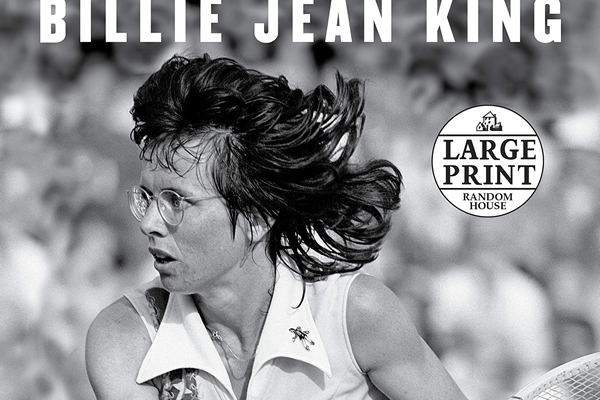
‘All In: An Autobiography’
By Billie Jean King with Johnette Howard and Maryanne Vollers
c.2020, Alfred A. Knopf
$30/482 pages
I know nothing about tennis except that I love Hitchcock’s thriller “Strangers on a Train,” in which a charming, sociopathic murderer enlivens the game.
There are no murders in “All In,” Billie Jean King’s memoir, co-authored with journalists Johnette Howard and Maryanne Vollers. But King’s candid autobiography is as exciting, as suspenseful, as a Hitchcock flick.
“All In” is a fab read not only for tennis aficionados and readers interested in LGBTQ history and women’s history but for anyone who enjoys a fascinating story of a living, larger-than-life, but very human, down-to-earth legend.
Some athletes, even the most acclaimed ones, are mainly known to sports fans.
Their achievements are important, sometimes record-setting, in their sports. But these sports figures aren’t cultural icons.
This isn’t the case with King. Like Jackie Robinson and Muhammad Ali, King, who was born in 1943, is iconic.
You likely remember where you were in 1973 when, along with 90 million other riveted viewers, you watched King beat self-proclaimed male chauvinist Bobby Riggs in the “Battle of the Sexes.”
If you weren’t born then, you’ve surely heard how excited your mom or grandma were to see male chauvinism taken down. Then, when women often had difficulty obtaining a credit card, let alone fighting workplace discrimination, beating the pants off Riggs was no small matter.
King, a feminist and lesbian, is believed to be the first woman athlete activist.
In 2009, King received the Presidential Medal of Freedom for her work for LGBTQ and women’s rights and equality.
Then there is King’s stunning record in tennis. She was the top United States tennis player – winning 39 Grand Slams and 20 Wimbledon titles.
Often, the memoirs of famous people are bland, unrevealing. They are as exciting as Velveeta.
“All In” is a feast of flavors. Most memoirs, no matter how good, have some dull stretches.
This isn’t so with “All In.” From the get-go, it grabs you by the lapels.
The memoir is so revealing that, as you read it, you feel as if you’re reliving King’s life. King tells us about the people she loves.
Her family, like most people at the time, were homophobic when she was growing up. Yet King loved and respected her parents. They taught her, among many things, to “respect and never underestimate” her opponents, she writes.
Her brother Randy Moffitt, who was a pitcher in Major League Baseball has given her, King writes, “a lifetime of support.”
King writes of her love for Ilana Kloss. The couple, who have been together for 40 years, were married in a private ceremony in 2018. David Dinkins, the former New York City Mayor officiated the wedding.
“To Ilana, my love, my partner, to the moon and back,” King writes in the memoir’s dedication.
It took decades for King to become open and unashamed about her sexuality.
She grew up in a working class family in Long Beach, Calif. Her father was a firefighter. It was a timwhen women were expected to get married (to men) and have children.
Middle-class and upper-class women, even if they’d been to college, weren’t supposed to want to work.
The idea that you could be a gay tennis player wouldn’t have been on the horizon when King began playing the game as a kid.
King married Larry King (not the broadcaster) in 1965. Though they divorced, they are still close friends.
Some of the most gut-wrenching moments of “All In” are where King writes of being outed in the 1980s by a former female lover who filed a palimony suit. Though the former lover didn’t win in court, the outing nearly derailed King’s career.
King writes movingly about how, after much therapy and self-reflection, she became comfortable about her sexuality.
She tells us how she dealt with an eating disorder and other health problems. Above all, King challenges us to work for social change. She dedicates the memoir “to everyone who continues to fight for equality, inclusion, and freedom.”
Who wouldn’t be “All In” with that?

Books
Historiography with heart
Pioneering author John D’Emilio continues to enlighten us in new book ‘Making Gay History’
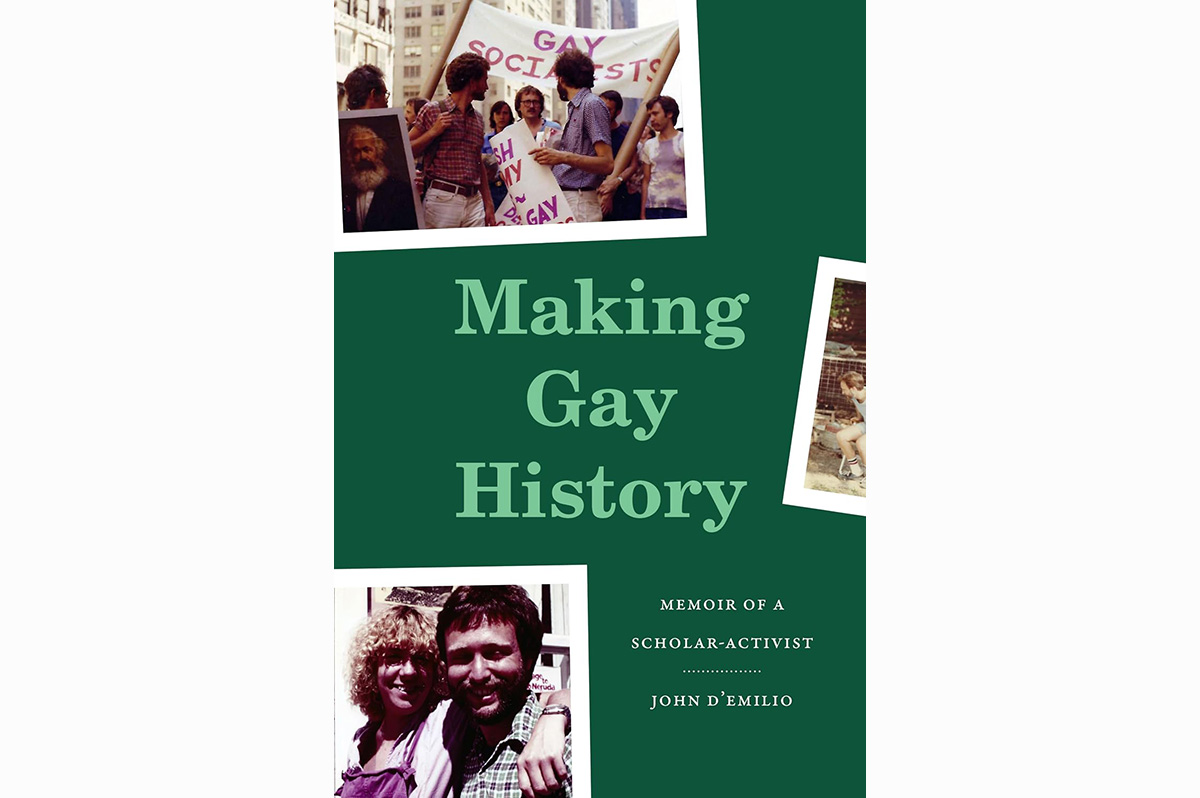
‘Making Gay History, Memoir of a Scholar-Activist’
By John D’Emilio
Dukeupress.edu/making-gay-history
“Dear Dr. Kameny,” wrote the earnest graduate history student almost 50 years ago. “As you know, the academic community only rarely deemed the lives of gay men and women to be worthy of serious scholarly study. To my knowledge, no American history faculty at a major university has yet sponsored a dissertation that deals with gays historically.”
That student was a young man from the Bronx who would change all that. His name is John D’Emilio.
“I must be able to uncover ‘manuscript’ sources, that is unpublished and unique historical materials,” he explained to D.C. gay civil rights pioneer Dr. Franklin E. Kameny who lived in a house stacked to the ceiling with “unique historical materials.” In reality, these were piles of correspondence with government officials and politicians, legal filings, mimeograph copies, gay newspapers, press releases, Mattachine Society brochures and picket signs. Frank Kameny, a self-described “pack rat,” invited D’Emilio into his private world of papers and memorabilia to begin uncovering an erased and forgotten pre-Stonewall history. This was one of many such research forays into “basements, garages and overcrowded living rooms” across America conducted by John D’Emilio. He was a young man on fire to complete a Ph.D. dissertation at the frontier of a distant galaxy — writing a scholarly gay and lesbian history backed by original research where there had been none, only a void.
Reading D’Emilio’s memoir “Making Gay History” (2026, Duke University Press) one has the sense of watching an emerging galaxy spinning around a galactic core of New York scholars and their mentors, young activists, and community historians throbbing with the New York City energy celebrated by Walt Whitman a century before in his epic poem “Mannahatta”. Spinning out of the ‘60s anti-Vietnam War activism; Marxist historical analysis, the Stonewall riots and gay liberation, we can see it coalescing around this one history student’s search for a dissertation topic and himself piecing together a new history that “no one had yet written about … a pioneering work in this newly emerging field.” D’Emilio pitches his idea for a dissertation that “spanned the length of U.S. history, moving from the religious teachings that shaped law and social attitudes … to how the federal government dealt with the increasing visibility of a homosexual world in the twentieth century.” With the blessings of Columbia’s Department of History, he completed his dissertation leading to the publication of his groundbreaking history: “Sexual Politics, Sexual Communities: The Making of a Homosexual Minority in the United States” (1983). When he received his first copy of the bound book in the mail, he “cradled the book in my arm holding it close to my chest….It was as if I had fathered a child.”
More so, D’Emilio fathered a new history. Historiography is the story of how history gets written, conducting original research, uncovering the data and creating the narrative(s) — often a snoozing read of academic process. But not this historiography. “Making Gay History” is a historiography with heart.
“Nothing was going to stop me from giving everything I had to this effort at making change in society and myself,” he declares while connecting with others who share his “boundless excitement for the collection of documents.” There were many others in this spiral with D’Emilio who are mentioned and play important roles. In the spiral were Jonathan Ned Katz (“Gay American History”, 1976); Allan Berube (“Coming Our Under Fire” 1990), Martin Duberman (“Hidden from History”, 1989); Daughters of Bilitis activists Del Martin and Barbara Gittings; Civil War historian Eric Foner and author/activist Larry Kramer. No libertarians among them. Well, maybe the divine Bette Midler who was well known for performing uptown at the Continental Baths who makes an appearance at a Washington Square rally.
He craved his parents’ approval. Among the most riveting scenes in the memoir are a series of family dinners in the Bronx with his old-school parents who go into near shock when he tells them he is gay. How to evade this any longer, especially now that his dissertation is going to be on homosexuality? It is a moving and hilarious sequence. After he says it out loud, “I am gay”: “No. No. No!” his father gasps. “This can’t be true. It can’t be.” D’Emilio thinks, “Oh my God, he’s going to die. I’ve killed my father.”
The D’Emilios — Vincent and Sophie — so resemble the wonderful Castorinis in “Moonstruck,” I am thinking “Oh my God, this is Cher coming out to her parents Cosmo and Rose.” The young graduate student survives the family dramatics even more certain that this was not just his success but “a gay liberation success.” From the family dinner table to the streets, he writes how he marched in the 1973 Pride parade beneath a banner held high: “Gay Socialists.” This man is a born scholar-activist.
D’Emilio does not seem able to pull back. There are passages that veer into autobiographical minutia, detail about the grind to earn a living from the University of North Carolina Greensboro to the University of Illinois Chicago. He writes, ”I would be living on less than half my usual salary for the year, but with the small amount of royalties that I got for my three books, plus some occasional speaking gigs and dipping into savings…”. Much of this is gray matter compared to the galaxy John D’Emilio helped energize that even now brightens our sky.
Charles Francis is president of The Mattachine Society of Washington, D.C. and author of “Archive Activism: Memoir of a ‘Uniquely Nasty’ Journey” (University of North Texas, 2023)
Books
New book examines fashionista Audrey Smaltz’s fabulous life
‘Every Inch a Lady’ reveals finding true love with another woman
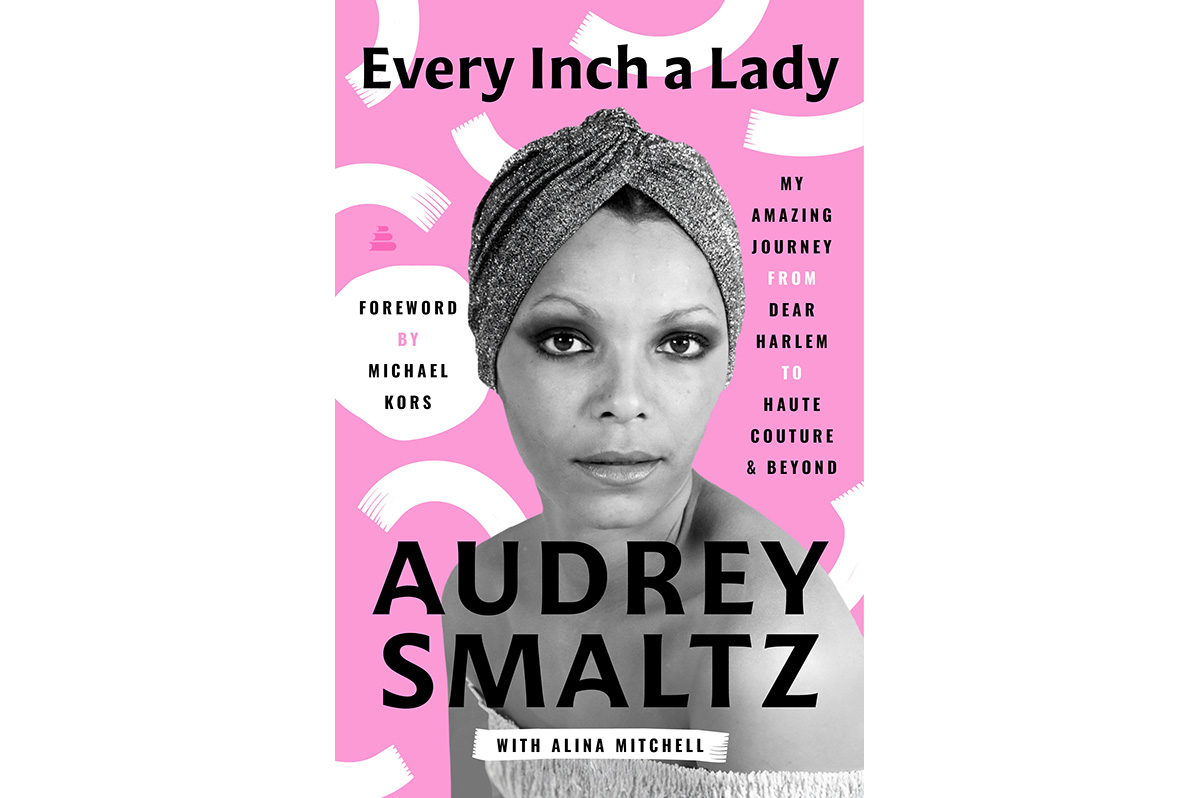
‘Every Inch a Lady’
By Audrey Smaltz with Alina Mitchell
c.2026, Amistad
$27.99/256 pages
Snaps, zippers, buttons, ties.
Toss that garment on, pull it up, wrap it around, you know what you like and how to wear it. The color is perfect for your skin tone, the fabric enhances your form. Yep, you always look your best and, as in the new book “Every Inch a Lady” by Audrey Smaltz (with Alina Mitchell), that best is fabulous.

”Born, bred, toasted, buttered, jellied, and honeyed in Harlem” in 1937, Audrey Smaltz was a force to be reckoned with almost from the time she could walk. Her parents imbued confidence in her, they nurtured her creativity and sent her to charm school, but they never allowed her to create a stir.
“That,” says Smaltz, “is not what ladies did.”
By the time she was a teenager, Smaltz was modeling for New York City designers. Shortly thereafter, she started working for a married man with whom she had an affair, and whom she loved very much. She broke up with him, attended college, worked a series of jobs that taught her about fashion and jobs that didn’t seem to fit her. An ill-fated marriage took her to Chicago where she ultimately landed a position that sent her to work in Ebony magazine’s New York office.
Working at Ebony was a career-changer, in a way. Smaltz was able to travel the world and learn more about fashion, but she didn’t exactly get along with her boss.
Finally, seizing an opportunity, Smaltz decided to launch her own company, Audrey Smaltz, Inc., a “fashion production business,” but she couldn’t get any designers to take a chance on her. Undaunted, she reorganized, re-branded, hit the streets, and knocked on doors until she finally found one client, which led to many others.
Through it all, her personal life was a whirlwind. She dated “more men than you can shake a book at,” settling down occasionally, briefly. Fashion had always been her first love, but she accidentally found real love, “the love of a woman,” at a leadership course.
There’s an old saying that writers need to add lots of “color” into their stories. Read a little of “Every Inch a Lady,” and you’ll notice immediately that author Audrey Smaltz (with Alina Mitchell) quite literally takes that to heart by mentioning nearly every color of the spectrum here. Hmm.
That oddity aside, Smaltz is a wonderfully lively storyteller, speaking with the energy of a woman much younger to the heart of anyone who loves fashion. That glee extends to collectors of vintage clothing, who will be delighted to read about the industry long ago and the way things worked then. Smaltz says she experienced racism, which is not unusual for pre-Civil Rights America, but doors were surprisingly closed for other reasons that will astound anyone who’s savvy about the fashion industry, even today.
There’s quite a bit of name-dropping in this book but most of it belongs in the anecdotes, so you likely won’t mind. If you’re a fashionista, too, find “Every Inch a Lady,” and snap it up.
The Blade may receive commissions from qualifying purchases made via this post.
Books
New book examines Trump cuts to LGBTQ healthcare
‘Aftershocks’ details impact of policy shifts on HIV response, broader public health

As LGBTQ and HIV advocates continue to grapple with the Trump administration’s attacks on healthcare, a new book offers a timely look at what happens when public health systems — and the democratic institutions that sustain them — are pushed to their limits.
The book, “Aftershocks: Trump 2.0, Public Health, and Our Better Angels,” was written by Dr. José M. Zuniga, president/CEO of Fast-Track Health. Zuniga is a globally recognized public health leader with more than three decades of experience advancing responses to HIV, communicable and non-communicable diseases, and the health impacts of climate change. He is also editor-in-chief of the Journal of Fast-Track Health.
The book covers the first year of the second Trump administration. It chronicles the impact of federal policy shifts and budget cuts on the HIV response and public health more broadly, including for LGBTQ communities. Drawing from policy analysis, frontline insight, and lived experience, the author reveal how decades of hard-won progress became vulnerable through Project 2025 and DOGE, but also a paralysis in the HIV and public health communities following the outcome of the 2024 elections.
“In other words, we were caught flat-footed when our opposition had a detailed plan to create chaos and disruption,” Zuniga says. “Thus, the book also offers Horizons 2028 as an antidote to Project 2025 as a starting point for a wide-ranging conversation about how we will build back better given the baseline pre-Trump 2.0 was already imperfect.”
Below is an excerpt from the book.
What Could Not Be Left Unsaid
Let me begin with a simple truth: I did not set out to write this book. Like many in the public health community, I set out daily to do the work of scaling prevention, expanding access to care, strengthening health systems, and ensuring that dignity, equity, and justice are operational realities. Writing, for me, has always been in service of action: policy briefs to shape decisions, editorials to provoke accountability, reports to document progress or failure, and books to synthesize experience into insight that can guide public health action. But Aftershocks is something different; it is not merely an analysis. Instead, it is a record of rupture, of response, and of what it means to continue when the ground beneath your work begins to shift.
This book was written because something changed, and that change came into sharp relief during the beginning days of the second Trump administration, including the erosion of norms, the weaponization of rhetoric, and the recalibration of governance itself. The change was not limited to policy reversals or budget cuts, though there were many. Moreover, it was not confined to rhetoric, though language played a central role. The change was structural and moral: a redefinition of how power understood its obligations to people, to evidence, and to truth itself. And for those of us working in public health, the effects were immediate and personal. We experienced a purposeful disruption of the public health ecosystem and a direct repudiation of the “health for all” principle that guides our work….
Writing this book was, unexpectedly, an act of catharsis. Not because it resolved anything, but because it created space to process what would otherwise have been overwhelming… Amid what many in the public health community experienced as both individual and collective trauma, documenting itself was stabilizing, allowing reflection without detachment and critique without disengagement. But catharsis alone is insufficient. This book is not an exercise in lament; it is also a response. If the period it chronicles is defined by disruption, then its purpose is to offer direction. Where Project 2025 represented a blueprint for ideological capture of institutions, language, and governance, this book offers a counterpoint: Horizons 2028…
Horizons 2028 is grounded in a simple premise: that the future of public health – and of democratic governance more broadly – depends on rebuilding systems that are resilient to political volatility. That means strengthening not only federal capacity, but subnational leadership. It means embedding community-led accountability into data systems. It means aligning health outcomes with social determinants and recognizing that equity is not an endpoint but a continuous process of adjustment and correction. It means treating global engagement not as optional, but as essential to national well-being. In other words, it is a roadmap not for returning to what was, but for building what is required…
I write as an Independent. Not in the sense of detachment, but in the sense of accountability to evidence, to outcomes, and to the people whose lives depend on both… Independence does not mean neutrality in the face of harm; it means refusing to filter reality through partisan allegiance. Importantly, it also means being guided by a consistent commitment to equity, dignity, and justice. These are not abstract values… They are tested in moments of crisis, when the gap between principle and practice becomes most apparent. They demand accountability not only for what is said, but for what is done – and for what is allowed to persist unchallenged. And they require the courage to name harm clearly, even when doing so is inconvenient or politically unwelcome.
That commitment shapes the analysis that follows, but it is also what makes the writing difficult. Because to document harm is to confront it. To trace its origins is to name decisions and their consequences. And to do so honestly is to risk being read as partisan in a landscape where truth itself has become politicized. But the alternative – silence, or false equivalence – is not acceptable. Not when the stakes are as high as they are. There is, however, a thread that runs through this book that resists cynicism, is not optimism, at least not in the conventional sense, but is something quieter and more durable: a belief that even in moments of rupture, there remains a capacity – within institutions, within communities, within individuals – to reorient toward something better.
The Blade may receive commissions from qualifying purchases made via this post.

‘Thelma and Louise’ remains landmark of unspoken queer rebellion

Comings & Goings

LGBTQ Military Happy Hour set for Sept. 15

Calendar: September 11-17

Multi-billion-dollar 9/11 Victim Compensation Fund to continue until 2090

Iceland implements gender-neutral blood donor rules

Anti-science, anti-LGBTQ movements go hand in hand

Everton Blair makes history as first openly gay congressman from Ga.

Chris Pappas wins NH Democratic Senate primary

Mujer trans salvadoreña es encontrada sin vida
-

 Iceland5 days ago
Iceland implements gender-neutral blood donor rules
-
Commentary5 days ago
Anti-science, anti-LGBTQ movements go hand in hand
-
Georgia5 days ago
Everton Blair makes history as first openly gay congressman from Ga.
-
2026 Midterm Elections5 days ago
Chris Pappas wins NH Democratic Senate primary