Virginia
Gay GenZer wants to be youngest Va. state delegate
Zach Coltrain is running in 98th House district

Zach Coltrain lives in two worlds. In one, he traverses the serene landscapes of Appalachian State University in North Carolina’s Blue Ridge Mountains — studying the use of music as a therapeutic intervention. In the other, he navigates the thorny world of politics in the neighboring state of Virginia, which saw a conservative shift after the election of Republican Gov. Glenn Youngkin in 2021.
Coltrain, a 20-year-old gay Democrat, said those two worlds have coexisted for him since high school — where he split time between the debate team and musicals, campaigning and band practice, politics and music.
“It’s really important to me, solidifying my education with mental health, especially when I let it exist with government, where it appears most people don’t have a strong grasp on how mental health works,” he told the Washington Blade.
The balance will certainly be harder to steer as Coltrain announced his campaign for Virginia’s 98th House of Delegates district in August 2021 — becoming the youngest candidate to run for a seat in Virginia’s lower body. In fact, Coltrain, who grew up in the district, won’t meet the minimum age requirement of 21 until his birthday in September, two months before the election.
Coltrain is joining an ever-growing list of political candidates from Generation Z — defined as those born between 1997 and 2012 — whose older members are just reaching the age where they can legally run for office, 2022 being the first year Gen Z could run in federal elections. And it didn’t take long for Gen Z to get on the board.
On Saturday, Florida Congressman Maxwell Frost, 25, was officially sworn into the U.S. House of Representatives, becoming the first Gen Z congressperson in history.
“The people of Orlando sent me to Washington, D.C., to fight for them and enact the kind of change they want to see in our communities. Gun reform, universal healthcare, housing affordability, tackling the climate crisis and more,” Frost said in a statement. “We have so much work to do, but I’m honored to represent my people.”
In addition, according to campaign finance tracker Open Secrets, Gen Z candidates for federal offices raised millions of dollars during the 2022 campaign season. The nonprofit identified at least seven Gen Z candidates — four Democrats and three Republicans — vying for congressional seats in 2022.
Gen Z is also partially responsible for thwarting the so-called “red wave” that many political analysts predicted for last year’s midterms. In 2022, Democrats overperformed, gaining one seat in the Senate and not losing nearly as many seats in the House as predicted.
Ashley Aylward, a senior researcher at the Washington-based public opinion research firm HIT Strategies, wrote in Time that an “earthquake of young voters shook up the political world” in 2022.
“When young people’s rights are on the ballot and championed by the candidate, they show up,” she wrote.
The numbers seemed to back up her claims. About 1 in 8 voters overall were under 30, according to early exit polling and AP VoteCast, and more than half supported Democratic candidates in the midterm elections. It came during the same year that the U.S. Supreme Court overruled Roe v. Wade, stripping pregnant people of the Constitutional right to an abortion; 74 percent of 18-29-year-olds believe abortion should be legal in all or most cases, according to recent data from the Pew Research Center.
In an interview with the Blade, Aylward couldn’t say definitively whether we could expect a similar turnout of young voters in statewide and local races. Coltrain’s race will be decided later this year — Nov. 7, 2023 — with no headline-grabbing national or gubernatorial elections to help boost turnout.
But Aylward — speaking broadly and making clear she didn’t have enough data to make any clear conclusions — speculated that Dobbs v. Jackson, the case that gave the state’s the power to decide abortion rights, could lead to increased turnout in often overlooked statewide elections.
“I have noticed a shift in attention being turned towards state and local politics, because we know that is where the most impact happens on our day-to-day lives,” she said. “But a lot of it was sparked from the Dobbs v. Jackson case, because people now realize that these decisions about our bodies are going to be made in our state legislatures.”
Aylward added that she hopes to do more research on the topic in the future.
Furthermore, Aylward said she has found that Gen Z voters are “way more motivated to vote when they see young people like them run for office.”
“Most often of what we hear in focus groups is that young people are usually feeling more jaded, because they don’t see people like them in elections, particularly young,” she said.
This begs the question: Can a man not yet able to legally consume alcohol convince the people of Virginia’s 98th House district to vote for him?

In general, Aylward said, she has found that age does matter to some folks. “But most of the time, it boils down to the issues. [Voters] go on and on about the issues that people are championing,” she said.
Coltrain is the only Democrat in the race, clearing his path to the general election. However, his journey to the Virginia House becomes murkier after the primaries. According to the Virginia Public Access Project, Coltrain’s Republican opponent will either be Glenn Davis or Barry Knight — both of whom are current Virginia delegates.
Davis has represented District 84 since 2014, and Knight has represented District 81 since 2010.
The district, which encompasses the southeast corner of the state, did change after redistricting, but it still favors Republicans. The new 98th District is made up of parts of the old 84th, 81st and 21st Districts — all of which favored former President Donald Trump in the 2016 election. In 2021, the 98th District overwhelmingly voted for Youngkin, who captured 63.06 percent of the vote. VPAP categorizes the district as “strong Republican.”
Coltrain admitted that competing in the district worried him, saying there are no guarantees that the district will be flipped. But he believes his campaign is unique and will make him tough competition for his Republican opponent.
Zeroing on Knight, Coltrain criticized the incumbent’s past challengers. “The past few candidates we put up against Barry Knight, my opponent, have been other rich white guys,” he said. “Nobody’s really eating that up.”
“I think that’s not our case, here,” Coltrain added. “I’m a student on a Pell Grant with student aid and a music scholarship, literally barely hanging on financially at points.”
Furthermore, Coltrain touted his campaign issues — which focus on environmental protection, education and healthcare — as a “reflection of both [his] district and also Gen Z in general.”
“I think I found a way to find this niche intersection, where a rural district with farmers in it have the same common interests as Gen Z advocates,” he said. “And I think a big part of that can be the environment.”
As for his opponent using his age against him, Coltrain said, “Honestly, I hope they do.”
“My age is something that I’m going to flip as a good thing, and I have been campaigning with it,” he said. “I started right off the jump telling people that I’m here, and I’m young, and I’m not even old enough to hold the office that I’m running for. I am aware that this is unique, and I’m aware that being the youngest person to run is something that will make people uncomfortable.”
But Coltrain, who has worked on campaigns since he was a teenager, thinks that the “argument that there’s not room for [young people] at the table is not true and won’t be true.”
“I know how to have a real impact in our district,” he said. “I know that specifically, when we’re looking at young activists and organizers, our district is looking for them, tirelessly. I think that this could be a wake up call for us, it can be a way for people my age and people of my generation to realize that this is something that they can do and realize this is the space that they are supposed to exist in.”
Coltrain has no lack of people who believe he could very well be the person to flip the district. In fact, Dr. William “Fergie” Reid, the founder of 90 for 90, an initiative that aims to supply a Democratic challenger in all Republican-controlled districts, reached out to Coltrain directly and encouraged him to run.
Reid — named after his father, William Reid, the first African American elected to the General Assembly in the 20th century — said he was looking for a candidate who was “in college, politically inclined and not scared.” Eventually, he said, “I got his name, and I tracked him down. When I talked to him, he couldn’t have been cooler, and [he] understood what I was talking about.”
In 2021, Republicans swept all three statewide positions — governor, Youngkin, lieutenant governor, Winsome Sears, and attorney general, Jason Miyares — and took control of the House of Delegates in an upset. Youngkin became the first Republican to win a statewide election in Virginia in more than a decade.
Reid said Democrats’ losses in the state were narrow in 2021 and came down to Democrats “not playing hard enough.” To Reid, “if Democrats just play a little bit harder, they’ll take back the majority. And this is what Zach is doing; he’s helping Democrats play just a little bit harder.”
Youngkin has since signed an executive order to root out critical race theory in Virginia’s education system. He has also supported anti-LGBTQ policies, including forcing teachers to out queer students and restricting the rights of transgender students.

Coltrain, who came out as gay when he was 11 years old, said he “was comfortable in telling everybody that I was gay from a really early age.” But “looking at the way things are now, I don’t know that even right now, people could still have that story in the area that I grew up in. And it’s been super, super scary.”
“He’s got the right stuff, and I couldn’t be more proud of him,” he said of Coltrain.
Coltrain is staring down a busy semester, one sure to be full of aching feet and headaches as he’s committed to his campaign, coursework, part-time food truck job and Application State’s debate team, where he is one of two captains.
“It’s a lot for sure,” he said with uncertainty in his voice. “We’re trying to balance it.”
But the brief moment was drowned out by his overwhelming enthusiasm.
“Schoolwork all day and campaigning all afternoon is just normal now,” he said, calling the opportunity “life changing.”



Virginia
Winsome Earle-Sears ‘Life and Marriage Tour’ to include Northern Va. stops
Voters to consider marriage equality, reproductive rights referenda in November
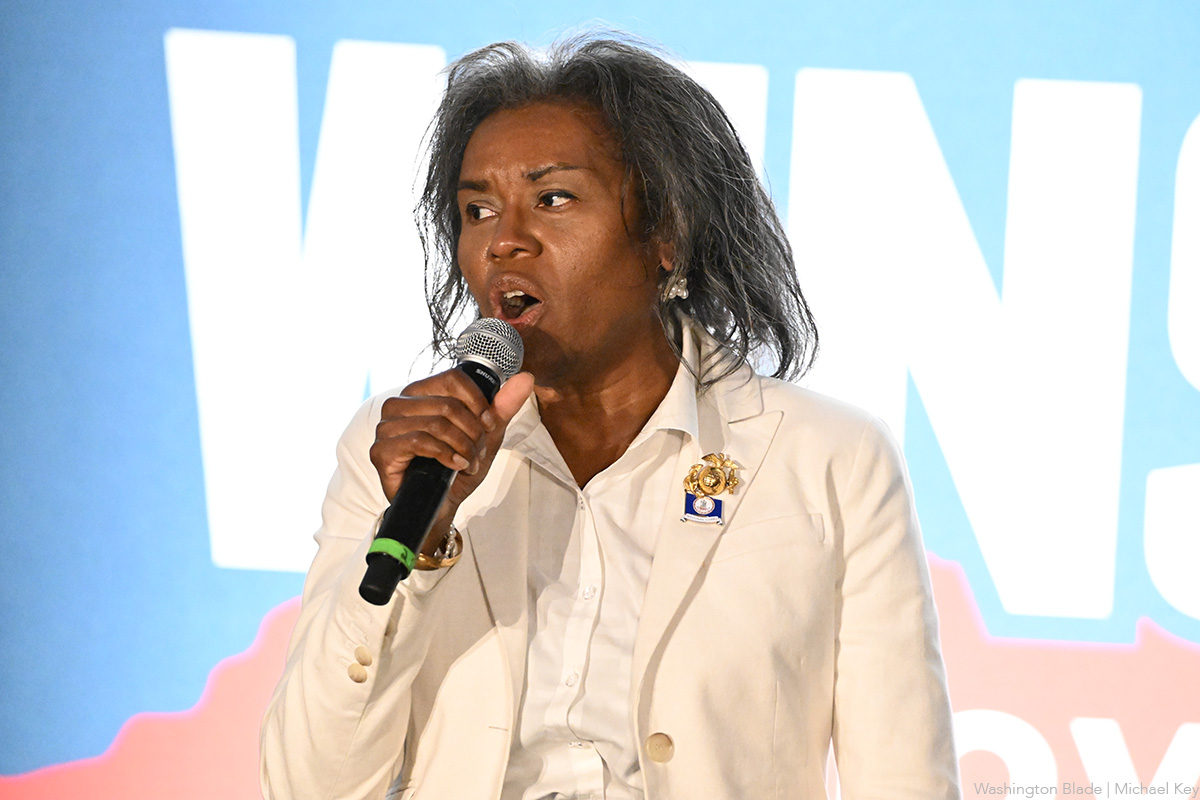
Former Virginia Lt. Gov. Winsome Earle-Sears has announced her campaign against efforts to enshrine marriage equality and reproductive rights in the state constitution will make several stops in Northern Virginia.
Her “Life and Marriage Tour” will include stops in Manassas, Winchester, and Harrisonburg. Earle-Sears said the “Life and Marriage Tour” will also travel to Virginia Beach, Lynchburg, Roanoke, Charlottesville, and other cities across Virginia “throughout September and October.”
The announcement did not include specific dates.
“Virginia, you’ve been asking where the Life and Marriage Tour is headed — here’s a look at our current tour locations,” she said on X on Tuesday. “We’ll be traveling across the commonwealth throughout September and October, and we’re still building the journey.”
Current Gov. Abigail Spanberger, a Democrat, last November defeated Earle-Sears, a Republican, in the race to succeed Republican Glenn Youngkin.
Voters in 2006 approved the Marshall-Newman Amendment, which defined marriage in Virginia as between a man and a woman.
Same-sex couples have been able to legally marry in Virginia since 2014. Youngkin a decade later signed a bill that codified marriage equality in state law.
Two successive legislatures must approve a proposed constitutional amendment before it can go to the ballot.
Spanberger signed bills that finalized the marriage equality and reproductive rights referenda’s language.
The referenda will take place on Nov. 3.
Virginia
Doug Ollivant to face Eugene Vindman in Va. 7th Congressional District
Republican defeated challengers in Tuesday’s primary

Republican Doug Ollivant will face off against incumbent U.S. Rep. Eugene Vindman (D-Va.) in Virginia’s 7th Congressional District.
Ollivant defeated his Republican opponents in Tuesday’s primary. Vindman ran unopposed.
Vindman in 2024 ran to succeed then-Congresswoman Abigail Spanberger in the U.S. House of Representatives after she ran for governor. Spanberger succeeded Republican Gov. Glenn Youngkin in 2025.
U.S. Sen. Mark Warner (D-Va.) on Tuesday easily won his primary. All other Democratic incumbent members of Congress from Northern Virginia also won their respective primaries.
Virginia
Winsome Earle-Sears launches campaign against Va. marriage equality amendment
Former LG lost to Abigail Spanberger in 2025 gubernatorial race
Less than a year after losing Virginia’s gubernatorial race, former Lt. Gov. Winsome Earle-Sears is campaigning across the state against constitutional amendments that would protect marriage equality and reproductive freedom.
She is launching a statewide “Life and Marriage Tour” ahead of November’s election.
Although same-sex couples can legally marry under the U.S. Supreme Court’s 2015 Obergefell v. Hodges decision, Virginia’s constitution still contains language that defines marriage as between one man and one woman. Supporters say removing the language would protect marriage equality should federal precedent change.
The original ban was written into the state constitution in 2006.
It has been hinted at in the past by Supreme Court Judge Clarence Thomas that he would consider revisiting Obergefell v. Hodges regarding contraception and marriage rights for same-sex couples. He stated this in his concurring opinion regarding the Dobbs v. Jackson ruling, which allows for state-level abortion bans.
Equality Virginia Executive Director Narissa Rahaman said removing the ban would bring the state’s constitution in line with existing law.
“20 years after banning marriage equality, it’s time for our commonwealth to fully complete our evolution — and finish the job on protecting marriage equality for all,” Rahaman said.
In an email to supporters, Earle-Sears said these amendments “raise serious concerns” and could alter principles about which Virginians care.
“That is why our efforts are focused not only on informing voters, but also encouraging them to carefully consider these proposals and vote NO on both amendments,” Earle-Sears said.
Virginia voters will consider three constitutional amendments this November.
Earle-Sears is campaigning for voters to reject two of them: the Virginia Remove Constitutional Same-Sex Marriage Ban Amendment and the Right to Reproductive Freedom Amendment.
A “Yes” vote on the Same-Sex Marriage Ban Amendment would include removing a provision that states marriage is between one man and one woman and prohibitng the state from denying a marriage license to two adults based on their sex, gender, or race, according to the Virginia Department of Elections.
In 2025, during debates against now Gov. Abigail Spanberger, Earle-Sears argued it is not discrimination to think that gay people should not be allowed to marry. She claims it conflicts with her faith.
According to ABC 8, in 2024 she wrote that she had a “moral opposition” to marriage equality, after former Gov. Glenn Youngkin, a Republican, signed a marriage equality bill that barred denying marriage licenses based on sex, gender, or race.
According to the Virginia Department of Elections, a “Yes” vote on the Reproductive Freedom amendment supports adding a section to the state constitution that would give Virginians the right to make and carry out decisions regarding reproductive healthcare, except in specific exemptions.
The Virginia Department of Elections wrote that if accepted, the amendment would allow the state government to pass laws to regulate abortion care in the third trimester of pregnancy, but require abortion care when it is medically needed to protect the life and health of the pregnant person or because the fetus is not viable.
During the 2025 election cycle, Earle-Sears was clear on her anti-abortion stance.
According to the Virginia Independent, she utilized campaign funds to donate to the Family Foundation of Virginia. The group is a faith-based, anti-abortion, and anti-in vitro fertilization non-profit.
The “Life and Marriage Tour” will include traveling throughout Virginia to speak with citizens, churches, community organizations, and local leaders. The exact locations have yet to be announced.

Gay-owned pizzeria in Dupont Circle burglarized

Advocates honored at Engendered Spirit Awards

Two awesome, affordable rides

Proposed Indian foreign funding law overhaul could further pressure LGBTQ groups

Why we need to protect ‘sacrilegious’ art

I respect AOC, even though I often disagree with her

Black Educated Lesbians: A movement rooted in community

Chicago’s LGBTQ+ youth: Why their zip code still matters

Hegseth uses transphobic slur while campaigning for Iowa congressman

Trump-Vance administration’s LGBTQ brain drain: what you need to know
-

 Opinions5 days ago
I respect AOC, even though I often disagree with her
-
Opinions5 days ago
Black Educated Lesbians: A movement rooted in community
-
Illinois5 days ago
Chicago’s LGBTQ+ youth: Why their zip code still matters
-
U.S. Military/Pentagon5 days ago
Hegseth uses transphobic slur while campaigning for Iowa congressman