Connect with us

Arts & Entertainment

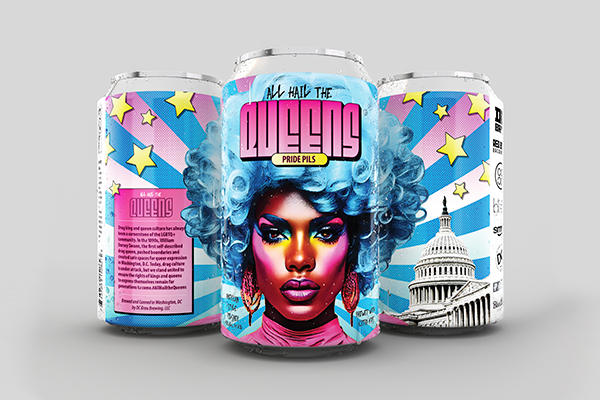
‘All Hail The Queens’ with the 2023 DC Brau Pride Pils can

DC Brau reveals design of its 6th Annual Pride Pils Can and announces upcoming Pride Pils Launch Party, Hosted by Red Bear Brewing Co.
Published

on

DC Brau, D.C.’s original craft brewery, reveals the design of its 6th annual Pride Pils can and announces the celebratory Pride Pils Launch event. In support of The Blade Foundation and SMYAL, DC Brau partnered with LGBTQ owned Red Bear Brewing Co. and local artist Chord Bezerra of District Co-Op to design this year’s can. 

DC Brau will showcase the Pride Pils design, kicking off DC Pride with a celebration at Red Bear Brewing Company (209 M St NE) in NoMA on Thursday, June 1st, from 6pm – 8pm. Guests will enjoy DC Brau beer, featuring the newly minted 2023 Pride Pils can. The event is free but can RSVP to HERE.
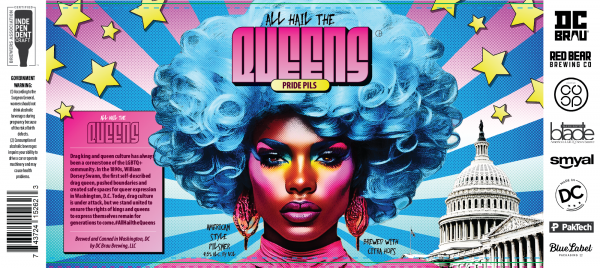
The art, designed by Chord Bezerra, was created in direct response to the anti-drag bills being passed around the country. Drag king and queen culture has always been a cornerstone of the LGBTQ+ community. In the 1890s, William Dorsey Swann, the first self-described drag queen, pushed boundaries and created safe spaces for queer expression in Washington, D.C. Today, drag culture is under attack, but we stand united to ensure the rights of kings and queens to express themselves remain for generations to come. #AllHailTheQueens. In addition to the design being featured on DC Brau’s 2023 Pride Pils can, supporters can purchase ‘Hail To The Queen’ merchandise, including T-shirts, sweatshirts, stickers, and more from District Co-Op. Proceeds from each purchase will benefit The Blade Foundation and SMYAL.
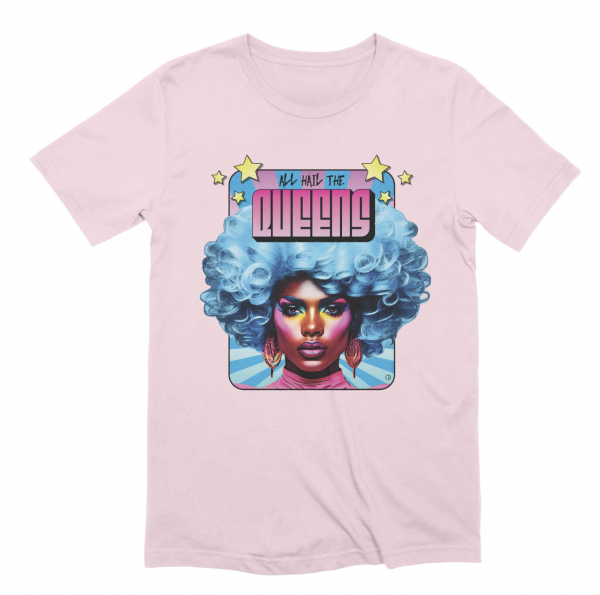
2023 #HailToTheQueens Shirt Available Now

Since launching Pride Pils in 2017, DC Brau has donated more than $48,731 to The Blade Foundation and SMYAL, selling more than 90,336 Pride Pils cans. This year, the can labels have been generously donated by Blue Label Packaging Co. along with PakTech’s donation of packaging handles. 

About DC Brau: DC Brau Brewery was founded in 2011 and is Washington D.C.’s leading craft brewery, producing a variety of high-quality beers that are distributed locally and throughout the Mid-Atlantic region. DC Brau’s commitment to quality and innovation has earned it numerous accolades, including multiple gold medals at domestic and international beer festivals. For additional information, please visit www.dcbrau.com.

About Red Bear Brewing: Red Bear Brewing Co is an LGBT owned West Coast style brew pub located in the NoMa neighborhood of Washington DC. Red Bear strives to promote diversity to the craft brewing community across the board with our inclusive taproom, company culture and delicious beer, beverage and food offerings. www.redbear.beer.

About The Washington Blade: The Washington Blade was founded in 1969 and is known as the “newspaper of record” for the LGBTQ community both locally and nationally. For more information, visit washingtonblade.com and follow on Facebook (@WashingtonBlade) & Twitter/Instagram (@WashBlade).

About District CoOp: District CoOp is a collection of artists celebrating design, diversity and the culture of D.C. We’re all about supporting and empowering local artists and creating a brand for the people by the people. All designs are available in both men’s and women’s and as a tank or crew. Follow us on Instagram (@District_CoOp) or Facebook (@DistrictCoOp).

About SMYAL: SMYAL (Supporting and Mentoring Youth Advocates and Leaders) supports and empowers lesbian, gay, bisexual, transgender, and questioning (LGBTQ) youth in the Washington, DC, metropolitan region. Through youth leadership, SMYAL creates opportunities for LGBTQ youth to build self-confidence, develop critical life skills, and engage their peers and community through service and advocacy. Committed to social change, SMYAL builds, sustains, and advocates for programs, policies, and services that LGBTQ youth need as they grow into adulthood. To learn more, visit SMYAL.org

Advertisement
FUND LGBTQ JOURNALISM
SIGN UP FOR E-BLAST

Arts & Entertainment

Sci-fi has long been at vanguard of LGBTQ representation

Story lines now criticized as ‘woke’ is weird

Published

on

Ncuti Gatwa as the Doctor and Jonathan Groff as Rogue lock lips in the long-running sci-fi show, 'Doctor Who.' (Screen capture via Doctor Who/YouTube)

Since I was a teenager, I have liked sci-fi because of the depth with which it explores social issues. At the time, I didn’t know that I was autistic and queer, so I couldn’t see myself in other autistic and queer people. Instead, I saw myself in androids, mutants, telepaths, and sometimes aliens who were portrayed as minorities persecuted by the human majority. It was a universal language for talking about alienation, systemic discrimination, conversion therapy, segregation, and internalized self-hatred.

Now, when so many sci-fi stories are being criticized online as “woke,” it seems weird for me. This is especially true when we are talking about franchises, such as the British TV series “Doctor Who” and American franchise “Star Trek,” both of which have always been remarkably progressive by the standards of their own time. 

Let’s take a closer look at “Doctor Who.”

In June 2026, the BBC cancelled the planned Christmas special, saying that viewers would have to wait longer for the next season after internal studio issues, and now the BBC is looking for new production partners. “Doctor Who” is the longest-running science fiction television series in the world, originally airing from 1963 to 1989 before returning in 2005. The future of the franchise is currently unclear, and many people online immediately began blaming “wokeness” for what had happened to their favorite show.

After all, the Doctor, an alien Time Lord who can regenerate and literally change faces, had traditionally been played by white men. But the last, Fifteenth Doctor was played by Ncuti Gatwa, a Black Scottish-Rwandan actor who has publicly identified as queer (and the doctor himself was first presented as queer character after a queer romantic episode where he kissed a man), while the Thirteenth Doctor was played for three seasons by Jodie Whittaker, the first woman to portray the Doctor. In 2023, the series also introduced Rose Noble, a trans feminine nonbinary teenager and supportive character played by transgender English actress Yasmin Finney.

But despite popular stereotypes online, “Doctor Who” did not suddenly “go woke.” The program has existed in two main eras: the classic series, which aired from 1963 to1989, and the modern revival, which has been broadcast on BBC One since 2005.

Even in the 1960s, one of the program’s earliest stories, “The Daleks” (1963–64), presented an obvious allegory for fascism, racial purity, bigotry and the horrors of war. Throughout the classic era, the Doctor frequently opposed militarism, authoritarian governments, and dictatorships. Many fans have also pointed to moments of queer coding and subtext throughout the classic series.

However, openly queer characters appeared as soon as the modern revival began. 

The 2005 revival introduced Captain Jack Harkness, played by John Barrowman, one of the first openly queer recurring characters in the “Doctor Who” universe. He openly flirted with people regardless of their gender and later became the lead character of the spin-off series “Torchwood.” “Torchwood” went even further with LGBTQ representation, featuring multiple queer characters, including trans and nonbinary characters whose identities were treated as a normal part of the story.

“Doctor Who” has always been remarkably progressive for its time. The franchise doesn’t suddenly change its values, it’s always been “woke.”

The same happened with the American franchise “Star Trek.” 

It is widely known as one of the most openly left-wing and progressive television franchises ever broadcast. The original series, which aired from 1966-1969, was created during the Cold War and featured the utopian United Federation of Planets, a society without poverty or money that can be characterised as socialist or even communist. It also featured Lt. Uhura, played by Nichelle Nichols, a Black woman serving as a highly respected bridge officer at a time when Black women weren’t portrayed in positions of authority on American television. The series also included one of the first interracial kisses in modern American television, between Capt. James T. Kirk (William Shatner) and Uhura in the 1968 episode “Plato’s Stepchildren,” a moment that had a significant cultural impact.

Gene Roddenberry, the creator of the franchise, said that he had wanted to include openly queer characters as well, but believed it would have been impossible to keep the show on the air because it had already pushed social boundaries in so many other ways.

Today, many viewers — including Elon Musk — claim that “Star Trek” has only recently become “woke.” In reality, I think it actually became less radical than the original series. Even queer characters are not a recent addition to the franchise. One of the earliest major queer characters appeared in “Star Trek: Deep Space Nine” (1993–1999): the Trill officer Jadzia Dax, played by Terry Farrell. In the 1995 episode “Rejoined,” she shared one of the first same-sex kisses in the history of the franchise.

However, for some reason, it was the openly gay couple Paul Stamets (Anthony Rapp) and Hugh Culber (Wilson Cruz) inStar Trek: Discovery” (2017–2024), together with the trans Trill character Gray Tal, played by trans actor Ian Alexander, that triggered a major backlash among conservative parts of the fandom. That backlash reached another peak with “Star Trek: Starfleet Academy,” which features the canonically gay Klingon cadet Jay-Den Kraag. The actor has spoken about receiving abuse and threats because of the role, despite the fact that there was nothing especially ideological about his character. He was simply a gay character whose sexuality was only one aspect of who he was. In fact, considering the ideals of the original “Star Trek,” I was more surprised that the franchise still includes relatively few trans or polyamorous characters, and that they are not part of the lead cast. After all, the franchise was created to imagine a future that was ahead of its time.

So why do conservatives and anti-LGBTQ people continue to watch franchises that have always been deliberately progressive? And why do they keep claiming that these shows have only recently “gone woke”?

A more logical explanation is that parts of the audience have become less willing to accept the same kinds of progressive ideas that these franchises have embraced for decades. In other words, it is not the shows that fundamentally changed. Some long-time viewers have become more conservative than they were in their youth, while newer conservative audiences have joined them and begun criticizing franchises without knowing their real history. 

In many ways, geeks have changed more than these shows have. Sci-fi hasn’t “gone woke.” Some of its fans have simply become less comfortable with the same progressive values these franchises have promoted for decades.

Continue Reading

Photos

PHOTOS: Vitamin C at JR.’s

Live drag show follows ‘Drag Race All Stars’ viewing party

Published

on

Brooke N Hymen performs at JR.'s at the Vitamin C drag show on Friday. (Washington Blade photo by Landon Shackelford)

JR.’s Bar held a “RuPaul’s Drag Race: All Stars” watch party followed by a live drag show on Friday, July 17. The Vitamin C weekly drag show was hosted by Citrine with performers Brooke N Hyman and Rosie Beret.

(Washington Blade photos by Landon Shackelford)
Continue Reading

Photos

PHOTOS: Rehoboth Beach Pride Festival

LGBTQ celebration held at convention center

Published

on

A scene from the 2026 Rehoboth Beach Pride Festival. (Washington Blade photo by Daniel Truitt)

The 2026 Rehoboth Beach Pride Festival was held at the Rehoboth Beach Convention Center on Saturday, July 18.

(Washington Blade photos by Daniel Truitt)

Continue Reading

Popular