North Carolina
Anti-trans bills in NC may trigger showdown with state’s Democratic governor
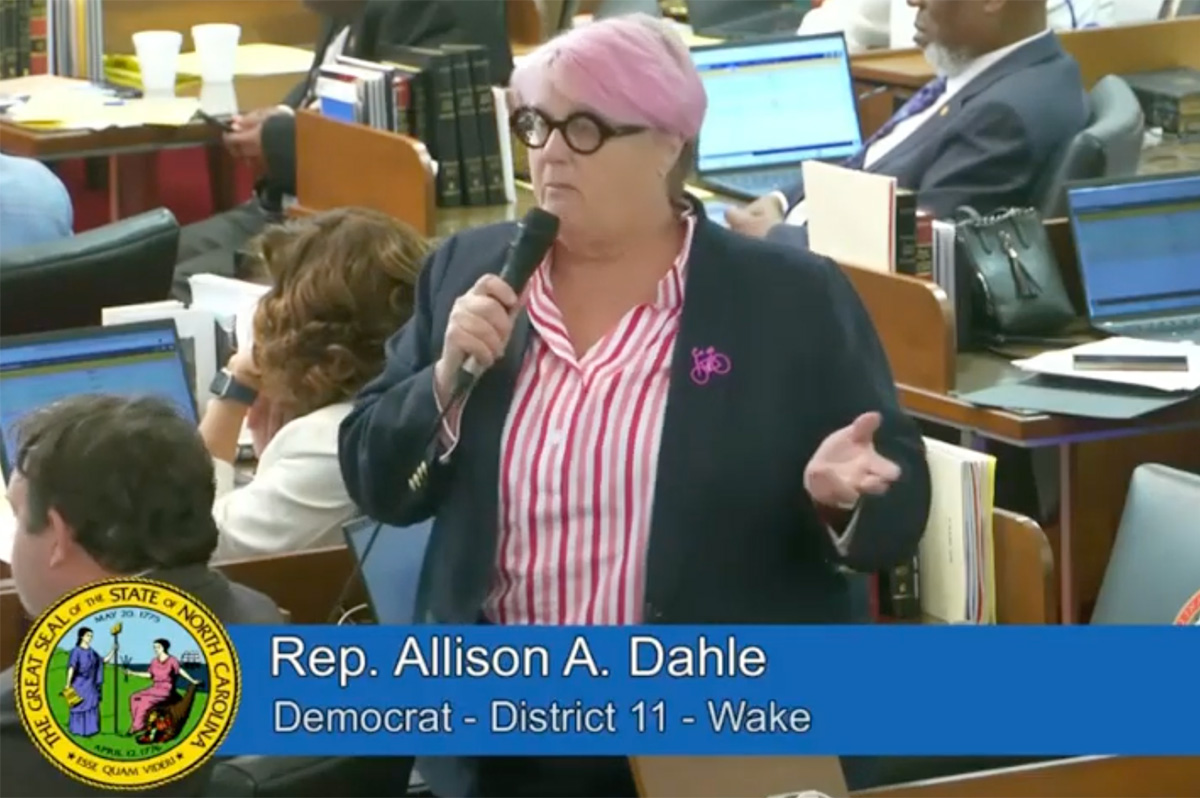
State Rep. Allison Dahle spoke out against effort
Anti-trans legislation passed this week by North Carolina’s Republican-controlled General Assembly will now head to the desk of Democratic Gov. Josh Stein, potentially setting up a showdown with just a few days before the legislature is set to break for the summer recess.
State Rep. Allison Dahle (D-Wake) told the Washington Blade during a phone interview Monday that she was “as confident as I can be” that Stein will reject the bills and also that her Democratic colleagues will line up behind him to block Republicans if they try to override the governor’s veto, which would require support from three-fifths of the House and Senate.
At the same time, there is a good chance one or two members will decide the outcome. Holding 30 of the 50 Senate seats and 71 of the 120 House seats, Republicans can clear the three-fifths threshold so long as there are no defections or abstentions and at least one House Democrat joins with the GOP caucus to override a veto.
Additionally, Dahle stressed that there are no guarantees, particularly as redistricting and shifting demographics can upend expectations for how legislators might ultimately come down on controversial votes. For example, legislation easing gun control restrictions was vetoed last week but remains in limbo because 10 House Republicans did not vote while two joined the unified Democratic caucus in opposing the bill.
With respect to the anti-trans bills passed this week, Dahle said she will “work within every inch, every millimeter of my power” to stop them from becoming law.
First was the Parents Protection Act, which per the Associated Press would “shield parents, guardians and caregivers from being cited for child abuse or neglect because they ‘raise a juvenile consistent with the juvenile’s biological sex,'” and prohibit adoption agencies from denying applicants based on their “unwillingness to allow the child to transition.”
The General Assembly passed the measure Monday with nine House Democrats joining with the GOP caucus. If those margins hold, Republicans would easily have enough support to override a veto.
On Tuesday, the North Carolina Senate passed a bill aimed at strengthening protections against the online sexual exploitation of women and children, legislation that had earned broad bipartisan support before Republican senators led by Buck Newton (Wilson) tacked on a series of anti-trans measures in committee last week, costing four votes from his caucus.
The provisions targeting transgender rights are effectively extensions of culture war legislation that was passed in 2023 during North Carolina’s last legislative session with Republicans overriding a veto from then-Democratic Gov. Roy Cooper.
Specifically, the bill passed on Tuesday would (1) extend the existing ban on most gender-affirming care for minors such that prisoners would not receive state funded gender transition hormones and therapies, (2) require officials who provide new birth certificates with updated gender markers to attach the original document with the individual’s birth sex, and (3) affirm the restrictive definitions for sex and gender that were outlined in President Donald Trump’s Jan. 20 “Defending Women” executive order.
Implications extend well beyond NC
North Carolina’s politics are often eyed as a bellwether or harbinger of trends and developments well beyond its borders because the state’s electorate is closely divided, races are often decided by razor thin margins, and control of the three branches of government is split between the two parties.
One clear take away from the anti-trans bills passed by the General Assembly this week, as noted by the AP, is how closely these efforts align with Trump’s policy agenda in his second term.
Dahle suggested that the culture war bills proposed and supported by her GOP colleagues, including those now awaiting Stein’s signature or veto, reflect the extent to which far-right wing advocacy groups are increasing their influence and exercising their leverage over conservative-led policymaking in the Tar Heel State.
Asked whether she thinks the battle over trans rights legislation in her state will have national implications, Dahle said North Carolina and Texas tend to be where Republicans launch trial balloons to see how far they can push their extreme policy proposals and their efforts to, for instance, undermine elections or redraw district maps to disadvantage Democrats.
She pointed to Allison Riggs, a Democrat who was sworn into the North Carolina Supreme Court on May 13, more than 180 days after she was elected and following a months-long battle in which her Republican opponent and his allies and supporters sought to throw out more than 68,000 votes. Riggs during the ceremony called out “efforts to undermine our rights and our democracy.”
“That was a test case,” Dahle said. “They felt like they had to try.”
With respect to efforts to undermine trans rights through legislation, Dahle said arguments against government involvement in the private lives of its people that might once have appealed to conservatives or libertarians are not picking up traction.
“None of the old school Republicans are left,” she said. Those who have left the General Assembly “know that this is wrong,” while GOP members currently serving either believe these bills serve the best interests of their constituents because “they’ve been fed a line of B.S.” or “they’re just not paying attention and they’re voting with their caucus.”
Dahle continued, “The bills are so extreme. They’re going over anything and everything having to do with transgender people. I mean, anything that has to do with care. I still, for the life of me, don’t know how this has anything to do with family values.”
She added that Republican colleagues promised during debate over a book ban proposal earlier this year that it would be the last culture war bill for a while. “it was pretty much over, or that’s at least what I was told by my colleagues on the other side, and then this one just came out of nowhere.”





North Carolina
In the middle of the Bible Belt, a summer camp lets trans kids exhale
Adulthood feels possible at Transcending Adolescence
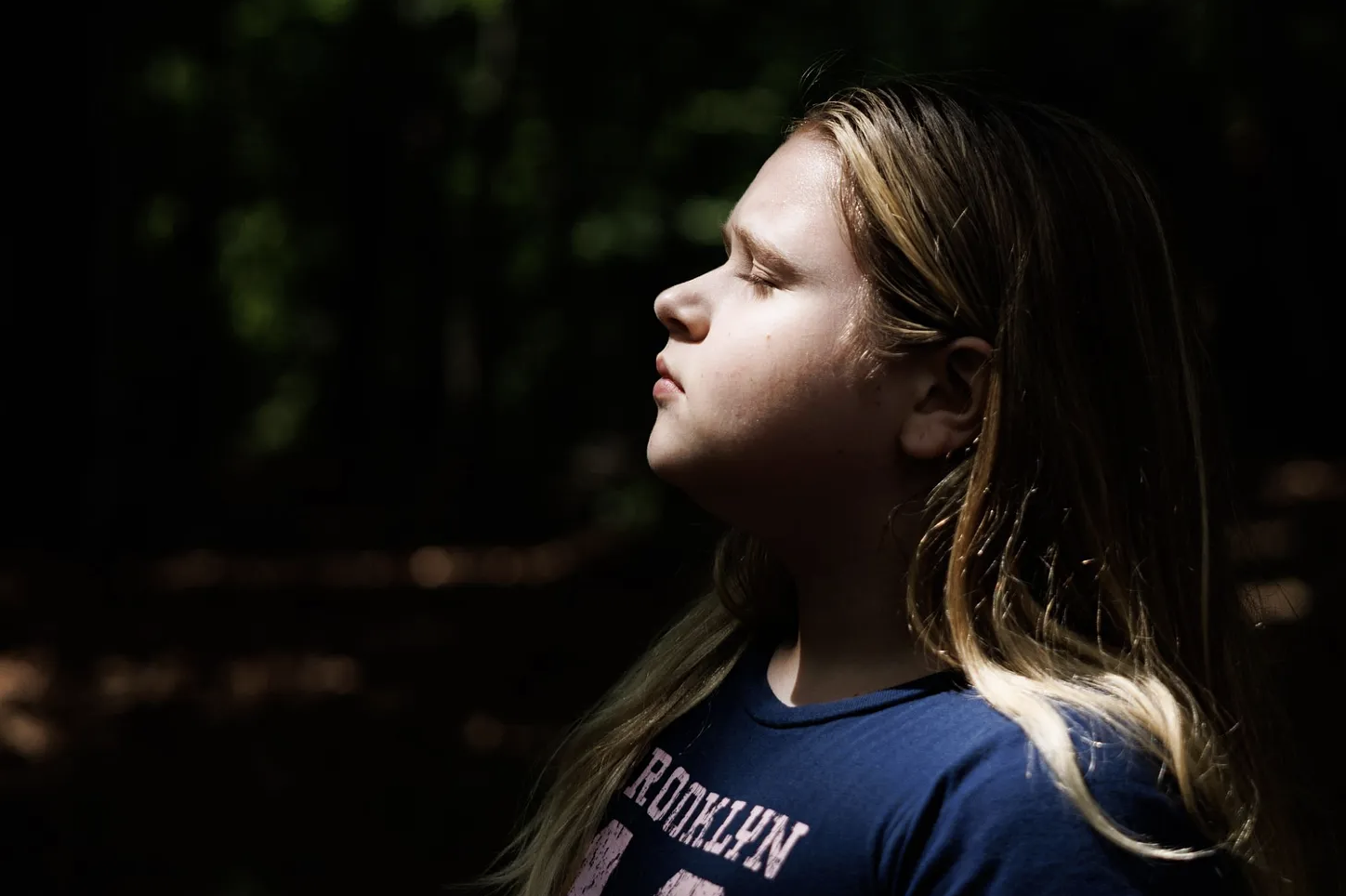
Uncloseted Media published this article on July 18.
By SAM DONNDELINGER | On a June night in rural North Carolina, dozens of campers sat around the fire as a counselor asked them to close their eyes.
“Picture a place where you feel completely safe,” they were told. “Think about what it looks like and how it feels, what you can hear, smell, and taste.”
When they were invited to share what they had imagined, one camper described sitting in a circle with other trans people. It was dark. Trees surrounded them. Mosquitoes buzzed.
“‘That place is here, and this is the place where I feel safe,’” Jacob Hofheimer, one of the camp’s founders, recalled the camper saying. “It got all of us.”
For many of the 8- to 17-year-olds who attend Transcending Adolescence, the weeklong summer camp offers a reprieve from the calculations they have to make in their day-to-day lives: Who knows they are trans? Who can be trusted? Which bathroom can they legally use?
At a time when 40 percent of transgender and nonbinary youth seriously considered attempting suicide in the past year, and 90 percent of LGBTQ youth reported that recent anti-LGBTQ laws, policies, and debates cause them stress or anxiety, those questions never disappear. But at this camp, young people are given space to ask them openly and to a community that understands why they need to.
“It really made me smile knowing that there’s a lot of people out there like me,” Ruby, a 12-year-old camper, told Uncloseted Media. “I’m putting myself out there, I’m being myself and no one judges me.”
Origins
Transcending Adolescence was founded in 2019 by Jacob and his wife Chrissy Hofheimer. The trans married couple wanted to create a camp for queer kids in America’s South, where affirming resources can be difficult to find.
Surrounded by thick woods and the backdrop of the Appalachian Mountains, campers swim, tie-dye shirts, complete ropes courses, roast marshmallows and perform in shows. They also gather for conversations about healthy relationships, medical care, legal rights, bathroom anxiety, coming out, misgendering, depression, substance use, and self-esteem.
“A huge part of it is that every single person there is trans or gender diverse, including the staff,” says Rory Sowers, a 19-year-old junior counselor from Florida. “That’s just something that you don’t get to experience a lot, especially as a young trans person.”
Sowers first attended Transcending Adolescence as a camper during its inaugural year in 2021. He returned three times before becoming a junior counselor.
“There’s so much that trans folks have to worry about just going about their day-to-day lives, especially living in the South,” Sowers says. “I was able to come into myself a lot more when I didn’t have all of those anxieties on my back.”
A place to be ‘just Ruby’
For 12-year-old Ruby, pre-camp anxiety was intense.
When she attended camp in June of last year, it was the first time traveling to another state without her parents.
“I was nervous about having someone there not really understanding me … and not really accepting me,” says Ruby, whose name has been changed to protect her privacy.
Outside camp, Ruby worries about how other people perceive her, according to her mom, Kate, whose name has also been changed. She says her daughter has to consider a litany of questions cis kids don’t have to worry about: “‘What if someone finds out? Are they looking at me? Do I look the part?’ … All these thoughts go through her head every single day.”
Before camp, Ruby had been struggling so intensely that her family had questioned whether it might feel easier for her “not to be who she was,” Kate says. Ruby had faced bullying in school, prompting her family to withdraw her and homeschool her for the remainder of fifth grade.
“I couldn’t really go anywhere without picking [at] myself because I was anxious,” Ruby says.
But when she arrived at camp, a lot of Ruby’s anxiety subsided. She didn’t have to introduce herself through the lens of being trans. She could just be herself: a funny, theatrical, outgoing 12-year-old who likes Beyoncé, improvises rap battles, and wants to be in the center of dance shows.
“She can just go there and just be [Ruby],” Kate says. “[Being trans] is only a little piece of her. There’s so much more to her, and she’s able to do that for the whole week. … It was completely life-changing for her.”
Research suggests that spaces like Transcending Adolescence can have powerful mental health effects.
Young people tend to fare better when they feel they belong and have access to peers and adults who understand them. In one small study from 2021, participants of a six-day LGBTQ summer camp reported increased resilience, self-esteem and quality of life. Focus groups indicated that transgender and nonbinary campers found an affirming environment that offered social opportunities they had been unable to find elsewhere.
Though this environment can be transformative, it’s intimidating at first for some. Jacob remembers asking one camper from Texas his pronouns during medical check-in, and the boy responding that he used “guy pronouns” because he “was a guy.”
Jacob recalled him being closed off and leery of the “hippie-dippy nonsense.”
But on the second-to-last night, Jacob overheard him speaking with a fellow camper.
“‘When I first came here, I thought that I was a disgusting, mutilated pig and an alien, and nobody would ever love me because I’m trans,’” Jacob recalls the camper saying. “‘And now I know that being trans doesn’t make me disgusting. It’s actually a beautiful thing.’”
He later texted Jacob to say the camp had given him confidence during the school year.
“‘Half the time, I forget that I’m trans,’” Jacob remembers him writing. “‘I’m just a guy. I’m just me.’”
“Finding places where you literally see yourself and can be seen by others for who you are is important during adolescence. It’s a human need,” Stephen Russell, professor of social and family dynamics at Arizona State University, told Uncloseted Media. “For trans youth, especially those who may not feel fully accepted at school, at home or in their faith communities, a camp where their identity isn’t something they have to navigate or defend, but is simply centered as part of who they are, can be transformative.”
Filling the gaps
The Hofheimers know that these spaces can transform the mental health of trans youth because they experienced it firsthand when they met while working as lifeguards at a summer camp for young queer people in New Hampshire.
The camp was doing important work, Jacob says, but many of its attendees came from privileged families in New England and other parts of the country where affirming programs were more accessible. Far fewer came from places such as Florida, Georgia, and Texas.
That’s why, for the location of the camp, they intentionally chose North Carolina, a state that has laws on the books that exclude trans girls from participating in sports, restrict the instruction of LGBTQ topics in schools and ban gender-affirming care for trans youth.
“Access is really, really important,” Chrissy says, adding that while the camp costs $1,975 for the week, they offer robust financial aid, including a $1,500 “no questions asked” subsidized rate for families who can’t afford it.
At the camp, the staff educates campers about anti-trans laws, coming out, and how to have conversations with their doctors about gender-affirming care.
“The kids want to talk about this stuff,” Jacob says. “That was the gap that we identified.”
For Chrissy, baking education into the camp’s programming is personal: When she was transitioning as a young adult, accessing informed medical care was difficult. During consultations, doctors either quoted prices she could not afford or refused to treat her. One told her that they did not “put boobs on men.”
Desperate to change her chest, Chrissy turned to a friend who had undergone illegal silicone injections without an apparent complication. She received what she believed were similar injections in Florida.
But the substance wasn’t silicone, she says, and it hardened and became intertwined with her breast tissue. Seventeen years later, Chrissy underwent a double mastectomy to fix the damage.
This experience became one of the driving forces behind the camp’s educational work.
“Accurate information might have changed the course of my life,” Chrissy says.
To provide information that breaks out of the TikTok and Reddit misinformation bubble many campers exist in at home, Chrissy and Jacob bring in experts and host nightly fireside chats.
Each night, campers gather around for structured conversations about the nuances of being trans. They talk about coping with misgendering, managing bathroom anxiety, identifying red and green flags in relationships, asking for help, and caring for their mental health.
Jacob, who is a certified nurse practitioner, helps answer questions about gender-affirming care. A trans attorney explains policies affecting campers in different states and separates the practical effects of those laws from incomplete information and political fearmongering.
“It made me think about the people who I tell I am trans to and what I have to do to make sure I feel comfortable telling them,” Ruby says. “It let me think about all these questions I had but didn’t really know how to ask.”
Building what comes next
Chrissy hopes the results from the camp’s program will eventually be replicated across the country.
For now, roughly 30 campers come together for one week each summer. Some arrive unhappy about being sent to camp. But by the final day, Sowers says, those same campers are often crying because they do not want to leave.
They return home to the same schools, states, and political climates where they have to decide when it is safe to disclose their identities and how to respond when someone does not understand them.
But at camp, Ruby, among the other campers, found a weeklong respite and saw trans adults who were not merely surviving but building careers, relationships, and communities.
“After the camp, I really haven’t been talking about how I feel insecure that I’m trans,” Ruby says. “I can’t wait to go back and see the people I met and [meet] new friends.”
North Carolina
Authorities investigate officer-involved shooting outside Asheville gay bar
Incident took place near Shakey’s on Wednesday

An officer-involved shooting outside of a gay dive bar, Shakey’s, in downtown Asheville, N.C., left one man dead Wednesday.
The bar released a statement the following morning regarding the incident, stating that bar staff had asked a patron to leave earlier in the night citing concerning behavior. The bar said that later the man was spotted with a gun in the parking lot.
The bar proceeded to call 911, locked the doors to the establishment, and followed dispatcher instructions on how to keep patrons of the bar safe while officers arrived. These protocols included getting patrons away from the windows and staying low to the ground.
According to Shakey’s, shots were fired outside of the business. When the Asheville Police Department officers arrived, they fired back. The individual died from their injuries, according to the police.
“Because of everyone’s quick actions, cooperation, and concern for one another, every customer and every employee inside Shakey’s made it home safely. We are incredibly thankful,” Shakey’s said on their Instagram page. They thanked Asheville police, emergency dispatchers, EMS, and all first responders who were on scene.
On Thursday, a spokesperson for the North Carolina State Bureau of Investigation, Chad Flowers, stated that the suspect involved in the shooting was Arturo Castillo Palomar.
The Washington Blade reached out to the North Carolina State Bureau of Investigation for a comment regarding the possibility of the event being considered a hate crime. They said the issue is currently under investigation and that the findings would be turned over to the district attorney for review.
North Carolina
NC lawmakers override vetoes of anti-transgender bills
Advocacy groups have labeled measures #SlateofHate
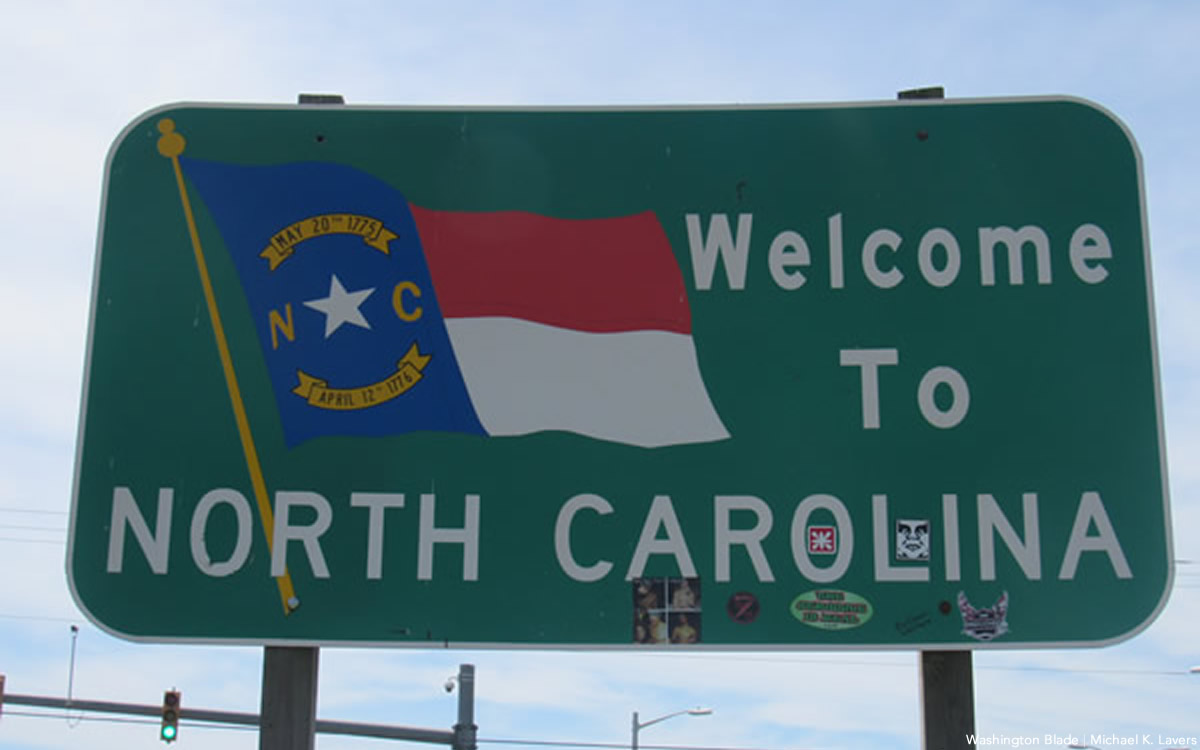
The North Carolina General Assembly overrode Democratic Gov. Roy Cooper’s vetoes of three anti-transgender bills in a late session Wednesday.
Cooper vetoed House Bill 574, House Bill 808 and Senate Bill 49 on July 5, stating in a press release the measures were “a triple threat of political culture wars using government to invade the rights and responsibilities of parents and doctors, hurting vulnerable children and damaging our state’s reputation and economy … .”
HB 574 bans trans girls and women from playing on girls and women’s middle school, high school and college sports teams. The House of Representatives overrode the veto by a 74-45 margin. The Senate followed suit.
“Since 2019, there have been only two transgender girls playing sports in the state of North Carolina … these girls are certainly not trying to destroy women’s sports. These girls are just trying to belong,” state Sen. Julie Mayfield (D-49) said.
HB 808 bans all health providers, public or private, in the state from providing gender-affirming care to minors. House lawmakers voted 73-46 to override the governor’s veto. The Senate followed suit by a 27-18 vote margin.
“This may be the most heartbreaking bill in a heartbreaking session,” state Sen. Lisa Grafstein (D-13) said. “This bill tells parents how to raise their kids … There have been so many families who have pleaded with us, testified before us, about this bill … The implication is somehow 30 people in this room know better than the families and children who know the pain we’re putting them through …”
SB 49 requires public school staff to tell parents and guardians if a student asks to use a new name or set of pronouns. The Senate overrode the veto by a 27-18 vote margin, followed by a 72-47 House vote. Some teachers are already planning to protest and act against the bill, according to the Associated Press.
“The legislature finally comes back to pass legislation that discriminates … Yet they still won’t pass a budget when teachers, school bus drivers and Medicaid Expansion for thousands of working people getting kicked off their health plans every week are desperately needed,” Cooper said in a press release prior to votes. “These are the wrong priorities, especially when they should be working nights and weekends if necessary to get a budget passed by the end of the month.”

‘Thelma and Louise’ remains landmark of unspoken queer rebellion

Comings & Goings

LGBTQ Military Happy Hour set for Sept. 15

Calendar: September 11-17

Multi-billion-dollar 9/11 Victim Compensation Fund to continue until 2090

Iceland implements gender-neutral blood donor rules

Anti-science, anti-LGBTQ movements go hand in hand

Everton Blair makes history as first openly gay congressman from Ga.

Chris Pappas wins NH Democratic Senate primary

Mujer trans salvadoreña es encontrada sin vida
-

 Iceland4 days ago
Iceland implements gender-neutral blood donor rules
-
Commentary4 days ago
Anti-science, anti-LGBTQ movements go hand in hand
-
Georgia4 days ago
Everton Blair makes history as first openly gay congressman from Ga.
-
2026 Midterm Elections4 days ago
Chris Pappas wins NH Democratic Senate primary