Maryland
Silver Spring holds annual Pride In The Plaza
‘Today means inclusion. It means to build resilience’
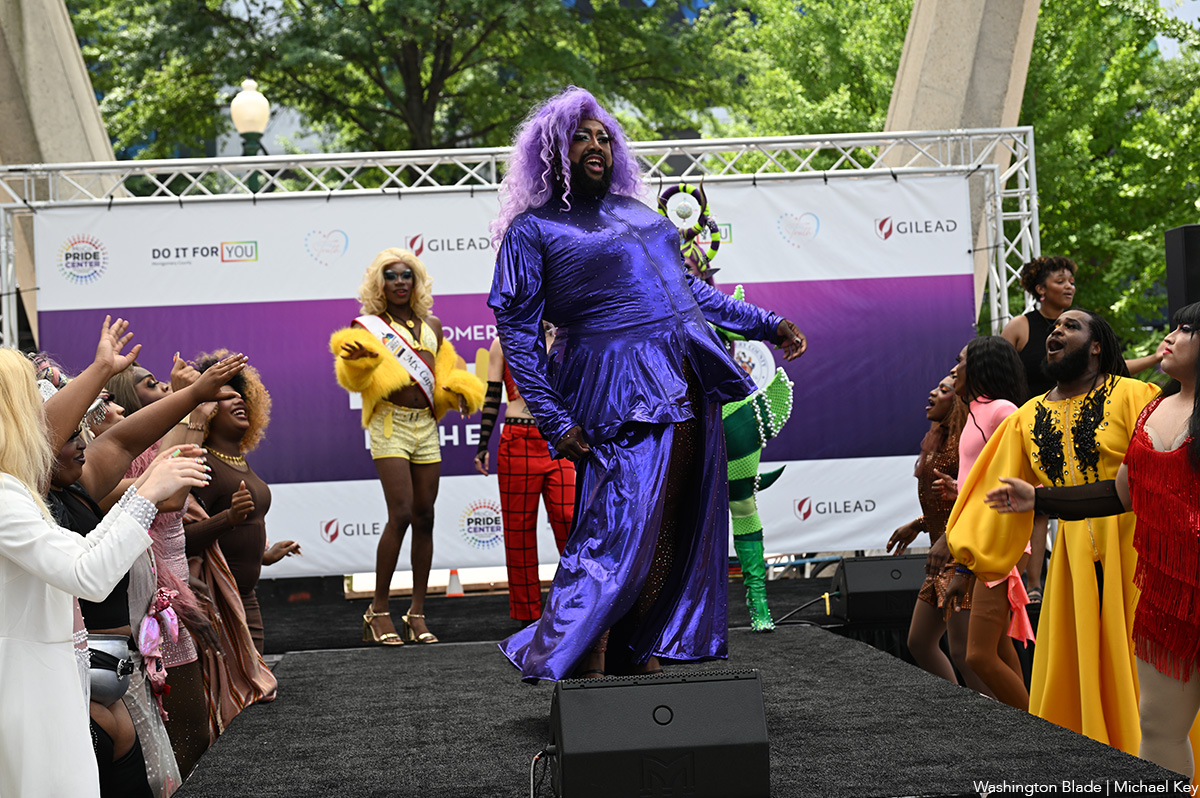
Silver Spring’s annual Pride in the Plaza event took place on Sunday to celebrate the LGBTQ community and emphasize inclusion and resilience.
“Today means inclusion. It means to build resilience, love,” Robyn Woods, program and outreach director for Live In Your Truth, which organized the event, said. “I mean, just being surrounded by the community and so many great entrepreneurs, business owners, and just being a part of this whole rainbow coalition that we call the LGBTQIA to be about.”
With the event being her first time organizing for Live In Your Truth, Woods said she felt emotional to see the support and love at the event.
“Some people (are) bringing out their children, their babies, their grandparents,” Woods said. “It’s a lot more allies here than anything else. That type of support to me means so much more than just support from my community; just outside support, inside support, so much support around it, so much love. Everyone’s smiling outside, helping each other.”
Attendees of the event were able to head over to the Family Fun Zone, an air-conditioned Pride Cool Down Lounge, or watch live drag performances in the main stage area.
Along with entertainment and a shaved-ice stand, rows of information tables stood along the plaza, including FreeState Justice, the Washington Spirit, Trans Maryland, Moco Pride Center, and the Heartwood Program, an organization that offers support, therapy, education, and resources to the LGBTQ community.
“I want people to know about our services, and I love what we have to offer,” Jessica Simon, psychotherapist for Heartwood Program’s Gender Wellness Clinic, said. “I (also) want to be part of a celebration with the community, and so it feels good to be here with other people who have something they want to give to the community.”
She added that within today’s political climate, to which she called an “antidote to shame,” it’s important to be celebrating Pride.
“There’s a lot of demonization of LGBTQI people,” Siena Iacuvazzi, facilitator for Maryland Trans Unity, said. “(Pride) is part of the healing process.”
Iacuvazzi said she was taught to be ashamed of who she was growing up, but being a part of a community helped her flourish in the future.
“I was taught how to hate myself. I was taught that I was an abomination to God,” she said. “But being a community is like understanding that there are people who have experienced the same thing, and they’re flourishing. They’re flourishing because they’re willing to stand up for themselves as human beings and discover themselves and understand what’s true for themselves.”
She added that Pride allows for a mutual understanding to take place.
“It’s more of a sense of belonging … and just taking that home and understanding you’re not alone,” Iacuvazzi said. “We’re each taking our own journey — we’re not putting that on each other. It’s just walking away with a sense of belonging and humanity.”
Similar to Iacuvazzi, Woods said she hopes attendees’ biggest takeaways would be family, fun, resilience, and pride.
“Being proud of yourself, being happy for who you are, and representation and how much it matters,” she continued. “And I think all these young people that are walking around here get to see versions of themselves, but older. They get to see so many different lesbian, gay, bisexual, pansexual people that are successful, that are showing love, that care, and it’s not how we’re portrayed in the media. It’s lovely to see it out here. (It’s) like we’re one big old, happy family.”





Maryland
Girlfriends charged with Silver Spring murder to go on trial in 2027
Prosecutors charged both women with killing mother of one of them

Two women identified as a couple who are charged with the May 22, 2026, murder of the mother one of them in her Silver Spring home and who were arrested three weeks later in Ohio are scheduled to go on trial for murder April 19, 2027.
According to online records filed with Montgomery County Circuit Court in Rockville, Vanessa Tjongarero-Henderson, 29, of Clarksburg, Md., and Samantha Raebel, 36, of Phoenix are being held without bond in the Montgomery County Correctional Facility until the time of their trial.
Statements from Montgomery County police show the two women were arrested June 10 in Genoa, Ohio, after fleeing from the scene of the murder in Silver Spring. Police statements and court records show they were extradited back to Maryland in July, where prosecutors with the Montgomery County State’s Attorney’s Office obtained indictments against them for murder.
Earlier statements from Montgomery County police say their investigation into the murder led to their decision to initially charge the two women with first-degree murder for the death of Hilde Henderson, 67, who was Tjongarero-Henderson’s mother.
“Through the course of the investigation, detectives identified Henderson’s daughter, Vanessa Tjongarero-Henderson, and Vanessa’s girlfriend, Raebel, as the suspects,” one of the police statements says. It says police obtained arrest warrants for both women and launched a nationwide search seeking help from the public in in locating them.
One of the police statements says an autopsy determined the cause of Hilde Henderson’s death was blunt-force trauma injuries brought about by a murder. Police and the State’s Attorney’s Office, which is prosecuting the case, have yet to disclose whether they have determined a motive for the murder.
Court records show that prior to the start of the April 19, 2027, trial a “motion” hearing was scheduled for Oct. 30, 2026, a pre-trail conference was scheduled for Feb. 12, 2027, and another motion hearing and a status hearing were scheduled for March 12, 2027.
Court records also show that Tjongarero-Henderson is being represented by attorneys with the Montgomery County court system’s public defender service. The records show that Raebel initially had been represented by a public defender service attorney, but updated records show Aug. 14 is listed as the “removal date” for that attorney.
The docket shows that on Aug. 20, two new attorneys with the prominent D.C. law firm of Covington & Burling made their official appearance as her attorneys in the murder case. One of them, Daniel Solomon, told the Washington Blade in response to an inquiry that the defense has no comment at this time on the case.
He confirmed that Covington & Burling is representing Raebel on a no-cost, pro bono bass.
The office of the Montgomery County public defender service didn’t immediately respond to a phone message from the Blade asking for a comment on the Tjongarero-Henderson case.
Congress
Chris Van Hollen says the Democratic Party needs change. Is he the one to lead it?
Senator is backing anti-establishment Democrats across the country
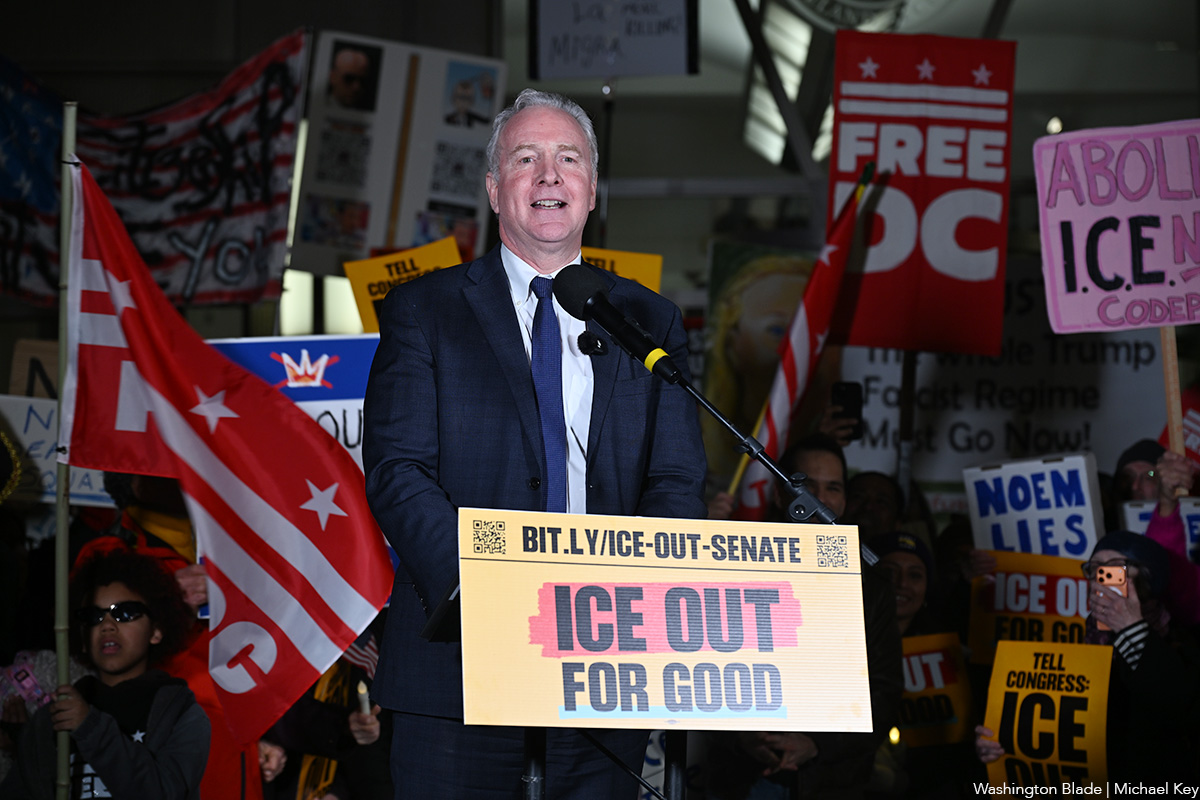
By LEE O. SANDERLIN | The Democratic Party is having something of an identity crisis — losing to President Donald Trump twice in three elections will do that.
Should the party embrace anti-establishment figures who espouse progressive policy ideas like Medicare for all and rhetoric about unrigging the economy for the 1 percent? Or should Democrats try to appeal to moderates who want to return to semi-normalcy in a time of political upheaval?
Although he’s been in Congress since 2002, with key leadership roles throughout his tenure, Maryland Sen. Chris Van Hollen, 67, counts himself firmly in the anti-establishment camp.
The rest of this article can be found on the Baltimore Banner’s website.
Maryland
Anne Arundel schools updates gender identity regulation following Trump administration threats
District facing federal lawsuit, White House threats over guidelines

By JESSICA CALEFATI | Under pressure from the Trump-Vance administration, Anne Arundel County Public Schools Supt. Mark Bedell announced Wednesday the district had updated a regulation intended to protect transgender students’ right to be called by their chosen name.
The revised language makes clear that district rules on gender identity do not block parents’ rights under the Family Educational Rights and Privacy Act as the federal government alleged last month, and that a student’s gender identity will not be treated as confidential medical information.
“No policy, guideline, or practice may limit or otherwise interfere with parental rights under FERPA,” Bedell wrote in a Wednesday letter to the community. “This includes any information maintained in education records that relates to gender identity, transgender status, sexual orientation, preferred name, or preferred pronouns.”
The rest of this article can be read on the Baltimore Banner’s website.

HRC president campaigns for Chris Pappas in NH

We’re getting married but our parents object

Michael Smith could make history as Delaware’s first LGBTQ treasurer

Poland begins to legally recognize same-sex marriages from other countries

Immersive ‘Nation-State’ imagines a society free of authoritarianism

Please join me in supporting the Washington Blade Foundation

American democracy on the brink

Girlfriends charged with Silver Spring murder to go on trial in 2027

Rehoboth mayor calls for commissioner’s resignation after investigation into improper behavior

Trans, nonbinary Americans find refuge in the Netherlands
-

 Commentary4 days ago
Please join me in supporting the Washington Blade Foundation
-
Opinions4 days ago
American democracy on the brink
-
Maryland4 days ago
Girlfriends charged with Silver Spring murder to go on trial in 2027
-
Rehoboth Beach4 days ago
Rehoboth mayor calls for commissioner’s resignation after investigation into improper behavior