Capitol Hill SE
House located in Historic District. Recently fully renovated. Two bedrooms/2 baths plus den & bonus light filled attic. Main level with 2 working fireplaces, original 1862 wood floors, modern upgraded fully equipped kitchen and rear patio w/half bath. Attention paid to details. Walking distance to Eastern Market or Potomac Ave Metro. Call your agent or Owner/realtor to view. 1600 sq. ft. A gem!!

Books
Feminist fiction fans will love ‘Bog Queen’
A wonderful tale of druids, warriors, scheming kings, and a scientist
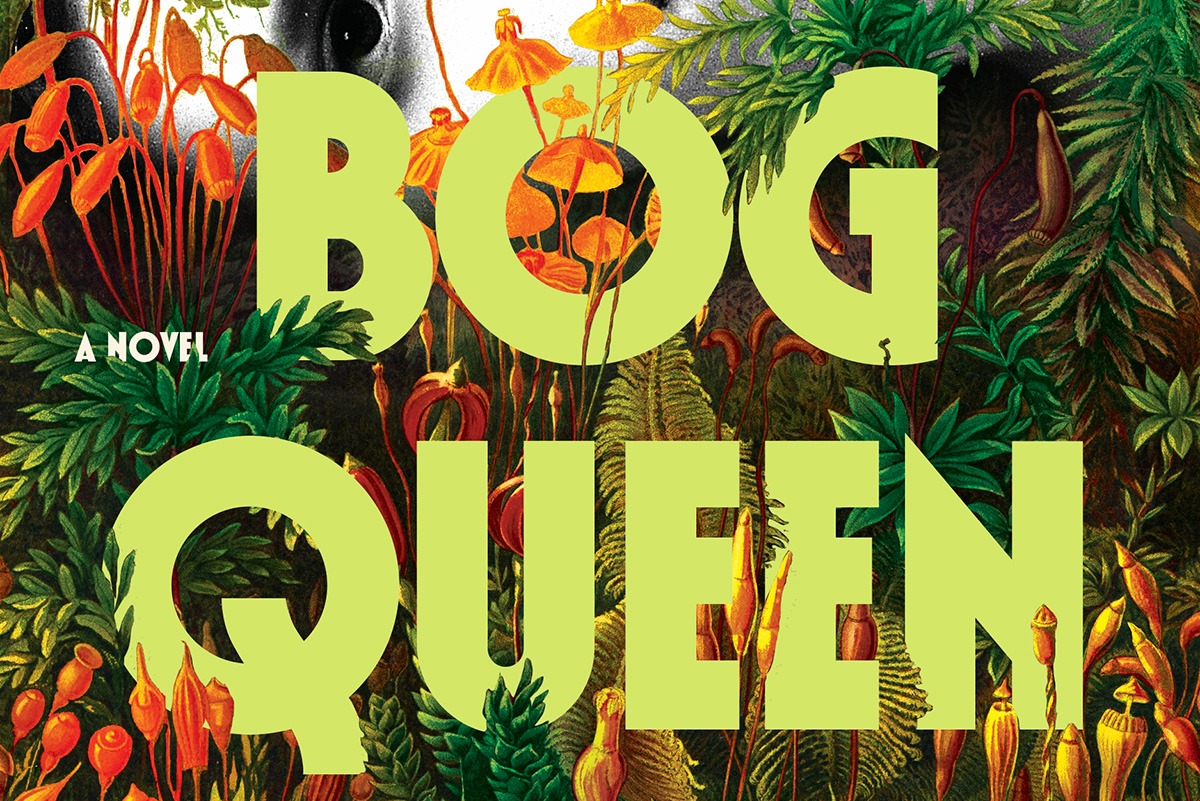
‘Bog Queen’
By Anna North
c.2025, Bloomsbury
$28.99/288 pages
Consider: lost and found.
The first one is miserable – whatever you need or want is gone, maybe for good. The second one can be joyful, a celebration of great relief and a reminder to look in the same spot next time you need that which you first lost. Loss hurts. But as in the new novel, “Bog Queen” by Anna North, discovery isn’t always without pain.

He’d always stuck to the story.
In 1961, or so he claimed, Isabel Navarro argued with her husband, as they had many times. At one point, she stalked out. Done. Gone, but there was always doubt – and now it seemed he’d been lying for decades: when peat cutters discovered the body of a young woman near his home in northwest England, Navarro finally admitted that he’d killed Isabel and dumped her corpse into a bog.
Officials prepared to charge him.
But again, that doubt. The body, as forensic anthropologist Agnes Lundstrom discovered rather quickly, was not that of Isabel. This bog woman had nearly healed wounds and her head showed old skull fractures. Her skin glowed yellow from decaying moss that her body had steeped in. No, the corpse in the bog was not from a half-century ago.
She was roughly 2,000 years old.
But who was the woman from the bog? Knowing more about her would’ve been a nice distraction for Agnes; she’d left America to move to England, left her father and a man she might have loved once, with the hope that her life could be different. She disliked solitude but she felt awkward around people, including the environmental activists, politicians, and others surrounding the discovery of the Iron Age corpse.
Was the woman beloved? Agnes could tell that she’d obviously been well cared-for, and relatively healthy despite the injuries she’d sustained. If there were any artifacts left in the bog, Agnes would have the answers she wanted. If only Isabel’s family, the activists, and authorities could come together and grant her more time.
Fortunately, that’s what you get inside “Bog Queen”: time, spanning from the Iron Age and the story of a young, inexperienced druid who’s hoping to forge ties with a southern kingdom; to 2018, the year in which the modern portion of this book is set.
Yes, you get both.
Yes, you’ll devour them.
Taking parts of a true story, author Anna North spins a wonderful tale of druids, vengeful warriors, scheming kings, and a scientist who’s as much of a genius as she is a nerd. The tale of the two women swings back and forth between chapters and eras, mixed with female strength and twenty-first century concerns. Even better, these perfectly mixed parts are occasionally joined by a third entity that adds a delicious note of darkness, as if whatever happens can be erased in a moment.
Nah, don’t even think about resisting.
If you’re a fan of feminist fiction, science, or novels featuring kings, druids, and Celtic history, don’t wait. “Bog Queen” is your book. Look. You’ll be glad you found it.
Movies
A Shakespearean tragedy comes to life in exquisite ‘Hamnet’
Chloe Zhao’s devastating movie a touchstone for the ages

For every person who adores Shakespeare, there are probably a dozen more who wonder why.
We get it; his plays and poems, composed in a past when the predominant worldview was built around beliefs and ideologies that now feel as antiquated as the blend of poetry and prose in which he wrote them, can easily feel tied to social mores that are in direct opposition to our own, often reflecting the classist, sexist, and racist patriarchal dogma that continues to plague our world today. Why, then, should we still be so enthralled with him?
The answer to that question might be more eloquently expressed by Chloe Zhao’s “Hamnet” – now in wide release and already a winner in this year’s barely begun awards season – than through any explanation we could offer.
Adapted from the novel by Maggie O’Farrell (who co-wrote the screenplay with Zhao), it focuses its narrative on the relationship between Will Shakespeare (Paul Mescal) and his wife Agnes Hathaway (Jessie Buckley), who meet when the future playwright – working to pay off a debt for his abusive father – is still just a tutor helping the children of well-to-do families learn Latin. Enamored from afar at first sight, he woos his way into her life, and, convincing both of their families to approve the match (after she becomes pregnant with their first child), becomes her husband. More children follow – including Hamnet (Jacobi Jupe), a “surprise” twin boy to their second daughter – but, recognizing Will’s passion for writing and his frustration at being unable to follow it, Agnes encourages him to travel to London in order to immerse himself in his ambitions.
As the years go by, Agnes – aided by her mother-in-law (Emily Watson) and guided by the nature-centric pagan wisdom of her own deceased mother – raises the children while her husband, miles away, builds a successful career as the city’s most popular playwright. But when an outbreak of bubonic plague results in the death of 11-year-old Hamnet in Will’s absence, an emotional wedge is driven between them – especially when Agnes receives word that her husband’s latest play, titled “Hamlet,” an interchangeable equivalent to the name of their dead son, is about to debut on the London stage.
There is nothing, save the bare details of circumstance around the Shakespeare family, that can be called factual about the narrative told in “Hamnet.” Records of Shakespeare’s private life are sparse and short on context, largely limited to civic notations of fact – birth, marriage, and death announcements, legal documents, and other general records – that leave plenty of space in which to speculate about the personal nuance such mundane details might imply. What is known is that the Shakespeares lost their son, probably to plague, and that “Hamlet” – a play dominated by expressions of grief and existential musings about life and death – was written over the course of the next five years. Shakespearean scholars have filled in the blanks, and it’s hard to argue with their assumptions about the influence young Hamnet’s tragic death likely had over the creation of his father’s masterwork. What human being would not be haunted by such an event, and how could any artist could avoid channeling its impact into their work, not just for a time but for forever after?
In their screenplay, O’Farrell and Zhao imagine an Agnes Shakespeare (most records refer to her as “Anne” but her father’s will uses the name “Agnes”) who stands apart from the conventions of her town, born of a “wild woman” in the woods and raised in ancient traditions of mysticism and nature magic before being adopted into her well-off family, who presents a worthy match and an intellectual equal for the brilliantly passionate creator responsible for some of Western Civilization’s most enduring tales. They imagine a courtship that would have defied the customs of the time and a relationship that feels almost modern, grounded in a love and mutual respect that’s a far cry from most popular notions of what a 16th-century marriage might look like. More than that, they imagine that the devastating loss of a child – even in a time when the mortality rate for children was high – might create a rift between two parents who can only process their grief alone. And despite the fact that almost none of what O’Farrell and Zhao present to us can be seen, at best, as anything other than informed speculation, it all feels devastatingly true.
That’s the quality that “Hamnet” shares with the ever-popular Will Shakespeare; though it takes us into a past that feels as alien to us as if it took place upon a different planet, it evokes a connection to the simple experience of being human, which cuts through the differences in context. Just as the kings, heroes, and fools of Shakespeare’s plays express and embody the same emotional experiences that shape our own mundane modern lives, the film’s portrayal of these two real-life people torn apart by personal tragedy speaks directly to our own shared sense of loss – and it does so with an eloquence that, like Shakespeare’s, emerges from the story to make it feel as palpable as if their grief was our own.
Yes, the writing and direction – each bringing a powerfully feminine “voice” to the story – are key to the emotional impact of “Hamnet,” but it’s the performances of its stars that carry it to us. Mescal, once more proving himself a master at embodying the kind of vulnerable masculine tenderness that’s capable of melting our hearts, gives us an accessible Shakespeare, driven perhaps by a spark of genius yet deeply grounded in the tangible humanity that underscores the “everyman” sensibility that informs the man’s plays. But it’s Buckley’s movie, by a wide margin, and her bold, fierce, and deeply affecting performance gives voice to a powerful grief, a cry against the injustice and cruelty of what we fumblingly call “fate” that resonates deep within us and carries our own grief, over losses we’ve had and losses we know are yet to come, along with her on the journey to catharsis.
That’s the word – “catharsis” – that defines why Shakespeare (and by extension, “Hamnet”) still holds such power over the imagination of our human race all these centuries later. The circumstantial details of his stories, wrapped up in ancient ideologies that still haunt our cultural imagination, fall away in the face of the raw expression of humanity to which his characters give voice. When Hamlet asks “to be or not to be?,” he is not an old-world Danish Prince contemplating revenge against a traitor who murdered his father; he is Shakespeare himself, pondering the essential mystery of life and death, and he is us, too.
Likewise, the Agnes Shakespeare of “Hamnet” (masterfully enacted by Buckley) embodies all our own sorrows – past and future, real and imagined – and connects them to the well of human emotion from which we all must drink; it’s more powerful than we expect, and more cleansing than we imagine, and it makes Zhao’s exquisitely devastating movie into a touchstone for the ages.
We can’t presume to speak for Shakespeare, but we are pretty sure he would be pleased.
The White House
Hundreds protest ICE killing of Renee Nicole Good in D.C.
Married queer woman shot in Minneapolis on Wednesday
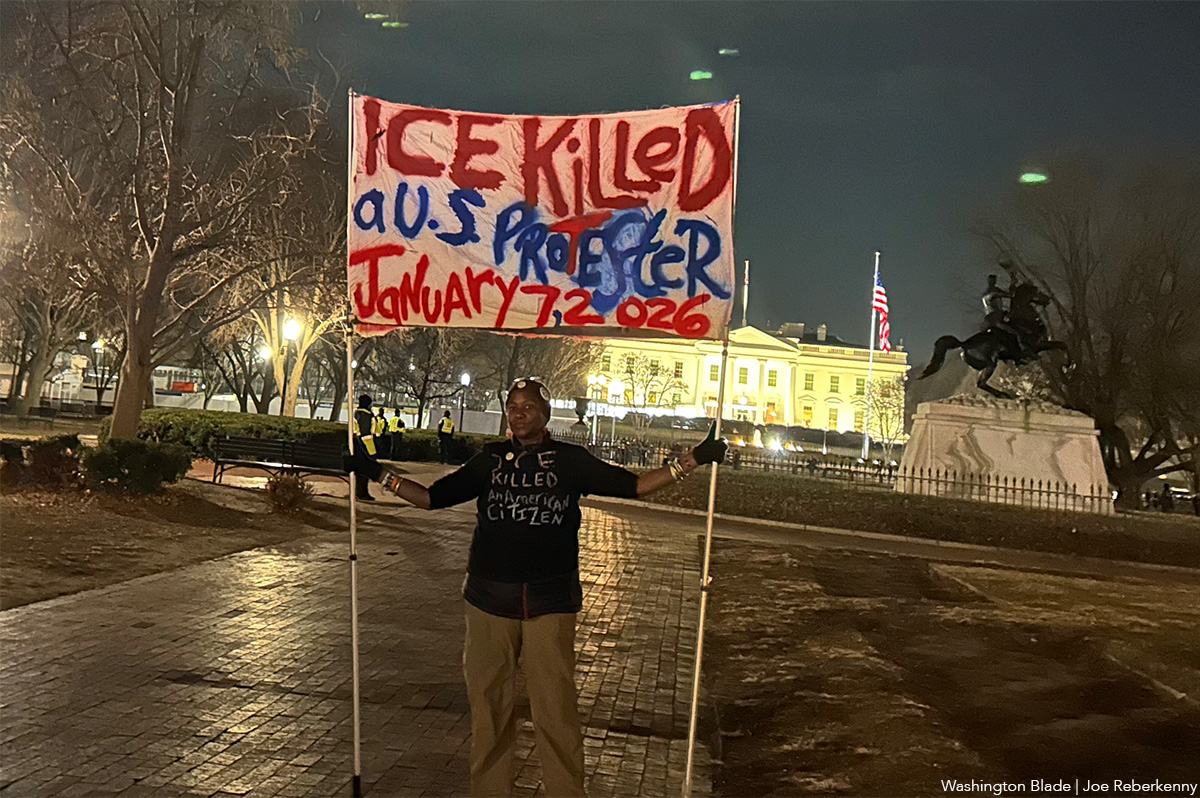
Hundreds of people took to the streets of D. C. on Thursday night to protest the killing of a U.S. citizen by a U.S. Immigration and Customs Enforcement agent.
Protests began at the busy — and increasingly queer — intersection of 14th and U Streets, N.W. There, hundreds of people held signs, shouted, and made their way to the White House to voice their dissent over the Trump-Vance administration’s choice to increase law enforcement presence across the country.
The protest, which also occurred simultaneously in cities large and small across the country, comes in the wake of the death of Minneapolis resident Renne Nicole Good at the hands of ICE Agent Jonathan Ross. Good left behind two children and a wife, Rebecca Good.
Records obtained by the Associated Press found that Ross was an Iraq War veteran and nearly two decades into his career with U.S. Border Patrol and ICE.
Good was gunned down just blocks away from where George Floyd was killed by police in 2020, sparking weeks of national protests. Minnesota officials say the FBI has blocked their access to an investigation into the fatal shooting, according to a BBC story published on Friday.
In the nation’s capital, protesters marched from the intersection of 14th and U Street to Lafayette Square, right outside the White House. Multiple D.C. organizations led the protest, most notably Free DC, a nonprofit that works to ensure the right of “self-determination” for District residents, as many local laws can be reviewed, modified, or overturned by Congress. Free DC had organized multiple protests since the Trump-Vance administration was elected.
The Washington Blade spoke to multiple protesters towards the tail end of the protest about why they came out.
Franco Molinari, from Woodbridge, Va., crossed the Potomac to partake in his first-ever protest.
“I don’t appreciate ICE and the use of federal agents being pretty much militarized against America,” Molinari said while holding a “Justice for Renee” sign. “The video of Renee being executed cartel style in her car was enough for me to want to come out, to at least do something.”
Molinari, like many others the Blade spoke with, found out about the protest on Instagram.
“It was my friend there, Sarah … had sent a link regarding the protest to a group chat. I saw it in the morning, and I thought, ‘You know what, after work, I’m head out.’”
He also shared why protesting at the White House was important.
“I already saw the response that the president gave towards the murder of Renee, and it was largely very antagonizing,” Molinari said.
President Donald Trump, along with federal leaders under him, claimed that Good “violently, willfully and viciously ran over the ICE officer.” The president’s claims have been widely discredited through multiple videos of the incident, which show Good was attempting to leave the scene rather than attacking the officer.
“I hope that anybody would be able to see that and see the response and see for themselves that it just is not correct,” Molinari said.
The Blade also spoke with leftist influencer Dave the Viking, who has more than 52,000 followers on TikTok, where he posts anti-fascist and anti-Trump videos.
“We’re out here to make sure that this regime can’t rewrite history in real time, because we all know what we saw … we’re not going to allow them to run with this narrative that they [ICE agents] were stuck in the snow and that that poor woman tried to weaponize her car, because we all saw video footage that proves otherwise,” he told the Blade. “We’re not going to let this regime, the media, or right-wing influencers try to rewrite history in real time and try to convince us we didn’t all see what we know we saw.”
Dave the Viking continued, saying he believes the perceived power of ICE and other law enforcement to act — oftentimes in deadly and unjustifiable ways — is a product of the Trump-Vance administration.
“There’s a line between fascism and anti-fascism. These motherfuckers have been pushing that envelope, trying to label an idea a terrorist organization, to the point of yesterday, crossing that line hardcore. You face the point of looking at history and saying there was this 1989, 2003 America, where we’re just going in, raiding resources. Where is this fucking 1930s Germany, where we’re going in and we’re about to just start clearing shit and pulling knots? Yeah, nope. We proved that shit yesterday.”
Two people were injured in another shooting involving federal agents, this time Border Patrol in Portland, Ore., on Thursday afternoon.
KC Lynch, who lives near American University, also spoke about her choice to protest with a group.
“I came out today because everything that ICE has done is absolutely unacceptable, not only killing this one woman, but also the fact that they’ve been imprisoning people in places that are literally, that have been literally on record by international organizations shown to be human rights violating. It’s unbelievably evil.”
Lynch also echoed Dave’s opinion about parallels between the Trump-Vance administration and the rise of Adolf Hitler in Nazi Germany.
“It’s literally what happened before the Holocaust. We should all be scared. We should all be angry. I’m so angry about it … even talking about it — I’m sorry,” she said before getting choked up.
Lynch emphasized that despite the circumstances in which people were protesting together, the sense of community was strong and powerful.
“I feel like it’s important for people to know that we’re angry, even if no policy changes come out of it, and it’s just nice to yell and be angry about it, because I feel like we’ve probably all been feeling this way, and it’s nice to be around people that are like minded and to like have a sense of community.”

Feminist fiction fans will love ‘Bog Queen’

A Shakespearean tragedy comes to life in exquisite ‘Hamnet’

Hundreds protest ICE killing of Renee Nicole Good in D.C.

Calendar: January 9-15

Support the Blade as mainstream media bend the knee for Trump

What to watch for in 2026: midterms, Supreme Court, and more

Blade travels to Colombia after U.S. forces seize Maduro in Venezuela

Tim Walz drops out of Minn. governor’s race

A reminder that Jan. 6 was ‘textbook terrorism’