National
Gay lawmakers back Pelosi’s leadership bid
But some advocates unhappy with decision to pursue post
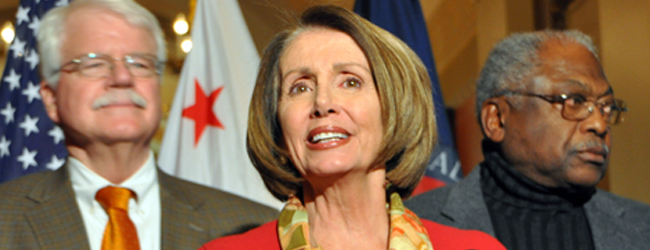
U.S. House Speaker Nancy Pelosi’s (D-Calif.) decision to pursue a bid as minority leader in the upcoming Congress is being met with unanimous support among the openly gay members of Congress as some LGBT advocates expressed regret that more pro-gay legislation didn’t pass during her tenure as presiding officer.
After Pelosi announced her decision to run for House minority leader last week, openly gay members of Congress declared their support for her decision and praised her work representing San Francisco in Congress for 23 years and her work in the last four years as speaker.
Rep. Tammy Baldwin (D-Wis.), the only out lesbian in Congress, said in a statement to the Blade that she’s among those endorsing Pelosi in her decision to become Democratic leader in the next Congress.
“I remain loyal to Nancy Pelosi,” Baldwin said. “In the last two years, she accomplished things that we’ve been trying to do for decades. Without her unique leadership passing health care reform, [the stimulus package], higher education reform, Wall Street reform, the Matthew Shepard Hate Crimes Act, and the House-passed Energy and Climate Change bill would never have happened.”
In an interview with the Washington Blade on Monday, Rep. Barney Frank (D-Mass.), the longest-serving openly gay member of Congress, also said he backs Pelosi’s decision to stay on as Democratic leader. He’s often spoken highly of her commitment to LGBT issues.
“I’m supporting her; I think she’ll win,” Frank told the Blade.
Also among those expressing support for Pelosi’s continued leadership is Rep. Jared Polis (D-Colo.), a gay lawmaker who last week issued a statement praising Pelosi’s decision and her support for the LGBT community.
“I strongly support the speaker and her decision to run for Democratic leader,” Polis said. “She has been a longstanding and ardent supporter of the LGBT community and I will do anything to help continue her leadership. The speaker has led the Democrats out of the wilderness before and I am confident she can do it again.”
David Cicilline, the Rhode Island politician who last week was elected to become the fourth openly gay member of Congress, also endorses Pelosi’s move. Richard Luchette, a spokesperson for Cicilline, said the congressman-elect “will be supporting Nancy Pelosi for minority leader.”
During the course of her tenure as speaker since 2007, Pelosi has pushed through a number of pro-LGBT bills through the U.S. House. The chamber passed hate crimes protections legislation in 2007 and again in 2009.
Pelosi also mustered enough votes in 2007 to pass through the House a version of the Employment Non-Discrimination Act that later died. This year, a measure that would lead to “Don’t Ask, Don’t Tell” repeal passed the House by a 40-vote majority.
The health care reform legislation that Pelosi dragged to the finish line earlier this year increases access to Medicaid for people with HIV and improves Medicare Part D by closing the “donut-hole” for people participating in AIDS Drug Assistance Programs. Additionally, the law prohibits insurance companies from discriminating based on pre-existing conditions, such as HIV status.
But despite Pelosi’s success in the House with pro-LGBT legislation, only hate crimes legislation also successfully passed through the Senate during her time as speaker. Additionally, Pelosi has endured criticism for not moving forward with a trans-inclusive ENDA during the 111th Congress.
Drew Hammill, who’s gay and a Pelosi spokesperson, said the California lawmaker has been “a staunch advocate” for LGBT people during her more than 20 year in Congress. Among the positions she’s taken that he cited are leading the fight against HIV/AIDS, opposing a U.S. constitutional amendment banning same-sex marriage and speaking out against Proposition 8 in California.
“Nancy Pelosi will continue to be a friend, advocate and staunch ally to the community and the leading voice in the Congress for LGBT equality,” Hammill said.
House Democrats will vote at the start of the lame duck session next week on who will become minority leader in the 112th Congress as well as which members will assume other positions in Democratic leadership. As of Blade deadline, no other House member has challenged Pelosi in her bid to become Democratic leader.
The more contentious battle will likely be over who will take the No. 2 position in the Democratic caucus. Both current House Majority Leader Steny Hoyer (D-Md.) and House Majority Whip Jim Clyburn (D-S.C.) are vying to become House minority whip. Hoyer is expected to have the backing of more moderate members of Congress, while Clyburn will likely have support from progressives as well as the Congressional Black Caucus and the Congressional Hispanic Caucus.
Although Pelosi thus far is running unopposed as minority leader, the speaker’s decision to continue to lead the House Democratic caucus has irked some conservative Blue Dogs who distanced themselves from the speaker during the campaign and barely survived the Republican onslaught on Election Day.
Among the U.S. House members who’ve publicly said they wouldn’t vote for Pelosi as minority leader are Reps. Larry Kissell (D-N.C.), Jim Matheson (D-Utah), Health Shuler (D-N.C.) and Dan Boren (D-Okla.).
Eager to tie Democrats to Pelosi again in the 2012 election, the Republican National Committee last week draped a red banner across the front of its headquarters reading, “Hire Pelosi.” Prior to Election Day, as Republican candidates hammered House Democrats belonging to the caucus that voted Pelosi into power, a similar banner hung on the face of the building reading, “Fire Pelosi.”
One Democratic lobbyist, who spoke to the Blade on the condition of anonymity, expressed disappointment with Pelosi’s decision to stay on as minority leader and said the move doesn’t bode well for Democrats.
The lobbyist noted that fewer Democrats will be in the House next year than the number that were present in the minority prior to Pelosi’s ascension to speaker in 2006.
“Her polarizing history as leader will severely hamper Democratic recruitment efforts in the districts we just lost; couple that with what will almost certainly be additional Democratic losses after redistricting next year and it makes Democrats’ road to reclaiming the House — and her speakership — nearly impossible in the foreseeable future,” the lobbyist said.
Among LGBT rights supporters, Pelosi’s decision to continue as Democratic leader in the 112th Congress is inspiring mixed reactions. Some commend her for pushing through pro-gay bills while others said she could have done more.
Fred Sainz, the Human Rights Campaign’s vice president of communications, said the decision on whether Pelosi would be able to stay on as minority leader is up to the Democratic caucus and “not any one group.” Still, he praised the Democratic lawmaker for her support for the LGBT community.
“Speaker Pelosi has been a consistent ally and advocate not just for LGBT people but for all fair-minded Americans throughout her congressional career,” Sainz said. “She has vigorously supported full and equal rights for LGBT people long before it was politically acceptable to do so.”
But John Aravosis, the gay editor of AMERICAblog, said Pelosi is responsible in part for the lack of progress on pro-LGBT legislation during the first two years of President Obama’s administration. Still, while he said he’s not completely satisfied with Pelosi, Aravosis said other LGBT advocates in power deserve worse job evaluations.
“All of our leaders let us down: HRC, Barack Obama, Harry Reid and Nancy Pelosi,” Aravosis said. “Having said that, Nancy Pelosi strikes me as the least culpable of the four. I’m not happy that she wasn’t able to even get ENDA through committee, but I’m a lot less happy at the moment with HRC, President Obama and Harry Reid. Pelosi at least came through for us part-way, the others have been MIA the last two years.”
GetEQUAL, the LGBT organization responsible for civil disobedience acts across the country, is calling on Pelosi to make public a plan for moving forward with LGBT legislation to win the group’s endorsement in her bid to become minority leader. The organization has protested the speaker both on Capitol Hill and in her home district of San Francisco for not moving forward with ENDA in the 111th Congress.
Heather Cronk, managing director for GetEQUAL, maintained her organization is “interested in full equality for all LGBT Americans” and “happy to endorse” any member of Congress that can “commit to carrying the mantle of full federal LGBT equality.”
“While GetEQUAL has protested Rep. Pelosi throughout 2010 to hold her accountable to her promises to the LGBT community, we’d be happy to endorse her if we see a concrete and realistic plan for moving pro-equality legislation through the House,” Cronk said. “We would also be happy to endorse any other representative who can offer such a plan. We’re seeking bold action for equality — and we’re far more interested in that end than in the political horse race that started the day after Election Day.”




National
Four bisexual women on stereotypes, erasure, representation, and joy
Panel talks coming out, pop culture, and why dating men doesn’t erase queerness
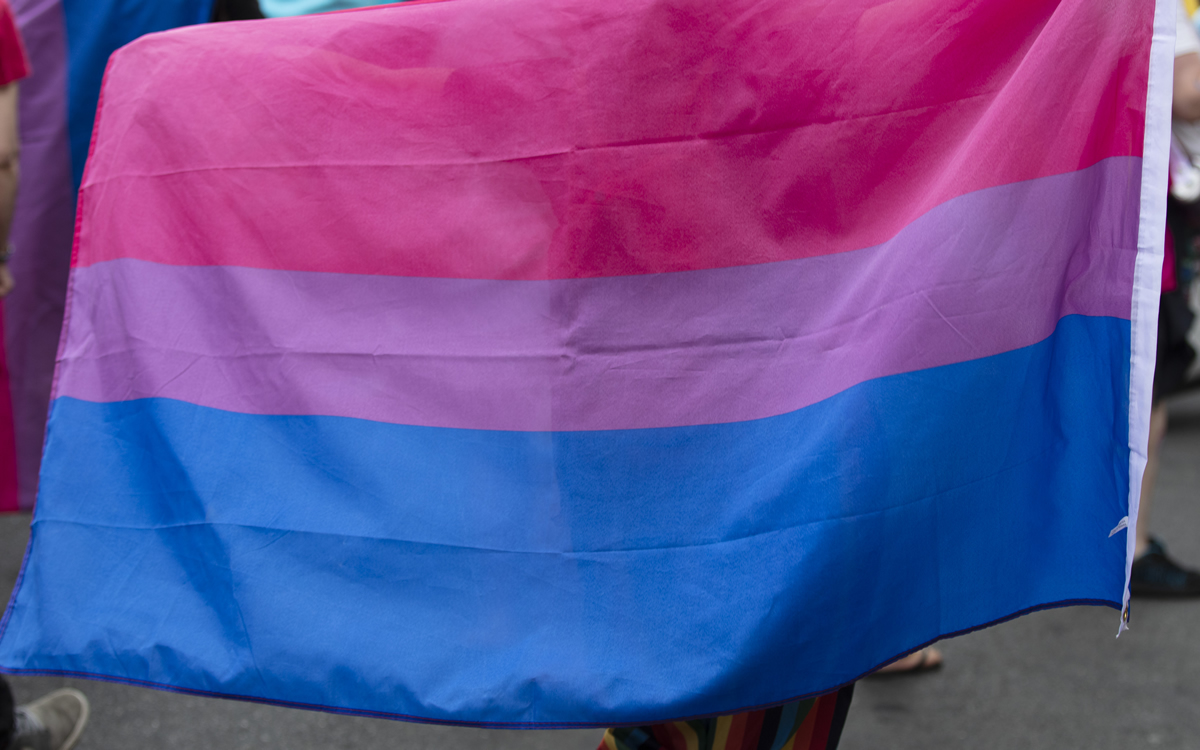
Uncloseted Media published this article on Feb. 7.
By SPENCER MACNAUGHTON, TAYA STRAUSS, and SAM DONNDELINGER | The number of openly LGBTQ American adults has skyrocketed in the past few years, but there’s one group that’s been leading the way: Gen Z women, 20.7 percent of whom are bisexual.
Despite this increase, many bi women still feel deeply misunderstood. To understand this, Uncloseted Media put together a panel of four bisexual women who spoke candidly about coming out, bi erasure and why bisexuality is often treated as a phase or something that disappears the moment a woman dates a man.
Watch the full interview above or read the transcript here:
Spencer Macnaughton: Hi everyone, I’m Spencer Macnaughton and today I am here with a panel of four bisexual women from across the United States. Thank you all so much for speaking with me and Uncloseted today.
Sophie Sandberg: Thanks so much for having us.
SM: So I always like to start with people’s coming out stories. So yeah, does somebody want to tell me their coming out story a little bit, or when you realized you were bi?
SS: I think part of being bisexual was that it was a long coming out story and kind of a long period of coming out. I always dated cis men when I was in middle school and high school. I started having boyfriends really early and was kind of even boy crazy, I would say. But I did always notice these crushes on my friends, on girls, on more queer and androgynous people I was seeing in the media. So, I would say I started noticing it myself in high school and definitely in college, but I didn’t have to come out because I was in serious relationships with cis men and very straight-passing. So I didn’t officially come out to everyone in my life until I was about 23.
SM: And was that like, I know when I was closeted, I’d hook up with girls, but I didn’t want to be hooking up with girls, right? And it stressed me out. But was there a stressor on that? I always wonder if the stress levels are the same or different as somebody who’s bisexual because you can date people you’re still genuinely interested in.
SS: Yeah, that’s a good point, and I think this is something that differs between me and my lesbian friends. They’ll be like, “yeah, I never enjoyed it, I was so unhappy, and then suddenly everything made sense when I came out.” And for me, I did genuinely have love and connection with cis men who I was in relationships with and slept with, but I also did always have this kind of knowledge or curiosity or interest in sleeping with people who weren’t cis men. So I think I was able to kind of have something genuine there, but also was always aware that there was more than just that for me. If that makes sense.
SM: Yeah. Kelly, how about you?
Kellie Wilson: Yeah, so I actually really only realized that I was bi about a year and a half ago, and so I feel a little bit of imposter syndrome being on a bi panel because I’m pretty new to this actually, and it was an interesting realization of learning that one of my friends that I had been growing closer with actually had feelings for myself and my husband. And at the time it was kind of like a, “whoa, I don’t know what to do with this information.” But over the course of the next few weeks and a bit of identity crisis and thinking about my past and my life and things like that, I realized “oh, I have a crush on her too.” And that I’ve probably had crushes on many women because there have been so many people in my life where I’d see them and like, “oh my gosh, they’re just, they are so cool. I love their vibe, they’re so pretty. I really want to be friends with them.” But then most of the time I wouldn’t actually become friends with them because I’d be too nervous when I was around them. There were absolutely signs and it just never clicked because I think, kind of like what you were saying Sophie, I had been in a long-term relationship with a cis man since my freshman year in college, which, he was my first boyfriend, my first everything. We got engaged, we got married, we had kids. And so there was never necessarily … I don’t know, there was no drive or reason for me to be questioning it, and I think part of that was some internalized biphobia from growing up in a very Christian, not fundamentalist, but gayness was of course a sin in the eyes of the church and all these things. It was something that I think I had internalized enough that it never really crossed my mind because I had feelings for cis men, and so it was like, “okay, yeah, I like men, I must be straight.”
Abby Stein: I think it’s a bit more complicated for me just because I’m also trans, and to add more to it, I grew up in a very gender-segregated community. So that played a very big role in this whole conversation. But the first, I guess, let’s call him a boyfriend for now, was in this very religious school. I was in upstate New York, kind of in the middle of nowhere. I guess in some ways it was a coming out but in other ways in my mind I made sense of it by being like “I’m actually a girl.” Then when, I guess when I was 18, I got married, arranged marriage, very much part of my community, to a woman, and I was very into that as well. So it’s hard for me to be like “okay at what point did I realize both of these people have been very interesting and therefore it says something about my sexuality.” I don’t know, I actually am having a hard time to be like the exact moment or even date or year.
SM: Yeah. And how does, obviously coming out as trans, especially in a gender-segregated community is a very tall task that I’m sure is an entirely different conversation, right? Was coming out as bi, did it feel like even a thing after having come out as trans or how did that play into it all?
AS: I think I struggled with it a lot more than with gender. People tell me a lot, “oh, you must have been struggling with your gender.” And I’m like, “no, I don’t know.” I think my gender, I was very comfortable with who I was and knew who I was since I was a child. Sexuality, I think, I’m still figuring out every day exactly what I do and don’t like. And it’s a constant struggle and journey. Not necessarily a struggle, sometimes a struggle. Sometimes a really great adventure. But it’s definitely something that has been, I think, more complicated to me than gender.
Katie Marie: I thought that I was straight for a very long time, thought that I was just an ally. I was married to a man for about 10 years. I had the house, the picket fence, the master’s degree, the job, and I was still very, very unhappy at the end of every day. I am Indigenous. I started leaning back into my spirituality and started to really dig deep into understanding who I am. It was at that moment in time, I had a really beautiful dream. And in that dream, I saw myself with a woman. I didn’t know that she was a woman, funnily enough, I just felt the energy. And I awoke from that dream and immediately turned to the man who was my husband at that moment in time and said, “I think I am interested in women.” Of course, whenever you first come out as bisexual in a situation like that — I was from the South — there are some negative implications that come with saying that you’re bisexual, especially even from the gay community, right? It’s that implication that you can’t choose a side or that you must choose a side or some version of that?
SM: Tell me a little bit about the biggest misconceptions about bisexual women in society specifically. What are the stereotypes, the misconceptions that are perhaps most frustrating for you guys?
KM: For me, I can speak to one. And this was just one that I experienced very quickly was this idea that for some, because I was bisexual, I was going to now have sex with everybody, right? This idea that I can’t choose a side, so I’m just gonna have relations with everyone and I just can’t make up my mind.
SM: A stereotype of promiscuity.
KM: Yes, exactly. That was a big one. And it came through in my marriage, actually, that was one of the initial problems is my husband started assuming that I was going to have sexual relationships with all of my girlfriends. And that became a big barrier for me to have to overcome.
SS: I feel like there’s a misconception, well, one, that bisexual women just want to be with men. I feel like there’s this misogynistic misconception that anyone who’s bisexual actually wants to be with a cis man, whether it’s a bisexual man or a bisexual woman.
SM: Interesting, I didn’t know that.
SS: If you’re a bisexual man you must really want to be with a man and if you are a bisexual woman you probably also just really want to be with a man. But I think in general just, yeah, people not fully understanding that bisexuality is more fluid and open than that.
KW: I think one of the things that I most often see would be on this idea of fluidity in levels of attraction and the bi cycle, right? And this idea that, “oh, it’s just a phase,” if you start off being more attracted to one gender and then it’s shifting over time, that it’s not gonna shift back. Existing in the middle space is not something that can happen. So I’m also biracial. I’m half black, half white, and I think that it’s this consistent theme in society, like, you can’t be both. And I think that’s really pervasive in the idea of stereotypes about bisexual women. You just have to pick one or you’re never gonna be enough of the other to fully fit. And so it’s sometimes easier to just exist in one space or the other. But then the internal experience of that is where it gets more uncomfortable. Like, no, it’s both. It’s absolutely both.
AS: So I’ve definitely had people saying, “oh, your sexuality” — by people I mean, literally my brother just a few weeks ago — “your sexuality is just part of your entire personality that’s just very confused.” And I don’t see it as that. I just don’t think that everything needs to fit in a very neat box. So it all ties into this idea, for me it all makes sense, which is that I like to look at things and constantly explore them and never decide that something has to be a specific way. And it’s like that with my sexuality, it’s that with the way I see my cultural and spiritual practices. And I think that’s beautiful.
SM: Well, I think it’s really interesting what you said. And I think it takes me back to what Kellie was mentioning about the bi cycle, right? Where people can be more interested in men one day, women the next day, anything in between, right? But I also think, Kellie, what you were mentioning is that there’s people who won’t accept that people can live in this gray zone. I could imagine that’s really frustrating.
KW: I don’t understand why people are so caught up on this need to check one box, right? And that you have to fit into one box. Because, I mean, to me, it’s just the most natural thing in the world to exist in this space of both and all the time and to understand that they — and I think everyone else is confused. I don’t understand why there’s this need to think you can only have one thing.
SS: And people wanna snap us back into a heteronormative space. So I think that’s something I experienced a lot early on coming out as bisexual. People saying, “you’re probably really straight, you’re probably gonna end up in a straight relationship, but this is kind of a phase or something you’re just trying out.” So, I think it comes from this heteronormative society that we live in. People just wanting to force us back into that box. And I think that’s what’s so beautiful about bisexuality. It’s constantly moving into the gray space, getting uncomfortable, having to explore and figure ourselves out. Yeah, I love that about bisexuality.
SM: I think I’ve heard before, “not queer enough.” I’ve heard that from bisexual folks as well. And is the reverse sometimes true as well? Can there be biphobia from gay people?
SS: Yes, absolutely, “not queer enough, not actually gay, just a little bit gay, half gay.” I feel like, yeah, this idea of bisexual as one half gay, one half straight has never made any sense to me ‘cause we’re all fully bisexual, that’s who we are. So yeah, that’s always a really frustrating stereotype too.
KW: I have been pretty nervous in terms of coming out to people who I know who are lesbian because of this stigma or this idea that can exist in the lesbian community, this idea of the gold standard, or if you’ve been with men, then you’re somehow tainted, or you’re not actually fully invested in other women and things like that. Or that if you’re with a woman, then you’re just gonna leave them for a man because of these heteronormative biases and things like that. And so I’ve found myself, I think more nervous to come out to people who I know who are lesbian than people who I know are straight.
AS: Just gonna add, and I think it’s very similar to what you’re saying, Kellie, which is this idea that people constantly assume that you’re never gonna be satisfied, whether from gay people, from straight people, from your own partners. Which is very weird to me, because I think even if you’re a straight person, if you have more than one very specific type, which I think a lot of people do, no one assumes, “oh, you’re never gonna be satisfied because this is not all your types in one person.” It’s not how it works.
SM: Again, frustrating too. I wanted to ask specifically, obviously in many societies in the U.S. right now, it’s still dominated, especially in religious areas, of patriarchal governance structures, right? There’s obviously still a lot of misogyny in society at large. How do you find men treat bisexual women differently than straight women, lesbian women, other women?
KW: Women are already so hypersexualized, and then when they find out that you’re bi it’s like this new level you didn’t even know existed of hypersexualization, of like, oh, they’re thinking, threesomes are always the first thought, and “this would be so hot,” and the idea of … what’s the word I’m looking for? Watching people …
SM: Voyeurism?
KW: There we go. Wanting to watch women be with women but then they’re also with you. And so then there’s this heightened level of fantasization that can happen when they find out that you’re bisexual. I noticed it at bars when I was with my husband and my girlfriend at the time and people trying to figure out the nature of your relationship and then, “oh, there’s these two bi women here, this is so hot.”
SM: Do people feel like they have more free rein to say things like that to you, perhaps because you’re bi?
KW: Not even, I think it’s not even saying things to me, but about me to the man, right? So then they’re directing their comments to my husband, like, “oh, you’re so lucky. How did you manage this?” And one, then that strips me of my own autonomy. And so then it’s weird because you’re objectified as this thing that this other man has somehow managed to collect, achieve. Yes, and then they’re not even directed at me. It’s just like I’m there as this object that exists for the satisfaction of the men in this interaction.
SM: It sounds like these men almost characterize it as though you don’t have agency to come out and say, “I am a proud bisexual woman,” but rather it’s your partner, your male partner who activated the bisexuality, which is obviously crazy. All very interesting. I want to talk quickly about pop culture and the media in 2026. Obviously I think — I’m a geriatric millennial here — and I think we’ve come a long way since Katie Perry’s “I kissed a girl and I liked it.” So we have celebrities now coming out as bi, Jojo Siwa, Billie Eilish. It feels like there’s more of a normalization, but I don’t know, I’m curious about the state of media representation of bi women in 2026. Go for it.
KM: For me, I feel like everybody’s gay. And I think that it is beautiful that more celebrities are coming out. It’s showing the natural progression of understanding who we are as beings, as people. Because I think as children, whenever we don’t get the chance to figure out who we are and who we love, and we’re told instead who we are and who we love, then we have a whole group of geriatric millennials figuring out just now, “wait a minute, maybe I’m somebody else.”
AS: There definitely seems to have been a very intentional, which has to do with the moment we’re in and with funding from federal grants and the attack on DEI and so on, that there’s definitely been. Shows that have been filmed over the past year, if that makes sense, seem to be less queer than, I think, what we had five, six years ago. Specifically traditional media, like network TV and the big name studios, are trying to dial back a bit, a lot of queer representation.
KW: I see that too, Abby. And I think that they’re, especially when it comes to bi representation in the media, I feel like it’s still much lower. When I was first realizing that I was bi, I was like, I couldn’t think of hardly anyone that I had seen in a movie or books that I knew that were about bisexuality. I couldn’t think of any. I had to really go and research and go on reddit and do all this googling to find things to watch to see representation.
SM: I do think what’s fascinating is that the Gallup poll came out this year, and it reported that 23 percent of Gen Z respondents self-identified as bisexual. That’s versus a 9 percent average of the population at large, and that’s a 146 percent rise. Why do you guys think young people are coming out so much more as bi?*1
AS: I think a lot of people, at least in religious communities, and I know some people who I grew up [with] who are like this, who are bi, and they would tell me directly, “if I was gay, I would leave this community and just go do my thing. But I’m bi, I made it work, it’s fine, I will be in this straight-passing relationship and it’s fine.” And the more we give people permission to be themselves, the more people are gonna come out. I don’t think suddenly there are more queer people, I think there’s just more people who are not afraid to literally be shunned from their families and societies for coming out as queer. So I think that is a big part of it. But I definitely think the bi part of this specifically is that even though it has been easier — it’s still not easy, but it has gotten easier over the past few decades. And I think that impacts bi people perhaps even more than — it gets harder for lesbians and gay people to choose not to be that, and to choose to be in a straight-passing relationship. If it’s hard to come out, it can be easier for bi people. So as we are making it easier for people to come out, the numbers go up by a lot.
SS: Abby I really agree with you there, I think that’s really interesting. But I also wonder if Gen Z is more flexible with gender identity and just fluidity in general, and I wonder if that creates more space for a bi identity, ‘cause we’re all talking about how bi-ness is fluidity and it has created this space for a gray area. And I think of Gen Z as being very open also with gender identity and being very fluid and accepting. So I wonder if that in turn creates more space for the bisexual identity. Because there’s fluidity in that too, if that makes sense.
SM: No, it definitely does. And I think a lot of what we’ve talked about today has been around, especially in years past, the idea of bi erasure, right? That’s a concept that’s discussed a lot. And I’m curious what you think we can do as a society to make bi erasure less of a problem and something that feels very prevalent still in 2026.
KW: I think the more that we deconstruct the idea that sexuality is a choice, I think the less bi erasure there will be. The idea of sexuality as a choice has been so harmful for the gay community, right? When people who are bi have been like, “oh, I’ve had the gay erased out of me or prayed the gay away” and things like that. This idea that you can have gayness removed has been so harmful. And so there’s that side of it. And then from the straight side of things, there’s no threat of “oh, well, now someone might see me as gay because there’s these people who are both,” you can never prove that you’re just straight or just lesbian. If you take away the need to prove this and take away this idea that it is a choice at all, then that’s where people can have this more accepting perspective of existence.
AS: I just wanna say we need to focus also on joy, bi joy and queer joy and our joy generally, because at the end of the day, it is really cool. I mean, we get to experience so much of the world. I’m not gonna say that people who are not open to all kinds of genders don’t have that, but I definitely think we are experiencing a very fun and very unique part of the world and that’s amazing.
SM: That is a great thing that I absolutely should have asked more about. What are the best parts about being bisexual?
KM: Freedom for me, freedom to love. It gave me a deeper understanding of self. And at the end of the day, I think that that’s what everybody deserves.
SS: I think that bisexuality has allowed me to understand my gender and my queerness differently because of my attractions to different types of people, and I think that’s a beautiful way that bisexuality allows for freedom and yeah, just like feeling more yourself. Also, I was just gonna say we need more representation. This conversation made me realize wow, yeah, I can’t think of a bi character who I found and looked up to, except for like Alice in The L Word, but she was basically within the lesbian community. So, if anyone’s out there listening and is like, “I wanna create an amazing, joyful bi character,” I feel like that would also be very helpful.
KW: I was just gonna echo the freedom piece, and having the freedom to explore and learn so much about myself has been so freeing, and this feeling of wholeness, I think, has been the most joyful thing of realizing there was a whole piece of me that I didn’t even know existed. It’s just been incredible.
SM: Sophie, Kellie, Katie and Abby, I’m so grateful for your time and for sharing all of this with me and Uncloseted Media today. It’s been a really fantastic conversation, so thank you.
KW: Thanks so much for having us.
SS: Thank you.
New York
Pride flag raised at Stonewall after National Park Service took it down
‘Our flag represents dignity and human rights’
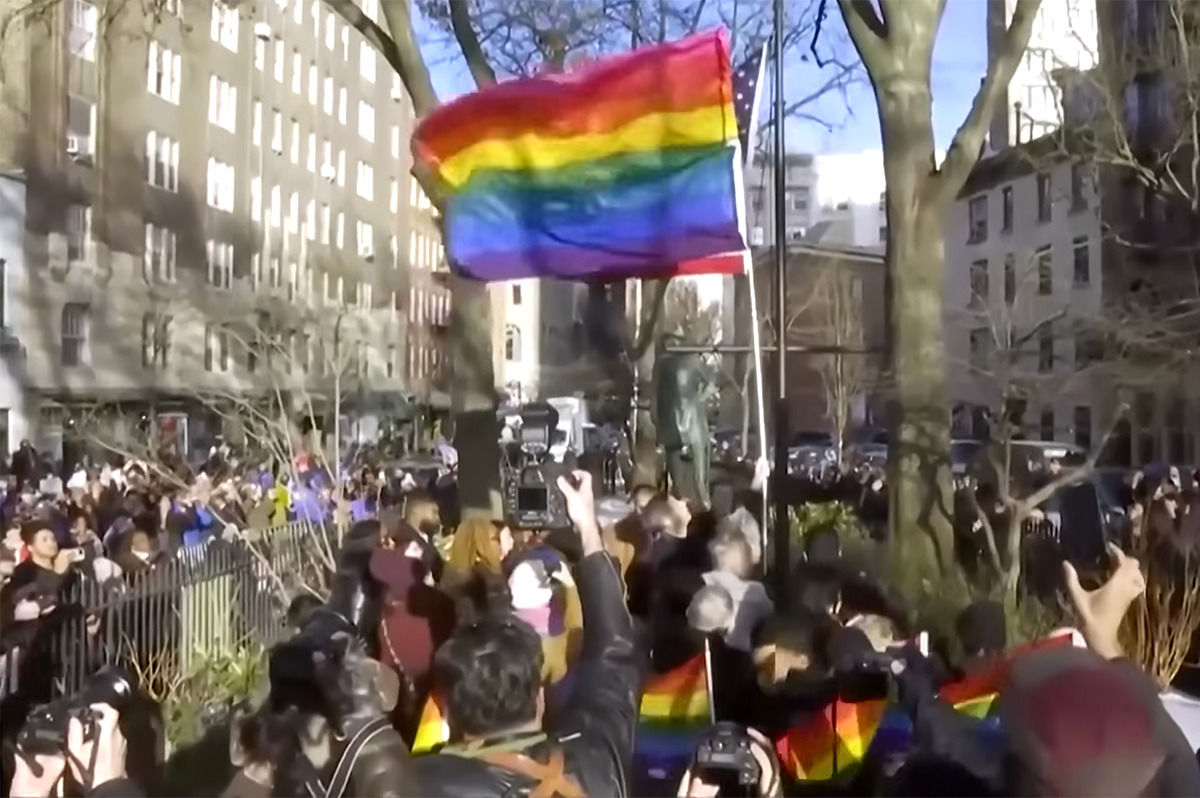
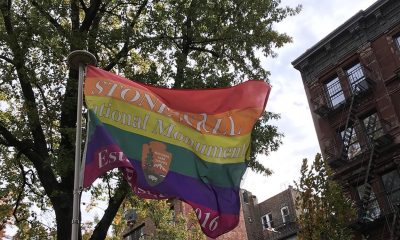
A Pride flag was raised at the site of the Stonewall National Monument days after a National Park Service directive banned flying the flag at the birthplace of the LGBTQ rights movement in the U.S.
The flag-raising was led by Manhattan Borough President Brad Hoylman-Sigal and supported by other elected officials.
“The community should rejoice. We have prevailed,” Hoylman-Sigal said shortly after the flag was hoisted. “Our flag represents dignity and human rights.”
The flag now sits in Christopher Street Park, feet away from the Stonewall Inn, where in 1969 a police raid of the gay bar sparked outrage and led to a rising of LGBTQ people pushing back on NYPD brutality and unjust treatment.
Elected officials brought a new flagpole with them, using plastic zip ties to attach it to the existing pole.
In 2016, President Barack Obama declared the site a national monument.
One day before the planned re-raising of the Pride flag, the National Park Service installed only an American flag on the flagpole, which days prior had flown a rainbow flag bearing the NPS logo.
The directive removing the flag was put forward by Trump-appointed National Park Service Acting Director Jessica Bowron.
This comes one day after more than 20 LGBTQ organizations from across the country co-signed a letter to Interior Secretary Doug Burgum and General Services Administrator Ed Forst, demanding the flag be restored to the monument.
“It is our understanding that the policy provides limited exceptions for non-agency flags that provide historical context or play a role in historic reenactments. Simply put, we urge you to grant this flag an exception and raise it once again, immediately,” the letter read. “It also serves as an important reminder to the 30+ million LGBTQ+ Americans, who continue to face disproportionate threats to our lives and our liberty, that the sites and symbols that tell our stories are worth honoring … However, given recent removals of the site’s references to transgender and bisexual people — people who irrefutably played a pivotal role in this history — it is clear that this is not about the preservation of the historical record.”
The letter finished with a message of resilience the LGBTQ community is known for: “The history and the legacy of Stonewall must live on. Our community cannot simply be erased with the removal of a flag. We will continue to stand up and fight to ensure that LGBTQ+ history should not only be protected — it should be celebrated as a milestone in American resilience and progress.”
When asked about the directive, the NPS responded with this statement:
“Current Department of the Interior policy provides that the National Park Service may only fly the U.S. flag, Department of the Interior flags, and the Prisoner of War/Missing in Action flag on flagpoles and public display points. The policy allows limited exceptions, permitting non-agency flags when they serve an official purpose. These include historical context or reenactments, current military branch flags, flags of federally recognized tribal nations affiliated with a park, flags at sites co-managed with other federal, state, or municipal partners, flags required for international park designations, and flags displayed under agreements with U.S. Citizenship and Immigration Services for Naturalization ceremonies.”
An Interior Department spokesperson on Thursday called the move to return the flag to the monument a “political stunt.”
“Today’s political pageantry shows how utterly incompetent and misaligned the New York City officials are with the problems their city is facing,” a department spokesperson said when reached for comment.
The clash comes amid broader efforts by the Trump-Vance administration to minimize LGBTQ history and political power. The White House has spent much of President Donald Trump’s second presidency restricting transgender rights — stopping gender-affirming care for transgender youth, issuing an executive order stating the federal government will recognize only two sexes, male and female, and blocking Medicaid and Medicare from being used for gender-affirming care.
State Department
FOIA lawsuit filed against State Department for PEPFAR records
Council for Global Equality, Physicians for Human Rights seeking data, documents

The Council for Global Equality and Physicians for Human Rights have filed a Freedom of Information Act lawsuit against the State Department for PEPFAR-related data and documents.
The groups, which Democracy Forward represents, filed the lawsuit in U.S. District Court for the Southern District of New York on Wednesday.
Then-President George W. Bush in 2003 signed legislation that created PEPFAR. UNAIDS Executive Director Winnie Byanyima last March said PEPFAR has saved 26 million lives around the world.
The Trump-Vance administration in January 2025 froze nearly all U.S. foreign aid spending for at least 90 days. Secretary of State Marco Rubio later issued a waiver that allowed PEPFAR and other “life-saving humanitarian assistance” programs to continue to operate during the freeze.
The Washington Blade has previously reported PEPFAR-funded programs in Kenya and other African countries have been forced to suspend services and even shut down because of gaps in U.S. funding. HIV/AIDS activists have also sharply criticized the Trump-Vance administration over reported plans it will not fully fund PEPFAR in the current fiscal year.
The lawsuit notes the Council for Global Equality and Physicians for Human Rights have “filed several FOIA requests” with the State Department for PEPFAR-related data and documents. The groups filed their most recent request on Jan. 30.
“On Jan. 30, 2026, plaintiffs, through counsel, sent State a letter asking it to commit to prompt production of the requested records,” reads the lawsuit. “State responded that the request was being processed but did not commit to any timeline for production.”
“Plaintiffs have received no subsequent communication from State regarding this FOIA request,” it notes.
“Transparency and inclusion have been hallmarks of PEPFAR’s success in the last decade,” said Beirne Roose-Snyder, a senior policy fellow at the Council for Global Equality, in a press release that announced the lawsuit. “This unprecedented withholding of data, and concurrent ideological misdirection of foreign assistance to exclude LGBTQI+ people and others who need inclusive programming, has potentially devastating and asymmetrical impacts on already marginalized communities.”
“This data is vital to understanding who’s getting access to care and who’s being left behind,” added Roose-Snyder.
“We filed this lawsuit to seek transparency: the administration’s PEPFAR data blackout withholds information the public, health providers, and affected communities need to track the HIV epidemic and prevent avoidable illness and death, obscuring the true human cost of these policy decisions,” said Physicians for Human Rights Research, Legal, and Advocacy Director Payal Shah.
The State Department has yet to respond to the Blade’s request for comment on the lawsuit.

Magic is happening for Round House’s out stage manager

Four bisexual women on stereotypes, erasure, representation, and joy

Unconventional love: Or, fuck it, let’s choose each other again

Pride flag raised at Stonewall after National Park Service took it down

Trans students not included in new India University Grants Commission equity rules

McPike wins special election for Va. House of Delegates

Pride flag removed from Stonewall Monument as Trump targets LGBTQ landmarks

Disney’s Gay Days ‘has not been canceled’ despite political challenges

Philippines Supreme Court rules same-sex couples can co-own property

Capital Pride wins anti-stalking order against local activist
-

 Virginia3 days ago
McPike wins special election for Va. House of Delegates
-
New York5 days ago
Pride flag removed from Stonewall Monument as Trump targets LGBTQ landmarks
-
Florida5 days ago
Disney’s Gay Days ‘has not been canceled’ despite political challenges
-
Philippines5 days ago
Philippines Supreme Court rules same-sex couples can co-own property