Politics
Senate hearing set for gay judicial nominee
Oetken could become first openly gay male to sit on federal bench
A Senate hearing has been scheduled on Wednesday for a judicial nominee who, if confirmed, could become the first openly gay male to sit on the federal bench.
The Senate Judiciary Committee is set to considered the nomination of J. Paul Oetken, whom President Obama nominated in January to become a U.S. district judge for the Southern District of New York. The hearing is scheduled for 2:30 p.m. in Room 226 of the Dirksen Senate Office Building.
Sen. Chuck Schumer, who recommended the nomination of Oetken to the bench in September, is set to preside over the hearing. Obama officially nominated Oekten to the position based on Schumer’s recommendation.
According to Schumer’s office, Oetken has practiced law at Debevoise and Plimpton, and since 2004, has served as associate general counsel at Cablevision. From 1999 to 2001, Oetken was associate counsel to President Clinton and specialized in First Amendment issues, presidential appointments, ethics, civil rights, and legal policy.
Oetken also served in various roles as an LGBT advocate. The nominee has been involved with Lambda Legal and the American Civil Liberties Union. Additionally, Oetken co-authored a U.S. Supreme Court friend-of-the-court brief in Lawrence v. Texas, which struck down sodomy laws throughout the country.
Along with Oetken, the committee is slated to consider during the hearing three other nominations: Bernice Bouie Donald, who’s been nominated to become U.S. circuit judge for the Sixth Circuit; Paul Engelmayer, who’s also been nominated to become a U.S. district judge for the Southern District of New York; and Ramona Villagomez Manglona, who’s been nominated to become a judge for the district court for the Northern Mariana Islands.
Obama in January also nominated another openly gay man to the federal bench, Edward DuMont. The president tapped him to serve as an appellate judge and to sit on the U.S. Court of Appeals for the Federal Circuit.
Whether the Senate first grants Oetken or DuMont confirmation will determine who becomes the first openly gay male to serve on the federal bench. Should DuMont receive confirmation, he would also become the openly LGBT federal appellate judge.
The Senate is considering the nomination of Oetken after the White House rejected the nomination of Daniel Alter, another New York attorney and former director of civil rights for the Anti-Defamation League, for the same position.
In October, the Washington Blade reported that the White House rejected the Alter nomination, which was recommended by Schumer, based on comments he reportedly made challenging inclusion of the phrase “under God” in the Pledge of Allegiance and suggesting that merchants not wish shoppers “Merry Christmas” during the holidays. Alter has denied he made the reported comments.
While Oetken could be the first openly gay male to serve on the federal bench, he wouldn’t be the first openly LGBT person. In 1994, President Clinton nominated Deborah Batts, an out lesbian, to serve as federal judge also for the U.S. District Court of the Southern District of New York.
The San Francisco Chronicle reported last year Judge Vaughn Walker of the U.S. District Court for Northern District of California is gay, although Walker wouldn’t comment on the reporting. Walker presided over Perry v. Schwarzenegger, a federal case that will determine the constitutionality of Proposition 8 in California.





Politics
Ind. prosecutor declines to press charges over false Buttigieg child welfare complaint
Former Biden-Harris Cabinet member declined to comment on decision

An Indiana prosecutor has declined to file criminal charges against a woman who made a false child welfare complaint against Pete Buttigieg.
Buttigieg, the former transportation secretary in the Biden-Harris administration, was accused in June of posing a threat to his children via an anonymous call to police that resulted in him being temporarily separated from his four-year-old twins.
Marshall County Prosecuting Attorney E. Nelson Chipman Jr. opted not to pursue charges against the Alabama woman who filed the false child welfare claim against the Democratic political figure while she was in Marshall County.
According to ABC 57, the television station in South Bend that published a letter from Michigan State Police to Indiana State Police, the 50-year-old woman, identified only as TJ of Alabama, was responsible for the “brief and intrusive investigation” into Buttigieg and his family.
In the letter to Indiana State Police, Michigan State Police described TJ’s documented alcoholism and other chemical dependencies, as well as hallucinations and delusional thinking. The prosecutor also noted that TJ has self-identified as God and claims to hear voices only she can hear.
The letter from Michigan State Police to Indiana State Police states:
“Your investigation reveals that TJ, 50 years old, has a documented history of alcohol abuse and has experienced numerous treatment facilities and programs for alcoholism and other chemical dependency over the years. Further, TJ has a long history of mental illness, manifested by hallucinations and delusional thinking which includes frequently responding to voices only she hears and grandiose ideation including self-identifying as God. She frequently reports she has enjoyed an evening meal with Barack and Michele Obama.
TJ is from Alabama. During her relatively short stay here, TJ was able to generate three separate police encounters that resulted in reports, one of which resulted in TJ’s arrest for domestic battery. I note her BAC in that case was reported at .323. I also note one of the three early reports was based upon TJ’s claim of herself being a victim of sexual abuse at the age of 3 by her mother some 47 years prior. Her explanation for such a delayed report was incoherent.
As you found out, TJ returned to Alabama and took up residence in a treatment facility only to be soon evicted for a rule violation. She currently resides in a half-way house near Alabama, with very limited mental health treatment options available. I note TJ’s abusive and harassing attitude has resulted in restricting only somewhat her access to a telephone, and that she continues to have access to computers at the facility. Obviously she may still have the ability to file additional complaints. No doubt a regrettable situation.
In light of the totality of circumstances, I am unable to conclude that TJ is capable of forming the requisite intent to support a criminal conviction for this offense. Accordingly, this office will not be filing a criminal case in this matter.
Thank you, as always, for a thorough investigation and cogent report.
Stay safe.
Best regards,
E. Nelson Chipman, Jr.
Marshall County Prosecuting Attorney”
When the situation first arose in June, Buttigieg opened up about the experience via his Substack, where he described the situation as one of the worst things that has ever happened to his family — one that resulted in him being separated from his twins, Joseph August “Gus” and Penelope Rose, for their safety.
“The caller said that he had spoken to a woman who claimed to have met me at a conference several years ago in Alabama, where she said I told her that I had committed unspeakable violent crimes, and the caller believed my children were still at risk,” Buttigieg wrote in a post he titled “A Terrible Thing Happened to My Family.” “I am a reasonable man. I try to keep as calm and low-key as possible. But I cannot describe the mix of rage and sadness that I feel at the idea that someone brought our children into this.”
A Buttigieg spokesman declined to comment on the prosecutor’s decision not to pursue charges, but did tell the Washington Post in a statement: “This has been a painful and infuriating situation for the family. They are in touch with Michigan authorities, seeking answers and accountability for what happened.”
In response to the story Buttigieg shared on his Substack, Kelley Robinson, president of the Human Rights Campaign, released the following statement:
“I know how I would feel if someone tried to come between me and my kids. This is truly bottom-of-the-barrel stuff. It takes an awful, hateful person to question someone’s fitness as a parent just because of who they are, who they love, or in Sec. Buttigieg’s case, perhaps even who he speaks out against politically. We’re thinking of Pete, Chasten, and their whole family in this moment — and we aren’t resting until all LGBTQ+ families have the kind of safety and justice every one of us deserves.”
The Washington Blade reached out to Michigan State Police after the story initially broke to ask if any disciplinary action would be imposed on the woman who made the false report, but was told to file a FOIA request to view the full report. After filing a FOIA request, the Blade was denied access to any additional information.
2026 Midterm Elections
Chris Pappas wins NH Democratic Senate primary
Gay congressman running to succeed retiring U.S. Sen. Jeanne Shaheen

New Hampshire Congressman Chris Pappas on Tuesday won the Democratic primary in the race to succeed retiring U.S. Sen. Jeanne Shaheen (D-N.H.) in the U.S. Senate.
Pappas defeated Karishma Manzur, who was his primary challenger, by a 61.8-36.1 percent margin.
The gay congressman will face off against former U.S. Sen. John E. Sununu, who defeated former U.S. Sen. Scott Brown in the Republican primary.
“Tonight’s victory sends a clear message that voters are looking for leaders who will fight for their rights, their freedoms, and to be treated with dignity and respect,” said Human Rights Campaign President Kelley Robinson in a statement.
She campaigned for Pappas in Manchester, New Hampshire’s largest city, on Aug. 30.
“Chris Pappas has delivered results, stood up for equality, and showed up for the people he serves,” said Robinson in her statement. “HRC was proud to mobilize Equality Voters across New Hampshire to help power this win. We don’t have a second to waste between now and November. We look forward to continuing our work with Rep. Pappas as he drives toward victory in November so he can help return a pro-equality majority to the United States Senate.”
A poll the University of New Hampshire Survey Center released on Aug. 26 showed Sununu ahead of Pappas by a 45-43 percent margin if they were to face off in the general election. The margin of error is +/-2.1 percent.
Pappas would become the first openly gay man elected to the U.S. Senate if he were to win in November.
2026 Midterm Elections
Markey’s primary win deemed success for LGBTQ activists
Mass. lawmaker champions transgender rights
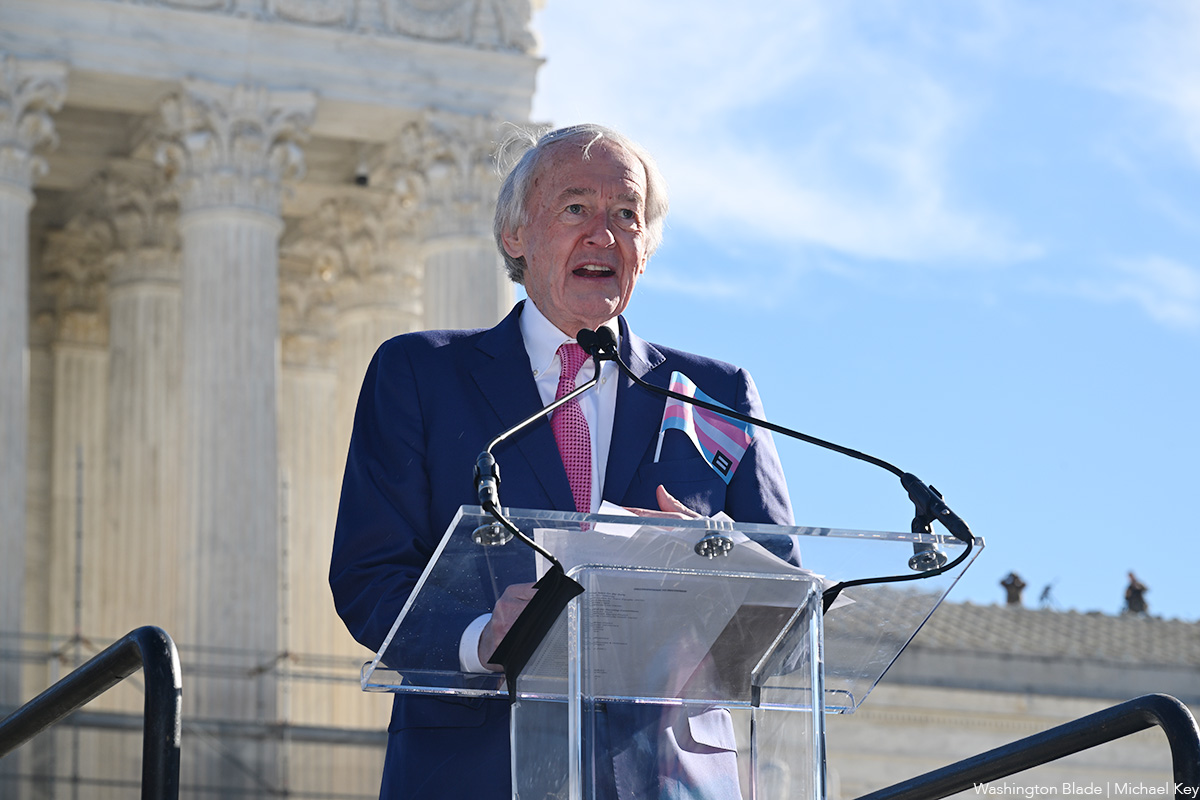
U.S. Sen. Ed Markey (D-Mass.) clinched the Democratic seat for his reelection campaign in Massachusetts’s primary election on Tuesday.
Markey won the deep-blue state with 64.8 percent of the vote, according to NBC News, triumphing over Marine Corps combat veteran and Congressman Seth Moulton, who received 35.2 percent of the vote.
Massachusetts’s primary election, which determined which Democratic candidate will head to the polls to face off against the Republican challenger in November, is being considered a victory for LGBTQ-inclusive policy, as well as for a divisive pro-transgender rights candidate — both things Markey has become an outspoken champion of.
Markey has experience at multiple levels of government, from the state level, where he served three terms in the state House of Representatives, to his federal tenure, including 20 terms in the U.S. House of Representatives and is now serving his second term as a senator. He has become a fixture of a changing Democratic Party in one of the most consistently blue places in the U.S.
This primary — and much of the national discussion surrounding the Senate seat — focused a lot of campaigning power on fighting the growing sentiment, led mostly by Republicans, that the frustration many Americans feel lends itself to an anti-establishment and anti-incumbent attitude.
Markey ran his campaign using his past as a reflection of his commitment to constantly putting his best foot forward for Bay Staters — particularly with apprehension for issues younger and more progressive democrats have been righting for — including Green New Deal and “Medicare for All” while Moulton — who was also elected to federal office prior to this run — campaigned on being younger than Markey, arguing that he was not the same type of established politician.
Moulton also faced backlash for negative comments about trans athletes, sparking criticism for those who did want younger candidate but want for trans rights to be protected.
Markey’s track record of supporting the LGBTQ community is one of the most clear in federal politics, one that has garnered a “100 percent lifetime voting record” on the Human Rights Campaign’s PAC politician review scorecard.
That list of Markey’s actions includes being a cosponsor of the Equality Act, driving landmark legislation to ensure federal protections for LGBTQ Americans, and being one of the most vocal proponents for trans rights in the federal government — specifically in multiple appropriations bills and in the National Defense Authorization Act. He was also the lead sponsor of the Transgender Health Care Access Act and the Transgender Bill of Rights resolution.
Markey first introduced the Transgender Bill of Rights in the Senate in 2023, where it ultimately failed to be brought to law. He reintroduced the legislation this year once again. This was a direct response to the attitude pushed by many conservatives after 2021, when the push to minimize trans rights started to become a key part of their cause and has been constantly propped up by the Trump-Vance administration.
“Massachusetts needs a senator who stands up and fights back, a senator who never forgets who they are fighting for,” Markey said during his victory speech. “That has been the mission of my life, and it always will be.”
Following the calling of the primary, a slew of LGBTQ organizations rallied behind Markey, many pushing his past as an asset that puts his money where his mouth is through advocating for legislation specifically protecting the LGBTQ community.
Tyler Hack, the executive director of the Christopher Street Project, an organization dedicated to pushing for legal protections for trans americans, released a statement following Markey’s win. Hack argued that putting forward such a staunchly pro-trans candidate is a win for the community, especially after endorsing him earlier this year.
“Tonight, anti-trans politics lost. Massachusetts rejected the idea that attacking transgender people is a shortcut to political power. Voters chose a different path: one where equality is not negotiable, cruelty is not courage, and transgender people do not have to disappear for Democrats to succeed.”
The Human Rights Campaign also endorsed him as a candidate earlier this year and issued a statement via its president, Kelley Robinson.
“Ed Markey has spent decades fighting for LGBTQ+ equality, for working people, and for a more livable world,” Robinson said. “He knows why equality matters. He’s stood with us no matter what. We were proud to endorse him this year, and when a pro-equality majority takes back the Senate this fall, we will continue to count on him as a champion for our community.”
Markey is running for reelection against Republican John Deaton in November, where he is expected to win.

‘Thelma and Louise’ remains landmark of unspoken queer rebellion

Comings & Goings

LGBTQ Military Happy Hour set for Sept. 15

Calendar: September 11-17

Multi-billion-dollar 9/11 Victim Compensation Fund to continue until 2090

Anti-science, anti-LGBTQ movements go hand in hand

Chris Pappas wins NH Democratic Senate primary

Md. groups receive state grants to fight hate crimes

Nominate your favorites for the Blade’s 25th annual Best Of LGBTQ DC Awards

PHOTOS: SUNFESTIVAL
-

 Commentary5 days ago
Anti-science, anti-LGBTQ movements go hand in hand
-
2026 Midterm Elections5 days ago
Chris Pappas wins NH Democratic Senate primary
-
Maryland4 days ago
Md. groups receive state grants to fight hate crimes
-
Arts & Entertainment4 days ago
Nominate your favorites for the Blade’s 25th annual Best Of LGBTQ DC Awards