Living
UAFA, ENDA introduction set for Thursday
Nadler, Merkley to take the lead on pro-gay legislation

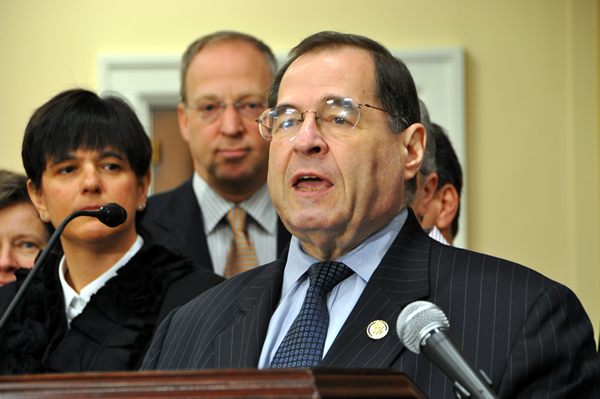
Rep. Jerrold Nadler is set to introduce UAFA in the House (Blade file photo by Michael Key)
Two key pieces of pro-LGBT legislation — the Uniting American Families Act and the Employment Non-Discrimination Act — are set for introduction in Congress on Thursday, according to an informed source.
An LGBT rights advocate, who spoke on condition of anonymity, said on Thursday Rep. Jerrold Nadler (D-N.Y.) would introduce UAFA in the House and Sen. Jeff Merkley (D-Ore.) would introduce ENDA in the Senate.
“It’s actually kind of a big gay week,” the advocate said. “We also have the civil unions bill in Delaware expected on Thursday and then Friday is the DOMA hearing. So it’s actually a pretty active week where our issues are concerned.”
Nadler’s office didn’t respond on short notice to respond to confirm that UAFA would see introduction in the House on Thursday. Last week, Ilan Kayatsky, a Nadler spokesperson, said the lawmaker would introduce the bill “shortly.”
As it was introduced in the 111th Congress, UAFA would enable gay Americans to sponsor their foreign partners for residency in the United States as straight Americans can do for their foreign spouses. Based on U.S. Census data from 2000, current immigration law threatens to tear apart 36,000 bi-national same-sex couples in the United States.
It wasn’t immediately clear if the House introduction of UAFA would be concurrent with the Senate introduction. In the 111th Congress, Sen. Patrick Leahy (D-Vt.) was the sponsor of UAFA.
Erica Chabot, a Leahy spokesperson, said her boss would again introduce the legislation in the 112th Congress, but added she doesn’t have a date for when that would happen.
“Sen. Leahy is committed to reintroducing UAFA, but I don’t have a date certain at this time,” she said.
On the same day Nadler is expected to introduce UAFA in the House, Merkley is expected to introduce ENDA in the Senate.
Julie Edwards, a Merkley spokesperson, said in response to a request to confirm whether the bill would be introduced Thursday that the legislation would be debut “soon” and she could say more later.
The Senate version of ENDA, according to Capitol Hill sources, is set to have Republican support immediately upon introduction from Sens. Susan Collins (R-Maine), Olympia Snowe (R-Maine) and Mirk Kirk (R-Ill.),
Kevin Kelley, a Collins spokesperson, said his boss and Kirk would be original co-sponsors along with Sen. Tom Harkin (D-Iowa), chair of the Senate Health, Education, Labor & Pensions Committee. But Kelley said he couldn’t confirm the date of introduction at this time.
Christian Berle, deputy executive director of Log Cabin Republicans, said Snowe would also be an original co-sponsor for ENDA. Snowe and Collins were both original co-sponsors in the 111th Congress.
“I just got confirmation from Sen. Snowe’s office that she will be an original co-sponsor of ENDA,” Berle said.
ENDA would bar job discrimination against LGBT people in most situations in the public and private workforce. Job discrimination on the basis of sexual orientation is legal in 29 states and legal in 38 states on the basis of gender identity.
Last week, gay Rep. Barney Frank (D-Mass.) introduced the House version of ENDA. As of Monday, the legislation had 117 co-sponsors. Frank has said Republican control of the House will prevent passage of ENDA during the 112th Congress.
UPDATE: On Wednesday, Chabot confirmed Leahy is set to introduce UAFA on Thursday in the Senate, which would be concurrent with the introduction of the bill in the House. She said she’d have information on co-sponsors upon introduction.







Valentine’s Day is often portrayed as a celebration of romantic love — flowers, chocolates, and candlelit dinners. But for many LGBTQ+ individuals and couples, Valentine’s Day can also be a moment to reflect on something deeper: the love that creates a safe, welcoming home.
For LGBTQ+ home buyers and sellers, homeownership is more than a financial milestone—it is an act of belonging, resilience, and pride. Owning a home can mean finally having a place where you can hold hands with your partner on the front porch, decorate with your authentic style, and build a life free from judgment. In this way, buying or selling a home is one of the most meaningful love stories many LGBTQ+ people will ever write.
This Valentine’s Day, whether you’re a first-time gay home buyer, a same-sex couple upgrading your space, or an LGBTQ+ seller moving on to your next chapter, it’s worth thinking about how love, identity, and real estate intersect—and how to navigate that journey with confidence, protection, and the right support.
Love, Identity, and the Meaning of ‘Home’
For generations, LGBTQ+ people were denied equal access to housing, homeownership, and legal protections. Even today, many LGBTQ+ home buyers still face subtle bias, uncomfortable interactions, or outright discrimination in the real estate process.
That’s why finding LGBTQ+ friendly real estate and an affirming gay friendly realtor or lesbian realtor matters so much. A home isn’t just a building—it’s a personal sanctuary. Working with LGBTQ+ real estate agents who understand your lived experience can make all the difference between a stressful transaction and a joyful one.
For over 30 years, GayRealEstate.com has been the leading gay real estate network, connecting LGBTQ+ home buyers and sellers with gay real estate agents, lesbian real estate agents, and LGBTQ+ friendly realtors who truly “get it.” Their mission has always been simple yet powerful: to ensure that every LGBTQ+ person has access to safe, respectful, and inclusive real estate services.
Finding Your Match: Choosing the Right LGBTQ+ Friendly Realtor
Much like dating, finding the right real estate agent is about compatibility, trust, and communication. Here are some key tips for choosing the best LGBTQ+ real estate representation:
- Look for experience with LGBTQ+ clients. Search for a gay realtor near me or lesbian realtor near me through GayRealEstate.com, where agents are vetted for cultural competency and community commitment.
- Ask about their experience with same-sex couple home buying. A strong agent should understand issues like joint ownership, legal protections, and financing considerations.
- Choose someone who listens. You should feel safe sharing your priorities—whether that includes proximity to LGBTQ+ nightlife, affirming schools, or lesbian-friendly neighborhoods.
- Prioritize respect and transparency. Your agent should advocate for you, not just push a quick sale.
The right gay friendly real estate agent isn’t just helping you buy a house—they’re helping you find a place to build your life.
Best Cities for LGBTQ+ Home Buyers
If love is your compass, location is your map. Some of the best cities for LGBTQ+ home buyers consistently offer strong community presence, legal protections, and welcoming neighborhoods:
- Wilton Manors, Florida – A hub for LGBTQ+ culture with thriving LGBTQ+ real estate opportunities
- Palm Springs, California – A long-standing LGBTQ+ retirement and second-home destination
- Provincetown, Massachusetts – Historic LGBTQ+ community with progressive housing protections
- Asheville, North Carolina – Growing market with inclusive real estate services
- Fort Lauderdale, Florida – Diverse, welcoming, and highly sought-after for LGBTQ+ home ownership
Working with GayRealEstate.com allows you to connect with local LGBTQ+ real estate experts who know these markets inside and out.
Navigating Legal Protections in LGBTQ+ Real Estate
Love is universal—but legal protections are not always consistent. Understanding your rights is essential when buying or selling a home as an LGBTQ+ person.
Key protections include:
- Fair Housing Act (FHA): Prohibits discrimination based on sex, which courts have increasingly interpreted to include sexual orientation and gender identity.
- State and local protections: Many cities and states offer additional safeguards against LGBTQ+ housing discrimination.
- Same-sex couple legal considerations: If you are married, joint ownership is typically straightforward. If not, consult an attorney about co-ownership agreements.
A knowledgeable LGBTQ+ friendly realtor from GayRealEstate.com can help guide you through these complexities and connect you with trusted legal professionals when needed.
Buying a Home as an LGBTQ+ Person: Practical Tips
If you’re embarking on your home-buying journey this Valentine’s season, here are smart, practical steps to take:
- Clarify your priorities. Do you want a vibrant LGBTQ+ neighborhood, quiet suburbs, or access to queer community spaces?
- Get pre-approved for a mortgage. This strengthens your position in competitive markets.
- Work with an LGBTQ+ real estate agent. Searching “finding a gay real estate agent” or “finding a lesbian real estate agent” through GayRealEstate.com is a great first step.
- Research inclusive communities. Some neighborhoods are more welcoming than others.
- Know your rights. If you experience bias, document it and seek legal guidance.
Buying a home is an act of self-love—and community love.
Selling a Home as an LGBTQ+ Person
Selling can be just as emotional as buying, especially if your home represents years of memories with your partner, friends, or chosen family.
When selling a home as an LGBTQ+ person, consider:
- Working with a gay friendly realtor who will market your home inclusively
- Highlighting LGBTQ+ community appeal in listings
- Being prepared for potential buyer bias (and knowing how to respond)
- Leaning on GayRealEstate.com’s LGBTQ+ real estate services for trusted guidance
Your story—and your home—deserve respect.
Real Estate for LGBTQ+ Families
More LGBTQ+ couples are raising children, fostering, or building blended families. This makes homeownership even more meaningful.
When searching for real estate for LGBTQ+ families, consider:
- LGBTQ+ affirming school districts
- Family-friendly queer communities
- Safe neighborhoods with inclusive values
- Access to LGBTQ+ resources and social networks
GayRealEstate.com specializes in helping LGBTQ+ families find homes that truly fit their lives.
Love, Pride, and Homeownership
At its core, Valentine’s Day is about connection. For LGBTQ+ people, homeownership can be one of the most profound expressions of love—love for yourself, your partner, your family, and your future.
Whether you are a first-time gay home buyer, a same-sex couple relocating, or an LGBTQ+ seller moving forward, you deserve an experience rooted in dignity, fairness, and celebration.
For over three decades, GayRealEstate.com has stood as the leading source for LGBTQ+ real estate, gay real estate, lesbian real estate, and LGBTQ+ home buying and selling representation. Their nationwide network of gay real estate agents, lesbian-friendly real estate agents, and LGBTQ+ friendly realtors ensures that your real estate journey is guided by professionals who understand your heart—and your home.
This Valentine’s Day, let your next chapter be written in a place where you can truly belong. Because when love leads the way, home is never far behind.
Scott Helms is president and owner of Gayrealestate.com.

Dear Michael,
I keep getting rejected on the apps. I don’t want to put myself out there anymore.
I don’t understand gay men. I think they behave really badly.
Guys stop replying in the middle of a text conversation and then un-match me. Guys don’t show up when we make a plan to meet. After a date or even a hookup that it seems clear we both enjoyed, I never hear from the guy again.
I am a pretty good looking and successful guy. I’m not a model or a billionaire but I’m sincerely wanting to date and eventually share a life with someone.
Unfortunately, everyone I am meeting, even if they say they have similar aspirations for a partner, acts like they’re looking over my shoulder for something better, and drops me for I-don’t-know-what reason.
I don’t have a lot of trust in the sincerity of gay men.
I know I sound bitter but I’ve been at this for a while and it keeps happening.
I know there’s a saying that if it keeps happening to you, you must be the problem. Logically that makes sense.
Except, I think this keeps happening so often and so predictably that it’s not me. These people hardly know me. It’s more along the lines of, if everything about me isn’t exactly what they want, or some little thing that I say, think, or do offends them, they vanish.
I’m lonely, but what’s out there is awful. Maybe it’s best to not keep trying.
If you have a different way of seeing it that’s honest, not just some fluff to make me feel better and be hopeful, please enlighten me.
Michael replies:
I agree with you, there is a lot of this kind of behavior out there. I hear stories similar to yours all the time. Though people do find great relationships online, relying on apps to meet a partner can be tricky.
Hookup apps have little to do with any kind of real connection. Often, they don’t even have much to do with sex. For a lot of people, they’re more about trying to fill up some kind of emptiness and seeking validation. They also, obviously, objectify men, which is the opposite experience of what you’re seeking.
And dating apps lend themselves to a sort of takeout menu concept of dating. You get to specify exactly what you’re looking for—a little of this, a lot of that, please omit something else—and then believe you should get what you ordered. As if that really exists. And when something isn’t just what you wanted, forget it.
But life doesn’t work that way. Nor do people: You can enter the exact criteria for the man of your dreams, but he will surprise you or let you down at times in some major ways. That’s how it goes. Part of being in a relationship is accepting that we all have to deal with imperfection.
All that said, hordes of people are going to keep using all sorts of apps and keep looking for “perfect” partners and keep ditching perfectly fine guys for the most minuscule of reasons.
But that doesn’t mean that you have to stay on the apps if it’s demoralizing you and leaving you hopeless.
Before you sign off, perhaps you would like to have some fun and be creative. Just for example, you could write in your profile that you’re interested in meeting a guy who isn’t looking for perfection and is looking for a decent soul rather than a set of stats. You still might encounter a lot of guys who ghost you for no apparent reason, but you also might have some luck finding a sincere someone with relationship goals that are similar to yours.
Another, complimentary strategy: Toughen up your attitude to stop letting let these rejections get under your skin. They have little to do with who you are (unless you are oblivious to some major issue about yourself), so you needn’t take them personally. In other words, expect this to keep happening; and when it does, laugh and keep moving forward.
I understand you are feeling like giving up on gay men in general. Keep in mind that while there are a lot of reasons why many gay men focus more on sex and less on commitment, that isn’t true across the board. In my work over the years, I have met many gay men who are looking for what you’re seeking. You could strive to be hopeful that if you keep looking, you are likely to cross paths with some of them.
And where you look may play a role.
Whether or not you stay on the apps, I suggest you seek additional ways to meet a potential boyfriend. Before apps existed, people did find other ways to meet romantic partners, and these ways do still exist. I know that this path is not an easy one. The whole dating endeavor isn’t easy. But difficult is not impossible.
There are social and activity groups for gay men that are organized around some sort of shared interest. They aren’t overtly sexual, so often attract people who are interested in and looking for a deeper connection. Even if you don’t meet a boyfriend there, you might make some like-minded friends, and one thing may lead to another in all sorts of ways.
There’s also plenty you can do as a human being (not simply as a gay man) in the offline world that might interest and even uplift you, where you just might meet a man you like. Again, you might also simply make some friends, and through having a bigger social life, might ultimately meet your guy.
Simply put: Don’t let yourself feel like or be a victim. Don’t keep putting yourself in miserable situations. And figure out what it means for you to do your best to make what you’d like to happen, happen.
Michael Radkowsky, Psy.D. is a licensed psychologist who works with couples and individuals in D.C., Maryland, Virginia, and New York. He can be found at michaelradkowsky.com. All identifying information has been changed for reasons of confidentiality. Have a question? Send it to [email protected].
Real Estate
New year, new housing landscape for D.C. landlords
Several developments expected to influence how rental housing operates

As 2026 begins, Washington, D.C.’s rental housing landscape continues to evolve in ways that matter to small landlords, tenants, and the communities they serve. At the center of many of these conversations is the Small Multifamily & Rental Owners Association (SMOA), a D.C.–based organization that advocates for small property owners and the preservation of the city’s naturally occurring affordable housing.
At their December “DC Housing Policy Summit,” city officials, housing researchers, lenders, attorneys, and housing providers gathered to discuss the policies and proposals shaping the future of rental housing in the District. The topics ranged from recent legislative changes to emerging ballot initiatives and understanding how today’s policy decisions will affect housing stability tomorrow.
Why Housing Policy Matters in 2026
If you are a landlord or a tenant, several developments now underway in D.C., are expected to influence how rental housing operates in the years ahead.
One of the most significant developments is the Rebalancing Expectations for Neighbors, Tenants and Landlords (RENTAL) Act of 2025, a sweeping piece of legislation passed last fall and effective December 31, 2025, which updates a range of housing laws. This broad housing reform law will modernize housing regulations and address long-standing court backlogs, and in a practical manner, assist landlords with shortened notice and filing requirements for lawsuits. The Act introduces changes to eviction procedures, adjusts pre-filing notice timelines, and modifies certain tenant protections under previous legislation, the Tenant Opportunity to Purchase Act.
At the same time, the District has expanded its Rent Registry, to have a better overview of licensed rental units in the city with updated technology that tracks rental units subject to and exempt from rent control and other related housing information. Designed to improve transparency and enforcement, Rent Registry makes it easier for all parties to verify rent control status and compliance.
Looking ahead to the 2026 election cycle, a proposed ballot initiative for a two-year rent freeze is generating significant conversation. If it qualifies for the ballot and is approved by voters, the measure would pause rent increases across the District for two years. While still in the proposal phase, it reflects the broader focus on tenant affordability that continues to shape housing policy debates.
What This Means for Rental Owners
Taken together, these changes underscore how closely policy and day-to-day operations are connected for small landlords. Staying informed about notice requirements, registration obligations, and evolving regulations isn’t just a legal necessity. It’s a key part of maintaining stable, compliant rental properties.
With discussions underway about rent stabilization, voucher policies, and potential rent freezes, long-term revenue projections will be influenced by regulatory shifts just as much as market conditions alone. Financial and strategic planning becomes even more important to protect your interests.
Preparing for the Changes
As the owner of a property management company here in the District, I’ve spent much of the past year thinking about how these changes translate from legislation into real-world operations.
The first priority has been updating our eviction and compliance workflows to align with the RENTAL Act of 2025. That means revising how delinquent rent cases are handled, adjusting notice procedures, and helping owners understand how revised timelines and court processes may affect the cost, timing, and strategy behind enforcement decisions.
Just as important, we’re shifting toward earlier, more proactive communication around compliance and regulatory risk. Rather than reacting after policies take effect, we’re working to flag potential exposure in advance, so owners can make informed decisions before small issues become costly problems.
A Bigger Picture for 2026
Housing policy in Washington, D.C., has always reflected the city’s values from protecting tenants to preserving affordability in rapidly changing neighborhoods. As those policies continue to evolve, the challenge will be finding the right balance between stability for renters and sustainability for the small property owners who provide much of the city’s housing.
The conversations happening now at policy summits, in Council chambers, and across neighborhood communities will shape how rental housing is regulated. For landlords, tenants, and legislators alike, 2026 represents an opportunity to engage thoughtfully, to ask hard questions, and to create a future where compliance, fairness, and long-term stability go hand-in-hand.

European Parliament resolution backs ‘full recognition of trans women as women’

Deon Jones speaks about D.C. Department of Corrections bias lawsuit settlement

Home is where the heart is

‘Heated Rivalry’ fandom exposes LGBTQ divide in Baltimore

Magic is happening for Round House’s out stage manager

McPike wins special election for Va. House of Delegates

Shooter who killed 7 people inside Canada school was transgender

Just when you think Trump can’t sink any lower, he does

Russia’s anti-LGBTQ crackdown takes absurd turn