Arts & Entertainment
‘Tis the season
DC Center, HRC and Victory Fund plan fall galas in coming days
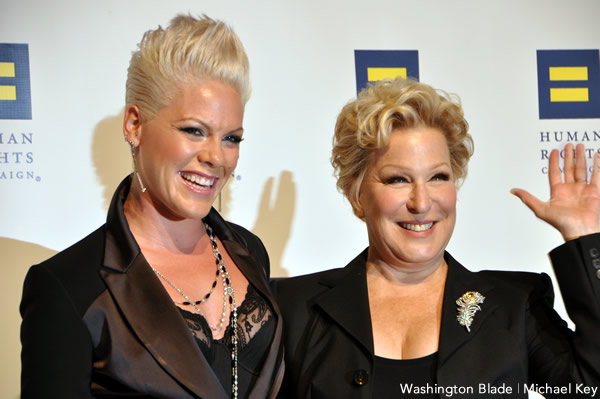
Pink, left, and Bette Midler at last year's HRC dinner. (Blade file photo by Michael Key)
This week’s social and political scene is busy with three events coming up honoring a diverse group of people.
The D.C. Center is having its annual fall reception tonight from 7 to 9 p.m. at the Sofitel (806 15th St., N.W.). The reception will serve to reflect on the Center’s work over the past year as well as honor those who have made outstanding contributions to the LGBT community. This year’s honorees are Rick Rosendall, Sheila Alexander-Reid, Frank Kameny and Earline Budd.
“This is a larger event than we’ve done in the past,” said David Mariner, the Center’s director. “It’s the first time we’ve done the event in a hotel …we’re going as an organization and that makes sense.”
Mariner thinks the event will be even bigger next year, as it will be the Center’s 10th anniversary. Tickets are $75 for individuals, $200 for host committee and $45 for students and seniors. For more information and to purchase tickets, visit thedccenter.org.
HRC holds its 15th annual national dinner at the Washington Convention Center on Saturday night.
President Barack Obama will make his second appearance as president at the Human Rights Campaign dinner, and will deliver the keynote address. New York City Mayor Michael Bloomberg will be presented with the National Ally for Equality Award for his advocacy on marriage equality in New York State.
“This has been a remarkable year in the fight for LGBT equality,” said HRC President Joe Solmonese. “We’re thrilled to be joined by national leaders and inspiring artists as we celebrate our victories and redouble our efforts for the fights that remain ahead.”
Rep. Tammy Baldwin (D-Wis.), who is running for the U.S. Senate, will also be a featured speaker.
Entertainment will be provided by Cyndi Lauper and Greyson Chance, who is the first artist to be signed to Ellen DeGeneres’ record label, eleveneleven. Pop singer Mika will also give a full concert for the event’s after-party. For more information, visit hrcnationaldinner.org.
And the Victory Fund’s 11th annual Gay and Lesbian Leadership Awards are Wednesday at 101 Constitution Rooftop (101 Constitution Ave., N.W.). This year’s honorees are Sen. Susan Collins (R-Maine), who was at the center of the fight to repeal “Don’t Ask, Don’t Tell,” and Rep. Keith Ellison (D-Minn.), vice-chair of the House LGBT Equality Caucus.
“Just as we need more openly LGBT members of Congress who can speak authentically about their lives, we also need more straight allies who see the value in removing barriers for LGBT Americans,” said Denis Dison, vice president of communications. “Lawmakers like Sen. Collins and Congressman Ellison deserve to be recognized for standing up and speaking out for a freer and fairer country.”
The event begins with a VIP reception starting at 6 p.m. and the program beginning at 6:30 p.m. Individual tickets are $150 and can be purchased online at victoryfund.org.






The weekly drag show “Daddy Issues” was held at Kiki on Wednesday, Aug. 5. Performers included Evry Pleasure, Indiana Bones and Tiara Missou-Sidora.
(Washington Blade photos by Landon Shackelford)


Books
Something’s off about Dad. When is it time to step in?
‘When Memory Fades’ can help when families face dementia

‘When Memory Fades’
By Nathaniel Chin, MD
c.2026, St. Martin’s Essentials
$30/422 pages
Mom called you in a panic the other day.
She’d lost her keys and by the time you arrived to help, she’d found them. In the refrigerator.
These kinds of things keep happening, not often but often enough, and you don’t know quite what to worry about. But in the new book “When Memory Fades” by Nathaniel Chin, MD, you’ll learn about the journey ahead, for both of you.
You can’t remember why you walked into a room. You got lost last week, going to the bank. Popular wisdom says that things like that are normal as we age, but Chin says that’s not true – although the answer may not be a worst-case scenario, either. Yes, memory problems could just be signs of stress, dehydration, or lack of sleep – or is it time to see a doctor?
Chin says maybe, yes.
He was working his way through medical residency when his father, a geriatrician in Madison, Wisc., was diagnosed with Alzheimer’s. Chin, now a geriatrician, was blindsided, but that diagnosis also changed his life.
Here, he writes about the brain, and how Alzheimer’s and dementia are diagnosed, explaining that dementia has many faces and, depending on a doctor’s evaluation, memory problems might be slowed or improved. He shares his father’s illness with readers, but he also writes about his mother, a steadfast, steady caretaker.
Her story reminds reader-guardians to care for themselves, too.
Know how to talk the talk, so that you can have “a more productive” conversation with your doctor. Understand that there’s nothing “normal” about dementia or Alzheimer’s. Know the statistics – African Americans are affected with dementia twice as much as whites – and know how to lower your risks. Learn here what questions to ask, how to break the news to everyone, and any legal matters that will be important soon. And know how to tend to you.
Says Chin, “The best action you can take is to educate yourself… The more you understand, the better equipped you are to make sound judgments.”
Something’s off about Dad, just a lot of little things that don’t add up. When is it time to step in? “When Memory Fades” can help you decide.
Wise, wide-spread, comprehensive, and compassionately helpful, this is a book you can read and then take it to the doctor with your loved one. It’s a book that makes sense when nothing else does, and its biggest feature is that it smoothly transitions from easy-to-grasp science and charts, to gentle coaching for caregivers. Author Nathaniel Chin, MD writes with storytelling, humility, grace, and experience from both sides of the Alzheimer’s/dementia issue, and his words are reassuring but also urgent. Learn, but don’t wait, he says. Know how to safeguard yourself. See your doctor, and don’t fear testing. Watch for signs of depression. And never, ever stop asking for help.
Read those last seven words, and find “When Memory Fades” now. It’s a book to have on your shelf, whether you’re 45 or 95 because, as you’ll see, dementia happens and knowledge is key.
Books
New book chronicles gay man’s life in hippie commune
Vietnam War-era tale a serious, sexy, joyous memoir
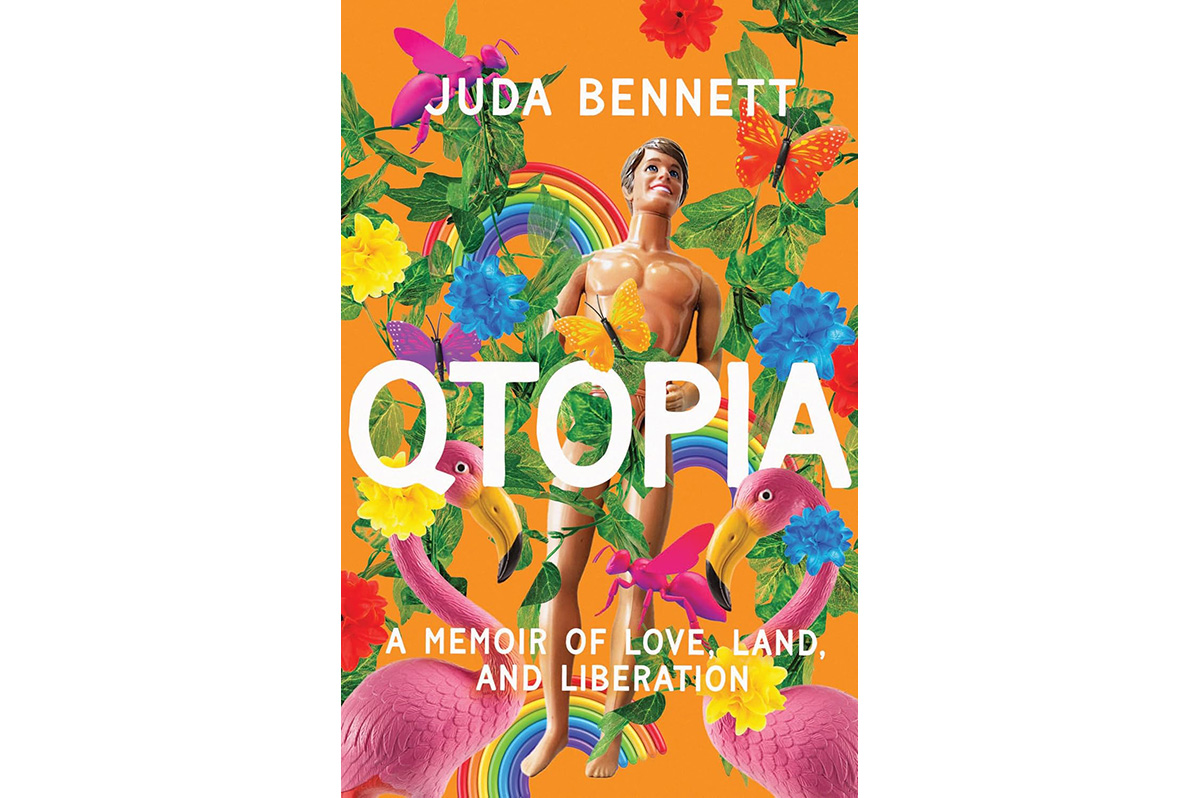
‘Qtopia: A Memoir of Love, Land and Liberation’
2026, University of Wisconsin Press
By Juda Bennett
Duffel packed, the new high school graduate could not fall asleep. “On the night before my departure, I stared at the duffel bag as if it were a body bag. We lived close to Dover, where the dead from Vietnam were shipped.”
It is 1971, and Charles was leaving home to join a hippie commune in rural Virginia. “I kept imagining bodies fitting into the bag and popping out in the middle of the night,” Juda Bennett writes in his memoir, “Qtopia: A Memoir of Love, Land and Liberation.” During Bennett’s high school years from 1968-1971 some 35,000 U.S. soldiers were killed in the Vietnam War, the vast majority processed at Dover Air Force Base.
Young Bennett was clueless about what lay ahead but he had a commune’s brochure in his pocket, certain his destiny was not in the military. “My father was a walking recruitment center, and my mother could have worked for the USO. Uncle Sam and the Andrews Sisters had nothing on them.” Inspired to find his way out of suburban Wilmington, Del., he boarded a Greyhound bus to Lexington, Va., and communes yet unknown. “Qtopia” is a serious, sexy and joyous memoir about a young man who knows he’s different in search of chosen family and, over coming decades, his own queer Utopia.
“We are leaving; you don’t need us,” was the popular refrain in the day from the Crosby, Stills & Nash song “Wooden Ships.” Communards like young Charles (going by the moniker C.B. with a full beard covering his handsome, androgynous features) were living it. How far this is from urban queer stories of the ‘70s. For this reason alone, it is marvelous reading about hot naked hippies farming together in the country, living and loving in secluded teepees when everything seemed possible. Novels like “Drop City” by T.C. Boyle (2003) and “Arcadia” (2012) by Lauren Groff set in hippie communes had no gay characters, only free-love for straights. When C.B.’s parents arrive to visit his back-to-the-land commune North Mountain bearing gifts like the orange powder Tang and Frosted Flakes, he “maintained” as the saying went. “It was a great time for visitors to see how hard we had worked—fields of sorghum swaying in the breeze, acres of vegetables in neat rows with beans, tomatoes and peppers hanging down….I was still thin as a matchstick, but I was a strong and muscular matchstick,” he tells the story of his development. By contrast, he had considered suicide before leaving home; this memoir fills in the pain, too.
There are times when C.B.’s voice as a teen communard with a secret is so authentic and rich, it is like reading fictional stories of American innocents on journeys of their own like J.D. Salinger’s character Holden Caulfield or Demon Copperhead from rural Virginia by Barbara Kingsolver. He tells us there was this guy Mark at North Mountain who had been pressuring him to sleep on the mattress next to his. C.B. was known as the only gay at North Mountain. One of the hippie women warned him Mark is “a square, the biggest downer.” Stepping out of the memoir, C.B. directly addresses the reader about the Mark issue, “I don’t want to write about Mark anymore because he’s not important to my story, and I didn’t even like him.” Got it. Hitchhiking with C.B. is like that, too.
“I got my best ride of the whole hike from a truck driver named TJ….If an eighteen wheeler…is willing to stop for you, it is because the driver wants something from you…I will forever remember this trucker as the most beautiful man I could have had sex with if I weren’t so innocent.”
North Mountain required the hippies work one week a month in Richmond to earn cash for the commune. For C.B., this translated into seven communards living in one small apartment on this cultish mission. It was in a Richmond park where he meets a stranger who would sexually abuse him over a month until C.B. ends it. Furious, the man threatens to shut down the commune if he does not obey. In a state of panic, C.B. attempts suicide by overdosing on every pill he can get his hands on. The memoir takes the reader through the author’s horror by deepening the shadows. What was the specific nature of the abuse? How did this stranger have credible power to threaten the commune? Entitled “What It’s Like to Die,” the chapter is a skillfully told, expressionistic turning point from an innocent’s hell to salvation at the intentional queer Lavender Hill commune in Central New York. C.B. desperately needed to “find my people.”
He’s a resilient young man after living in three communes by the time he hit San Francisco. His two gay neighbors on Ashbury Street—Crow and Moonsnake—pressure him to get a new “hippie name.” Walking home from Golden Gate Park he zeroes in on a passing streetcar, “North Judah.” Goodbye “Charles,” Judah will be his new hippie name. Crow and Moonsnake, approve: “If that’s what the Universe called out to you.” If you remember the Sixties…
“Too often,” Bennett writes, “we think of dropouts as withdrawing from life, but in truth, I think they are in a heightened state of seeking their rightful path and purpose. Nothing stays the same.” Juda Bennett remains a believer to this day, “Always putting my faith in my journey to Utopia”.
(Charles Francis is president of the Mattachine Society of Washington, D.C., and author of “Archive Activism: Memoir of a ‘Uniquely Nasty’ Journey.”)

PHOTOS: Daddy Issues at Kiki

Something’s off about Dad. When is it time to step in?

New book chronicles gay man’s life in hippie commune

HRC condemns DoE removal of LGBTQ bullying data from federal survey

Dutch PM: More needs to be done to defend trans rights

My evening with Madonna

Buttigieg indicates he may run for president in 2028

Remembering Elliot Leonard, generous visionary who helped LGBTQ communities thrive

Dutch prime minister opens World Pride Human Rights Conference

Progressives score victory as El-Sayed wins Mich. Senate primary
-

 Celebrity News4 days ago
My evening with Madonna
-
Politics4 days ago
Buttigieg indicates he may run for president in 2028
-
Obituary4 days ago
Remembering Elliot Leonard, generous visionary who helped LGBTQ communities thrive
-
Netherlands3 days ago
Dutch prime minister opens World Pride Human Rights Conference