National
Romney, Santorum show new strength in Iowa polls
Controversy surrounds Paul’s newsletters and endorsement from anti-gay pastor
[Editor’s Note: The Washington Blade will have this reporter in Des Moines, Iowa, next week monitoring activity on the ground prior to the caucuses as well as their results.]
Two GOP presidential contenders are experiencing new strength in the polls just days before the Iowa caucuses as new concerns emerge about another candidate’s anti-gay connections and past.
Recent polls show former Massachusetts Gov. Mitt Romney slightly ahead of other candidates in Iowa — where on Jan. 3 the GOP will hold the nation’s first contest for who’ll win the Republican nomination — as former U.S. Sen. Rick Santorum has also risen to become a major candidate in the contest.
According to a NBC/Marist poll published Friday, Romney is virtually tied for support with Rep. Ron Paul (R-Texas) among likely Republican caucus-goers in Iowa. The poll revealed that Romney has support from 23 percent of respondents while Paul has support from 21 percent.
MORE IN THE BLADE: ROMNEY EDGES SANTORUM TO WIN IOWA CAUCUS
Meanwhile, Santorum has risen to third place in Iowa while Gingrich has plummeted after enjoying a commanding lead. The former senator has support from 20 percent of respondents, followed by Texas Gov. Rick Perry at 14 percent and Gingrich at 13 percent.
Gingrich, who until recently was the front-runner in the polls, has fallen after his opponents have attacked for his decisions over the course of this more than 30-year-long political career.
Criticism have been based on his admitted martial infidelities and the $1.6 million he received in consulting fees he received from Freddie Mac, a government-sponsored secondary home mortgage company whose activities some say contributed to the financial crisis of 2008.
Dan Pinello, a gay political science professor at the City University of New York, accounted for Romney’s modest new lead as conservatives coming to terms with the stronger prospects of the former Massachusetts governor winning in the general election.
“A lot of conservatives are finally realizing that they don’t have a viable alternative to Romney, and some of them are just holding their nose and going with him as the best alternative to someone they dislike even more, and that’s Barack Obama,” Pinello said.
Pinello added Romney’s rise in Iowa also could be because a win for Paul — who has significantly less of a chance of winning the Republican nomination or the general election — would have the effect of diminish the caucuses’ importance in the presidential primaries.
“Iowa Republicans have had heard their leadership’s cry that they’ve got to maintain the salience of the Iowa caucus system for the long haul, and choosing someone like Ron Paul doesn’t achieve that,” Pinello said.
As for Santorum — who’s known for being a social conservative and holding anti-gay views — Pinello said the candidate’s new strength is the anti-Romney crowd “scraping the bottom of the barrel” now that Gingrich has become a more unpopular candidate.
“They’ve gone with everyone else, and all those others have never panned out for the long haul,” Pinello said. “And so, [Santorum] is what’s left; he’s the consolation prize it seems in a sense.”
Just last week, anti-gay leader Bob Vander Plaats, CEO of FAMiLY LEADER, threw his personal support behind Santorum in the election, so the candidate’s rise could be the result of that support. ABC News later reported that Vander Plaats solicited money for the endorsement, although the Santorum campaign denied that any agreement was made about money.
Pinello declined to make prediction on who’ll win the Iowa caucuses because of the rapid change of the candidates’ positions in the polls, but said the outcome probably won’t have much bearing on who’ll win the Republican nomination.
“Over the past 40 years, Iowa has only accurately predicted the GOP nominee twice in five contests where there was no incumbent president running on the Republican side,” Pinello said. “That’s not a very good track record.”
Former Arkansas Gov. Mike Huckabee won the Iowa caucuses in 2008 with 35 percent of the vote while Sen. John McCain (R-Ariz.) came in forth. The nomination went to Sen. John McCain (R-Ariz.).
Pinello said the outcome of the Iowa caucuses would only make a difference the race to win the Republican presidential nomination if Romney emerged as the victor.
“If, in fact, Romney is in first place after everything is over next Tuesday, that would be, I think, significant because it would show that it doesn’t seem to be a really truly viable two-person race after the initial contest,” Pinello said.
Paul’s anti-gay ties under scrutiny
As the Republican candidates continue to rise and fall in the polls, Paul’s record has come under increasing scrutiny because of anti-gay ties and statements found in the newsletters he once published.
The newsletters, which were published under various titles in the 1970s, 1980s and 1990s, describe AIDS as a disease wrought by gays for sexual misbehavior. The newsletters also contain many racially charged and anti-Semitic statements.
Among the gay-related content of the newsletters:
* If you heard a certain behavior of yours caused a deadly disease, wouldn’t you immediately cease and desist?
* Well, gays in San Francisco do not obey the dictates of good sense. They have stopped practicing “safe sex.”
* The rate of AIDS infection is on the increase again. From the gay point of view, the reasons seem quite sensible.
* They are not married, they have no children, and their lives on centered on new sexual partners.
* They enjoy the attention and pity that comes with being sick.
* Put it all together, and you’ve got another wave of AIDS infections, that you, dear taxpayer, will be asked to pay for.
In a radio interview Thursday with WHO Radio in Des Moines, Paul disavowed the content of the letters, saying he had limited input on the content of the letters beyond the economic pieces. The candidate said controversy over the letters hasn’t harmed his campaign.
“It wasn’t a reflection of my views at all…I think it was terrible,” Paul reportedly said. “It was tragic, and I had some responsibility for it, because the name went out in my letter. But I was not an editor. I (was) like a publisher.”
Christian Berle, deputy executive director of the National Log Cabin Republicans, said Paul’s distancing of himself from the newsletters was “appropriate” because the anti-gay statements contained within them are “outside of the mainstream.”
“When looking at Paul as a candidate it is important to look at his focus on small, limited government which positions himself with many LGBT Americans, who are looking to succeed without Washington, telling them what to do,” Berle said.
Berle noted Paul twice voted against the Federal Marriage Amendment and in favor of measures to repeal “Don’t Ask, Don’t Tell” in accordance with libertarian views.
“That libertarian message is one that is resonating in Iowa and across the country,” Berle concluded.
Meanwhile, a recent Paul endorsement from Rev. Phillip Kayser, pastor of Dominion Covenant Church in Omaha, Neb., has also been controversial. The religious leader is known for holding anti-gay views and gone so far as to state the death penalty should be imposed upon gays for homosexual acts.
Kayser makes the case for imposing biblical law in a 2009 publication titled “Is the Death Penalty Just?” and contends that gays should be subject to the death penalty to deter their behavior.
“Difficulty in implementing Biblical law does not make non-Biblical penology just,” he says. “But as we have seen, while many homosexuals would be executed, the threat of capital punishment can be restorative. Biblical law would recognize as a matter of justice that even if this law could be enforced today, homosexuals could not be prosecuted for something that was done before.”
According to Talking Points Memo, Kayser confirmed by phone that he still favors instating biblical punishments for gays — although he doesn’t anticipate the punishment being put in place anytime soon.
The Paul campaign touted the endorsement in a statement, although the response to the pastor’s support has apparently been removed from Paul’s web site.
“We welcome Rev. Kayser’s endorsement and the enlightening statements he makes on how Ron Paul’s approach to government is consistent with Christian beliefs,” said Ron Paul 2012 Iowa Chairman Drew Ivers. “We’re thankful for the thoughtfulness with which he makes his endorsement and hope his endorsement and others like it make a strong top-three showing in the caucus more likely.”
Jerame Davis, interim executive director of the National Stonewall Democrats, said the newsletters and endorsement demonstrate that Paul “has never been a friend to the LGBT community.
“He has a long history of close association with racist, anti-Semitic, and homophobic language,” Davis said. “A new endorsement or yet another revelation doesn’t really change a whole lot.”



Federal Government
Two very different views of the State of the Union
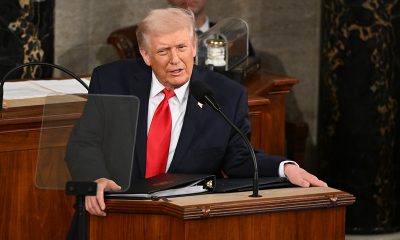
As Trump delivered his SOTU address inside the Capitol, Democratic lawmakers gathered outside in protest, condemning the administration’s harmful policies.
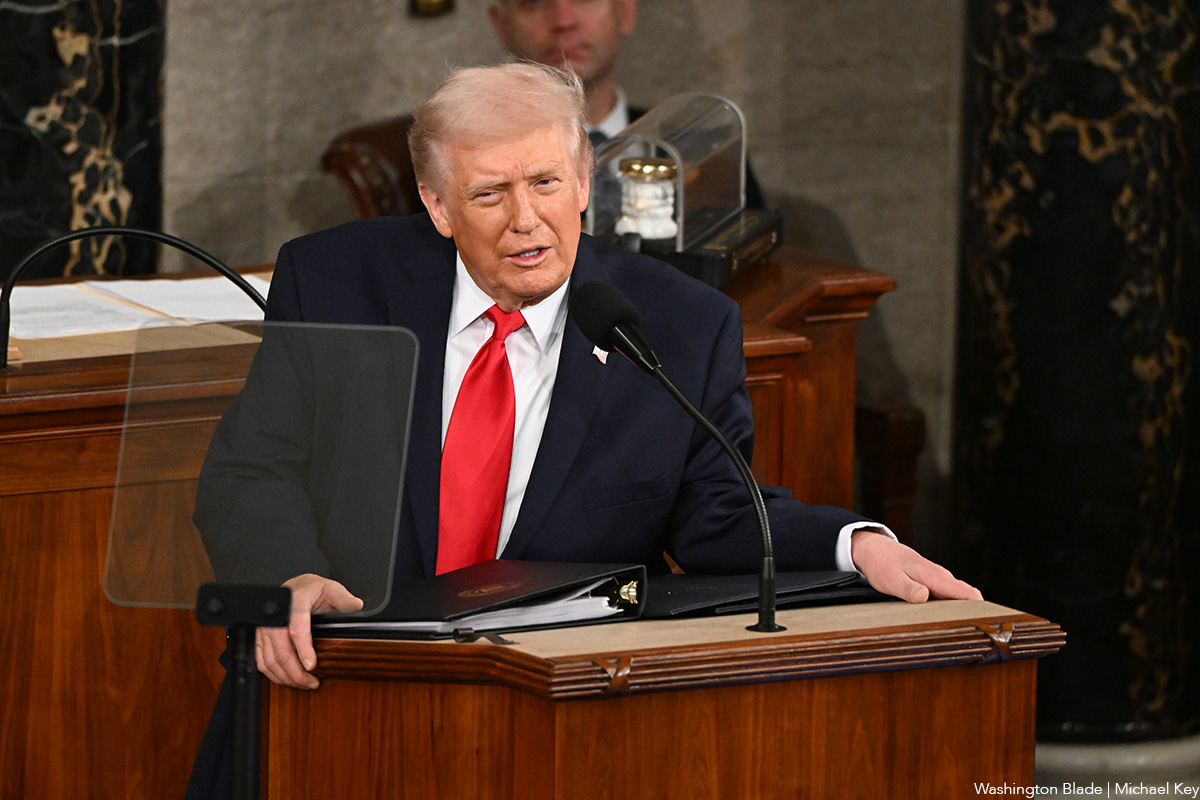
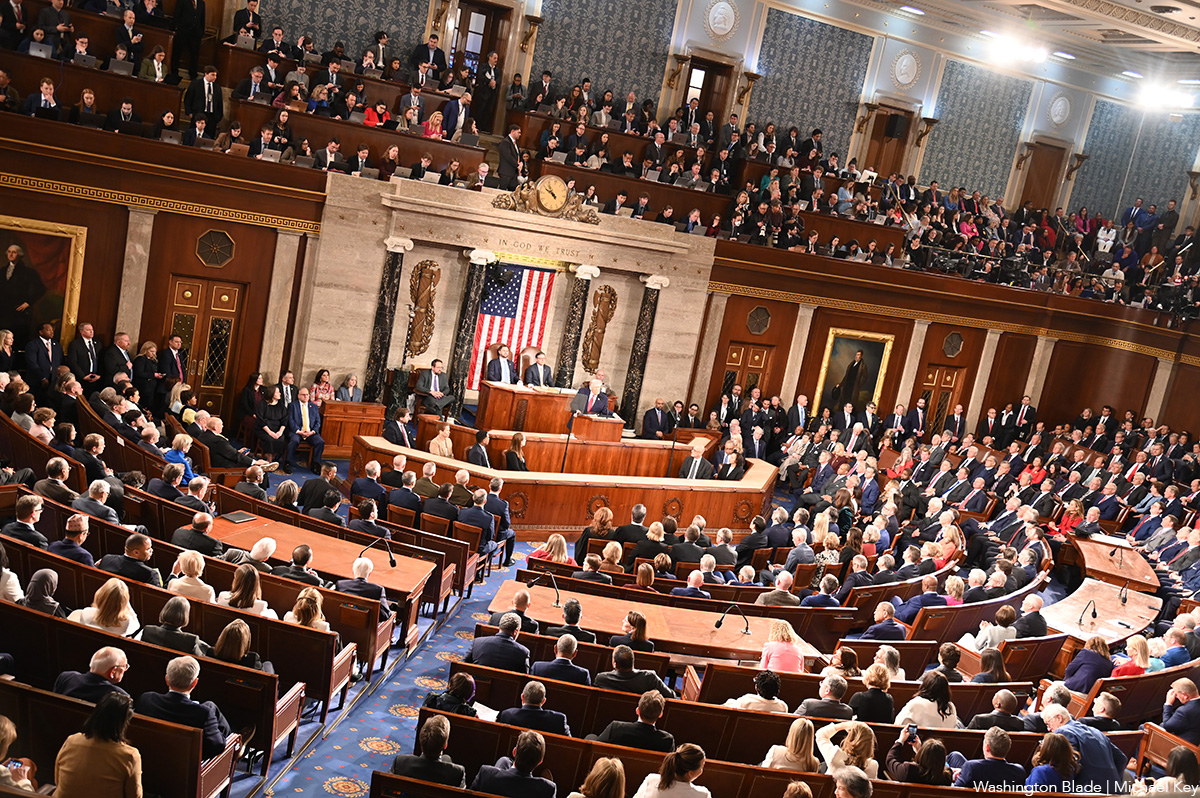
As President Donald Trump delivered his State of the Union address inside the U.S. Capitol — touting his achievements and targeting political enemies — progressive members of Congress gathered just outside in protest.
Their message was blunt: For many Americans, particularly LGBTQ people, the country is not better off.
Each year, as required by Article II, Section 3 of the Constitution, the president must “give to the Congress Information of the State of the Union.” The annual address is meant to outline accomplishments and preview the year ahead. This year, Trump delivered the longest State of the Union in U.S. history, clocking in at one hour and 48 minutes. He spoke about immigration, his “law and order” domestic agenda, his “peace through strength” foreign policy doctrine, and what he framed as the left’s ‘culture wars’ — especially those involving transgender youth and Christian values.
But one year into what he has called the “Trump 2.0” era, the picture painted outside the Capitol stood in stark contrast to the one described inside.
Transgender youth
In one of the most pointed moments of his speech, Trump spotlighted Sage Blair, using her story to portray gender-affirming care as coercive and dangerous. Framing the issue as one of parental rights and government overreach, he told lawmakers and viewers:
“In the gallery tonight are Sage Blair and her mother, Michelle. In 2021, Sage was 14 when school officials in Virginia sought to socially transition her to a new gender, treating her as a boy and hiding it from her parents. Hard to believe, isn’t it? Before long, a confused Sage ran away from home.
“After she was found in a horrific situation in Maryland, a left-wing judge refused to return Sage to her parents because they did not immediately state that their daughter was their son. Sage was thrown into an all-boys state home and suffered terribly for a long time. But today, all of that is behind them because Sage is a proud and wonderful young woman with a full ride scholarship to Liberty University.
“Sage and Michelle, please stand up. And thank you for your great bravery and who can believe that we’re even speaking about things like this. Fifteen years ago, if somebody was up here and said that, they’d say, what’s wrong with him? But now we have to say it because it’s going on all over, numerous states, without even telling the parents.
“But surely, we can all agree no state can be allowed to rip children from their parents’ arms and transition them to a new gender against the parents’ will. Who would believe that we’ve been talking about that? We must ban it and we must ban it immediately. Look, nobody stands up. These people are crazy. I’m telling you, they’re crazy.”
The story, presented as encapsulation of a national crisis, became the foundation for Trump’s renewed call to ban gender-affirming care. LGBTQ advocates — and those familiar with Blair’s story — argue that the situation was far more complex than described and that using a single anecdote to justify sweeping federal restrictions places transgender people, particularly youth, at greater risk.
Equality Virginia said the president’s remarks were part of a broader effort to strip transgender Americans of access to care. In a statement to the Blade, the group said:
“Tonight, the president is choosing to double down on efforts to disrupt access to evidence-based, lifesaving care.
“Rather than allowing families and doctors to navigate deeply personal medical decisions free from federal interference — or allowing schools to respond with nuance and compassion without putting marginalized children at risk — the president is instead advocating for reckless, one-size-fits-all political control.
“At a time when Virginians are worried about rising costs, economic uncertainty, and aggressive immigration enforcement actions disrupting communities and families, attacking transgender young people is a blatant political distraction from the real challenges facing our nation. Virginia families and health care providers do not need Donald Trump telling them what care they do or do not need.”
For many in the LGBTQ community, the rhetoric inside the chamber echoed actions already taken by the administration.
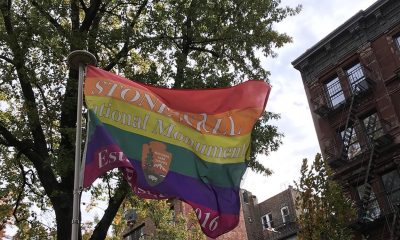
Earlier this month, the Pride flag was removed from the Stonewall National Monument under a National Park Service directive that came from the top. Community members returned to the site, raised the flag again, and filed suit, arguing the removal violated federal law. To advocates, the move was symbolic — a signal that even the legacy of LGBTQ resistance was not immune.
Immigration and fear
Immigration dominated both events as well.
Inside the chamber, Trump boasted about the hundreds of thousands of immigrants detained in makeshift facilities. Outside, Democratic lawmakers described those same facilities as concentration camps and detailed what they characterized as the human toll of the administration’s enforcement policies.
Sen. Ed Markey (D-Mass.), speaking to the crowd, painted a grim picture of communities living in fear:
“People are vanishing into thin air. Quiet mornings are punctuated by jarring violence. Students are assaulted by ICE agents sitting outside the high school, hard working residents are torn from their vehicles in front of their children. Families, hopelessly search for signs of their loved ones who have stopped answering their phones, stop replying to text… This is un-American, it is illegal, it is unconstitutional, and the people are going to rise up and fight for Gladys Vega and all of those poor people who today need to know that the people’s State of the Union is the beginning of a long fight that is going to result in the end of Republican control of the House of Representatives and the Senate in the United States of America in 2026.”
Speakers emphasized that LGBTQ immigrants are often especially vulnerable — fleeing persecution abroad only to face detention and uncertainty in the United States. For them, the immigration crackdown and the attacks on transgender health care are not separate battles but intertwined fronts in a broader cultural and political war.
Queer leadership
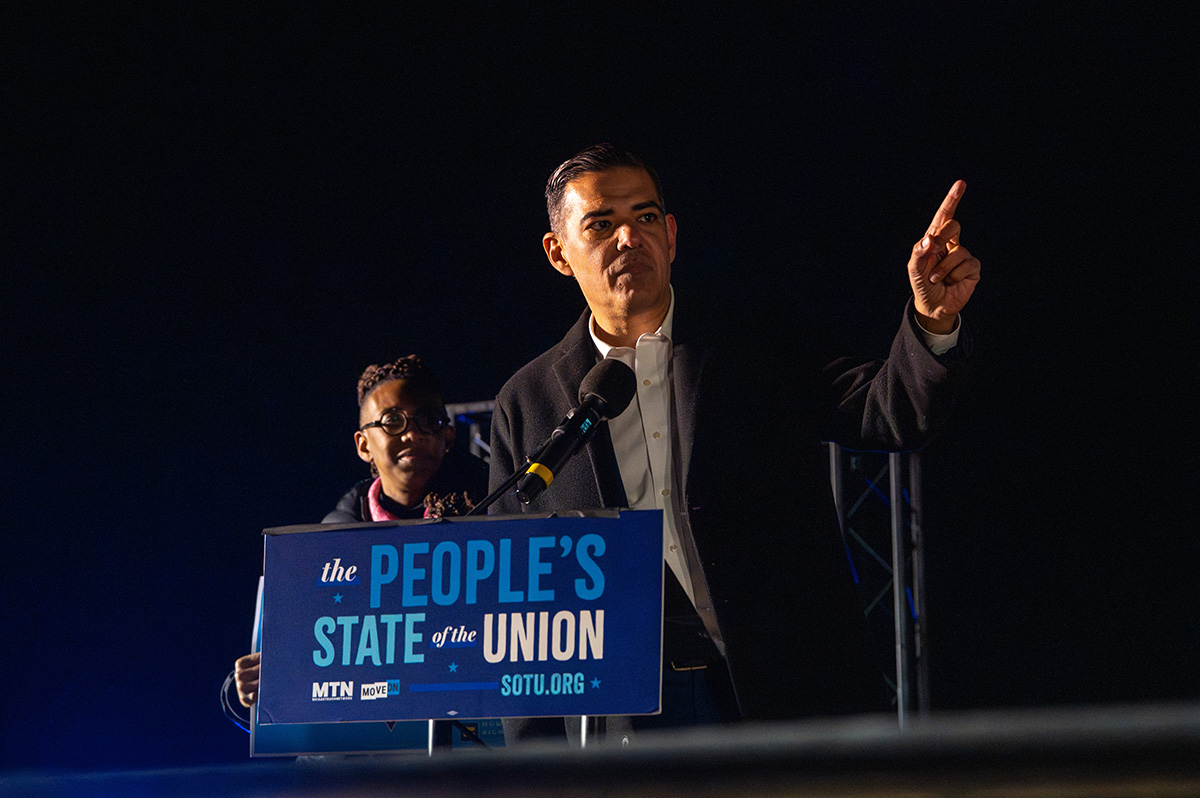
After delivering remarks alongside Robert Garcia, Kelley Robinson, president of the Human Rights Campaign, took the stage and transformed the freezing crowd’s anger into resolve.
Garcia later told the Blade that visibility matters in moments like this — especially when LGBTQ rights are under direct attack.
“We should be crystal clear about right now what is happening in our country,” Garcia said. “We have a president who is leading the single largest government cover up in modern history, we have the single largest sex trafficking ring in modern history right now being covered up by Donald Trump and Pam Bondi In the Department of Justice. Why are we protecting powerful, wealthy men who have abused and raped women and children in this country? Why is our government protecting these men at this very moment? In my place at the Capitol is a woman named Annie farmer. Annie and her sister Maria, both endured horrific abuse by Jeffrey Epstein and Ghislaine Maxwell. As we move forward in this investigation, always center the survivors; we are going to get justice for the survivors. And Donald Trump may call this investigation a hoax. He may try to deflect our work, but our message to him is very clear that our investigation is just getting started, and we will we will get justice for these survivors.”
He told the Blade afterwards that having queer leaders front and center is itself an act of resistance.
“I obviously was very honored to speak with Kelley,” the California representative said. Kelley is doing a great job…it’s important that there are queer voices, trans voices, gay voices, in protest, and I think she’s a great example of that. It’s important to remind the country that the rights of our community continue to be attacked, and then we’ve got to stand up. Got to stand up for this as well.”
Robinson echoed that call, urging LGBTQ Americans — especially young people — not to lose hope despite the administration’s escalating rhetoric.
“There are hundreds of thousands of people that are standing up for you every single day that will not relent and will not give an inch until every member of our community is protected, especially our kids, especially our trans and queer kids. I just hope that the power of millions of voices drowns out that one loud one, because that’s really what I want folks to see at HRC. We’ve got 3.6 million members that are mobilizing to support our community every single day, 75 million equality voters, people that decide who they’re going to vote for based on issues related to our community. Our job is to make sure that all those people stand up so that those kids can see us and hear our voices, because we’re going to be what stands in the way.”
A boycott — and a warning
The list of Democratic lawmakers who boycotted the State of the Union included Sens. Ruben Gallego, Ed Markey, Jeff Merkley, Chris Murphy, Adam Schiff, Tina Smith, and Chris Van Hollen, along with dozens of House members.
For those gathered outside — and for viewers watching the livestream hosted by MoveOn — the counter-programming was not merely symbolic. It was a warning.
While the president spoke of strength and success inside the chamber, LGBTQ Americans — particularly transgender youth — were once again cast as political targets. And outside the Capitol, lawmakers and advocates made clear that the fight over their rights is far from over.
U.S. Military/Pentagon
4th Circuit rules against discharged service members with HIV
Judges overturned lower court ruling

A federal appeals court on Wednesday reversed a lower court ruling that struck down the Pentagon’s ban on people with HIV enlisting in the military.
The conservative three-judge panel on the 4th U.S. Circuit Court of Appeals overturned a 2024 ruling that had declared the Defense Department and Army policies barring all people living with HIV from military service unconstitutional.
The 4th Circuit, which covers Maryland, North Carolina, South Carolina, Virginia, and West Virginia, held that the military has a “rational basis” for maintaining medical standards that categorically exclude people living with HIV from enlisting, even those with undetectable viral loads — meaning their viral levels are so low that they cannot transmit the virus and can perform all duties without health limitations.
This decision could have implications for other federal circuits dealing with HIV discrimination cases, as well as for nationwide military policy.
The case, Wilkins v. Hegseth, was filed in November 2022 by Lambda Legal and other HIV advocacy groups on behalf of three individual plaintiffs who could not enlist or re-enlist based on their HIV status, as well as the organizational plaintiff Minority Veterans of America.
The plaintiffs include a transgender woman who was honorably discharged from the Army for being HIV-positive, a gay man who was in the Georgia National Guard but cannot join the Army, and a cisgender woman who cannot enlist in the Army because she has HIV, along with the advocacy organization Minority Veterans of America.
Isaiah Wilkins, the gay man, was separated from the Army Reserves and disenrolled from the U.S. Military Academy Preparatory School after testing positive for HIV. His legal counsel argued that the military’s policy violates his equal protection rights under the Fifth Amendment’s Due Process Clause.
In August 2024, a U.S. District Court sided with Wilkins, forcing the military to remove the policy barring all people living with HIV from joining the U.S. Armed Services. The court cited that this policy — and ones like it that discriminate based on HIV status — are “irrational, arbitrary, and capricious” and “contribute to the ongoing stigma surrounding HIV-positive individuals while actively hampering the military’s own recruitment goals.”
The Pentagon appealed the decision, seeking to reinstate the ban, and succeeded with Wednesday’s court ruling.
Judge Paul V. Niemeyer, one of the three-judge panel nominated to the 4th Circuit by President George H. W. Bush, wrote in his judicial opinion that the military is “a specialized society separate from civilian society,” and that the military’s “professional judgments in this case [are] reasonably related to its military mission,” and thus “we conclude that the plaintiffs’ claims fail as a matter of law.”
“We are deeply disappointed that the 4th Circuit has chosen to uphold discrimination over medical reality,” said Gregory Nevins, senior counsel and employment fairness project director for Lambda Legal. “Modern science has unequivocally shown that HIV is a chronic, treatable condition. People with undetectable viral loads can deploy anywhere, perform all duties without limitation, and pose no transmission risk to others. This ruling ignores decades of medical advancement and the proven ability of people living with HIV to serve with distinction.”
“As both the 4th Circuit and the district court previously held, deference to the military does not extend to irrational decision-making,” said Scott Schoettes, who argued the case on appeal. “Today, servicemembers living with HIV are performing all kinds of roles in the military and are fully deployable into combat. Denying others the opportunity to join their ranks is just as irrational as the military’s former policy.”
New York
Lawsuit to restore Stonewall Pride flag filed
Lambda Legal, Washington Litigation Group brought case in federal court
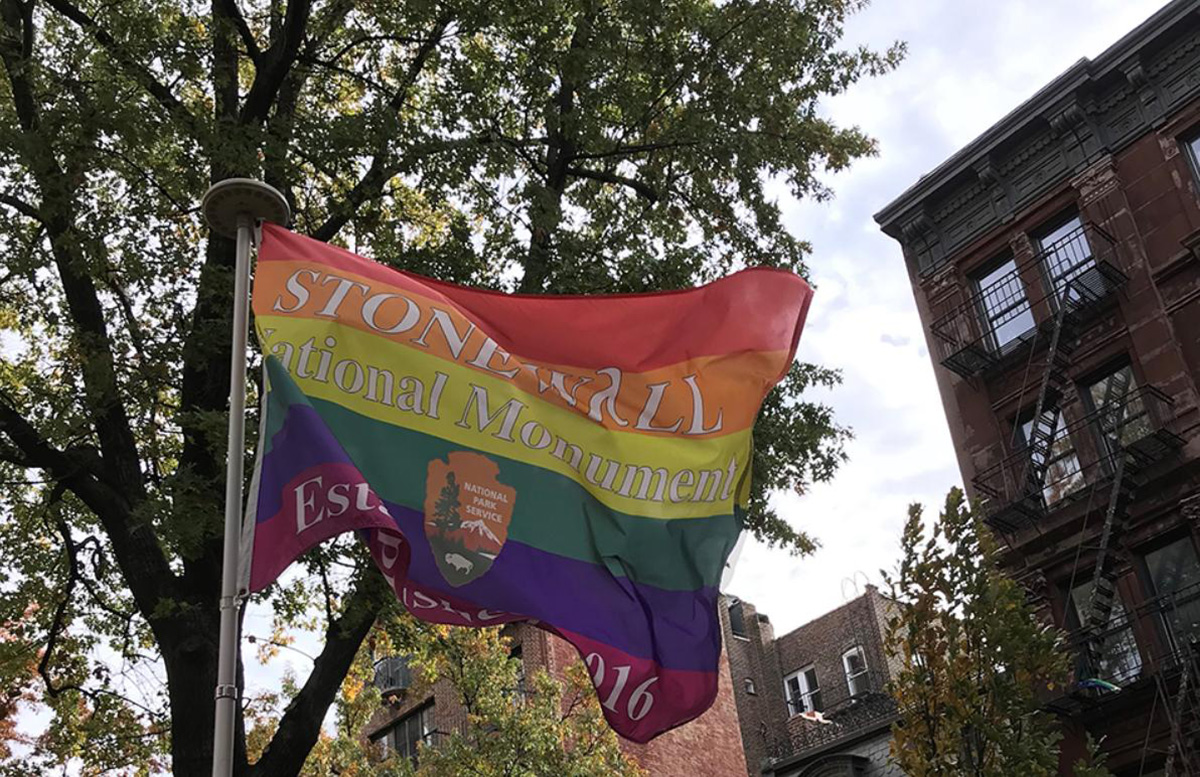
Lambda Legal and Washington Litigation Group filed a lawsuit on Tuesday, challenging the Trump-Vance administration’s removal of the Pride flag from the Stonewall National Monument in New York earlier this month.
The suit, filed in the U.S. District Court for the Southern District of New York, asks the court to rule the removal of the Pride flag at the Stonewall National Monument is unconstitutional under the Administrative Procedures Act — and demands it be restored.
The National Park Service issued a memorandum on Jan. 21 restricting the flags that are allowed to fly at National Parks. The directive was signed by Trump-appointed National Park Service Acting Director Jessica Bowron.
“Current Department of the Interior policy provides that the National Park Service may only fly the U.S. flag, Department of the Interior flags, and the Prisoner of War/Missing in Action flag on flagpoles and public display points,” the letter from the National Park Service reads. “The policy allows limited exceptions, permitting non-agency flags when they serve an official purpose.”
That “official purpose” is the grounds on which Lambda Legal and the Washington Litigation Group are hoping a judge will agree with them — that the Pride flag at the Stonewall National Monument, the birthplace of LGBTQ rights movement in the U.S., is justified to fly there.
The plaintiffs include the Gilbert Baker Foundation, Charles Beal, Village Preservation, and Equality New York.
The defendants include Interior Secretary Doug Burgum; Bowron; and Amy Sebring, the Superintendent of Manhattan Sites for the National Park Service.
“The government’s decision is deeply disturbing and is just the latest example of the Trump administration targeting the LGBTQ+ community. The Park Service’s policies permit flying flags that provide historical context at monuments,” said Alexander Kristofcak, a lawyer with the Washington Litigation Group, which is lead counsel for plaintiffs. “That is precisely what the Pride flag does. It provides important context for a monument that honors a watershed moment in LGBTQ+ history. At best, the government misread its regulations. At worst, the government singled out the LGBTQ+ community. Either way, its actions are unlawful.”
“Stonewall is the birthplace of the modern LGBTQ+ rights movement,” said Beal, the president of the Gilbert Baker Foundation. The foundation’s mission is to protect and extend the legacy of Gilbert Baker, the creator of the Pride flag.
“The Pride flag is recognized globally as a symbol of hope and liberation for the LGBTQ+ community, whose efforts and resistance define this monument. Removing it would, in fact, erase its history and the voices Stonewall honors,” Beal added.
The APA was first enacted in 1946 following President Franklin D. Roosevelt’s creation of multiple new government agencies under the New Deal. As these agencies began to find their footing, Congress grew increasingly worried that the expanding powers these autonomous federal agencies possessed might grow too large without regulation.
The 79th Congress passed legislation to minimize the scope of these new agencies — and to give them guardrails for their work. In the APA, there are four outlined goals: 1) to require agencies to keep the public informed of their organization, procedures, and rules; 2) to provide for public participation in the rule-making process, for instance through public commenting; 3) to establish uniform standards for the conduct of formal rule-making and adjudication; and 4) to define the scope of judicial review.
In layman’s terms, the APA was designed “to avoid dictatorship and central planning,” as George Shepherd wrote in the Northwestern Law Review in 1996, explaining its function.
Lambda Legal and the Washington Litigation Group are arguing that not only is the flag justified to fly at the Stonewall National Monument, making the directive obsolete, but also that the National Park Service violated the APA by bypassing the second element outlined in the law.
“The Pride flag at the Stonewall National Monument honors the history of the fight for LGBTQ+ liberation. It is an integral part of the story this site was created to tell,” said Lambda Legal Chief Legal Advocacy Officer Douglas F. Curtis in a statement. “Its removal continues the Trump administration’s disregard for what the law actually requires in their endless campaign to target our community for erasure and we will not let it stand.”
The Washington Blade reached out to the NPS for comment, and received no response.

The global cost of Trump’s foreign aid ideology

Two very different views of the State of the Union

Va. activists preparing campaign in support of repealing marriage amendment

PHOTOS: Queen of Hearts

New book profiles LGBTQ Ukrainians, documents war experiences

D.C. police arrest man for burglary at gay bar Spark Social House

PHOTOS: Cupid’s Undie Run

Going for gold: Ford Bronco Sport vs. Toyota RAV4

US Embassy in Mexico issues shelter in place order for Puerto Vallarta