National
UPDATED: Nation’s largest LGBT funder changing its focus?
Advocates worry ‘ATM is closed’ at Arcus Foundation


The Arcus Foundation, founded by billionaire philanthropist Jon Stryker, is the top LGBT-specific funder of grants, giving away $58.4 million to LGBT causes from 2007-2010.
UPDATE: We learned Friday after publishing this story that Arcus founder Jon Stryker had committed $200,000 to the campaign against North Carolina’s Amendment One late last week.
While most LGBT people have probably never heard of the Arcus Foundation, it has touched many of their lives.
The nation’s largest grant-maker to LGBT causes, Arcus delivers money to a range of non-profit groups advocating for LGBT rights and health.
But recent changes at Arcus have some advocates quietly worrying about the future of those programs.
Arcus CEO Yvette Burton departed April 3 amid rumors she was fired by the board. Burton, a former market development research director at IBM, took the helm of Arcus in January 2011 not long after the departure of longtime activist Urvashi Vaid, who spent five years running the foundation.
“Yvette’s departure was a termination,” said a source with knowledge of the situation at Arcus who spoke on condition of anonymity. The source added that Burton’s efforts to “clean house” at Arcus ruffled feathers throughout the organization.
Burton did not respond to several requests for comment.
An Arcus official told the Blade that the foundation’s work continues but the organization would not comment specifically on Burton’s departure.
“The Foundation’s commitment to its mission is longstanding,” Bryan Simmons, vice president of communications at Arcus, told the Blade. “Our strategies will continue to support that mission regardless of any change in leadership.”
Other changes at Arcus were evident before Burton’s departure. The organization’s board of directors had purportedly initiated a new strategic planning process to reassess programming and giving priorities, according to the source. Many organizations were reportedly told that they would not be guaranteed funding beyond 2012, and some ties were severed altogether.
“‘You’ll have to qualify under our new guidelines,’” the source paraphrased the message from Arcus to some of its LGBT grant recipients. “Subtext: ‘You’ll probably not be getting funding moving forward.’”
In addition, several sources also contend the organization’s founder, billionaire philanthropist Jon Stryker, may have ceased personally giving to political campaigns and 501(c)4 organizations, however after this article was originally published, the organizers of the campaign to stop Amendment One in North Carolina revealed that Stryker had wired the campaign $200,000 Friday. Stryker could not be reached for comment.
“Is this a prep to exit the LGBT space altogether? Possibly,” the source said. “Was [Burton] a disaster? Possibly.”
Another knowledgeable source noted the turnover at Arcus’ main office in Kalamazoo, Mich., and said that Stryker has had a change of heart regarding his philanthropic priorities.
Some activists unaffiliated with grantee organizations have attempted to sound the alarm.
“Any change at any funder in the LGBT movement is pretty big for any orgs they fund,” said Kalpana Krishnamurphy, director of the Race and Gender Justice Program at the Western States Center, an immigration-focused organization. “Changes in leadership bring new priorities and new focuses for the work.”
Though Arcus has no direct programming of its own, more than $58.4 million in Arcus grants went to small programs and organizations doing LGBT-related work between 2007-2010, making it the largest grant maker to LGBT causes.
“Hearing from organizations in different areas — men who have sex with men [support organizations], HIV-specific projects, younger gay men of color — hearing that organizations have not been getting funded or getting the cold shoulder, is not the worst kept secret in the world,” another prominent LGBT activist told the Blade on condition of anonymity. “The ATM is closed.”
Sources familiar with Arcus said that Burton took seriously her mission to transform the way the Foundation operated and made many staffing changes quickly. One source said that Burton sought to increase grantee accountability and professionalize the organization. The staffing changes, however, may have led to a revolt by some in the organization. Vaid, who ran Arcus for five years, did not respond to emailed interview requests.
Despite the upheaval, other leaders that rely on Arcus dismissed concerns about a shift in focus and expressed confidence in the foundation’s commitment to LGBT causes.
“With Arcus and, actually, all the LGBT funders, they’ve been consistent with their funding over a number of years, and to us and I’m sure to other organizations, that’s extremely important,” said Brad Sears, executive director of the Williams Institute at UCLA, which receives funding from Arcus for its research in the field of LGBT workplace issues. “When you’re hiring people, and you want them to have a job now and in the future, it’s great to have both funding for multiple years, and funding that is at least somewhat more flexible for general operating.”
The Arcus Foundation’s reach is broad. The organization has contributed to everything from the Gill Foundation, the National Gay & Lesbian Task Force and the Transgender Law Center to AIDS and HIV research, small LGBT-welcoming churches, LGBT religious advocacy groups and non-LGBT organizations that develop programming targeting LGBT people of color or other underrepresented groups within the LGBT community.
“We are not an LGBT organization — we are an organization being funded by Arcus because of the work we’re doing to bridge racial justice and LGBT justice,” Krishnamurphy said. “Arcus’s funding in this area [is really] crucial.”
“We wouldn’t have been able to have our GLBT program at all,” said Akaya Windwood, president of the Rockwood Leadership Institute, about Arcus’s contributions. “It made it possible for us to have a robust LGBT program that focuses a lot on communities of color, underrepresented communities within the movement, and rural.”
According to the most recent available IRS forms from 2010, the organization’s total assets were just short of $180 million, most of that being in investments, rather than cash on hand.
The largest single contributor was the organization’s founder, Stryker who gave $30,790,736. The contribution was made in 583,600 shares of Stryker Medical stock. Along with savings and securities interest and dividends, as well as assets on sales of several million dollars worth of assets, the Stryker money made the biggest chunk of the organization’s nearly $50 million in revenue for 2010.
Meanwhile, after expenses and new investments, Arcus contributed $27 million to various LGBT-focused and conservation programs throughout the world in 2010, which — when compared to the Gill Foundation’s nearly $12 million in disbursements that same year — makes Arcus the biggest funder of LGBT programs in the world.
“General operating support from any foundation is really critical for LGBT organizations,” said Masen Davis, executive director of the Transgender Law Center. “There are still too few funders throughout the United States that are supporting LGBT equality and that can make it very difficult for organizations of any size to really work in scale to create change for our community. Arcus has been really important to us and I hope that they continue to be important to our work for years to come.”
Hundreds of LGBT-focused programs at non-profits throughout the nation might not exist if not for Arcus.
“We’re extremely thankful,” said Troy Plummer, executive director of Reconciling Ministries — a group that pushes for LGBT inclusion in the United Methodist Church — explaining that the multi-year grants from Arcus for general operations helped the organization expand programs within the denomination.
“We have been able to consider projects that we would have never considered before the funding from the Arcus Foundation,” Plummer said. “And they were intentionally strategic in wanting to build capacity of our organization, and that was very helpful, and it continues to be helpful in doing so.“
Arcus’s focus on intersectional work — especially in regard to race, religion and age groups — is considered vital for organizations outside what many consider the marriage-focused mainstream of the LGBT movement.
“We’ve observed some drift in traditional funders in amount or percentage allocation toward ‘marriage equality efforts,” said Cindi Love, executive director of SoulForce, whose Equality Ride targeting anti-gay policies at private colleges has been partially funded by an Arcus grant for several years. “Arcus has absolutely from the first day been one of the strongest supporters of the ride because of its emphasis on the development of the next generation of leaders within our movement.”
Amid the nervousness, optimism still springs from the LGBT leaders that continue to rely on Arcus.
“I feel like Arcus has really taken care with their grantees so that they’re able to build and take action when they need to, so shifts in that funding are clearly important to all the grant receivers,” Plummer told the Blade. “I appreciate Arcus rethinking their strategic visioning, and what they want to do to make an impact on a large scale,” saying that he was impressed with the result of the last iteration of the foundation’s strategic plan.
“I don’t know yet whether or not we’re part of that plan,” he added.
“I know that they’re undergoing some strategic planning, and that Arcus has gone through quite a bit of transition, so, we’re all out here cheering them on, and hoping that they get to a really solid place,” said Windwood. “If Arcus thrives then that means that other organizations thrive.”




California
Calif. governor signs 6 pro-LGBTQ bills, vetoes 1
Gavin Newsom rejected measure he claimed is legislative overreach

Last week, California Gov. Gavin Newsom signed and vetoed a slew of bills into state law. Among them were seven pertaining to California’s LGBTQ community. Newsom signed six while vetoing one. His actions drew applause and scorn from advocacy groups in the state.
The six signed bills:
Assembly Bill 1775 allows transgender veterans, who were banned from service last year by the Trump-Vance administration, to access housing assistance, use California’s discharge upgrade assistance program, and get support for gaining employment.
Assembly Bill 1930 strengthens privacy protections for healthcare patients and providers by creating clear guidelines for California agencies, individuals, and corporations to respond to out-of-state subpoena requests relating to abortion or gender-affirming care. This includes a requirement to contact the California Attorney General at least seven days prior to responding to the subpoena or providing legal documents. This should add additional protection to those residing in California from investigations in states where abortion or gender-affirming care has more restrictions.
Senate Bill 934 targets conversion therapy in California and increases the amount of time a patient has to bring a medical malpractice lawsuit against a provider for attempting to change the patient’s sexual orientation or gender identity. The bill takes aim at the widely debunked practice that treats queerness as a mental disorder that could be cured through psychotherapeutic methods. Conversion therapy has been illegal in California since 2012; however, a recent Supreme Court decision threw the ban into question, prompting lawmakers to write this new bill that legally defines it as medical malpractice.
Senate Bill 1023 expands access to PrEP, a medication that protects people from contracting HIV. The bill requires insurers to cover the drug through the medical benefit and the pharmacy benefit pathways, allowing for more providers to give patients PrEP.
Senate Bill 1114 strengthens privacy protections for voluntary self-identification data about sexual orientation and gender identity. The bill limits when California government agencies can share this data and bars it from being disclosed outside of the state government, with few exceptions.
Senate Bill 1328 expands support for LGBTQ students and staff in California colleges. The bill requires any institution of higher education to designate an employee at any campus, satellite campus, branch campus, or outreach center to support the needs of LGBTQ individuals.
Equality California, the largest statewide LGBTQ civil rights group in the country, commended the governor for his support of legislation that protects and supports the queer community amid escalating threats, attacks, and rollbacks from the federal government.
Executive Director Tony Hoang said in a written statement, “California is once again demonstrating that when LGBTQ+ people are targeted, our state will respond with action,” adding, “We are grateful to Gov. Newsom for signing these measures.”
The vetoed bill:
Assembly Bill 2164 would have banned California from extraditing anyone residing in California for providing abortions or gender-affirming care in another state. Newsom vetoed this bill despite agreeing with its principles, claiming in a written statement that “extradition is an exclusively executive function” and that he did not want to limit the “executive authority of an incoming governor.”
This bill was created in response to Louisiana’s attempt to extradite a California physician for allegedly sending abortion pills in the mail to a Louisiana woman. Newsom responded forcefully to the extradition request, publicly denying it and stating, “We will not allow extremist politicians from other states to reach into California and try to punish doctors based on allegations that they provided reproductive health care services.”
In a written statement responding to the veto, Lizzy Hinkley, the legal director of the bill’s lead sponsor, Abortion Coalition for Telemedicine, criticized Newsom, stating, “[the] outgoing governor’s principled stance is cold comfort to Californians living and working in the real world post-Dobbs. A high-brow, academic justification for refusing to codify legal protections only reveals an ignorance for the lived reality of patients and providers — and does nothing to help them.”
National
HRC report: LGBTQ students face ‘far greater challenges’ in non-supportive states
Survey finds anti-LGBTQ school harassment, bullying highest in 17 states
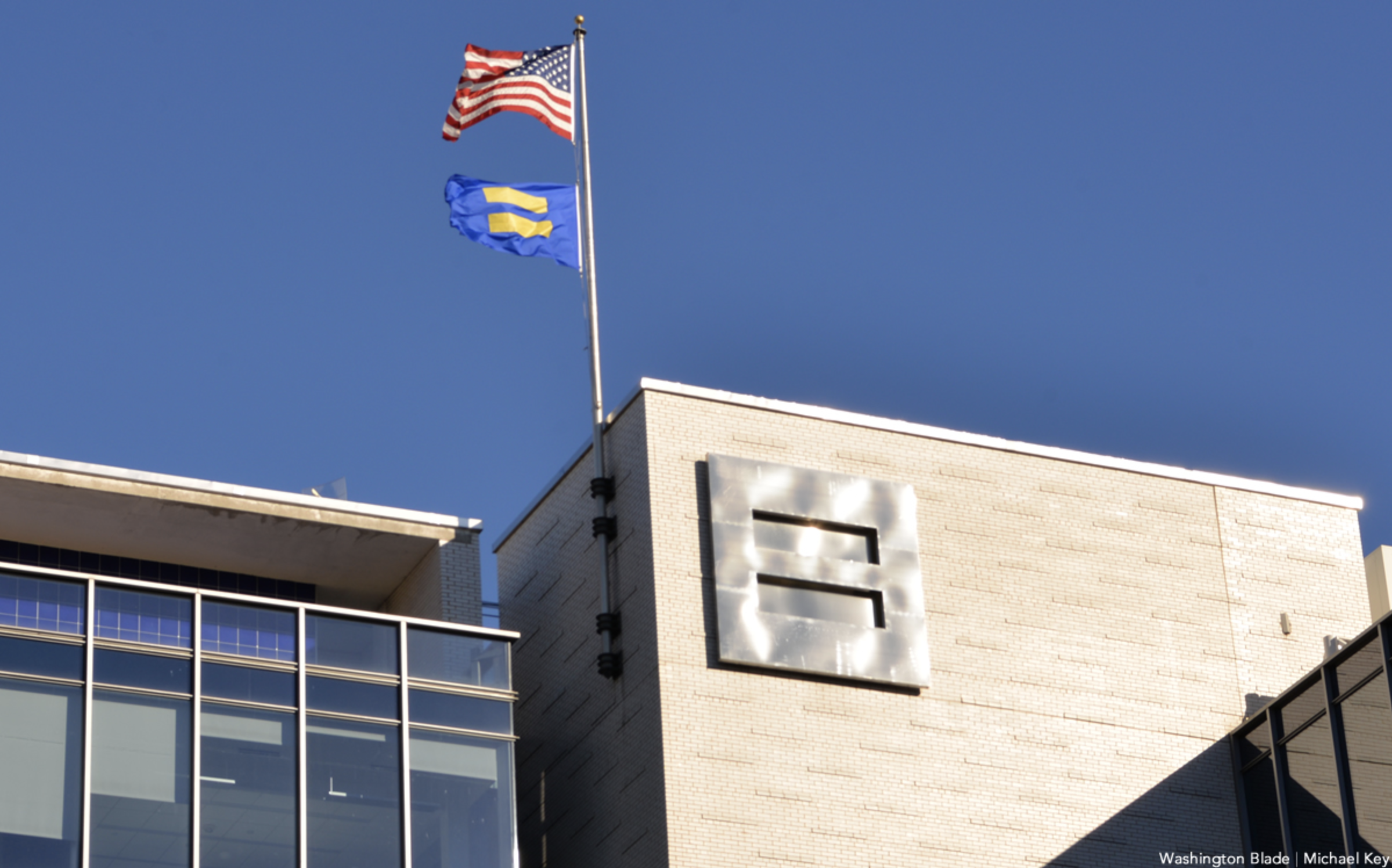
The Human Rights Campaign Foundation, the educational arm of the national LGBTQ advocacy organization Human Rights Campaign, has released a report showing LGBTQ public school students are more likely to face bullying, harassment, and “other barriers” in states that have less overall supportive LGBTQ laws and policies.
The report is based on the HRC Foundation’s National Educator Survey of School Climate and Bullying, which was released on Sept. 17.
“The report finds that harassment, bullying, and other barriers to LGBTQ+ inclusion are more prevalent in states with limiting policies, where educators report widespread restrictions on LGBTQ+ resources, visible expressions of support, and assistance for transgender students,” a statement released by HRC says.
“As just one example,” the statement adds, “while 59 percent of educators in states with limiting policies report restrictions on supporting their transgender students, just 6 percent to 8 percent of educators in states with supportive policies report the same, underscoring the impact of these policies on school climate, student well-being, and the stakes of the upcoming midterm elections for LGBTQ+ youth and inclusive classrooms.”
The report says the survey consisted of responses by 826 educators in 42 states who worked as teachers, principals, counselors, administrators, and others who worked in support services. All worked at schools with students from pre-kindergarten to 12th grade, most being public schools and a smaller number being charter schools, the report says.
It says the survey was conducted between April 15 and May 21, 2026, and included a survey questionnaire with about 55 questions covering a wide range of LGBTQ related school issues.
According to the report, its classification of LGBTQ supportive and non-LGBTQ supportive states is based on a detailed analysis of the LGBTQ related laws and policies of all 50 states, D.C., and U.S. territories conducted by the Movement Advancement Project, or MAP, which describes itself as an “independent, nonprofit thinktank.”
The report includes a chart consisting of 51 boxes representing the 50 states and D.C., with 32 plus D.C. colored as blue and said to have overall LGBTQ supportive policies. The 17 boxes colored in red are said to have overall non-LGBTQ supportive policies and laws, Each of the boxes has the initial of a state or D.C. printed inside it.
In addition to D.C., the chart shows Maryland, Virginia, New York, California, and Massachusetts as among the supportive states. Florida, Texas, West Virginia, and Ohio are among the states shown to be non-LGBTQ supportive.
The HRC statement includes these “key” findings from the survey:
- In states with restrictive LGBTQ+ inclusion policies, 59 percent of educators report restrictions on supporting transgender students, compared to just 6-8 percent of educators in states with supportive LGBTQ+ inclusion policies.
- In states with restrictive policies, nearly 50 percent of educators reported restrictions on LGBTQ+ books or resources, compared to just 7 percent of educators in states with supportive policies.
- Roughly 32 percent of educators in states with restrictive policies reported anti-LGBTQ+ harassment was a moderate or serious problem, compared with 11 percent of educators in states with supportive LGBTQ+ inclusion policies.
- In states with restrictive LGBTQ+ inclusion policies, 29 percent of educators were very worried about anti-LGBTQ+ harassment, compared to 15 percent in states with supportive LGBTQ+ inclusion policies.
- In states with restrictive LGBTQ+ inclusion policies, 36 percent of educators witnessed anti-LGBTQ+ student bullying, compared to 27 percent in states with supportive LGBTQ+ inclusion policies.
- In states with supportive LGBTQ+ inclusion policies, 75 percent of educators reported no restrictions on LGBTQ+-supportive displays, highlighting a substantially more supportive school environment than in states with restrictive policies.
- Educators in states with restrictive LGBTQ+ inclusion policies also reported significant harassment of students based on appearance (57 percent), race or ethnicity (43 percent), sexual orientation (42 percent), and gender identity or expression (39 percent). (No direct comparison figure from supportive-policy states is provided in the data above.)
“Every young person deserves to feel safe and supportive at school, but this report makes clear that for too many LGBTQ+ students, especially transgender youth, are being failed by policies designed to exclude them,” said HRC President Kelley Robinson in the HRC statement.
“We know that when students feel seen, supported, and affirmed, they are more likely to thrive, but when schools become places of exclusion or hostility, young people pay the price through lower engagement, missed opportunities to learn, and poorer mental and physical health,” Robinson said.
The HRC statement notes that the survey findings come at a time when a growing number of states have passed laws targeting LGBTQ students and the school officials and teachers who support them. It says that for the first time, the survey found that “educators themselves are also experiencing anti-LGBTQ+ harassment, highlighting the growing impact of these policies on school staff as well as students.”
The full survey findings and report can be accessed here:
U.S. Supreme Court
Trump asks Supreme Court to allow restrictions on gender-affirming care in prisons
SCOTUS could further restrict rights of trans inmates
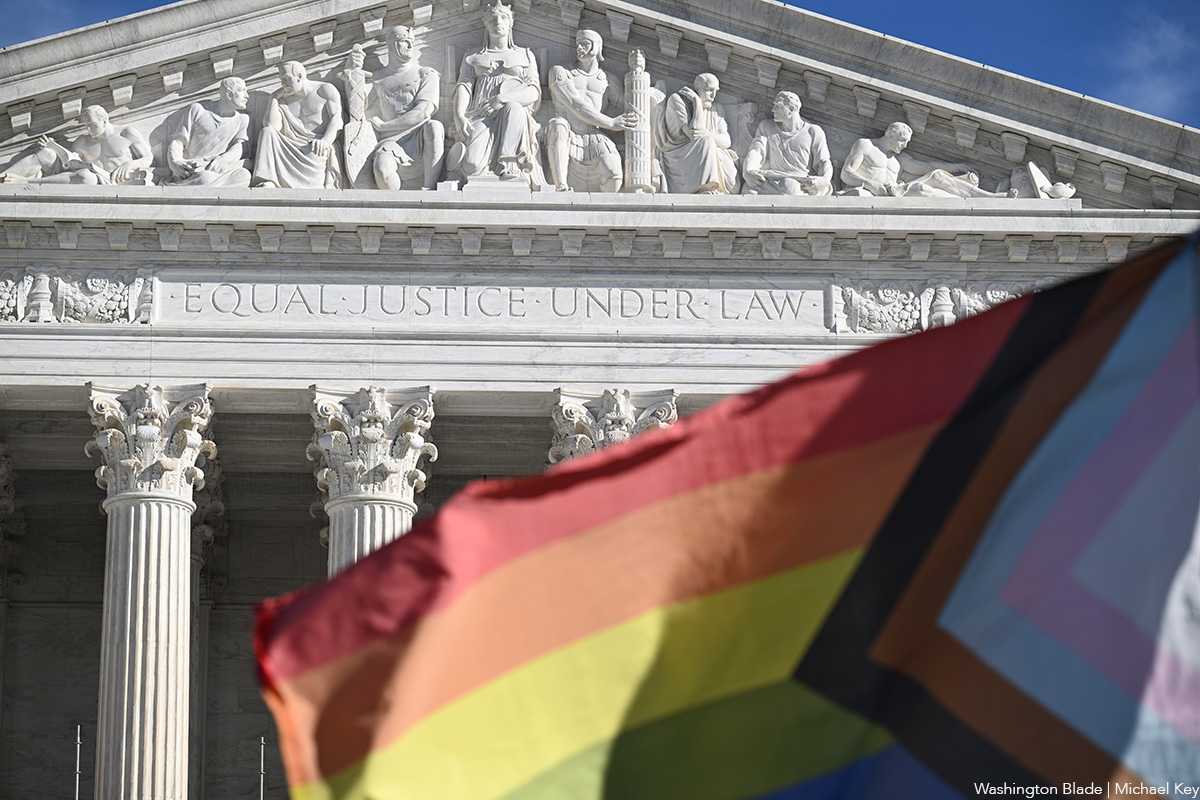
The Trump administration has asked the Supreme Court to allow its policy limiting gender-affirming treatment for federal inmates to take effect while a legal challenge plays out in court.
U.S. District Judge Royce Lamberth ordered the government to continue providing gender-affirming care, such as hormone therapy, which had become policy nearly a decade ago for inmates who were transitioning.
The Trump administration argues in its application that its policy restricting transgender rights was properly adopted and that the judge overstepped, posing nationwide “security and prison-administrative concerns.”
If allowed, the policy would halt surgeries, hormones and social accommodations such as wigs while allowing mental health therapy to continue as the legality of the policy reversal is litigated.
The government also argues in the application that the Bureau of Prisons had “determined that sex-trait-modification surgeries, hormone interventions in general, and social accommodations could no longer be justified as treatment for gender dysphoria.”
American Civil Liberties Union attorneys for the inmates said the policy is “a direct threat to the well-being of transgender people in federal custody and an open violation of their fundamental rights,” and said withholding necessary gender-affirming healthcare constitutes cruel and unusual punishment.
The Blade has covered the ongoing developments surrounding changes to Federal Bureau of Prisons transgender inmate policy that went into effect earlier in Trump’s term. The changes primarily focus on rolling back Biden-era protections for trans inmates.
Earlier this year, the Blade published a joint letter from multiple senators in response to the rollback of the policy. Multiple senators — including Edward Markey (D-Mass.), Jeffrey A. Merkley (D-Ore.) and Mazie K. Hirono (D-Hawaii) — sent a letter to Attorney General Todd Blanche and Federal Bureau of Prisons Director William Marshall III calling for them to reverse the policy change, saying it endangers inmates’ health and safety.
The senators described how the policy shift, along with President Trump’s Executive Order 14168, titled “Defending Women from Gender Ideology Extremism and Restoring Biological Truth to the Federal Government,” is forcing policy changes they argued are rooted more in political rhetoric than in medical research or evidence-based correctional practices.
Federal Bureau of Prisons responded to the Blade’s request for comment in May, declining to reconsider its transgender inmate policy.
The Blade reached out to the Federal Bureau of Prisons once again over the application to the Supreme Court, but did not hear back before publication.

Calif. governor signs 6 pro-LGBTQ bills, vetoes 1

Gay Va. couple hopeful voters will enshrine marriage equality in state constitution

Vote now! Best Of LGBTQ DC readers’ choice awards

Meet the LGBTQ candidates running for U.S. House, Senate

Ana Brnabić becomes world’s first openly lesbian head of state

PHOTOS: HRC National Dinner

What’s frightening is also funny in ‘Venus’

I’m 66, he’s 27. Is it love or am I being played?

The LGBTQ real estate map is being redrawn