Arts & Entertainment
Birds of a feather?
Species co-mingle in abstract Shakespeare production
‘The Conference of the Birds’
Through Nov. 25
Folger Theatre
201 East Capitol Street, SE
$40-$68
202-675-0342
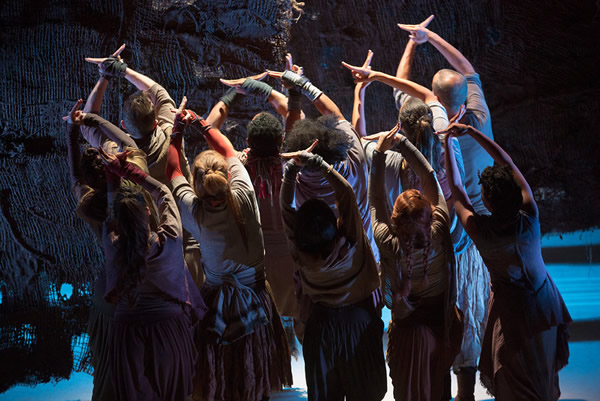
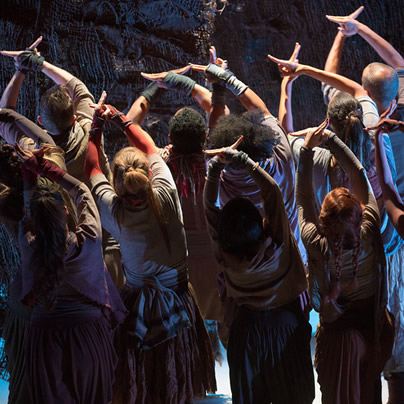
The cast of ‘Conference of the Birds.’ (Photo by Scott Suchman, courtesy Folger)
Best known for fresh takes on Shakespeare, director Aaron Posner has expanded his repertoire. For his current offering at the Folger Theatre on Capitol Hill, he’s taken on “The Conference of the Birds,” an ensemble piece based on the 12th century Persian fable by Sufi poet Farid Uddi Attar. Told from the point of view of anthropomorphized feathered friends, it’s a compelling exploration of humanity’s quest for meaning.
At the urging of an unrelenting hoopoe, a varied flock of 10 birds are convinced to undertake an arduous journey to meet their ruler, the Simorgh. Understandably, they’re not all so eager to fly the coop: the parrot is content to remain in his gilded cage; the duck doesn’t want to leave water and the sparrow thinks she’s too weak for such a flight. But the hoopoe, played with wide-eyed intensity by Patty Gallagher, is very persuasive and off they all go.
The bird’s pilgrimage is long and hazardous: After crossing the desert (the anteroom of their trip), they must fly through seven valleys each of which offers its own lesson in love, understanding, annihilation, etc. Not all of the flock makes it to the Simorgh, but those who do are rewarded with an ample serving of universal truth.
Using words, music and movement, “Conference” takes its audience on a theatrical adventure. Posner’s inventive directing along with choreographer Erika Chong Shuch’s quirky, spasmodic moves brings the wordy work alive in exciting and unexpected ways. The talented 11-person cast (which includes Tara Giordano, Britt Duff and Jens Rasmussen who double duties as dance captain) is always in motion, transforming from birds to kings, slaves and hermits. Without ever leaving the stage floor, the actors subtly morph into a v-formation flock flying high overhead, seemingly covering great stretches of terrain on their winged journey.
Perched high atop the Folger’s stage, composer/musician Tom Teasley performs original music throughout the two-hour play using instruments from around the world. His exhilarating score — drawn from an eclectic variety of sound, rhythm and melody — adds significantly to the production.
The remainder of the design team is equally top notch. Meghan Raham’s timeless set of hanging burlap panels and twinkly amber lights is backed meaningfully by a wall of mirrors. And whether it’s the blinding light found in the valley of amazement or the darkness and fire in the telling of the moth to flame story, Jennifer Schriever’s lighting design is consistently clever and evocative.
While the cast mimics bird movements here and there, costume designer Olivera Gajic smartly resists the temptation to go avian. Instead, she outfits the birds in comfortable tops and drapey pants (and one or two skirts) in muted tones. Even the glorious peacock’s multi-colored wings are much quieter than what you’d expect from that feathered diva (memorably played by Jessica Frances Dukes).
Adapted for the stage by famed British director Peter Brooks and screenwriter/actor Jean-Claude Carriére, “Conference” premiered in 1971, touring Saharan African before playing to Western audiences. Its wisdom and beauty stimulates self-exploration. The work is “The Wizard of Oz”-ish in its suggestion that the search for fulfillment begins and ends within ourselves.
“Conference” is definitely a bold theatrical choice and Posner pulls it off with great imagination and style.





Theater
José Zayas brings ‘The House of Bernarda Alba’ to GALA Hispanic Theatre
Gay Spanish playwright Federico García Lorca wrote masterpiece before 1936 execution
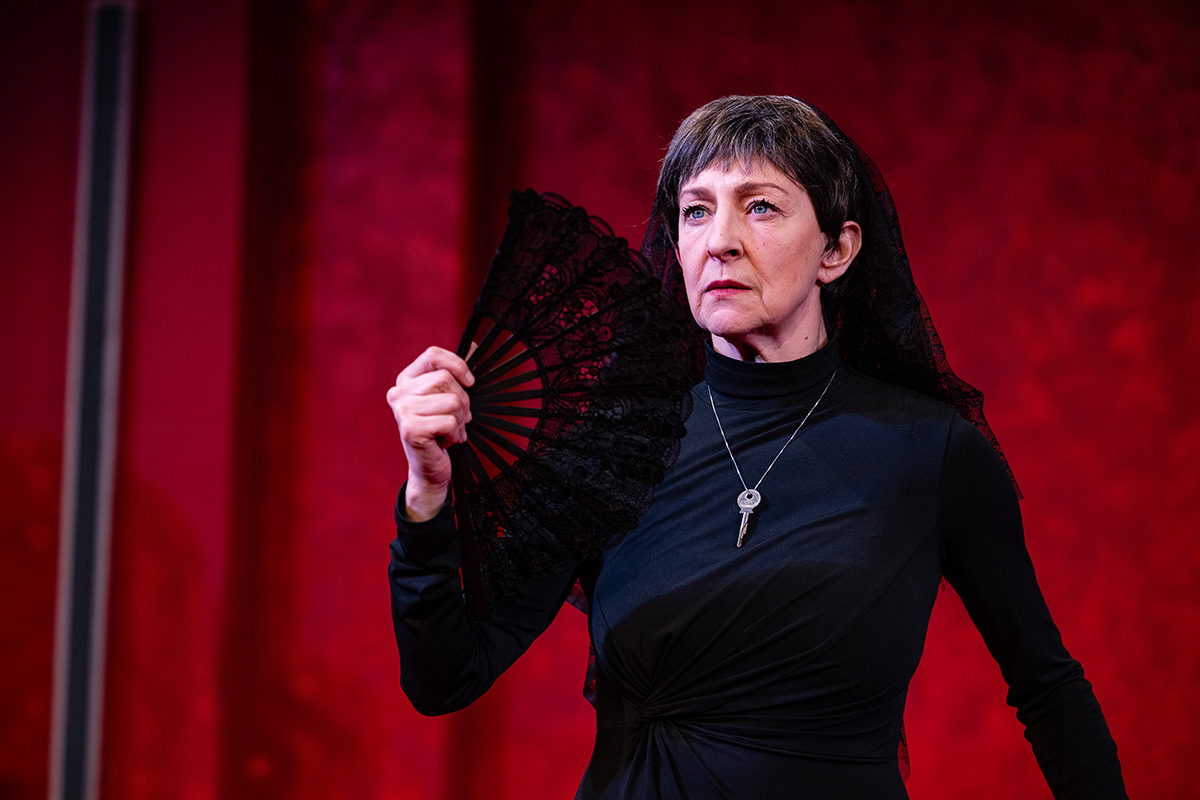
‘The House of Bernarda Alba’
Through March 1
GALA Hispanic Theatre
3333 14th St., N.W.
$27-$52
Galatheatre.org
In Federico García Lorca’s “The House of Bernarda Alba,” now at GALA Hispanic Theatre in Columbia Heights, an impossibly oppressive domestic situation serves, in short, as an allegory for the repressive, patriarchal, and fascist atmosphere of 1930s Spain
The gay playwright completed his final and arguably best work in 1936, just months before he was executed by a right-wing firing squad. “Bernarda Alba” is set in the same year, sometime during a hot summer in rural Andalusia, the heart of “España profunda” (the deep Spain), where traditions are deeply rooted and mores seldom challenged.
At Bernarda’s house, the atmosphere, already stifling, is about to get worse.
On the day of her second husband’s funeral, Bernarda Alba (superbly played by Luz Nicolás), a sixtyish woman accustomed to calling the shots, gathers her five unmarried daughters (ages ranging from 20 to 39) and matter-of-factly explain what’s to happen next.
She says, “Through the eight years of mourning not a breeze shall enter this house. Consider the doors and windows as sealed with bricks. That’s how it was in my father’s house and my grandfather’s. Meanwhile, you can embroider your trousseaux.”
It’s not an altogether sunny plan. While Angustias (María del Mar Rodríguez), Bernarda’s daughter from her first marriage and heiress to a fortune, is betrothed to a much younger catch, Pepe el Romano, who never appears on stage, the remaining four stand little chance of finding suitable matches. Not only are they dowry-less, but no men, eligible or otherwise, are admitted into their mother’s house.
Lorca is a literary hero known for his mastery of both lyrical poetry and visceral drama; still, “Bernarda Alba’s” plotline might suit a telenovela. Despotic mother heads a house of adult daughters. Said daughters are churning with passions and jealousies. When sneaky Martirio (Giselle Gonzáles) steals the photo of Angustias’s fiancé all heck kicks off. Lots of infighting and high drama ensue. There’s even a batty grandmother (Alicia Kaplan) in the wings for bleak comic relief.
At GALA, the modern classic is lovingly staged by José Zayas. The New York-based out director has assembled a committed cast and creative team who’ve manifested an extraordinarily timely 90-minute production performed in Spanish with English subtitles easily ready seen on multiple screens.
In Lorca’s stage directions, he describes the set as an inner room in Bernarda’s house; it’s bright white with thick walls. At GALA, scenic designer Grisele Gonzáles continues the one-color theme with bright red walls and floor and closed doors. There are no props.
In the airless room, women sit on straight back chairs sewing. They think of men, still. Two are fixated on their oldest siter’s hunky betrothed. Only Magdelena (Anna Malavé), the one sister who truly mourns their dead father, has given up on marriage entirely.
The severity of the place is alleviated by men’s distant voices, Koki Lortkipanidze’s original music, movement (stir crazy sisters scratching walls), and even a precisely executed beatdown choreographed by Lorraine Ressegger-Slone.
In a short yet telling scene, Bernarda’s youngest daughter Adela (María Coral) proves she will serve as the rebellion to Bernarda’s dictatorship. Reluctant to mourn, Adela admires her reflection. She has traded her black togs for a seafoam green party dress. It’s a dreamily lit moment (compliments of lighting designer Hailey Laroe.)
But there’s no mistaking who’s in charge. Dressed in unflattering widow weeds, her face locked in a disapproving sneer, Bernarda rules with an iron fist; and despite ramrod posture, she uses a cane (though mostly as a weapon during one of her frequent rages.)
Bernarda’s countenance softens only when sharing a bit of gossip with Poncia, her longtime servant convincingly played by Evelyn Rosario Vega.
Nicolás has appeared in “Bernarda Alba” before, first as daughter Martirio in Madrid, and recently as the mother in an English language production at Carnegie Melon University in Pittsburgh. And now in D.C. where her Bernarda is dictatorial, prone to violence, and scarily pro-patriarchy.
Words and phrases echo throughout Lorca’s play, all likely to signal a tightening oppression: “mourning,” “my house,” “honor,” and finally “silence.”
As a queer artist sympathetic to left wing causes, Lorca knew of what he wrote. He understood the provinces, the dangers of tyranny, and the dimming of democracy. Early in Spain’s Civil War, Lorca was dragged to the the woods and murdered by Franco’s thugs. Presumably buried in a mass grave, his remains have never been found.

Cupid’s Undie Run, an annual fundraiser for neurofibromatosis (NF) research, was held at Union Stage and at The Wharf DC on Saturday, Feb. 21.
(Washington Blade photos by Michael Key)














Sweat DC is officially expanding to Shaw, opening a new location at 1818 7th St., N.W., on Saturday, March 28 — and they’re kicking things off with a high-energy, community-first launch event.
To celebrate, Sweat DC is hosting Sweat Fest, a free community workout and social on Saturday, March 14, at 10 a.m. at the historic Howard Theatre. The event features a group fitness class, live DJ, local food and wellness partners, and a mission-driven partnership with the Open Goal Project, which works to expand access to youth soccer for players from marginalized communities.
For more details, visit Sweat DC’s website and reserve a spot on Eventbrite.

US Embassy in Mexico issues shelter in place order for Puerto Vallarta

José Zayas brings ‘The House of Bernarda Alba’ to GALA Hispanic Theatre

2026: prices, pace, and winter weather

PHOTOS: Cupid’s Undie Run

Sweat DC expands to Shaw

EXCLUSIVE: Markey says transgender rights fight is ‘next frontier’

Lawsuit to restore Stonewall Pride flag filed

Gay Treasury Secretary’s silence on LGBTQ issues shows he is scum

4th Circuit rules against discharged service members with HIV

PHOTOS: Clash
-

 Massachusetts4 days ago
EXCLUSIVE: Markey says transgender rights fight is ‘next frontier’
-
New York4 days ago
Lawsuit to restore Stonewall Pride flag filed
-
Opinions4 days ago
Gay Treasury Secretary’s silence on LGBTQ issues shows he is scum
-
U.S. Military/Pentagon4 days ago
4th Circuit rules against discharged service members with HIV