National
Bi-national couples in ‘surreal’ wait for DOMA decision
150 attorneys in training to assist when ruling comes


Heather (left) and Maria “Mar” del Mar have already filed their I-130 applications in anticipating of a ruling against DOMA. (Photo courtesy of Immigration Equality)
After being together for five years, Heather and Maria “Mar” del Mar are making their final preparations in anticipation of a ruling from the Supreme Court that could mean they can stay together in the United States.
Heather, a U.S. citizen, and Mar, a Spanish national, have already completed their I-130 marriage-based green card application and have sent it to the LGBT group Immigration Equality with the expectation that the high court will strike down the Defense of Marriage Act.
“We’re actually largely done with that,” Heather said. “Our intention on that front is, of course, to file that petition the first day it’s legally viable to do so.”
Although Mar has legal status because she’s living in the United States on a work visa, it expires in November. Section 3 of DOMA, which prohibits federal recognition of same-sex marriage, has blocked the New York City couple, who married in 2011, from a more permanent solution.
In March of last year, U.S. Customs & Immigration Enforcement denied Heather and Maria a marriage-based green card based on an earlier application, citing DOMA as the reason. They’re one of the estimated 28,500 bi-national same-sex couples in danger of separation.
That could change in the coming days. The Supreme Court is expected to deliver a ruling on the constitutionality of DOMA as a result of pending litigation along with ruling in a separate case challenging California’s Proposition 8.
If the court rules DOMA is unconstitutional, blocking the U.S. government from enforcing it, USCIS will have no legal reason to withhold the marriage-based green card from Heather and Mar.
Heather, a marketing director for a global non-profit organization in New York, said the wait for the decision has been “kind of surreal” and what’s been on the couple’s minds in the days heading to the ruling.
“We look at each other every night before we go to bed I would say for the last few weeks, where it’s been kind of like a month countdown, and we’ve said, “Oh my God, what is it going to really be like the day after?” she said. “How much is our life going to change when this issue isn’t a huge weight on our relationship and even on our everyday thought process.”
Mar, who works in marketing for a Spanish-language newspaper in New York, said a ruling against DOMA would lift a considerable burden because they are unable to plan for the future as they fear separation.
“We are really nervous because this would be a big change in our life,” Mar said. “We are very excited.”
As of today, the Supreme Court calendar designates only June 20 and June 24 as days on which opinions will be handed down; But with 14 cases yet to be decided, it is widely expected that they will add another day to the calendar, either June 26 or June 27 and the decisions for the marriage will be announced at that time.
And Heather and Mar, who are among the plaintiffs in Immigration Equality’s lawsuit against DOMA, already have plans. On the last Saturday of the month, they’re inviting friends and family to come to their home to celebrate the moment when the federal government will view their relationship as legally equal to others.
“We actually already have — I guess this is probably superstitious; I shouldn’t say this out loud — but we actually already have a celebration planned for family and friends — we have to be optimistic — for Saturday night on the 29th,” Heather said. “So, we’re celebrating at our place.”
And what if the Supreme Court rules in favor of DOMA? Heather said it’s not an outcome they like to consider, but in that event, they’d pursue additional litigation, find a way to renew Mar’s work visa and push for the inclusion of gay couples in comprehensive immigration reform legislation.
“To be honest, it will just be devastating; all of those things are just technically the things that we’ll do,” Heather said. “I’ll tell you what we’re going to do; we’re going to start a family anyway because we refuse to live at the effect of our circumstances. We’ve already postponed things in our life much more than is fair — and we’ll consider the option of moving to Spain where our marriage is recognized.”
But Heather and Mar are just one of many bi-national same-sex couples readying for a Supreme Court ruling that would ensure they can stay together in the United States.
Rachel Tiven, executive director of Immigration Equality, said she’s expecting thousands of green card applications from bi-national same-sex couples in the months following a court ruling against DOMA.
“We think that there will be over the first year many thousands,” Tiven said. “I think in the remaining five months of the year, we’ll see something between 2,000 and 10,000 applications, but that’s a guess.”
In the meantime, Tiven said her organization is already preparing some applications for same-sex bi-national couples and making plans for others to renew applications that were previously denied.
“We’re preparing some families who will file immediately if the Supreme Court will enable them to do so,” Tiven said. “Other families who filed a long time ago — either because they were plaintiffs, or because it was a step to seeking deferred action — we are asking the administration, for those who were denied, we’re asking the administration to reopen those applications so they don’t have to file all over again, and don’t have to pay the fee again.”
In order to facilitate the expected increase in couples filing marriage-based green card applications, Immigration Equality’s legal team has conducted two trainings last week for attorneys who have signed up to assist couples with their petitions following a court ruling striking down Section 3 of DOMA.
Steve Ralls, a spokesperson for Immigration Equality, said 150 lawyers from across the country to date have joined that network of attorneys and have taken part in one of those two trainings.
“As part of that training, our legal team discussed topics related to identifying issues that may arise for same-sex bi-national couples during implementation following the court’s ruling,” Ralls said. “A key goal is to ensure that attorneys working with LGBT families can also serve as watchdogs during that critical implementation period and report any issues they encounter with relevant government agencies in their processing of green card applications for affected families.”
Another couple making preparations in anticipation of a court ruling is Rachel Wilkins and Jennifer Blum, a New Jersey couple that married a year-and-a-half ago. Blum, a New Jersey native, is awaiting the opportunity to sponsor Wilkins, a British national, for residency in the United States.
The couple has never filed a marriage-based green card application before, but Blum, an attorney, said they’ve already hired an attorney to help them through the process in anticipation of a ruling against DOMA.
“We’ve hired an attorney to prepare our application for us,” Blum said. “So we’ve been really just trying to get all the paperwork together, and we’re excited for this decision to finally come to fruition, and we just want to move on with our lives.”
Wilkins, a curator who’s in the country on work visa, said she shares a sense of optimism that the Supreme Court will issue a decision that renders Section 3 of the the Defense of Marriage Act inoperable.
“I think we’re feeling optimistic,” Wilkins said. “We were watching the Supreme Court blog to see the orders handed down just waiting to see the right decision made.”
The couple came to D.C. when the oral arguments took place at the Supreme Court in March and had the opportunity to meet lesbian New Yorker Edith Windsor, who filed the lawsuit that’s currently before the court.
“We walked up on the steps and I lost it … because it’s just the culmination of so many people’s hard work, sweat, they’ve given so much to be able to get to this point where we could get this case in front of the Supreme Court, and for the Supreme Court to finally do the right thing, and for justice to be done,” Blum said.
Should the court strike down DOMA, Blum said they’ll celebrate by gathering at the Stonewall Inn in New York City, where riots began in 1969 that were considered the start of the modern gay rights movement.
“Legally, factually, I just can’t see the Supreme Court determining any other way,” Blum said. “Like I said, there’s no other option.”
Lavi Soloway, a gay immigration attorney at Masliah & Soloway and co-founder of The DOMA Project, said his firm worked for several months on preparing to file new marriage-based green card applications — some on the day the court issues a decision against DOMA — and has several filed in 2011 and 2012 that haven’t yet been denied.
“The couples have undertaken the preparation with the understanding that that the Supreme Court ruling on DOMA is not something that we can predict in advance, but it would be fair to say that their perspective, like mine, is cautiously optimistic,” Soloway said.
CORRECTION: An earlier version of this article misattributed quotes to Jennifer Blum and Rachel Wilkins. The Blade regrets the error.


The White House
Hundreds protest ICE killing of Renee Nicole Good in D.C.
Married queer woman shot in Minneapolis on Wednesday
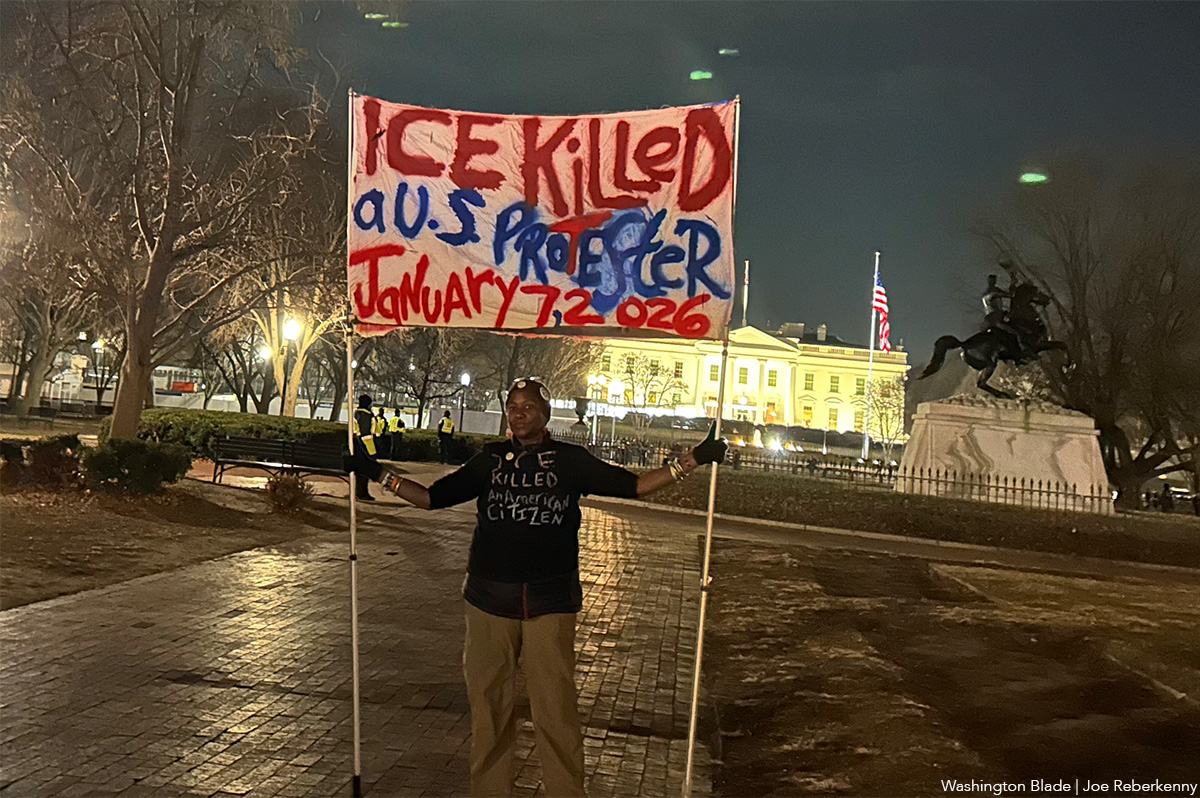
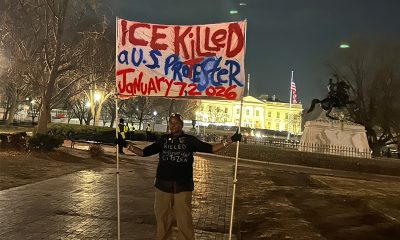
Hundreds of people took to the streets of D. C. on Thursday night to protest the killing of a U.S. citizen by a U.S. Immigration and Customs Enforcement agent.
Protests began at the busy — and increasingly queer — intersection of 14th and U Streets, N.W. There, hundreds of people held signs, shouted, and made their way to the White House to voice their dissent over the Trump-Vance administration’s choice to increase law enforcement presence across the country.
The protest, which also occurred simultaneously in cities large and small across the country, comes in the wake of the death of Minneapolis resident Renne Nicole Good at the hands of ICE Agent Jonathan Ross. Good left behind two children and a wife, Rebecca Good.
Records obtained by the Associated Press found that Ross was an Iraq War veteran and nearly two decades into his career with U.S. Border Patrol and ICE.
Good was gunned down just blocks away from where George Floyd was killed by police in 2020, sparking weeks of national protests. Minnesota officials say the FBI has blocked their access to an investigation into the fatal shooting, according to a BBC story published on Friday.
In the nation’s capital, protesters marched from the intersection of 14th and U Street to Lafayette Square, right outside the White House. Multiple D.C. organizations led the protest, most notably Free DC, a nonprofit that works to ensure the right of “self-determination” for District residents, as many local laws can be reviewed, modified, or overturned by Congress. Free DC had organized multiple protests since the Trump-Vance administration was elected.
The Washington Blade spoke to multiple protesters towards the tail end of the protest about why they came out.
Franco Molinari, from Woodbridge, Va., crossed the Potomac to partake in his first-ever protest.
“I don’t appreciate ICE and the use of federal agents being pretty much militarized against America,” Molinari said while holding a “Justice for Renee” sign. “The video of Renee being executed cartel style in her car was enough for me to want to come out, to at least do something.”
Molinari, like many others the Blade spoke with, found out about the protest on Instagram.
“It was my friend there, Sarah … had sent a link regarding the protest to a group chat. I saw it in the morning, and I thought, ‘You know what, after work, I’m head out.’”
He also shared why protesting at the White House was important.
“I already saw the response that the president gave towards the murder of Renee, and it was largely very antagonizing,” Molinari said.
President Donald Trump, along with federal leaders under him, claimed that Good “violently, willfully and viciously ran over the ICE officer.” The president’s claims have been widely discredited through multiple videos of the incident, which show Good was attempting to leave the scene rather than attacking the officer.
“I hope that anybody would be able to see that and see the response and see for themselves that it just is not correct,” Molinari said.
The Blade also spoke with leftist influencer Dave the Viking, who has more than 52,000 followers on TikTok, where he posts anti-fascist and anti-Trump videos.
“We’re out here to make sure that this regime can’t rewrite history in real time, because we all know what we saw … we’re not going to allow them to run with this narrative that they [ICE agents] were stuck in the snow and that that poor woman tried to weaponize her car, because we all saw video footage that proves otherwise,” he told the Blade. “We’re not going to let this regime, the media, or right-wing influencers try to rewrite history in real time and try to convince us we didn’t all see what we know we saw.”
Dave the Viking continued, saying he believes the perceived power of ICE and other law enforcement to act — oftentimes in deadly and unjustifiable ways — is a product of the Trump-Vance administration.
“There’s a line between fascism and anti-fascism. These motherfuckers have been pushing that envelope, trying to label an idea a terrorist organization, to the point of yesterday, crossing that line hardcore. You face the point of looking at history and saying there was this 1989, 2003 America, where we’re just going in, raiding resources. Where is this fucking 1930s Germany, where we’re going in and we’re about to just start clearing shit and pulling knots? Yeah, nope. We proved that shit yesterday.”
Two people were injured in another shooting involving federal agents, this time Border Patrol in Portland, Ore., on Thursday afternoon.
KC Lynch, who lives near American University, also spoke about her choice to protest with a group.
“I came out today because everything that ICE has done is absolutely unacceptable, not only killing this one woman, but also the fact that they’ve been imprisoning people in places that are literally, that have been literally on record by international organizations shown to be human rights violating. It’s unbelievably evil.”
Lynch also echoed Dave’s opinion about parallels between the Trump-Vance administration and the rise of Adolf Hitler in Nazi Germany.
“It’s literally what happened before the Holocaust. We should all be scared. We should all be angry. I’m so angry about it … even talking about it — I’m sorry,” she said before getting choked up.
Lynch emphasized that despite the circumstances in which people were protesting together, the sense of community was strong and powerful.
“I feel like it’s important for people to know that we’re angry, even if no policy changes come out of it, and it’s just nice to yell and be angry about it, because I feel like we’ve probably all been feeling this way, and it’s nice to be around people that are like minded and to like have a sense of community.”
Minnesota
Reports say woman killed by ICE was part of LGBTQ community
Renee Nicole Good shot in Minneapolis on Wednesday
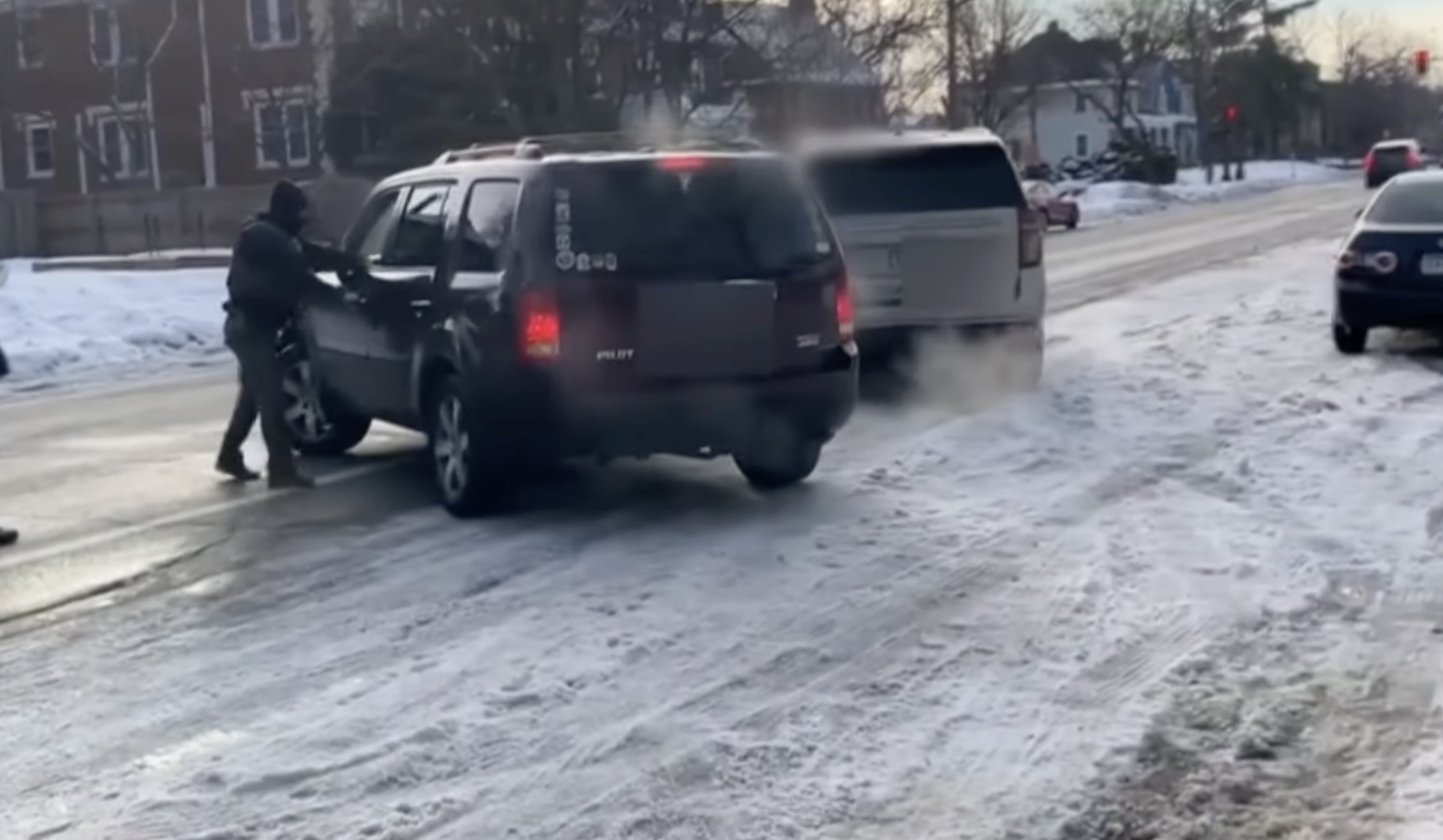
A U.S. Immigration and Customs Enforcement agent shot and killed a woman in Minneapolis as she attempted to drive away from law enforcement during a protest on Wednesday.
The Star Tribune newspaper identified the victim as Renee Nicole Good, 37, a Minneapolis resident who lived blocks from where she was shot in the Central neighborhood, according to reports. Donna Ganger, Good’s mother, told the Star Tribune that her daughter lived in the Twin Cities with her wife.
Multiple videos of the shooting have gone viral on social media, showing various angles of the fatal incident — including footage that shows Good getting into her car and attempting to drive away from law enforcement officers, who had their weapons drawn.
In the videos, ICE agents can be heard telling Good to “get out of the fucking car” as they attempted to arrest her. Good, who press reports say was married to a woman, ended up crashing her car into an electric pole and other vehicles. She was later transported from the scene of the shooting and died at the hospital.
President Donald Trump defended the ICE agent on Truth Social, saying the officer was “viciously” run over — a claim that coincides with Homeland Security Secretary Kristi Noem’s assessment of the situation. Noem, a South Dakota Republican, insisted the officer “fired defensive shots” at Good after she attempted to run over law enforcement agents “in an attempt to kill them — an act of domestic terrorism.”
Multiple state and local officials disputed claims that the shooting was carried out in self-defense at the same time Noem was making those assertions.
An Instagram account that appears to belong to Good describes her as a “poet and writer and wife and mom and shitty guitar strummer from Colorado; experiencing Minneapolis, MN,” accompanied by a rainbow flag emoji.
A video posted to X after the shooting shows a woman, reportedly her wife, sitting on the ground, crying and saying, “They killed my wife. I don’t know what to do.”
“We’ve dreaded this moment since the early stages of this ICE presence in Minneapolis,” Mayor Jacob Frey said during a Wednesday press conference. “Having seen the video myself, I want to tell everybody directly that [the DHS’s claim of self-defense] is bullshit. This was an agent recklessly using power that resulted in somebody dying, getting killed.”
“I have a message for ICE. To ICE, get the fuck out of Minneapolis,” Frey continued. “We do not want you here. Your stated reason for being in this city is to create some kind of safety, and you are doing exactly the opposite. People are being hurt. Families are being ripped apart. Long-term Minneapolis residents that have contributed so greatly to our city, to our culture, to our economy are being terrorized, and now somebody is dead. That’s on you, and it’s also on you to leave.”
Across the Capitol, members of the House and the Senate condemned the actions of the officer.
“There’s no indication she’s a protester, there’s nothing that at least you can see on the video, and therefore nothing that the officers on the ground could see that identify her as someone who’s set out to try to do harm to an ICE officer,” U.S. Sen. Elizabeth Warren (D-Mass.) said Wednesday night on MS NOW’s “The Weeknight.”
“There is no evidence that has been presented to justify this killing,” House Minority Leader Hakeem Jeffries (D-N.Y.) said in a statement on his website. “The masked ICE agent who pulled the trigger should be criminally investigated to the full extent of the law for acting with depraved indifference to human life.”
“ICE just killed someone in Minneapolis,” U.S. Rep. Robert Garcia (D-Calif.) the highest-ranking Democrat on the House Oversight Committee, posted on X. “This administration’s violence against communities across our country is horrific and dangerous. Oversight Democrats are demanding answers on what happened today. We need an investigation immediately.”
In a statement to the Advocate, Human Rights Campaign President Kelley Robinson wrote, “Today, a woman was senselessly killed in Minneapolis during an ICE action — a brutal reminder that this agency and the Trump regime put every community at risk, spreading fear instead of safety. Reports that she may have been part of the LGBTQ+ community underscore how often the most vulnerable pay the highest price.”
National LGBTQ Task Force President Kierra Johnson also responded to Good’s death.
“We recognize and mourn the loss of Renee Nicole Good and extend our condolences to her family, loved ones, and community,” said Johnson in a statement. “This loss of life was preventable and reprehensible, particularly coming at the hands of federal agents.”
National
U.S. in midst of ‘genocidal process against trans people’: study
Attacks rooted in Nazi ideology’s views on gender

Earlier this week, the Lemkin Institute for Genocide Prevention and Human Security issued a haunting warning. Dr. Elisa von Joeden-Forgey, president of the Lemkin Institute, stated that the U.S. is in the “early-to-mid stages of a genocidal process against trans and nonbinary and intersex people.” Dr. Gregory Santon, former president of the International Association of Genocide Scholars, flags “a hardening of categories” surrounding gender in a “totalitarian” way.
Stanton argues that this is rooted in Nazi ideology’s surrounding gender — this same regime that killed many LGBTQIA individuals in the name of a natural “binary.” As Von Joeden-Forgey said, the queer community, alongside other “minority groups, tends to be a kind of canary in the coal mine.”
In his first year in office, Trump and his Cabinet’s anti-trans rhetoric has only intensified, with a report released late September by journalist Ken Klippenstein in which national security officers leaked that the FBI is planning to classify trans people as “extremists.” By classifying trans people as “Nihilistic Violent Extremists,” far-right groups would have more “political (and media) cover,” as Abby Monteil reports for them, for anti-trans violence and legislation.
While the news is terrifying, it’s not unprecedented – the fight against trans rights and classification of trans people as violent extremists was included in Project 2025, and in the past several weeks, far-right leaders’ transphobic campaign has expanded: boycotting Netflix to pressure the platform to remove trans characters, leveraging anti-trans attack ads in the Virginia governor’s race and banning professors from acknowledging that trans people exist. In fact last month, two Republican members of Congress called for the institutionalization of trans people.
It’s a dangerous escalation of transphobic violence that the Human Rights Campaign has classified as an epidemic. According to an Everytown for Gun Safety report published in 2020, the number of trans people murdered in the U.S. almost doubled between 2017 and 2021. According to data released by the Gun Safety report from February 2024, 34 percent of gun homicides of trans, nonbinary, and gender expansive people remain unsolved.
As Tori Cooper, director of Community Engagement for the Transgender Justice Initiative for the Human Rights Campaign Foundation, this violence serves a purpose. “The hate toward transgender and gender expansive community members is fueled by disinformation, rhetoric and ideology that treats our community as political pawns ignoring the fact that we reserve the opportunity to live our lives full without fear of harm or death,” Cooper said.
“The genocidal process,” Von Joeden-Forgey said, “is really about destroying identities, destroying groups through all sorts of means.” And just like the Nazi regime, former genocide researcher Haley Brown said, the Trump administration is fueling conspiracy theories surrounding “cultural Marixsm” — the claim that leftists, feminists, Marxists, and queer people are trying to destroy western civilization. This term, Brown states, was borrowed directly from the Nazi’s conspiracies surrounding “Cultural Bolshevism.”
As Brown explains, historians are just beginning to research the Nazis’ anti-trans violence, but what they are finding reveals a terrifying pattern wherein trans people are stripped of their identification documents, arrested and assaulted, and outright killed.
Before World War II, Germany – especially Berlin – was a hub for transgender communities and culture. In 1919, Dr. Magnus Hirschfield, a Jewish gay sexologist and doctor, founded the Institut für Sexualwissenschaft, the Institute for Sexual Science. The Institute was groundbreaking for offering some of the first modern gender-affirming healthcare, with a trans-affirming clinic and performing some of the first gender-affirming surgeries in the 1930s for trans women Dora Richter and Lili Elbe.
Researchers at the institute coined the term “trassexualism” in 1923, which while outdated now, was the first modern term that Dr. Hirschfield used when working with Berlin police to acquire “transvestite passes” for his patients to help them avoid arrest under public nuisance and decency laws. During the Weimar Republic, trans people could also change their names although their options were limited. In Berlin, queer press flourished after World War I along with a number of clubs welcoming gay, lesbian and trans clientele, including Eldorado, which featured trans performers on stage.
But as Hitler rose to power, trans people were targeted. In 1933, Nazi youth and members of the Sturmabteilung ransacked the institute, stealing and burning books – one of the first book burnings of the Nazi regime. German police stopped recognizing the “transvestite” passes and issuing new ones, and under Paragraph 175, which criminalized sexual relationships with men, trans women (who were misgendered by the police) were arrested and sent to concentration camps.
As the Lemkin Intsitute for Genocide Prevention and Human Security wrote in a statement:
“The Nazis, like other genocidal groups, believed that national strength and existential
power could only be achieved through an imposition of a strict gender binary within the racially pure ‘national community.’ A fundamentalist gender binary was a key feature of Nazi racial politics and genocide.”
History professor Laurie Marhoefer wrote for The Conversation that while trans people were targeted, there was not extensive discussion of them by the regime. But there was evidence of the transphobia behind the regime’s violence, specifically in Hermann Ferdinand Voss’s 1938 book “Ein Beitrag zum Problem des Transvestitismus.”Voss noted that during the Nazi regime, trans people could and were arrested and sent to concentration camps where they underwent forced medical experimentation (including conversion therapy and castration) and died in the gas chambers.
While there is growing recognition that gay, bisexual, and lesbian individuals were targeted during the Holocaust, few know about the trans genocide through which trans individuals were arrested, underwent forced castration and conversion therapy, and were outright killed alongside gay, lesbian, disabled and Jewish individuals in concentration camps. Historians are just beginning to undertake this research, writes Marhoefer, and to delve further into the complex racial hierarchies that affected how trans people were treated.
As Zavier Nunn writes for Past & Present, trans people of “Aryan” racial status and those not considered to be homosexuals were sometimes spared from the worst violence and outright murder. Depending on their skills, they could even be considered for rehabilitation into the Volksgemeinschaft, or Nazi utopian community. As Nunn highlights, trans violence was much more nuanced and individualized and should be explored separately from violence against gay and lesbian individuals during the Holocaust.
Marhoefer’s research of violence against trans women, as recorded in police files (as is the persecution of gay and lesbian individuals), is groundbreaking but rare. He gave a talk at the Museum of Jewish Heritage in 2023, shortly after a 2022 civil lawsuit about denial that trans people were victims of the Holocaust. The German court recognized that trans people were victimized and killed by the Nazi regime, but in the United States, there is still a hesitancy by the wider LGBTQ community and leftist groups to acknowledge that we are living during a time of anti-trans violence, that trans people are being used as political scapegoats in order to distract from real problems of accountability and transparency around government policy.
As anti-trans legislation escalates, it’s important to remember and call out how trans violence is not only a feminist issue, it’s a human rights one as well. While Shannon Fyfe argues that the current campaigns against trans people may not fit the traditional legal definition of a genocide, the destruction and denial of life saving care, access to public spaces, and escalating violence is still immensely devastating.
Kaamya Sharma also notes that the term “genocide” has deep geo-political implications. As she explained, “western organisations are, historically and today, apathetic to the actual lives of people in the Global South, and put moral posturing above Brown and Black lives,” so the choice to use “genocide” is a loaded one. But as the Lemkin Institute for Genocide Prevention and Human Security writes in the same statement: “The ideological constructs of transgender women promoted by gender critical ideologues are particularly genocidal. They share many features in common with other, better known, genocidal ideologies. Transgender women are represented as stealth border crosses who seek to defile the purity of cisgender women, much as Tutsi women were viewed in Hutu Power ideology and Jewish men in Nazi antisemitism.”
Trans people are not extremists, nor are they grooming children or threatening the fabric of American identity – they are human beings for whom (like all of us) gender affirming care is lifesaving. As we remember the trans lives lost decades ago and those lost this year to transphobic violence, knowing this history is the only way to stop its rewriting.

PHOTOS: ‘ICE Out For Good’

Feminist fiction fans will love ‘Bog Queen’

A Shakespearean tragedy comes to life in exquisite ‘Hamnet’

Hundreds protest ICE killing of Renee Nicole Good in D.C.

Calendar: January 9-15

What to watch for in 2026: midterms, Supreme Court, and more

Imperial Court of Washington drag group has ‘dissolved’

Gay Venezuelan man who fled to Colombia uncertain about homeland’s future

2026 Most Eligible LGBTQ Singles nominations

Kennedy Center renaming triggers backlash
-

 National5 days ago
What to watch for in 2026: midterms, Supreme Court, and more
-
District of Columbia5 days ago
Imperial Court of Washington drag group has ‘dissolved’
-
Colombia4 days ago
Gay Venezuelan man who fled to Colombia uncertain about homeland’s future
-
Arts & Entertainment4 days ago
2026 Most Eligible LGBTQ Singles nominations