Politics
Berry, four other gay nominees confirmed to high-ranking posts
In first, Senate approves openly gay U.S. ambassador to G-20 nation
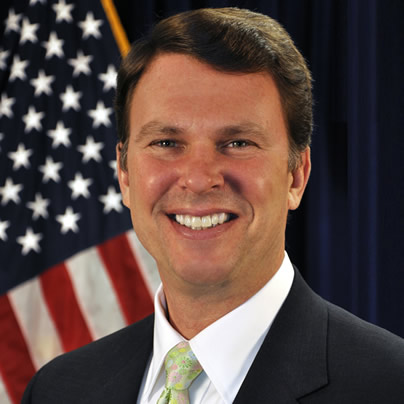
John Berry was confirmed by the Senate as U.S. ambassador to Australia along with other gay nominees. (Photo public domain).
The U.S. Senate confirmed for the first time an openly gay man as ambassador to a G-20 country with no opposition on Thursday evening along with four other out nominees.
John Berry, former head of the U.S. Office of Personnel Management and the highest-ranking openly gay Obama administration official, was approved for the position of U.S. ambassador to Australia by unanimous consent en banc along with dozens of nominees, including other gay appointees.
During his confirmation hearing last month, Berry said he was inspired by the talent he saw in the federal workforce and would take that experience with him to his new post.
“Along the way, I was reminded again and again of the tremendous diversity of our great country, building lasting relationships with fellow Americans from all backgrounds as we worked together to address shared challenges,” Berry said. “If confirmed, I will carry with me these many voices of America, along with a profound commitment to strengthening the shared values that lie at the heart of our strategic relationship with Australia.”
Other openly gay men confirmed to ambassadorial posts were Daniel Baer, who was confirmed as U.S. ambassador to the Organization for Security & Cooperation in Europe; Rufus Gifford, who was confirmed as U.S. ambassador to Denmark; and James Costos; who was confirmed as U.S. ambassador to Spain.
Michael Guest, who’s gay and a former U.S. ambassador to Romania, told the Washington Blade each of the ambassadorial appointees are well-qualified to serve in their new posts.
“All four of these men have the strong intellect, presence and skills needed to lead our interagency teams abroad,” Guest said. “It’s heartening that the Senate recognized that these qualities, not their sexual orientation, are what matter in service to our country. They’ll be terrific American representatives, and I wish them well in their new duties.”
Another openly gay nominee was also confirmed for a non-ambassadorial post. Stuart Delery, was confirmed as assistant attorney general for the Civil Division at the Justice Department after having served in an acting capacity in that role.
Delery had represented the Obama administration at the district and appellate court level during oral arguments and contended Section 3 of the Defense of Marriage Act should be struck down.
U.S. Attorney Eric Holder had kind words for Delery in a statement following the news the Senate had confirmed him for a high-level position within the Justice Department.
“I am pleased to congratulate Stuart Delery on his confirmation as Assistant Attorney General for the Civil Division, an office he has held in an acting capacity for more than a year,” Holder said. “During that time, and throughout his service at the department – including his tenure as chief of staff to the deputy attorney general and senior counselor in my office – Stuart has exemplified the highest standards of integrity and professionalism.”
Chad Griffin, president of the Human Rights Campaign, praised the Senate in a statement for confirming each of the five nominees and also said they’re well-qualified to serve.
“Today the U.S. Senate confirmed five highly qualified nominees to important posts who happen to be gay,” Griffin said. “It is a testament to President Obama and the U.S. Senate that the sexual orientation of these nominees was irrelevant to their qualifications for their posts, as it should be. All Americans should be proud to have these fine public servants representing the interests of the United States.”
Each of the nominees has a history of commitment to public service and the Obama administration. Baer previously worked in the State Department as assistant secretary for the Bureau of Democracy, Human Rights & Labor and worked to advance LGBT rights overseas as part of his portfolio.
His new post at OSCE, which is based in Vienna, comprises 57 European, Asian and North American countries that cooperate on security, terrorism, economic and human rights issues.
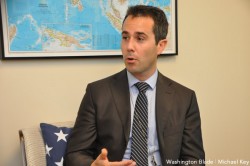
Daniel Baer (Washington Blade photo by Michael Key)
During his confirmation hearing, Baer emphasized the link between advancing human rights overseas and protecting security.
“Today, no serious observer can doubt the link between human rights and security,” Baer said. “We know that respect for human rights cannot be relegated to the ‘nice to have, but not essential’ category, because there is no genuine security in the absence of respect for human rights and adherence to the rule of law.”
Gifford and Costos gave strong support to President Obama in his election efforts and the Democratic Party in years past. Gifford raised money for Obama’s campaign in California in 2008, then served as finance director of the Democratic National Committee before becoming finance director for Obama’s 2012 re-election campaign.
Costos, vice president of global licensing and retail for HBO, contributed more than $60,000 to the Democratic National Committee in the previous election and nearly $5,000 to Obama’s presidential campaign.
One pending gay nominee yet to be confirmed by the Senate is Todd Hughes, who was appointed for a seat on the U.S. Court of Appeals for the Federal Circuit. The Senate Judiciary Committee reported out his nomination last week. Upon confirmation, he’ll become the first openly gay person to serve on a federal appeals court.
Shin Inouye, a White House spokesperson, commended the Senate for the approving these openly gay nominees.
“We appreciate the Senate’s confirmation of many of the Presidents nominees on Thursday,” Inouye said. “These individuals will serve the American people well in their new roles.”
Another openly gay ambassadorial not yet confirmed by the Senate is James “Wally” Brewster, who was nominated as U.S. ambassador to the Dominican Republican. The Senate Foreign Relations Committee has yet to hold a confirmation hearing for him.
Religious groups are opposing his confirming in that country. In July, a high-ranking Catholic cardinal used an anti-gay slur to describe him and religious leaders organized a “Black Monday” protest to oppose him. It’s unclear if this opposition is playing a role in the Senate’s delay in confirming Brewster.



The White House
HRC files class action over federal ban on gender-affirming care coverage
Lawsuit filed Monday challenges White House effort to restrict care

The Human Rights Campaign Foundation, the nonprofit sister organization to the largest LGBTQ human rights lobbying and advocacy organization in the U.S., along with law firms Correia & Puth and Cohen Milstein Sellers & Toll, filed a class action lawsuit against the government as it attempts to restrict gender-affirming healthcare for federal employees.
The suit, filed on Monday, alleges that the Office of Personnel Management, run by Trump appointee Scott Kupor, is discriminating against LGBTQ federal employees (and their families and retired employees) by prohibiting health insurance coverage for gender-affirming care under the Federal Employees Health Benefits and Postal Service Health Benefits plans. There are five plaintiffs named in the complaint, but it extends to others who have those healthcare plans.
The document asserts that OPM’s prohibition on coverage for “gender transition” care in the FEHB and PSHB programs violates Title VII, the federal law that prohibits discrimination based on sex, race, color, religion, or national origin.
The policy, which was implemented on Jan. 1 following the 2025 issuing of Program Carrier Letter, mandated that insurance providers in these programs deny any coverage for gender-affirming care. In February, HRC filed a federal complaint with OPM over the change in healthcare policy, which was ultimately passed to the Equal Employment Opportunity Commission for review. That complaint is now an officially filed class action lawsuit in the U.S. District Court for the District of Columbia.
Research from the Williams Institute at UCLA Law, a think tank that collects data and conducts research on issues related to sexual orientation and gender identity, indicates that this policy denying gender-affirming care will impact healthcare access for at least 39,400 current and former federal employees and their dependents.
Human Rights Campaign President Kelley Robinson released a statement following the lawsuit’s filing.
“Our message to the Trump administration is simple: we’ll see you in court,” said Robinson. “Healthcare access should never be weaponized to advance discrimination — and the denial of coverage for critical healthcare based simply on who you are blatantly violates the rights of all of us.”
Gender-affirming care has been under constant attack by the Trump-Vance administration since its return to the White House, despite the practice being considered as extensively evidence-based but also supported by nearly every major medical organization. This type of care is provided to all people—not just transgender people—and includes things such as social affirmation, including using correct names and pronouns and wearing clothing that matches a person’s gender identity; mental health support, such as counseling to reduce depression and anxiety; and, in some cases, medical interventions such as reversible puberty blockers or hormone therapy when deemed medically appropriate.
“Federal employees have been through the wringer with the Trump administration,” said Cathy Harris, partner at Correia & Puth. “We draw the line at blatant discrimination to deny healthcare to our nation’s dedicated civil servants.”
“This odious policy is the latest example of the Trump administration’s obsession with targeting transgender people, using shameful and cruel tactics to threaten their employment, their health, and the well-being of themselves and their families,” Robinson added. “OPM’s actions will not go unchallenged, and we’ll continue to fight so that federal employees and their families receive the dignity they deserve.”
This is not the first time the White House has directly attacked gender-affirming care.
In January 2025, the administration issued Executive Order 14187, titled “Protecting Children from Chemical and Surgical Mutilation.” The order directs federal agencies to restrict gender-affirming medical care — including puberty blockers, hormone therapy, and surgeries — for individuals under the age of 19.
For more information on how to get involved with the lawsuit, visit hrc.org.
Politics
Buttigieg indicates he may run for president in 2028
Former Transportation Secretary was in Biden-Harris administration’s Cabinet

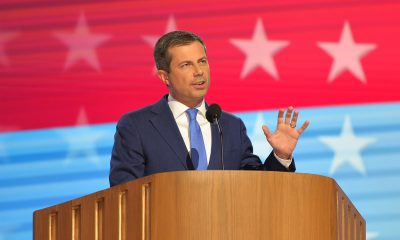
Former Transportation Secretary Pete Buttigieg told a podcaster he is considering throwing his hat in the ring for president once again.
“I don’t know,” Buttigieg told Steven Bartlett, the British host of The Diary of a CEO, the most popular top business and tech podcast on Spotify, which aired Monday. “I think I’m more inclined than not, but there’s so much we don’t know.”
“There’s so much I don’t even know about what’s going to happen this year, let alone … what we need to know later,” he added.
Buttigieg is no stranger to running for the Oval Office.
In 2019, the former South Bend, Ind., mayor was a serious contender in the Democratic primary for the 2020 presidential election but ultimately ended his campaign and endorsed Joe Biden.
In May, an Emerson College Polling survey found Buttigieg at the top of the list of potential presidential contenders, leading California Gov. Gavin Newsom, New York Congresswoman Alexandria Ocasio-Cortez, former Vice President Kamala Harris, and others.
In addition to discussing his future in federal politics, Buttigieg also discussed President Donald Trump’s handling of the Iran war — which reached its 5-month mark two weeks ago — the changing landscape of U.S. jobs due to the rise of artificial intelligence, and the growing national debt, all issues he could face if he ultimately returns to the White House.
Following his 2020 presidential campaign, Buttigieg gained prominence within the Democratic Party, eventually leading to his confirmation as Transportation Secretary. In February 2021, he became the first openly gay Cabinet member to be confirmed by the U.S. Senate.
In addition to his experience as an elected official, the 44-year-old served as a Navy intelligence officer in the reserves from 2009-2017, including a seven-month deployment to Afghanistan in 2014. Buttigieg came out as gay in 2015 and later married his husband, Chasten Glezman, in 2018. The couple now has two children: twins.
Buttigieg also has an extensive educational background.
He graduated from Harvard University with a bachelor’s degree in history and literature and later became a Rhodes Scholar, attending the University of Oxford, where he earned a bachelor’s degree in philosophy, politics, and economics.
This is not the first time Buttigieg has made headlines this year.
In June, he went public about being falsely accused of posing a threat to his children’s safety. An anonymous police report claimed he was a danger to his 4-year-old twins and was not allowed to be with them until after police interviews were conducted.
The police report was later determined to be false. The Washington Blade reached out to the Michigan State Police to ask what course of action, if any, would be taken against the woman who filed the false report, but the agency did not answer the question.
The Blade reached out to Buttigieg’s team for comment on his potential 2028 presidential bid, but did not hear back before publication.
Congress
House blocks effort to codify transgender servicemember ban into law
Lawmakers approved two anti-trans NDAA amendments

The U.S. House of Representatives on Tuesday rejected an amendment to the National Defense Authorization Act that would have codified a ban transgender servicemembers in the military.
The bipartisan vote was 212-217.
The NDAA is for the 2027 fiscal year and sets policies for the Defense Department programs and activities and the national security programs of the Department of Energy.
U.S. Rep. Lauren Boebert (R-Colo.) proposed the amendment on July 21. It stated that all personnel are required to serve in accordance with their biological sex, citing military readiness and discipline.
Human Rights Campaign Senior Director of Government Affairs Jennifer Pike Bailey stated that she is grateful for the bipartisan vote that rejected President Donald Trump and Defense Secretary Pete Hegseth’s “dangerous and discriminatory policy that has kicked brave transgender servicemembers out of the military and weakened our national security.”
“Everyone who meets the same rigorous standards should be able to serve their country. We should honor that patriotism, particularly in this moment where we are witnessing brave servicemembers making the ultimate sacrifice for our country, instead of ending their careers and politicizing their existence. We’re grateful that a permanent extension of this ban failed, and we will keep fighting to reverse this senseless policy,” Bailey said.
Mark Takano, chair of the Congressional Equality Caucus, stated that he and his members put in countless hours of work to kill the amendment.
“When Americans know they or their families are going to be targeted by or not supported by the military, that leads them to avoid signing up to serve or staying in the service — making it harder to keep the ranks of the armed services full and our nation safe. My colleagues in the Equality Caucus and I will continue working to prevent these attacks on our servicemembers and their families from becoming law,” Takano said.
According to the Congressional Equality Caucus, two other bills could potentially be passed that would also target the transgender community, both of which were proposed by U.S. Rep. Nancy Mace (R-S.C.).
The first was a bill that would have prohibited gender-related medical care under TRICARE and to prevent TRICARE from covering certain gender-related medical procedures and treatments, which was approved in a vote of 219-208.
The second was a bill that would have prohibited male participation in female sports at DoDEA schools. DoDEA schools are Department of Defense Dependents Schools, which is a network of primary and secondary schools.
The amendment was approved in a vote of 221-203.

HRC condemns DoE removal of LGBTQ bullying data from federal survey

Dutch PM: More needs to be done to defend trans rights

HRC files class action over federal ban on gender-affirming care coverage

Perez Hilton’s live breakdown reveals social media mental health crisis

Mr. Henry’s to host 60th anniversary party

PHOTOS: Petal Release Party

My evening with Madonna

Buttigieg indicates he may run for president in 2028

Remembering Elliot Leonard, generous visionary who helped LGBTQ communities thrive