Connect with us

News

Onward to the House for ENDA

Boehner pressured to allow vote after bipartisan Senate passage

Published

on

John Boehner, Speaker of the House, GOP, Republican, gay news, Washington Blade

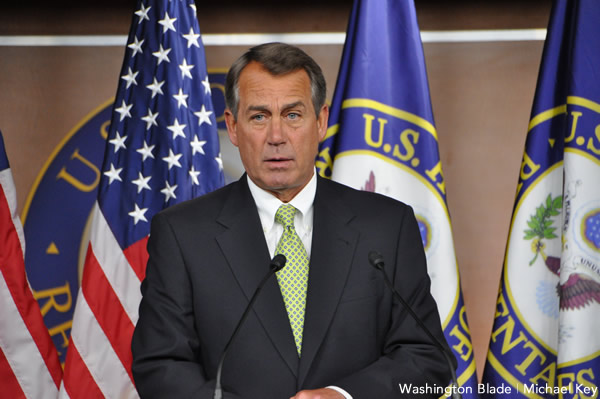
All eyes will be on Speaker John Boehner as advocates push for a House vote on ENDA. (Washington Blade file photo by Michael Key)

Supporters of the Employment Non-Discrimination Act are hoping to capitalize on the momentum from last week’s historic bipartisan Senate victory as they pursue a vote on the bill in the U.S. House.

Ten Senate Republicans voted for ENDA, which would prohibit most employers from discriminating on the basis of sexual orientation or gender identity. Their support gave the bill more bipartisan support than “Don’t Ask, Don’t Tell” repeal, which had just eight GOP votes, and more than any other pro-LGBT bill that has come to a vote in the Senate.

Liz Mair, a Republican political strategist who favors LGBT inclusion in the party, said the support that ENDA received in the Senate from Republicans demonstrates the party isn’t as opposed to LGBT rights as some observers might think.

“The fact that ENDA garnered 10 Republican votes in the Senate — and from a Republican caucus that is significantly less moderate than certain predecessor versions now that it lacks Scott Brown, Olympia Snowe, Judd Gregg and the like — is a reminder that the GOP is much more attuned to gay rights issues and much more in line with mainstream American attitudes on those issues than one would think from the image of the GOP that certain very conservative party leaders and the media tend to present,” Mair said.

The two Republican original co-sponsors — Sens. Susan Collins (R-Maine) and Mark Kirk (R-Ill.) — were joined in support by Sens. Rob Portman (R-Ohio), Kelly Ayotte (R-N.H.), Pat Toomey (R-Pa.), Dean Heller (R-Nev.), Orrin Hatch (R-Utah), Lisa Murkowski (R-Alaska) John McCain (R-Ariz.) and Jeff Flake (R-Ariz.).

Of those 10, the votes from McCain and Flake are particularly noteworthy because they represent a “red” state that President Obama lost in both 2008 and 2012. In addition, both senators expressed misgivings about ENDA before they ultimately voted for the bill.

Gregory Angelo, executive director of the Log Cabin Republicans, nonetheless said he wasn’t surprised by their support for the bill in the end.

“I know that both senators had expressed some hesitancy before casting their votes, but Flake is someone who voted for ENDA in 2007 when he was a member of the House, and Sen. McCain had even indicated that he would be open to supporting ENDA when he was running for president in 2008 — as part of, I believe, a questionnaire or interview he did with the Blade no less,” Angelo said.

A Senate source familiar with ENDA said McCain was able to support the bill after the adoption of the Portman-Ayotte amendment, which would prohibit federal, state and local governments from retaliating against institutions that invoke the religious exemption in the bill to discriminate against LGBT employees.

For Flake, who earlier told the Washington Blade he’d vote against ENDA because of the transgender protections in the bill, the Senate source said his support was solidified after he received assurances that businesses would receive guidance on the prohibition of gender identity discrimination.

Also significant on the Republican position on ENDA was the fact that Senate Minority Leader Mitch McConnell, according to Senate Republican aides familiar with the bill, didn’t whip the vote on the legislation and instead allowed members of his caucus to vote their conscience.

Angelo was among those who saw no evidence of Republican leadership instructing members to vote against ENDA.

“The fact that you had almost one-in-four members of the GOP caucus in the Senate vote in favor shows that membership was allowed to take a vote of conscience on this issue,” Angelo said.

Will the House vote on ENDA?

Now that the Senate has wrapped up its consideration of ENDA, attention has turned to passing the bill in the House, where Republican support will be necessary, first, to bring the bill to the floor and, second, to find 218 votes for the bill in the Republican majority chamber.

House Speaker John Boehner (R-Ohio) has indicated his opposition to the bill out of concern it would lead to “frivolous lawsuits” and a spokesperson for House Minority Leader Eric Cantor (R-Va.) was quoted in The Huffington Post as saying the bill “is currently not scheduled in the House.”

Nonetheless, Democrats ranging from Senate Majority Leader Harry Reid (D-Nev.) to gay Rep. Jared Polis (D-Colo.), ENDA’s chief sponsor in the House, insist that the House has enough votes for passage should it come to the floor.

Drew Hammill, a spokesperson for House Minority Leader Nancy Pelosi (D-Calif.), told the Blade his boss is among those who believe ENDA has sufficient support in the House for passage.

“Leader Pelosi has made it clear that there is sufficient support in the House to pass ENDA now,” Hammill said. “Instead of scheduling a vote on this measure, House Republicans are planning to vote for the 46th time to repeal or undermine the Affordable Care Act. There is only one man standing in the way of the expansion of workplace protections for millions of LGBT Americans. His name is John Boehner.”

ENDA has 196 House sponsors. That’s just 22 votes short of the necessary votes to pass the legislation on the House floor.

While the bill could technically come up at any time during the 13 months that remain in the current Congress, Polis said the legislation should come up sooner rather than later because, as Election Day approaches, members of the House will leave to campaign in their districts. It would be the first time that ENDA has come to the House floor since 2007, and the first time ever the chamber would consider a version of the bill that included transgender protections.

ENDA supporters claimed another Republican as their own last week when former White House Press Secretary Ari Fleischer, who served as spokesperson for former President George W. Bush, penned an op-ed in Politico urging the House to pass the bill.

“Allowing people to be successful in their workplaces is an essential piece of individual opportunity and liberty,” Fleischer said. “Working for a living is one of America’s freedoms. It’s a virtue to be encouraged — and supporting it is important to the future of the Republican Party.”

But not all LGBT advocates agree that sufficient votes exist to pass ENDA in the House. Some Republican supporters of the legislation stopped short of saying ENDA already has sufficient support to pass on the floor.

Jeff Cook-McCormac, senior adviser to the pro-LGBT Republican group American Unity Fund, said more work is needed when asked if ENDA is ready to move to the House floor.

“We’re encouraged by the momentum, working to identify and demonstrate majority support and committed to engaging legislators in the thoughtful and respectful conversations necessary to get there as quickly as possible,” Cook-McCormac said.

Mair said ENDA will be “a more uphill battle in the House” not only because of conservative worries over the bill’s content, but also out of fear of supporting anything seen as part of Obama’s agenda. Still, she wouldn’t rule out a surprise.

“Even back in 2007, ENDA garnered a noteworthy amount of GOP support in the House, including from some rather conservative members,” Mair said. “Thirty-five Republicans voted for ENDA then, including John Campbell, Jeff Flake, Thaddeus McCotter and Paul Ryan. So it will be interesting to see how it plays out this time around.”

For Cook-McCormac, the next priority is to build the number of Republican co-sponsors for ENDA. There are currently five: Reps. Charlie Dent (R-Pa.), Chris Gibson (R-N.Y.), Richard Hanna (R-N.Y.), Ileana Ros-Lehtinen (R-Fla.) and Jon Runyan (R-N.J.).

Dent told the Washington Post that Boehner “should allow a vote on this bill” because the American public believes the workplace should be free of discrimination.

Ros-Lehtinen said in a statement to the Blade that she also hopes Republican leadership will bring ENDA to the floor for a vote, but chose her words carefully about its prospects.

“The passage of ENDA by the Senate is a great first step toward making this bill law,” Ros-Lehitnen said. “I urge my colleagues in the House to sign on to the companion bill and hope House leadership will bring it up for a vote. I believe if it is brought to a vote, it has the opportunity to pass.”

Renee Gamela, a Hanna spokeswoman, said ENDA is good for business.

“Rep. Hanna would like ENDA to receive a vote in the House when it is clear that there are sufficient votes for passage,” Gamela said. “He intends to speak directly with his colleagues about why, as a small business owner, he believes supporting the legislation is good for economic competitiveness, individual liberty and our party.”

As articulated by Pelosi, one approach seen as a pathway for passage of ENDA in the House would be similar to what happened with reauthorization of the Violence Against Women Act. Amid public pressure, the House in February passed a bill with protections for LGBT victims of domestic violence after the Republican version of the bill without the provisions failed on the floor.

Log Cabin’s Angelo said whether a vote on ENDA will take place in the House “comes down to pressure” both from Republicans in the House who support it and advocates on the outside who want to see it passed.

“I think if you had a similar push that happened with the Violence Against Women Act, where you had a tremendous surge among grassroots, and you also had GOP members of Congress urging leadership to bring this up for a vote, you got there,” Angelo said. “But it’s going to take considerable pressure. I’m not a Pollyanna when it comes to prospects in the House, but I am cautiously optimistic.”


Advertisement
FUND LGBTQ JOURNALISM
SIGN UP FOR E-BLAST

U.S. Military/Pentagon

HRC holds retirement ceremony for ousted transgender servicemembers 

White House executive order bans openly trans military personnel

Published

on

From left: Colonel Bree B. Fram from the U.S. Space Force, Commander Blake Dremann from the U.S. Navy, Lt. Col. (Ret.) Erin Krizek from the Air Force, Chief Petty Officer (Ret.) Jaida McGuire from the Coast Guard, and Sgt. First Class (Ret.) Catherine Schmid from the Army at the Human Rights Campaign on Jan. 8, 2026. (Washington Blade photo by Joe Reberkenny)

When retirement celebrations are planned — especially military ones — crowded rooms are usually filled with joyous energy: smiling people celebrating over glasses of champagne and stories of “the good old days,” marking the moment when service members decide it is the right time to step back from work. This retirement event, however, felt more like a funeral than a major life milestone.

The Human Rights Campaign Foundation hosted an event on Jan. 8 in D.C. to commemorate the forced retirement of transgender servicemembers. The event was a direct result of President Donald Trump’s 2025 Executive Order 14183, titled “Prioritizing Military Excellence and Readiness,” which directed the Pentagon to adopt policies prohibiting trans, nonbinary, and gender-nonconforming people from serving in the military.

In the heart of the nation’s capital, mere blocks from where the president signed that executive order, five military members followed the traditional pomp and circumstance that military retirement celebrations demand — the U.S. Army’s passing of the NCO sword, the U.S. Navy’s reading of “The Watch,” speeches from colleagues and bells ringing, flags folded tightly while family members, and bosses talk about the peaks of their careers and sacrifices made to protect the Constitution. But the tears that could be heard and seen were not bittersweet, as they often are for the millions of Americans who came before them. They were tears of sadness, fear, and ultimately of acceptance — not agreement — that they were removed from their posts because of their gender identity.

Thousands of trans servicemembers were forced out of all six branches of the military after Executive Order 14183, joined by a February memo from Defense Secretary Pete Hegseth stating that trans and nonbinary individuals would no longer be eligible to join the military. The memo also directed that all trans people currently serving be separated from service because their gender identity supposedly goes against the military’s accession requirements and that, as a collective group, they “lack the selflessness and humility” required for military service.

For many trans servicemembers, their careers had suddenly come to an end. Unlike the five on stage on Jan. 8, they would not have a ceremony, the ability to say goodbye to a job they didn’t want to leave, or a packed room of supporters clapping and crying alongside them.

Colonel Bree B. Fram from the U.S. Space Force, Commander Blake Dremann from the U.S. Navy, Lt. Col. (Ret.) Erin Krizek from the U.S. Air Force, Chief Petty Officer (Ret.) Jaida McGuire U.S. from the Coast Guard, and Sgt. First Class (Ret.) Catherine Schmid from the Army were granted the chance to say goodbye to more than 100 years of combined service to the country.

“This ceremony is unprecedented — not because their careers fell short in any way, but because they shined so brightly in a military that cast them aside as unworthy,” said Maj. Gen. Tammy Smith (Ret.), who was the master of ceremonies for the roughly 5-hour event. “For every one of them, there are thousands of other transgender service members who were denied the opportunity to even reach this moment of retirement, despite records that mark them as among the best of the best.”

Shawn Skelly, former assistant secretary of defense for readiness under President Joe Biden and member of HRC’s board of directors, also spoke at the event. She emphasized that this is not a result of anything a trans servicemember did — or didn’t do — but rather a country trying to villainize them.

“Trans service members … are on the front lines, canaries in the coal mine of our democracy as to who can be seen as not just American, but among the best that America has to offer,” Skelly said.

Two members of Congress who have been at the heart of the fight for ensuring LGBTQ rights for Americans also addressed the crowd and the retiring officers: the first openly gay non-white member of the U.S. House of Representatives, U.S. Rep. Mark Takano (D-Calif.), and the first openly trans member of Congress, U.S. Rep. Sarah McBride (D-Del.).

“I want to begin by apologizing to our [trans] servicemembers and reiterating that your service and commitment to our nation does not go unnoticed,” Takano said. “I am sorry this administration has chosen to target you for no reason other than cruelty.”

“Each of you answered the call to serve. Each of you met the standards. And each of you served and led with integrity, professionalism, and courage,” said McBride. “Each of you are brave, honorable, and committed patriots who also dared to have the courage to say out loud that you’re transgender.”

Former Air Force Secretary Frank Kendall also gave a speech, noting that there was no reason for thousands of trans military members to lose their jobs and for the country to lose invaluable personnel that make the Armed Forces the best in the world.

“As I read the biographies of each of our retirees today, one thing came across to me,” former Kendall said. “It was how similar these read to those of all other retirees, and to others still serving. … It is a huge injustice, and an enormous loss to our nation that [they] … are not being allowed to continue to serve their country in uniform.”

Each service member had an introducer highlight their accomplishments before they gave their own heartfelt and pointed speeches, all of which can be watched in full on HRC’s YouTube page.

“I joined the military to be part of the solution … I learned that living authentically proved far more truthful and beneficial to not only myself but also my units than pretending to be someone else,” McGuire told the audience of family members, friends, LGBTQ rights activists, and former military personnel. “Being transgender never kept me from deploying, and I never failed to fulfill my duties.”

Despite the circumstances, McGuire said she would use this moment as an opportunity to continue serving.

“Even when it was forced upon you with no choice or discussion, [retirement] is still a new chapter … I’ll keep advocating for the rights and freedoms we all cherish,” McGuire said.

Schmid from the Army spoke about accepting the feeling of institutional betrayal after giving so much of herself to the service.

“The Army taught me what honor and integrity meant, and that integrity cost me the only thing I’ve ever really known how to do — it cost me being a soldier,” Schmid said. “Institutions fail people, but institutions are made of people, and that’s what I keep going back to … the soldiers, the people — that’s the Army that matters.”

Presik from the Air Force went next.

“Over my career, I’ve been called a hero and thanked for my service … I did all those things for the hope that I was making this country a better place for my three children and for your children and your families and your hopes as well,” Presik said, emphasizing that this was a fundamental policy failure, not a personal failure. “Now I have been separated from the Air Force, not because my performance, commitment, or ideals were found lacking, but because the policy changed on who could serve — and that reality is difficult to say out loud.”

“You matter. Your service matters, and you are not alone … transgender airmen are surrounded daily by so many fellow Americans who serve quietly and professionally,” Presik added, acknowledging that some trans people will continue to serve their country, even if it means hiding a piece of themselves until this policy is remedied.

Draiman from the Navy was fourth, emphasizing that his work serving the American people would continue despite retirement.

“I have spent my entire career pushing back against systems that too often treated my sex, my sexuality, or my gender as a measure of my capability under the guise of readiness,” Draiman told the crowd. “The work of dismantling hate and building better systems is far from over, and I still have more to give as I step out of uniform.”

Fram from the Space Force went last.

“My service was real. My dedication was real, and the years I gave to this country were given fully, honorably, and especially at the end with great pride,” she said with tears welling in her eyes — as did most of those in the audience. “Transgender service members are persons of character, not caricatures, and a society that justifies exclusion by denying our humanity needs to learn its lesson better from the Civil Rights Movement.”

“The uniform may come off, but the values it represents never will.”

Across the five branches of the military represented, each retiree carried countless honors and awards, evidence of their strength and dedication to protecting a country that elected a president who has now attempted to strip them of their service in both of his terms in office.

After the ceremony, the Washington Blade sat down with HRC Senior Vice President of Campaigns and Communications Jonathan Lovitz, to discuss why HRC decided to honor these five servicemembers.

“Why do this? Because they deserve nothing less. These are our heroes. These are our fellow Americans who have done more to serve this country than anyone who has been attacking them for that service,” Lovitz said. “These five are stand-ins for the thousands more, many of whose stories we’re never going to know, but it’s our obligation to find and uplift every single one of them.”

Multiple times during the ceremony, it was noted that military members vow to protect the Constitution rather than any individual in the White House. For Lovitz, that is the crux of why HRC felt the need to act.

“Civil rights protect all of us — or at least they’re supposed to. That’s at the heart of the Constitution … and that includes, and especially includes, our heroes who fight, sometimes die, to protect even those who would try to erase them.”

He ended the conversation by sharing a private moment with one of the retirees.

“I just hugged one of the honorees, and she said to me, ‘We never should have had to do this, but if we had to do it, this was the way.’ So I feel great that they feel loved and honored and seen and celebrated, and that so many leaders in the community were able to be here to lift them up.”

Continue Reading

Virginia

Mark Levine running in ‘firehouse’ Democratic primary to succeed Adam Ebbin

Outgoing gay Va. state senator has endorsed Elizabeth Bennett-Parker

Published

on

Former Virginia state Del. Mark Levine (D-Alexandria) (Washington Blade file photo by Michael Key)

Gay former Virginia House of Delegates member Mark Levine (D-Alexandria) is one of four candidates running in a hastily called “firehouse” Democratic primary to be held Tuesday, Jan. 13, to select a Democratic nominee to replace gay state Sen. Adam Ebbin (D-Alexandria)

Ebbin, whose 39th Senate District includes Alexandria and parts of Arlington and Fairfax Counties, announced on Jan. 7 that he was resigning effective Feb. 18, to take a job in the administration of Gov.-elect Abigail Spanberger.

The Jan. 13 primary called by Democratic Party leaders in Alexandria and Arlington will take place less than a week after Ebbin announced his planned resignation.

According to the Community News of Alexandria publication, a public debate between the four candidates was scheduled to take place one day earlier on Monday, Jan. 12, from 7-9 p.m. at the Charles Houston Recreation Center in Alexandria.

The winner of the so-called firehouse primary will compete in a Feb. 10 special election in which registered voters in the 39th District of all political parties and independents will select Ebbin’s replacement in the state Senate.

The other candidates competing in the primary on Tuesday, in addition to Levine, include state Del. Elizabeth Bennett-Parker, former Alexandria Vice Mayor Amy Jackson, and World Wildlife Fund executive Charles Sumpter.

Another Alexandria news publication, ALXnow, reports that Ebbin, Spanberger, and at least four other prominent Democrats in the Virginia General Assembly have endorsed Bennett-Parker, leading political observers to view her as the leading contender in the race.

“I have worked alongside Elizabeth and have seen her fight for the values of our community,” Ebbin said in a statement, ALXnow reports.

Arlington gay Democratic activist TJ Flavall said Parker-Bennett has attended LGBTQ community events and is known as an LGBTQ ally. 

Ebbin’s endorsement of Bennett-Parker over fellow gay politician Levine in the Jan. 13 firehouse primary follows what observers have said is a longstanding rivalry between the two over disagreements around legislative issues.

In 2021, Ebbin endorsed Parker-Bennett when she challenged Levine in the Democratic primary for his House of Delegates seat in the then 45th House District in Alexandria.

Parker-Bennett defeated Levine in that race at a time when Levine, in an unusual move, also ran for the position of lieutenant governor. He also lost that race.

ALXnow reports that in his Facebook announcement of his candidacy for Ebbin’s state Senate seat Levine discounted the relevance of the large number of prominent endorsements that Parker-Bennet has received. In campaigns that last for just a few days rather than weeks or months, “it’s about turnout,” ALX now quoted him as saying.

Levine, an attorney, has a longstanding record as an LGBTQ rights advocate. He worked as a legislative counsel to gay former U.S. Rep.  Barney Frank (D-Mass.) before becoming a radio talk show host and TV political commentator in Virginia prior to his election to the Virginia House of Delegates. 

The firehouse primary on Jan. 13, which is open only to voters with identification showing they live in the 39th District, will take place from 8:30 a.m. to 7 p.m. in these locations:

Alexandria: Charles E. Beatley, Jr. Public Library, 5005 Duke St.; and the Charles Houston Recreation Center, 901 Wythe St.

Arlington:  Aurora Hills Library, 735 18th St. S.

Annandale: New John Calvin Presbyterian Church, 6531 Columbia Pike

Continue Reading

The White House

Hundreds protest ICE killing of Renee Nicole Good in D.C.

Married queer woman shot in Minneapolis on Wednesday

Published

on

Hundreds of people took to the streets of D. C. on Thursday night to protest the killing of a U.S. citizen by a U.S. Immigration and Customs Enforcement agent.

Protests began at the busy — and increasingly queer — intersection of 14th and U Streets, N.W. There, hundreds of people held signs, shouted, and made their way to the White House to voice their dissent over the Trump-Vance administration’s choice to increase law enforcement presence across the country.

The protest, which also occurred simultaneously in cities large and small across the country, comes in the wake of the death of Minneapolis resident Renne Nicole Good at the hands of ICE Agent Jonathan Ross. Good left behind two children and a wife, Rebecca Good.

Records obtained by the Associated Press found that Ross was an Iraq War veteran and nearly two decades into his career with U.S. Border Patrol and ICE.

Good was gunned down just blocks away from where George Floyd was killed by police in 2020, sparking weeks of national protests. Minnesota officials say the FBI has blocked their access to an investigation into the fatal shooting, according to a BBC story published on Friday.

In the nation’s capital, protesters marched from the intersection of 14th and U Street to Lafayette Square, right outside the White House. Multiple D.C. organizations led the protest, most notably Free DC, a nonprofit that works to ensure the right of “self-determination” for District residents, as many local laws can be reviewed, modified, or overturned by Congress. Free DC had organized multiple protests since the Trump-Vance administration was elected.

The Washington Blade spoke to multiple protesters towards the tail end of the protest about why they came out.

Franco Molinari, from Woodbridge, Va., crossed the Potomac to partake in his first-ever protest.

“I don’t appreciate ICE and the use of federal agents being pretty much militarized against America,” Molinari said while holding a “Justice for Renee” sign. “The video of Renee being executed cartel style in her car was enough for me to want to come out, to at least do something.”

Molinari, like many others the Blade spoke with, found out about the protest on Instagram.

“It was my friend there, Sarah … had sent a link regarding the protest to a group chat. I saw it in the morning, and I thought, ‘You know what, after work, I’m head out.’”

He also shared why protesting at the White House was important.

“I already saw the response that the president gave towards the murder of Renee, and it was largely very antagonizing,” Molinari said.

President Donald Trump, along with federal leaders under him, claimed that Good “violently, willfully and viciously ran over the ICE officer.” The president’s claims have been widely discredited through multiple videos of the incident, which show Good was attempting to leave the scene rather than attacking the officer.

“I hope that anybody would be able to see that and see the response and see for themselves that it just is not correct,” Molinari said.

The Blade also spoke with leftist influencer Dave the Viking, who has more than 52,000 followers on TikTok, where he posts anti-fascist and anti-Trump videos.

“We’re out here to make sure that this regime can’t rewrite history in real time, because we all know what we saw … we’re not going to allow them to run with this narrative that they [ICE agents] were stuck in the snow and that that poor woman tried to weaponize her car, because we all saw video footage that proves otherwise,” he told the Blade. “We’re not going to let this regime, the media, or right-wing influencers try to rewrite history in real time and try to convince us we didn’t all see what we know we saw.”

Dave the Viking continued, saying he believes the perceived power of ICE and other law enforcement to act — oftentimes in deadly and unjustifiable ways — is a product of the Trump-Vance administration.

“There’s a line between fascism and anti-fascism. These motherfuckers have been pushing that envelope, trying to label an idea a terrorist organization, to the point of yesterday, crossing that line hardcore. You face the point of looking at history and saying there was this 1989, 2003 America, where we’re just going in, raiding resources. Where is this fucking 1930s Germany, where we’re going in and we’re about to just start clearing shit and pulling knots? Yeah, nope. We proved that shit yesterday.”

Two people were injured in another shooting involving federal agents, this time Border Patrol in Portland, Ore., on Thursday afternoon.

KC Lynch, who lives near American University, also spoke about her choice to protest with a group.

“I came out today because everything that ICE has done is absolutely unacceptable, not only killing this one woman, but also the fact that they’ve been imprisoning people in places that are literally, that have been literally on record by international organizations shown to be human rights violating. It’s unbelievably evil.”

Lynch also echoed Dave’s opinion about parallels between the Trump-Vance administration and the rise of Adolf Hitler in Nazi Germany.

“It’s literally what happened before the Holocaust. We should all be scared. We should all be angry. I’m so angry about it … even talking about it — I’m sorry,” she said before getting choked up.

Lynch emphasized that despite the circumstances in which people were protesting together, the sense of community was strong and powerful.

“I feel like it’s important for people to know that we’re angry, even if no policy changes come out of it, and it’s just nice to yell and be angry about it, because I feel like we’ve probably all been feeling this way, and it’s nice to be around people that are like minded and to like have a sense of community.”

Continue Reading

Popular