Local
Uproar after arrest of trans woman in D.C.
Activist Corado says aggressive police traumatized passengers
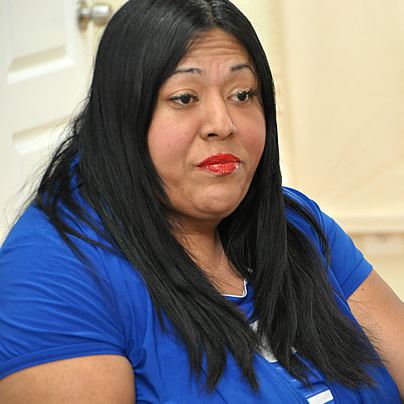
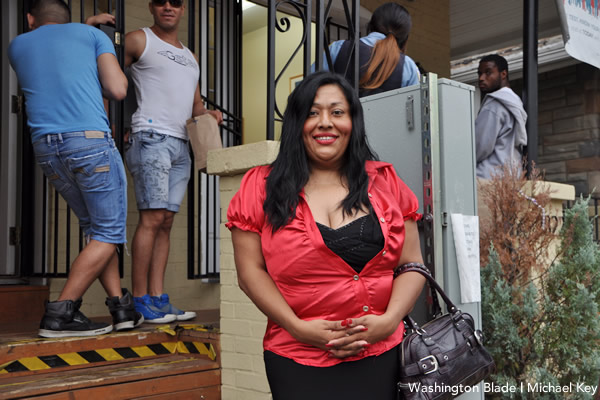
Ruby Corado said hostile D.C. police officers traumatized a group of young transgender and gay passengers in her SUV over the weekend. (Washington Blade photo by Michael Key)
Local LGBT activists on Facebook were in an uproar over the weekend when transgender advocate Ruby Corado posted a message claiming hostile D.C. police officers traumatized a group of young transgender and gay passengers in her SUV on Feb. 28 when they handcuffed and arrested a transgender woman for driving the vehicle without a valid license.
“I sat in my car as a passenger as we are driving my clients home after a support group when a police officer stopped us and in three minutes I witness a D.C. police officer turn into a very homo-transphobic cop,” Corado wrote in her Facebook posting.
Activists commenting on the incident noted it took place less than a week after Police Chief Cathy Lanier released a report conducted by an independent task force that found shortcomings in the department’s dealings with the transgender community.
Sgt. Matthew Mahl, supervisor of the department’s Gay and Lesbian Liaison Unit, told the Blade he looked into the matter after speaking with Corado and reading her Facebook comments. Mahl said that aside from one of the officers referring to the arrested woman by an incorrect pronoun and gender in a police report, he could not immediately identify any improper action by the officers on the scene.
“Anyone involved is welcome to file a formal complaint, which would enable us to look into this further,” he said.
Corado told the Blade she asked Patrice Williams, 51, a volunteer at Casa Ruby, the LGBT community center that Corado heads, to help her drive home three trans women and two young gay men who attended a support group meeting there last Friday night.
Saying she was too tired to drive, Corado said Williams, with Corado sitting in the front passenger seat, was driving north along the 5200 block of 13th Street, N.W. when a police car flashed its lights, prompting Williams to pull over and stop the vehicle.
Officer Ramon I. Moe states in a police report that he conducted a “traffic stop” after observing that two people were sitting in the vehicle’s cargo area “not occupying a seat without a seatbelt restraint.” He stated in the report that he requested an I.D. check for Williams by radio to the Fourth District dispatcher and discovered that Williams did not have a valid driver’s license.
“Suspect 1 [Williams] was placed under arrest for No Permit and transported to the Fourth District Station for processing,” Moe wrote in the report.
According to Corado, the transporting of Williams to the police station came after an ordeal in which the arresting officer and at least one other officer spoke to both Williams and Corado in a hostile manner. She said as many as three or four police cars arrived on the scene.
“I understand that they were going to arrest her for not having a license,” Corado told the Blade. “But my concern is the way they treated her.”
Corado and Williams, who also spoke with the Blade, said the officer’s attitude appeared to change after he saw that Williams’ identification document identified her as a male. Mahl said a more detailed police report not available to the public says Williams handed the officer her auto insurance card rather than a driver’s license.
“When the officer stopped us, I told him it was my car,” said Corado. “I said I am so sorry. I’m the director of an agency and I made the decision to seat the people in the back. I said we just got out of a meeting and it was freezing outside and I wanted to give my clients a ride home rather than have them wait for a bus.”
In her Facebook posting, Corado said, “Looking at his facial expressions, listening to his demanding voice, watching his intimidating body language as he questions and quickly arrests my black trans sister make my advocate persona come out and start questioning why my black sister is being arrested.”
Williams told the Blade the officer asked her if she was white. She said that when she told him she’s black, he appeared to be surprised.
She said she was sitting in the vehicle talking to the male officer who first approached her.
“All of a sudden hands grabbed me, the door swung open and a female officer pulled me out of the car,” Williams said. “They threw me up against the back of the car” and searched her, she said.
“It was verbal abuse and it was physical abuse,” she said of the officers’ conduct toward her.
Corado said the officers’ action and demeanor toward her and Williams caused a lot of stress for the three transgender women and the two gay men as they sat in the vehicle watching.
One of the passengers, Claudia Martinez, told the Blade she suffered an anxiety attack and Corado took her to the Washington Hospital Center for treatment after Corado drove the others home on the night of the incident.
“It just got to me,” Martinez said. “We were in the car for an hour or more.”
Added Corado: “Maybe I caused some of the hostility. I said I have people in the car who are very vulnerable. We were coming from a support group session. Could you be a little nicer?”
That’s when at least of one the officers appeared to become even more hostile toward her, she said.
She said it was then that she called Mahl of the GLLU and asked him to send a GLLU officer to the scene. Mahl said he immediately contacted GLLU Officer Juanita Foreman and asked her to respond to the scene. He said Foreman called him about 15 minutes later to confirm she had arrived on the scene, but she told him she did not see Corado and assumed that Corado left the scene.
Corado told the Blade she didn’t leave the scene until after police drove Williams to the Fourth District station. She said she assumes that Foreman missed seeing her and talked to Williams.
“If she talked to Kaprice, that’s good,” said Corado. “She didn’t need to talk to me.”
Corado and several of the dozens of people who added comments to her Facebook posting expressed concern that the officer stopped the vehicle as part of a “profiling” policy that singles out transgender women for special scrutiny.
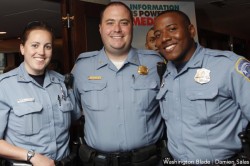
Sgt. Matthew Mahl (center). (Washington Blade photo by Damien Salas)
Mahl, however, noted that the SUV was stopped about 10:10 p.m. on a dark street and he doubts the officer could have determined the gender of the passengers before getting out of his squad car and walking up to the SUV to question the driver.
When asked about the officer’s description of Williams as a “male” on the police report, Mahl said doing that violated a police department general order that requires officers to ask transgender people or anyone whose gender may not be obvious which gender they prefer to be identified as.
“The order says we must ask the person what is your preferred gender and preferred name,” Mahl said. “They did put down ‘Kaprice’ as an aka,” he said. “We are always required to report the legal name of a person being arrested.”
Mahl said he would suggest that police officials treat this mistake as a “teachable moment” to make sure the officers involved in the arrest know about the general order for dealing with transgender citizens.
The police report identifies Williams by her birth name of Howard Williams.
Mahl said a longstanding police policy gives motorists a 90-day grace period after their driver’s license expires in which no penalty is given if they are stopped for a driving infraction. He said Williams had not had a valid, current license for more than a year.
“She was not treated any different than anyone else,” he said, whose license elapsed for more than 90 days.
Court records show that Williams was arrested in August 2013 on an identical charge of driving with “no permit.” The records show that case is still pending and Williams is scheduled to return to court for a status hearing on April 8.
She told the Blade on Monday that she currently has a valid learner’s permit and is in the process of arranging for a road test needed to obtain a new license. She said she meant to show the learner’s permit to the arresting officer during the incident last Friday but, while nervous and reaching into her purse, pulled out her insurance card instead.
Court records also show that Williams successfully applied for and was granted a legal change of her name to Kaprice Williams on July 2, 2013. She said she’s hopeful that the legal name change will protect her from future situations where her identity is questioned.
Corado said LGBT activists plan to raise the issue of police handling of Williams’ Feb. 28 arrest at a news conference being planned later this month to discuss a report released last week that assessed D.C. police handling of anti-LGBT hate crimes and the police relations with the LGBT community.
The report, prepared at the request of Police Chief Cathy Lanier by an independent task force, offers recommendations for improving LGBT-police relations and ways to improve police response to hate crimes.




Rehoboth Beach
Officials raise troubling concerns about Rehoboth mayoral candidate Suzanne Goode
Homophobic emails, ‘aggressive’ behavior cited: ‘It just seems to be getting worse’

As Rehoboth Beach voters prepare to elect a new mayor on Aug. 8, some city officials and local residents are raising new concerns about the behavior of City Commissioner and mayoral candidate Suzanne Goode.
In addition to a history of troubling emails in which she has used homophobic language and criticized the city’s rainbow crosswalks, Goode is being accused of inappropriate behavior by a neighbor and a fellow Commissioner related to a dispute on the Nextdoor online platform.
The Blade spoke to City Manager Taylour Tedder, Commissioner Chris Galanty, and others about Goode’s behavior during her time as commissioner.
Goode was elected commissioner in August 2024. Fellow commissioner Susan Stewart, who is also running for mayor, criticized Goode’s behavior in a March 9, 2026 meeting, bringing up emails outlining Goode’s offensive conduct toward city staff.
In one email, Goode wrote to Rehoboth Beach City Solicitor Lisa Borin Ogden: “I am sorry that I learned from Google when you were first interviewed [in the] spring [of] 2025 that you are Jewish. My opinion of my fellow Jews declined significantly thanks to you since last summer. Actually would have thought you would have more compassion than the average person, based on your late brother. Except you don’t. I am sick of your haughty attitude toward me.”
In other emails, Goode questions why city officials encouraged CAMP Rehoboth and Clear Space Theatre to apply for grant funds. She has denigrated both institutions, referring to CAMP as a “questionable non-profit” and Clear Space as “second rate” with a “woke, drag queen bent” at times. She accuses Rehoboth’s LGBTQ community of displaying “their sex lives in public view” and fears physical violence from LGBTQ activists.
Goode disputed the claims and called for the city to remove Stewart’s remarks from the website.
The following statements were included in the emails sent by Goode:
• “Gays and theatre aficionados can donate as much as they like to these pet causes. Some taxpayers think the theatre is second-rate as community theatres go, and many dislike the RB emphasis on LGBTQ when heterosexuals don’t demand equivalent display of their sex lives in public view.”
• “Just because the LGBTQ community feels oppressed and discriminated against, that doesn’t mean that those who identify as LGBTQ are better able to recognize racial discrimination than someone like myself. It might surprise some of you to learn that I briefly dated an African American fellow college student.”
• “A performing arts and LGBTQ agenda isn’t appropriate for BOC spending when the city faces over $60M in debt.”
• “But there are some folks in town, who ironically have to remain in the closet (conservatives now have to do what gays had to do in the 20th century — ah, the irony) who object to the woke, drag queen bent of Clear Space at times. They have confided this in me, and thanked me for fighting for their tax dollars. Maybe I will regret speaking up, as some LGBTQ activist will attack me physically, even though I am a complete supporter of gay rights, and have as many gay male friends as female friends now that I live in RB with a large gay population.”
In the emails, Goode also referred to City Manager Tedder as “the mayor’s whore.”
Stewart told the Blade that the troubling behavior has since escalated.
Commissioner Chris Galanty spoke to the Blade about Goode’s behavior as commissioner and her issues with the rainbow crosswalks in town.
“Suzanne told me on two separate occasions that she didn’t like the rainbow crosswalks, and she said that she didn’t understand why they had to exist, and she didn’t understand why gay people had to advertise their sexuality, and she said straight people don’t have to do that.”
Galanty said that when he challenged her on this, she “moved very quickly to another topic.” He said that she has now shifted her perspective and is more concerned that the rainbow crosswalks are an issue of labor costs.
Goode told the Blade that, “Unfortunately, the rainbow crosswalks have potentially reduced the upkeep of the conventional crosswalks. But the rainbow crosswalks are attractive in and of themselves, and they do add to our recognition of Rehoboth’s longstanding status as a gay-friendly town.”
Accusations of “aggressive” behavior by Goode aren’t limited to emails. Last summer, Goode came to the home of Diana Jones, a property owner in Rehoboth Beach who is a neighbor of Galanty’s. Jones spoke to the Blade to share her experience with Goode.
Jones is active on Nextdoor, an online social network for neighborhoods. She said that she got involved on the platform during the time of the commissioners election last summer, in which her neighbor, Chris Galanty, was elected as commissioner.
Jones said that she made posts supporting Galanty. She said that someone posted a link of a lawsuit that involved Goode’s husband, Jeffrey Goode, who lost his race for commissioner last summer. Jones said that she reposted the link after it was taken down.
Jones said that the lawsuit was “very relevant to somebody who is running for city commissioner.”
Jones said that Suzanne Goode showed up at her house as a result of the post. Jones was out walking her dog nearby so Goode briefly spoke with Jones’s husband who was home.
“She came over to my house because she was saying I was doxing him,” said Jones. Jones said that Goode then found her as she was walking her dog and tried to talk to her about her Nextdoor posts, saying that she “brought up a very painful time in her life.”
Jones said that she has not had any communication with Goode since.
When asked for comment on the situation with Jones, Goode responded by saying “Diana Jones’s behavior toward me was despicable, and the way she has chosen to give her side of the story to news media says more about her than it will ever say about me.”
Galanty told the Blade that Goode came to his house in late June of this year when he was not home. She then called him about Jones.
“She relayed to me that she was having a disagreement with my neighbor on the Nextdoor platform, and she asked me to intercede with the neighbor,” said Galanty. “She said, ‘Please speak to her because I am frustrated with what she is saying. She needs to stop, and you need to say something to her.'”
Galanty said that Goode called him four times and texted him 32 times in the span of three and a half hours the next day.
Galanty said that he responded the next day, telling her that her behavior was inappropriate.
“Eventually it took a couple of weeks, but she apologized in her own way. She just said we just need to let it go.”
From his perspective as commissioner, Galanty said, “She likes to re-litigate things that have happened, six months ago, nine months ago. She likes to rehash issues that are in the past.”
“She can be really aggressive, and people are just really turned off by her,” said Galanty.
Tedder, who has accused Goode of creating a “hostile work environment,” told the Blade about his experiences working with Goode.
“She does not support the staff, and constantly tells us to resign,” said Tedder.
Tedder said that Goode texted City Solicitor Ogden at 7:45 a.m. on a Saturday, telling her to resign.
“Sometimes she does have good ideas. It’s just it gets so lost in these pages and pages of emails and thousands of emails that she sends,” said Tedder.
In regards to Goode’s behavior, Tedder said it has been going on since the beginning. “It just seems to be getting worse.”
Maryland
Advocates for trans students urge Md. to fight White House threats
Four school districts under federal investigation
By JESSICA CALEFATI | Allies of transgender children are urging state education officials to fight back against the Trump-Vance administration, which has threatened to punish a growing number of Maryland school districts over local policies that affirm students’ gender identities.
The advocates testified Tuesday morning before the Maryland State Board of Education — one day after the U.S. Education and Justice departments alleged that Anne Arundel County’s school system violated federal student privacy law by withholding a student’s gender identity from their parents. A spokesperson for the district said Monday legal counsel had not yet reviewed the claims and that the district had no further comment.
School districts in Prince George’s, Montgomery, and Frederick Counties were already under investigation for allegedly violating Title IX, the civil rights law that prohibits sex-based discrimination. The federal government last month threatened to revoke funding from the districts because they allow trans students to use restrooms and locker rooms that align with their identities.
The rest of this article can be read on the Baltimore Banner’s website.
Maryland
White House threatens Anne Arundel schools over gender identity policy
District faces possible legal action or loss of federal funding
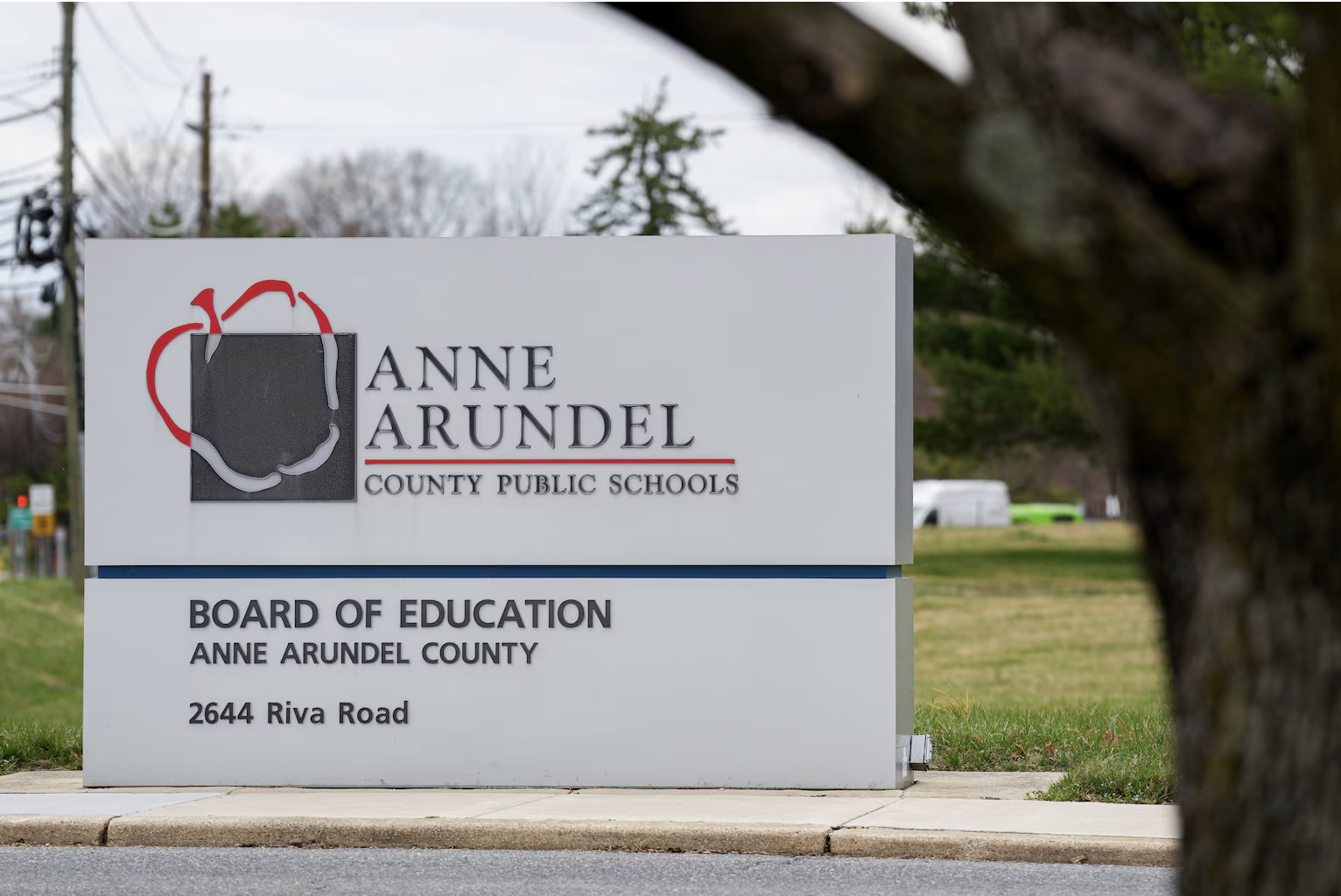
By JESSICA CALEFATI | The Trump-Vance administration on Monday threatened to punish Anne Arundel County’s school system with legal action or the loss of federal funding for allegedly withholding information about a student’s gender identity and transition from the child’s parents.
The U.S. Education and Justice Departments together determined that the suburban Maryland district treats students’ gender identities as confidential medical information that cannot be shared with parents, in violation of federal student privacy law, according to a news release. A federal lawsuit filed against the district earlier this month made similar claims.
“As a mother and a grandmother, it is unconscionable that any school district would hide the most sensitive information about children in their care from their own parents,” U.S. Secretary of Education Linda McMahon said in a statement. “This is not only an affront to basic moral principles, but also to parents’ rights under federal law.”
The rest of this article can be read on the Baltimore Banner’s website.

PHOTOS: Petal Release Party

Madonna headlines World Pride Music Festival in Amsterdam

Reggie White relishing first season as artistic director of Woolly Mammoth

PHOTOS: Amsterdam Pride Canal Parade

Amsterdam Pride Canal Parade draws hundreds of thousands

Madonna to perform at World Pride in Amsterdam

BLADE ENDORSEMENT: Susan Stewart for mayor of Rehoboth Beach

PHOTOS: Lambda Legal in the Pines

Calendar: July 31-August 6