News
Nearly 200 lawmakers seek action from Obama for LGBT workers
Dem leaders, zero Republicans, call for executive order
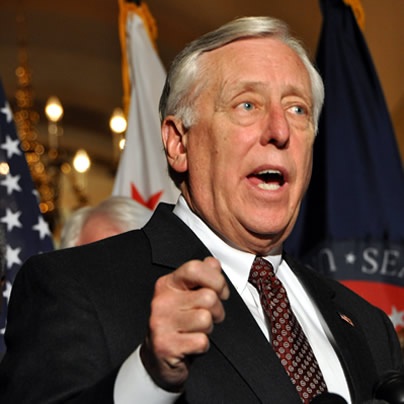
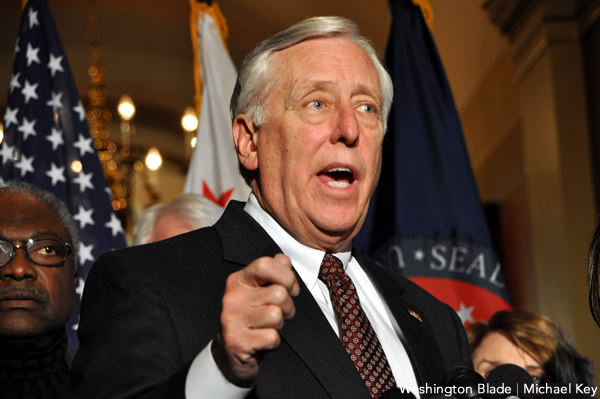
House Minority Whip Steny Hoyer (D-Md.) was the highest-ranking congressman to call for the ENDA executive order. (Washington Blade photo by Michael Key)
As legislation to protect LGBT workers from discrimination continues to languish in the U.S. House, an unprecedented number of nearly 200 lawmakers on Tuesday — including members of House Democratic leadership — called on President Obama to take administrative action.
In a letter dated March 18, 148 House members and 47 senators — making for a total of 195 lawmakers — urged Obama to sign an executive order barring federal contractors from discriminating on the basis of sexual orientation and gender identity as part of his plan for a “Year of Action” in 2014.
“As we continue to work towards final passage of the Employment Non-Discrimination Act (ENDA) with strong bipartisan support, we urge you to take action now to protection millions of workers across the country from the threat of discrimination simply because of who they are or who they love,” the letter says. “We are committed to doing all that we can in Congress to get ENDA to your desk this year; however, there is no reason you cannot immediately act by taking this important step.”
The letter says “time is of an essence” for a signature on the executive order because even when that happens, a process that “will take many months, if not longer” to implement the directive fully will be necessary.
In the House, the letter was circulated by the LGBT Equality Caucus along with Reps. Frank Pallone (D-N.J.) and Lois Capps (D-Calif.), while ENDA’s chief sponsor in the Senate Jeff Merkley (D-Ore.) circulated the letter in that chamber with Sens. Tammy Baldwin (D-Wis.) and Tom Harkin (D-Iowa).
It’s not the first time members of Congress have penned their names to a letter calling on Obama to take administrative action to protect LGBT workers from discrimination. In 2011, Pallone and Capps led an effort to sign a similar letter, which at the time was signed by 72 House members. In 2013, they circulated another letter on the issue signed by 110 House members as Merkley submitted yet another missive signed by 37 senators.
The series of letters from lawmakers over the course of recent years — in addition to regular questioning on the issue for White House Press Secretary Jay Carney — have been to Obama on the executive order as LGBT advocates have pressed for it for some time.
But the latest missive has more lawmakers calling for the executive order than the 2013 letter and, for the first time, has members of Democratic leadership as signatories: House Minority Whip Steny Hoyer (D-Md.) and Assistant Minority Leader Jim Clyburn (D-S.C.). The Blade first reported Hoyer would sign the letter on Monday.
Although House Minority Leader Nancy Pelosi has publicly said she supports the executive order as far back as 2011 she didn’t sign the letter. Drew Hammill, a Pelosi spokesperson, said his boss rarely signs group letters and would raise the issue in a private missive to Obama.
Also missing from the letter is Senate Majority Leader Harry Reid (D-Nev.), who also gave his green light for the potential directive in January. Reid’s office indicated that he doesn’t typically sign member letters.
Rep. Debbie Wasserman Schultz (D-Fla.), chair of the Democratic National Committee, also didn’t pen her name to the letter. Last week, sources told the Blade she had discouraged members from signing previous iterations of the letter, but her office called that assertion a “bald-faced lie.” She hasn’t articulated support for the executive order.
Not a single Republican signed the letter. Not one of the 10 Republicans who voted for the Employment Non-Discrimination Act in the Senate late last year or any of the six GOP co-sponsors of ENDA in the House penned their name to the missive.
Tico Almeida, president of Freedom to Work, said his organization helped to secure signatures for the letter — and hopes it’ll be the last time the effort is necessary.
“This week, we collaborated with the Equality Caucus for the third time to collect signatures on the 2014 letter to President Obama on the same topic,” Almeida said. “These year-after-year delays from the White House are making this all start to feel like Bill Murray’s ‘Groundhog Day,’ and I really hope we don’t have to push for yet another congressional letter to President Obama in 2015 or 2016 or a letter to President Hillary Clinton in 2017. It’s long past time for President Obama to keep his word and create LGBT workplace protections at the companies that profit from taxpayer-funded contracts.”
The White House has responded to other letters like this one in the past by saying it has no updates to provide on a “hypothetical” executive order protecting LGBT workers. It didn’t respond to comment on the latest letter.
Last week, Carney reiterated Obama’s support for the Employment Non-Discrimination Act when asked about the executive order.
“Our view is that Congress ought to pass the Employment Non-Discrimination Act,” Carney said. “I don’t have any updates for you on possible executive orders. What we’re focused on is on a legislative remedy that would be more comprehensive and that has already seen progress in Congress. So I don’t have a view to express on that particular issue.”
Lawmakers who organized the signature-gathering for the letter in both the House and Senate issued their own words on the importance of Obama signing the executive order.
Merkley said signing the executive order would help ensure LGBT people have access to equal opportunity in the workplace.
“All Americans deserve fairness in the workplace,” Merkley said. “There is no reason to wait any longer to extend non-discrimination policies to federal contractors and protect millions of Americans from being fired for who they are or who they love.”
Capps said in a statement she hopes Obama “will immediately sign an executive order” to protect LGBT workers against discrimination.
“This issue has lingered for far too long and this year, in the president’s year of action, he should take this opportunity to expand employment protections,” Capps said. “Doing so would be a significant and meaningful advancement for LGBT Americans—legally, politically, and culturally. With workers across the country facing discrimination every day, the time is now to make sure workplace discrimination isn’t supported by taxpayer funds.”
As Capps observes, the Williams Institute published a report finding that the executive would extend non-discrimination protections to the estimated 16.5 million employees at federal contractors. (The number of people within this population who are LGBT is estimated to be smaller and between 400,000 and 600,000 people.)
Capps added that she been pushing Obama to sign the executive order for years and “will not stop pushing this issue — it is time for the president to act.”




Japan
Japanese Supreme Court to consider marriage equality
Japan only G7 country that does not legally recognize same-sex couples
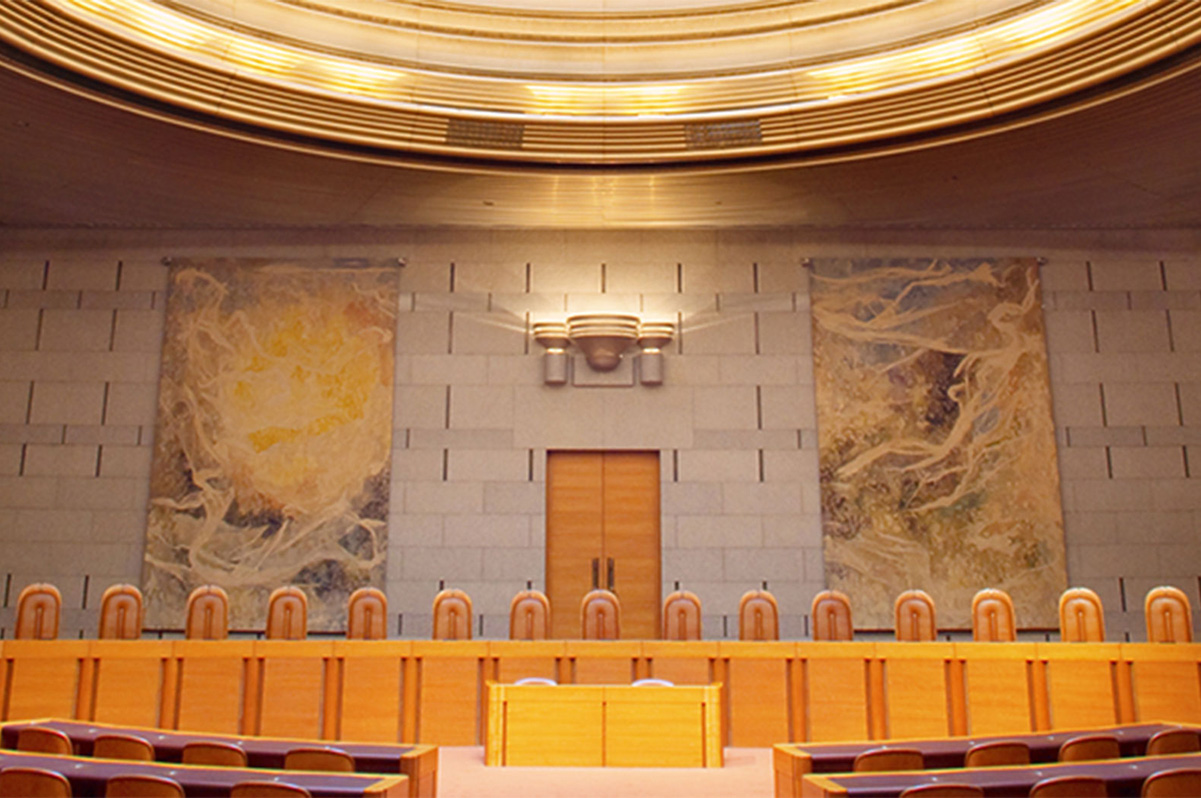
The Japanese Supreme Court on Wednesday said it will consider six marriage equality lawsuits.
NHK, the country’s public broadcaster, noted all 15 of the court’s justices will consider the case.
Japan is the only G7 country that does not legally recognize same-sex couples, despite several court rulings in recent years that found the denial of marriage benefits to gays and lesbians unconstitutional.
Tokyo High Court Judge Ayumi Higashi last November upheld Japan’s legal definition of a family as a man and a woman and their children.
Prime Minister Sanae Takaichi, who became the country’s first female head of government last October, opposes marriage rights for same-sex couples. She has also reiterated the constitution’s assertion that the family is an institution based around “the equal rights of husband and wife.”
Same-sex couples can legally marry in Taiwan, Nepal, and Thailand.
NHK reported the Supreme Court is expected to issue its ruling in early 2027.
Botswana
Lorato ke Lorato: marriage equality, democracy, and the unfinished work of justice in Botswana
High Court considering marriage equality case

As Botswana prepares for the resumption of a landmark marriage equality case before the High Court on July 14–15, the country finds itself at a critical constitutional crossroads.
At first glance, the matter may appear to be about whether two women, Bonolo Selelelo and Tsholofelo Kumile, can have their love legally recognized. At its core however, this case is about something far more profound: the dismantling of patriarchy, the decolonization of law, and the integrity of Botswana’s constitutional democracy.
Beyond marriage: a question of power
Marriage, as a legal institution, has never been neutral. It has historically functioned as a mechanism for regulating women’s bodies, sexuality, and social roles within a patriarchal order. To deny LBQ (lesbian, bisexual, and queer) women access to marriage is not merely to exclude them from a legal benefit, it is to reinforce a hierarchy of relationships, where heterosexual unions are deemed legitimate and all others invisible. This case therefore challenges the very foundations of who gets to love, who gets to belong, and who gets to be protected under the law.
As feminist scholars have long argued, patriarchy is sustained through institutions that appear ordinary but are deeply political. The law is one such institution. And it is precisely here that this case intervenes: by asking whether Botswana’s legal system will continue to uphold exclusion, or evolve to reflect the constitutional promise of equality.
A constitutional journey: Botswana’s courts and human dignity
This is not the first time Botswana’s courts have been called upon to affirm the dignity of LGBTQI+ persons. Over the past decade, the judiciary has built a progressive body of jurisprudence grounded in equality, nondiscrimination, and human dignity.
In Attorney General v. Rammoge and Others (Court of Appeal Civil Appeal No. CACGB 128-14, 2016), the Court of Appeal upheld the right of LEGABIBO to register as an organization. The court affirmed that:
“The refusal to register the appellant society was not only unlawful, but a violation of the respondents’ fundamental rights to freedom of association.”
This was followed by the ND v. Attorney General of Botswana (MAHGB-000449-15, 2017) case, where the High Court recognized the right of a transgender man to change his gender marker. The court held:
“Gender identity is an integral part of a person’s identity … and any interference with that identity is a violation of dignity.”
In Letsweletse Motshidiemang v. Attorney General (MAHGB-000591-16, 2019), the High Court decriminalized same-sex activity, declaring sections of the Penal Code unconstitutional. Justice Leburu powerfully stated:
“Human dignity is harmed when minority groups are marginalized.”
This decision was affirmed by the Court of Appeal in Attorney General v. Motshidiemang (CACGB-157-19, 2021), where the court emphasized:
“The Constitution is a dynamic instrument … it must be interpreted in a manner that gives effect to the values of dignity, liberty, and equality.”
These cases collectively establish a clear principle: the Constitution of Botswana protects all persons, not just the majority.
The marriage equality case now asks a logical next question: If LGBTQI+ persons are entitled to dignity, identity, and freedom from criminalization, why are their relationships still denied recognition?
Decolonizing the law: What is truly ‘UnAfrican’?
Opponents of marriage equality often argue that homosexuality is “unAfrican.” This claim, while politically powerful, is historically inaccurate. Same-sex relationships and diverse gender identities have existed across African societies long before colonial rule. What is foreign, however, are the laws that criminalize these identities.
Botswana’s anti-sodomy laws were inherited from British colonial legal systems, not from indigenous Tswana culture. As scholars of African history have demonstrated, colonial administrations imposed rigid Victorian moral codes that erased and suppressed existing sexual diversity. To claim that homosexuality is unAfrican, while defending colonial-era laws, is therefore a contradiction.
A truly decolonial approach to the law requires us to ask: Whose morality are we upholding? And whose history are we erasing?
Marriage equality, in this sense, is not a Western imposition: it is part of a broader project of reclaiming African dignity, plurality, and humanity.
Democracy on trial: the question of separation of powers
This case also raises important questions about the health of Botswana’s democracy.
Following the 2021 Court of Appeal decision affirming the decriminalization of same-sex relations, Botswana witnessed public demonstrations, including marches led by groups such as the Evangelical Fellowship of Botswana (EFB), opposing the judgment and calling for the retention of discriminatory laws.
While public participation is a cornerstone of democracy, these events raise deeper concerns about the separation of powers. Courts are constitutionally mandated to interpret the law and protect fundamental rights, even when such decisions are unpopular. When judicial decisions grounded in constitutional principles are publicly resisted on moral or religious grounds, it risks undermining the authority of the courts and the rule of law itself.
Democracy is not simply about majority opinion: it is about the protection of minority rights within a constitutional framework.
Botswana is not a theocracy
It is also important to clarify a recurring misconception: Botswana is not a Christian nation.
Botswana is a secular constitutional democracy and more accurately, a pluralistic society that recognizes and respects diversity of belief, culture, and identity. The Constitution does not elevate one religion above others, nor does it permit religious doctrine to dictate legal rights. The law must serve all citizens equally, regardless of faith.
To frame marriage equality as a threat to Christianity is therefore misplaced. The question before the courts is not theological, but constitutional: Does the exclusion of same-sex couples from marriage violate the rights to equality and nondiscrimination?
Love, equality, and the future of justice
At its heart, this case is about love, but it is also about power, history, and justice. It asks whether Botswana is prepared to move beyond colonial legal frameworks and patriarchal norms, and to embrace a future grounded in equality, dignity, and inclusion.
It asks whether the Constitution will continue to be interpreted as a living document, one that evolves with society, or remain constrained by outdated moral assumptions. Ultimately, it asks whether Botswana’s democracy can hold true to its founding promise: that all persons are equal before the law.
As the High Court prepares to hear this case in July 2026, the nation has an opportunity to affirm not only the rights of two individuals, but the broader principle that love, in all its diversity, deserves recognition, and protection.
Lorato ke lorato.
Love is love.
Justice, if it is to mean anything at all, must make space for it.
Nozizwe is the CEO of LEGABIBO (Lesbians, Gays and Bisexuals of Botswana)
District of Columbia
‘No Kings’ protests set for D.C.
Anti-Trump demonstrations to take place across country on Saturday

As President Donald Trump and his administration escalate rhetoric targeting transgender youth and student athletes, push efforts to restrict voting access for millions of Americans, and pursue foreign policy decisions that critics say bypass congressional authority, organizers across the country are once again mobilizing in protest.
For many LGBTQ advocates, the moment feels especially urgent.
In recent months, activists have pointed to a surge in anti-trans legislation, attacks on gender-affirming care, and efforts to roll back nondiscrimination protections as direct threats to the safety and visibility of queer and trans communities. Organizers say the demonstrations are not just about policy, but about defending the right of LGBTQ people — particularly trans youth and people of color — to live openly and safely.
Thousands of “No Kings” protests are planned nationwide, with multiple demonstrations set to take place in D.C.
One of the primary events, “No Kings Washington,” will be held in Anacostia, an overwhelmingly Black area of D.C. that is often at the center of conversations around racial justice, policing, and access to resources in the nation’s capital.
The protest in Anacostia is focused on what organizers describe as the “power behind the throne,” specifically Stephen Miller, the White House Deputy Chief of Staff for Policy and Homeland Security Advisor. Miller has been closely associated with the administration’s “zero tolerance” immigration policy, including the family separation practice that resulted in thousands of children being separated from their parents at the Southern border.
Activists have also linked immigration enforcement policies to broader concerns about LGBTQ migrants, including queer asylum seekers who often face heightened risks of violence and discrimination both in their home countries and within detention systems.
Anacostia protest details:
Participants are asked to gather starting at 1:30 p.m. on the southeast side of the Frederick Douglass Bridge. The closest Metro station is Anacostia on the Green Line, about an 8-minute walk from the starting point. Organizers strongly encourage attendees to use public transportation, as street parking is limited.
The march will proceed past Fort McNair and conclude near the Waterfront Metro station.
D.C. icon and LGBTQ activist Rayceen Pendarvis is set to speak at the protest around 2 p.m.
Kalorama protest details:
A separate protest will take place earlier in the day in Kalorama, a neighborhood long associated with political power and home to presidents, cabinet officials, and foreign ambassadors. Demonstrators are expected to gather at 10 a.m., with a march running until approximately noon near the intersection of Connecticut Avenue and Kalorama Road.
Arlington/National Mall protest details:
Another group is expected to assemble at Memorial Circle near Arlington National Cemetery at 10 a.m. before crossing the Memorial Bridge into D.C., passing the Lincoln Memorial and continuing on to the Washington Monument. Organizers say the march is intended to defend “American democracy, the rule of law, and a healthy planet.”
Unlike last June — when organizers discouraged large-scale demonstrations in D.C. due Trump’s military/birthday parade — activists are now explicitly calling on people to show up in the nation’s capital and surrounding areas.
The protests also coincide with Transgender Day of Visibility weekend, which includes additional gatherings and celebrations on the National Mall. At the same time, peak bloom for the National Cherry Blossom Festival is expected to draw large crowds to the city. With multiple major events happening simultaneously, officials and organizers anticipate significant congestion, increased traffic, and crowded public transit throughout the weekend.
Organizers are urging participants to plan ahead and come prepared.
“Bring your signs, noisemakers, music, and creative ideas, and gather in joyful, nonviolent protest,” they said. “Children are very welcome.”
For more information, visit nokings.org.

Japanese Supreme Court to consider marriage equality

The outrage economy is not the LGBTQ community

Calendar: March 27-April 2

Celebrate cherry blossoms the drag way

Lorato ke Lorato: marriage equality, democracy, and the unfinished work of justice in Botswana

PHOTOS: Capital Stonewall Democrats 50th anniversary

Polish court rules country must recognize same-sex marriages from EU states

Capital Stonewall Democrats 50th anniversary gala draws sold out crowd

Trans Day of Visibility events planned

Virginia General Assembly’s 2026 legislative session ends
-

 Photos4 days ago
PHOTOS: Capital Stonewall Democrats 50th anniversary
-
Poland4 days ago
Polish court rules country must recognize same-sex marriages from EU states
-
District of Columbia4 days ago
Capital Stonewall Democrats 50th anniversary gala draws sold out crowd
-
District of Columbia3 days ago
Trans Day of Visibility events planned