Local
Couple walks out during anti-gay sermon
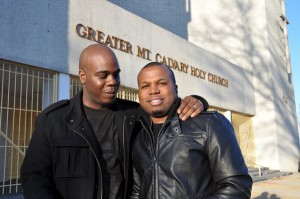
Jon Mack and Michael Garrett (DC Agenda photo by Michael Key)
Jon Mack and his partner, Michael Garrett, said their one-year tenure as members of Greater Mount Calvary Holy Church in Northeast D.C. came to an abrupt end last week.
The two gay men said they were startled and deeply hurt when Bishop Alfred Owens, the church pastor, appeared to be sending them and other same-sex couples a blunt message Jan. 3.
“Sex is only pleasing to God in the marriage bed, and the marriage bed is a man and … a woman!” Owens shouted from the pulpit, with hundreds in the church pews shouting their approval, according to accounts by Mack and Garrett.
Owens’ remarks are also captured on a recording of his sermon made available last week on the church’s web site.
“If marriage wasn’t between a man and a woman, you wouldn’t be here because two men doing it don’t produce no kids,” Owens said. “And two women doing it don’t produce no kids! It’s all about family,” he said as members of the congregation continued to clap and cheer.
“During this homophobic rant, me and my partner got up and walked out,” said Mack, 28.
Mack and Garrett, 32, contacted DC Agenda about their decision to walk out on Owens’ sermon and are believed to be the first gays to publicly disclose their departure from a church that activists say has a large number of closeted gay members, mostly black.
“What hurt me more than what he said is how the congregation yelled and agreed with him,” Mack said. “It showed me that people that don’t even know me hate me just because of my sexuality.”
Mack and Garrett said they were aware of reports that Owens had previously made anti-gay remarks during his sermons at Greater Mount Calvary, which boasts a membership of more than 6,000 people. But the two noted they were attracted to the church’s charismatic, highly animated services, which include performances by several different choirs.
Owens previously drew media attention in 2006 when, in one of his recorded sermons on the Sunday before Easter, he referred to gays as faggots.
“It takes a real man to confess Jesus as Lord and Savior,” he said in the 2006 sermon. “I’m not talking about no faggot or no sissy. … Let the real men come down here and take a bow — all the real men. I’m talking about straight men. … Praise God that you’re straight.”
His references to gays in the sermon prompted LGBT activists to ask then D.C. Mayor Anthony Williams to expel Owens from a mayoral task force on faith. In response, Owens issued an apology, which prompted Williams to announce he would retain the minister on the faith task force.
Garrett said his initial reaction upon hearing Owens’ hostile references to gays in the Jan. 3 sermon was to blame himself for continuing to attend Greater Mount Calvary services, despite the reports from friends and acquaintances that Owens is hostile to gays.
“Since going there for the past year, I never heard anything out of the way like that,” Garrett said. “So a lot of it was inspirational up until that point. And it kind of took me aback. … And then due to the fact that Jon and I are together and we’re going to see about getting married in D.C., it really was like, ‘Why am I supporting this person? How come I couldn’t see this beforehand?’”
Mack and Garrett, who live in Bowie, Md., said they now plan to worship at Covenant Baptist Church in Southeast D.C, which bills itself as an LGBT-affirming congregation. The church’s husband and wife co-pastors, Dennis and Christine Wiley, served as leaders of a coalition of clergy in support of same-sex marriage in D.C.
The two men said they’re hopeful that other gays will leave Greater Mount Calvary and other churches whose pastors and congregations are hostile toward or unwelcoming of LGBT members.
“I was depressed and actually thought about suicide,” Mack said. “I kept thinking, ‘What’s the point of going on if God hates me and I’m going to hell anyway?’ and ‘Why does God hate me?’
“My hope is if this is put in the paper or in the media and it deters one person from attending Greater Mount Calvary Holy Church so they never have to feel how I felt [that] Sunday, then I’ll feel as though I’ve accomplished something,” Mack said.
Leaders of three D.C. Christian churches with mostly gay congregations have called on gay members of churches such as Greater Mount Calvary to consider joining their congregations. The leaders are Rev. Abena McCray, pastor of Unity Fellowship Church; Bishop Rainey Cheeks, pastor of Inner Light Ministries; and Rev. Dwayne Johnson, pastor of Metropolitan Community Church of Washington.
District of Columbia
How Pepper the courthouse dog helps victims of abuse
Reshaping how the legal system balances compassion with procedure
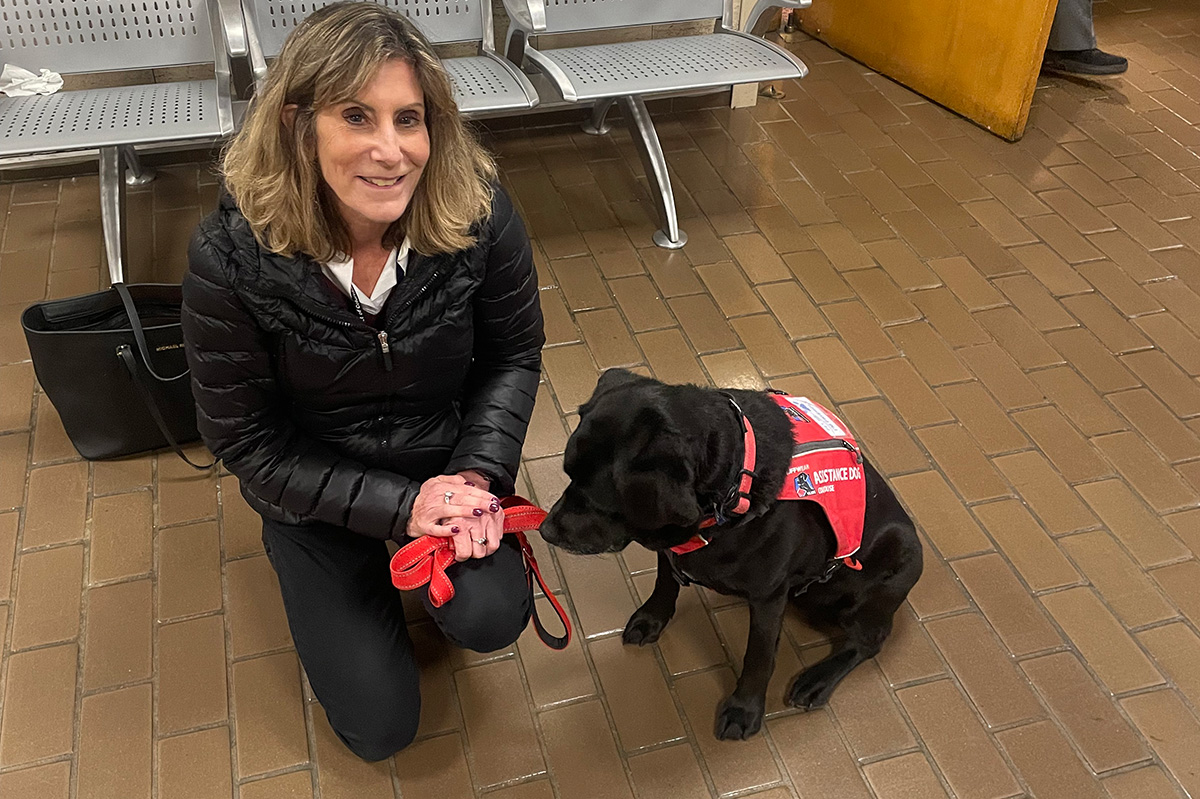
Deborah Kelly’s blind husband, Alton, was dragged for blocks to his death by a hit-and-run driver who had already plowed into her on Alabama Ave., S.E., in June 2024.
But her trauma had only just begun. It took 10 months before the driver, Kenneth Trice, Jr., was arrested, and another six months before he was sentenced to just six months behind bars.
As she heaved and sobbed in the courtroom in November, Kelly had a steady four-legged presence by her side: Pepper the Courthouse Dog, as the black Labrador retriever is known in D.C. Superior Court.
Abby Stavitsky, a former federal prosecutor who now serves as a victims’ advocate, is the owner and handler of nine-year-old Pepper. She says that one of the things that has made Pepper such a great asset in the court in the past six years is the emotional support and comfort she provides to victims.
“She absorbs all of the feelings and the emotions around her, but she’s very good at handling it,” Stavitsky said.
Pepper and Stavitsky started working in Magistrate Judge Mary Grace Rook’s courtroom — and now works in Magistrate Judge Janet Albert’s — to provide support for youth who suffer trauma, especially young survivors of commercial sexual exploitation.
These specially trained dogs offer emotional support to trauma victims of all ages. Courthouse dogs can reduce victims’ and witnesses’ anxiety and stress, making it easier for them to provide clear statements in the courtroom, according to a 2019 report in the Criminal Justice Review.
“Having something to pet and interact with is a distraction that results in victims being calmer when testifying in court,” says Stavitsky. “This gives them an extra level of comfort.”
What brought Stavitsky and Pepper together
Stavitsky, who spent 25 years as an assistant U.S attorney, handled a lot of victim-based crimes, mostly domestic violence and sex offenses. She was also a dog lover, and once she learned about courthouse dogs and their use, she was inspired.
In 2019, Pepper was given to Stavitsky by a Massachusetts-based organization, NEADS, formerly known as the National Education for Assistance Dog Services. Although Pepper was originally trained to be a service dog, evaluators determined her character was best suited for a courthouse dog.
Pepper now works regularly in various treatment court cases involving juveniles, many of whom have experienced trauma or are involved in the child welfare system. She also sits with victims while they are testifying in a trial.
“She loves people, especially children,” Stavitsky said. “She loves that interaction.”
Courthouse dogs have a long history
In courthouses across the U.S. specially trained “facility dogs” are becoming an important part of how the justice system supports vulnerable victims and witnesses.
Since the late 1980s, these dogs were used to help trauma survivors and anxious children during testimonies and interviews. The first dog to make an appearance in a courtroom was Sheba, a German shepherd who assisted child sexual abuse victims in the Queens (N.Y.) District Attorney’s Office. Courthouse dogs help them communicate more clearly, especially in these settings that make them anxious and stressed.
Unlike service dogs, courthouse facility dogs are professionally trained through accredited assistance dog organizations and work daily alongside prosecutors, victim advocates, and forensic interviewers. For example, courthouse dogs can have more social interaction, unlike service dogs.
Courthouse dogs’ growing use has prompted state laws and professional guidelines to recognize the dogs as a trauma-informed tool that helps victims participate in the justice process without compromising courtroom fairness.
As more jurisdictions adopt these programs, courthouse dogs are reshaping how the legal system balances compassion with procedure, ensuring that victims’ voices can be heard in environments that might otherwise silence them.
Pepper makes it easy to see why.
“I really love people, especially kids, and can provide emotional support and comfort during all stages of the court process,” reads the business card Stavitsky hands out with Pepper’s picture. “I’m calm, quiet and can stay in place for several hours.”
(This article was written by a student in the journalism program at Bard High School Early College DC. This work is part of a partnership between the Washington Blade Foundation and Youthcast Media Group, funded through the FY26 Community Development Grant from the Office of D.C. Mayor Muriel Bowser.)
Rehoboth Beach
Women’s FEST returns to Rehoboth Beach next week
Golf tournament, mini-concerts, meetups planned for silver anniversary festival
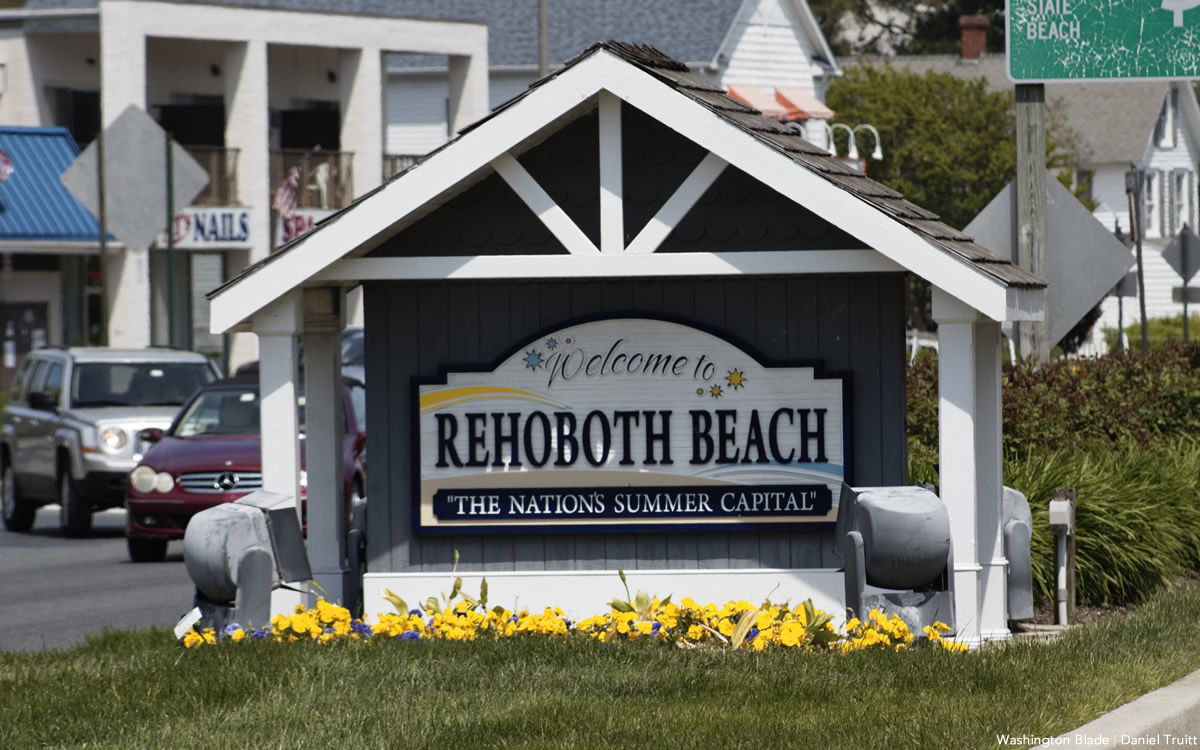
Women’s+ FEST 2026 will begin on Thursday, April 9 at CAMP Rehoboth Community Center.
The festival will celebrate a remarkable milestone in 2026: its silver anniversary. For 25 years, Women’s+ FEST has brought fun and entertainment for all those on the spectrum of the feminine spirit. There will be a variety of events including a golf tournament, mini-concerts and happy hour meetups.
For more information, visit Camp Rehoboth’s website.
District of Columbia
How new barriers to health care coverage are hitting D.C.
Federally qualified health centers bracing for influx of newly uninsured patients

Washington, D.C. has the second-lowest rate of people who lack health insurance in the country, but many residents are facing new barriers to health care due to provisions of the sweeping federal law passed in July, which threatens access for thousands.
Changes to insurance eligibility and the rising cost of premiums, which kicked in for some in October and others more recently, are expected to leave many more patients uninsured or unable to afford medical care. Federally qualified health centers, including D.C.’s Whitman-Walker Health, where 10 to 12 percent of patients are uninsured, are bracing for an influx of newly uninsured patients while facing their own financial challenges.
Even in D.C., where uninsured rates have been among the lowest in the country, changes brought on by the passage of the Republican mega bill (known as the “Big Beautiful Bill”) will have major effects.
The changes from the bill affect Medicaid, which is free to low-income patients, and subsidies for insurance that people buy on the health insurance exchanges that were started under the Affordable Care Act, which were allowed to expire on Dec. 31.
Erin Loubier, vice president for access and strategic initiatives at Whitman-Walker Health, says some Whitman-Walker Health patients have received notices about premium increases, including several who say the increases are up to 1,000 percent more than they were paying.
“That is like paying rent,” she says. “We live in an expensive city, so any increases are going to be really, really hard on people.”
Whitman-Walker Health and other healthcare providers are expecting the changes to have multiple effects — some patients may not be able to afford coverage or may avoid going to the doctor and allow health conditions to worsen because they can’t afford care, and many more will be seeking care who don’t have insurance.
“I’m worried that we’re going to not just have people who can’t get care, but that they delay care until they’re really sick, and then the care is not as effective because they might have waited too long, and then we may have a less healthy population,” Loubier says.
Loubier says delaying care, and serving more people without insurance has major implications for Whitman-Walker Health and other health centers serving the community.
“There’s going to be a lot of pressure on us to try to find and raise more money, and that’s going to be harder, because I think all organizations who provide health care are going to be facing this,” she says.
The U.S. health care system is the most expensive in the world, and has much higher out-of-pocket costs for individuals. But in other countries like the United Kingdom, Australia, Canada, and many others, health care is much less expensive — or even free.
Even though the U.S. has a high-priced healthcare system, critics say there are still ways to bring down costs by forcing insurance and pharmaceutical companies to absorb more of the costs, rather than transferring the costs to patients.
“In the U.S., they end up trying to cut costs at the person’s level, not at the level of the different corporations or structures that are making a lot of money in healthcare,” said Loubier. “Our system is so complicated and there is probably waste in it, but I don’t think that that cost and waste is at the ‘people’ level. I think it’s higher up at the system level, but that is much, much harder to get people to try to make cuts at that end.”
Ultimately at Whitman-Walker Health, healthcare providers and insurance navigators are planning to help with everyday necessities when it comes to healthcare coverage and striving to provide healthcare in partnership with patients, said Loubier.
“The key here is we’re going to have a lot of people who may lose insurance, and they’re going to rely on places like Whitman-Walker Health and other community health centers, so we have to figure out how we keep providing that care,” she said.
(This article was written by a student in the journalism program at Bard High School Early College DC. This work is part of a partnership between the Washington Blade Foundation and Youthcast Media Group, funded through the FY26 Community Development Grant from the Office of D.C. Mayor Muriel Bowser.)

PHOTOS: The Bonnet Ball

Risking it all for love during World War II

Surviving spring cleaning

Iconic Eddie Izzard takes on 23 characters in ‘Hamlet’

How Pepper the courthouse dog helps victims of abuse

Kristi Noem ‘devastated’ as husband’s alleged fetish spending surfaces

D.C.’s affirming congregations to mark Holy Week, Easter

Glisten report details hostile climate for LGBTQ students

Supreme Court ruling against conversion therapy bans could affect Md. law

VIDEO: Gay journalist detained for booing Trumps at ‘Chicago’ opening night
-

 The White House4 days ago
Kristi Noem ‘devastated’ as husband’s alleged fetish spending surfaces
-
Local5 days ago
D.C.’s affirming congregations to mark Holy Week, Easter
-
Research/Study5 days ago
Glisten report details hostile climate for LGBTQ students
-
Maryland5 days ago
Supreme Court ruling against conversion therapy bans could affect Md. law