Local
Heroic distinction ‘very humbling’
Capital Pride honors locals working to help others
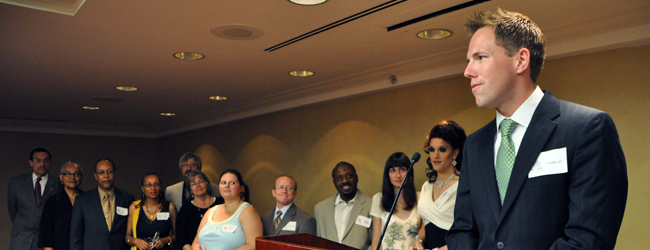
The Capital Pride heroes are honored in advance of this year's festival. (Washington Blade photo by Michael Key)
This year’s Capital Pride Heroes include four individuals and two organizations. Meet the heroes below.
MARTA ALVARADO
Latina and LGBT rights advocate Marta Alvarado leads the annual “Creating Change” conference, an important contribution to advancing the cause of LGBT rights.
Alvarado, whose National Gay and Lesbian Task Force job title of program coordinator for movement building barely hints at the array of skills she brings to getting all those cantankerous ducks in a row for five days of intensive movement-building, which she calls “the largest gathering of LGBT people and their allies.” It’s an exercise requiring equal parts precision and empathy.
Next year’s “Creating Change” conference — February 2-6 in Minneapolis — is expected to draw 2,000-3,000 people, she says. The year after that she will bring the conference to Baltimore.
For Alvarado, the Capital Pride Hero award is “a big honor … I had to take a step back, and receiving it takes me back to age 15 to my very first Pride event, and now it’s 15 years later, and I know the significance of Pride, and it’s very humbling.”
DESTINY B. CHILDS
How many ways are there to be dazzled by Destiny B. Childs?
Her list of titles as female impersonator and lady-illusionist are legendary, including her newest title of Miss Capital Pride 2010, the award she just won in a June 4 competition with seven other contestants at Town Danceboutique to kick off Capital Pride’s schedule. As such, she will preside over the parade on Saturday evening and the festival on Sunday.
Also known as Richard Legg, a 32-year-old government contracting specialist during the day, Destiny will be married on Aug. 28 in D.C. to her beloved, Rudy Benavides. With her theme song by Diana DeGarmo of “I Believe” and her special motto of “defy gravity,” Destiny has been doing drag for seven years in D.C.
Born in Albuquerque, Legg entered the Army and then completed his undergraduate education with a bachelor’s in health care management from Southern Illinois University in 2005. In D.C., he has been the featured entertainer at Freddie’s Beach Bar for six years and also a member of the Ladies of Illusion at Ziegfeld’s.
REV. ELDER DARLENE GARNER
Garner, the mother of four, grandmother of seven and great-grandmother of three, is a warrior of the spirit. She was born in Columbus, Ohio but after her divorce in 1973 she moved to D.C. to take a job as an administrative assistant at the World Bank.
Raised in the National Baptist Church, in 1976 she joined the still relatively new Metropolitan Community Church, where she is now an ordained minister and member of the MCC Board of Elders. She leads the MCC Conference for African-American Leaders and has also worked as executive director of the Philadelphia Mayor’s Commission on Sexual Minorities and previously as chaplain for an AIDS hospice and as board president for the Northern Virginia AIDS Ministry. She also helped to found the National Coalition of Black Lesbians and Gays.
On March 9, she and her partner of many years, Rev. Candy Holmes, were married along with two other couples in the first ceremony under D.C.’s new same-sex marriage law.
DC CLERGY UNITED FOR MARRIAGE EQUALITY
This diverse group of more than 200 “affirming and welcoming” clergy, representing religious institutions in every ward of the District, pushed back with robust fortitude and biblical testimony against the dogmatic naysayers from the homophobic corners of religious life.
“We are the District of Columbia clergy and religious leaders of many faiths, races, ethnicities, and sexual orientations,” they declared in a statement full of eloquent yet simple profundity: “We now join our voices again to speak a faithful word for freedom and equality.”
“We declare that our faith calls for us to affirm marriage equality for loving same-sex couples,” because “where love is present, God is also present,” and “it is holy and good.”
These clergy fought the “battle of Jericho” in D.C. and the walls came tumbling down.
DC FOR MARRIAGE
A program of the DC Center, this group of local residents became activists pushing politically every inch of the way to win votes on the D.C. Council in favor of this historic step. And the organization continues its important work today, for example in offering legal updates for D.C. residents on creating legal protections for “families of choice” brought together under the new marriage law. See more information on their ongoing work at www.dcformarriage.org.



District of Columbia
Lewis George holds strong lead over McDuffie in D.C. mayor’s race
Gay Council member Parker wins in Ward 5; bi candidate leads in Ward 1

D.C. Council member Janeese Lewis George (D-Ward 4) was leading former D.C. Council member Kenyan McDuffie (D-At-Large) in the D.C. primary race for mayor late Tuesday night by a margin of 52.79 percent of the vote compared to 36.57 percent for McDuffie with 64 percent of the votes counted, according to information released by the D.C. Board of Elections at 11:55 p.m.
A Board of Elections spokesperson informed the media by email that the board had stopped its vote counting shortly before midnight and would resume its counting Wednesday morning, June 17.
The late-night returns showed Lewis George and McDuffie were far ahead of the other five candidates competing in the Democratic primary for mayor, with candidate Rini Sampath, who self-identifies as queer, receiving 2.93 percent of the vote.
Of the remaining Democratic mayoral candidates, former Council member Vincent Orange received 3.73 percent; businessman Gary Goodweather received 3.0 percent; and civic activists Hope Solomon, 1.09 percent; and Ernest Johnson 0.53 percent.
Election board spokesperson Sarah Graham noted in her email to the media that the initial vote percentages released Tuesday night were counted under the city’s newly implemented ranked choice voting system, which was in place for mayor, D.C. Council, D.C. congressional delegate, and D.C. attorney general. She said the follow-up “round-by-round tabulation results” when voters’ second, third, fourth and possibly fifth choices are counted under the ranked choice system, they are estimated to be released between Sunday, June 21 and Wednesday, June 24.
“The final round-by-round tabulation results will be released on or after June 26, 2026,” she stated. The ranked-choice system does not go into effect if a candidate receives at least 50 percent of the vote.
Lewis George and McDuffie have strong records of support on LGBTQ issues, and Goodweather expressed strong support for LGBTQ issues during the campaign. The Capital Stonewall Democrats, the city’s largest LGBTQ political group, endorsed Lewis George for mayor.
Although the election board had yet to declare a winner in the mayor’s race, with 36 percent of the votes cast not yet counted, Lewis George delivered a rousing speech at her election-night event at the Howard Theatre that many of her supporters considered a victory speech. Among those attending the event and expressing the belief that Lewis George was the expected winner was Capital Stonewall Democrats President Stevie McCarty.
“There’s still a lot of votes to count, but I feel very confident and it looks really good,” he said in referring to Lewis George and the LGBTQ community members who supported her campaign.
Like the other races for D.C. Council, the D.C. congressional delegate seat, and D.C. attorney general, most if not all of the candidates had either expressed support for LGBTQ rights or had strong records of support, like McDuffie and Lewis George. LGBTQ activists have said that meant LGBTQ voters would be choosing a candidate based on issues other than LGBTQ rights issues.
In other races, D.C. Council member Zachary Parker (D-Ward 5), the Council’s only gay member, was far ahead of two Democratic challengers, with 76.37 percent of the vote. Challengers Bernita Carmichael and Bridgete French received 15.28 percent and 7.57 percent respectively.
Political observers believe Parker is the strong favorite to win re-election in November against a Republican and a Statehood Green Party candidate.
In the Ward 1 D.C. Council race, where five LGBTQ supportive candidates were competing for the seat being vacated by Democratic incumbent Brianne Nadeau, who is not running for re-election, community activist Aparna Raj, who identifies as bisexual, was leading gay candidate and LGBTQ rights activist Miguel Trindade Deramo by a margin of 46.7 percent to 20.27 percent in a five-candidate race.
The other candidates were Rashida Brown, 17,18 percent; Jackie Reyes Yanes, 9.98 percent; and Terry Lynch, 5.75 percent.
In the race for the D.C. delegate seat to the U.S. House of Representatives, which is being vacated by retiring Del. Eleanor Holmes Norton (D), D.C. Council member Robert White (D-At-Large) was leading in a five-candidate race with 63.16 percent of the vote. His leading opponent, D.C. Council member Brooke Pinto (D-Ward 2) had 21.45 percent of the vote.
The vote count for the other candidates was 7.66 percent for Kinney Zalene; 4.55 percent of Trent Holbrook; and 2.8 percent for Greg Jaczko.
In other D.C. Council races Council Chair Phil Mendelson (D-At-Large) and Council member Matthew Frumin (D-Ward 3) were unopposed in the Democratic primary and are considered strong favorites to win re-election in November.
Nine Democrats competed for the At-Large D.C. Council seat being vacated by Council member Anita Bonds (D), who is not seeking re-election. Community activist and local pharmacist Oye Owolewa, who was endorsed by Capital Stonewall Democrats, was leading in the Democratic primary with 33.77 percent of the vote.
The vote count percentage for the other candidates were: Lisa Raymond, 15.22; Kevin Chavous, 13.84; Greg Jackson, 10.95; Candis Nelson, 7.67; Dwight Davis, 6.02; Dyana Forester, 3.72; and Leniqua Jenkins, 3.0.
In the Ward 6 D.C. Council race, Democratic incumbent Charles Allen, a longtime LGBTQ rights supporter who received the Capital Stonewall Democrats endorsement, was far ahead of his two Democratic challengers with 74.43 percent of the vote. Gloria Ann Nauden had 18.68 percent, and Michael Murph had 6.51 percent.
D.C. Attorney General Brian Schwalb, an outspoken supporter of LGBTQ rights who also received the Capital Stonewall Democrats endorsement, had 90.34 percent of the vote in the Democratic primary, with his sole opponent J.P. Szymkowicz receiving 9.15 percent.
In the special election to fill the At-Large Council seat that must go to a non-Democrat under the city’s Home Rule Charter, and which was vacated by McDuffie when he decided to run for mayor as a Democrat, former Council member Elissa Silverman was leading with 54.75 percent of the vote. Incumbent Council member Doni Crawford, who was temporarily appointed to the seat, was in second place with 34.81 percent of the vote. A third candidate, Jaque Patterson, had 19.27 percent. All three candidates ran as independents.
In the separate D.C. Republican and D.C. Statehood Green Party primaries held on June 16, all the offices for which a candidate from those two parties were on the ballot ran unopposed. No Republican candidate ran for D.C. mayor in the primary. With a large majority of D.C. voters being registered as Democrats, no Republican or Statehood Green Party candidate has won election to public office in D.C. for at least the past 10 years or longer. No known LGBTQ Republican or Statehood Green Party candidate was on the ballot in the June 16 primary.
Delaware
57 towns in 57 hours: Rep. McBride kicks off re-election campaign
Touts record of championing bipartisan legislation
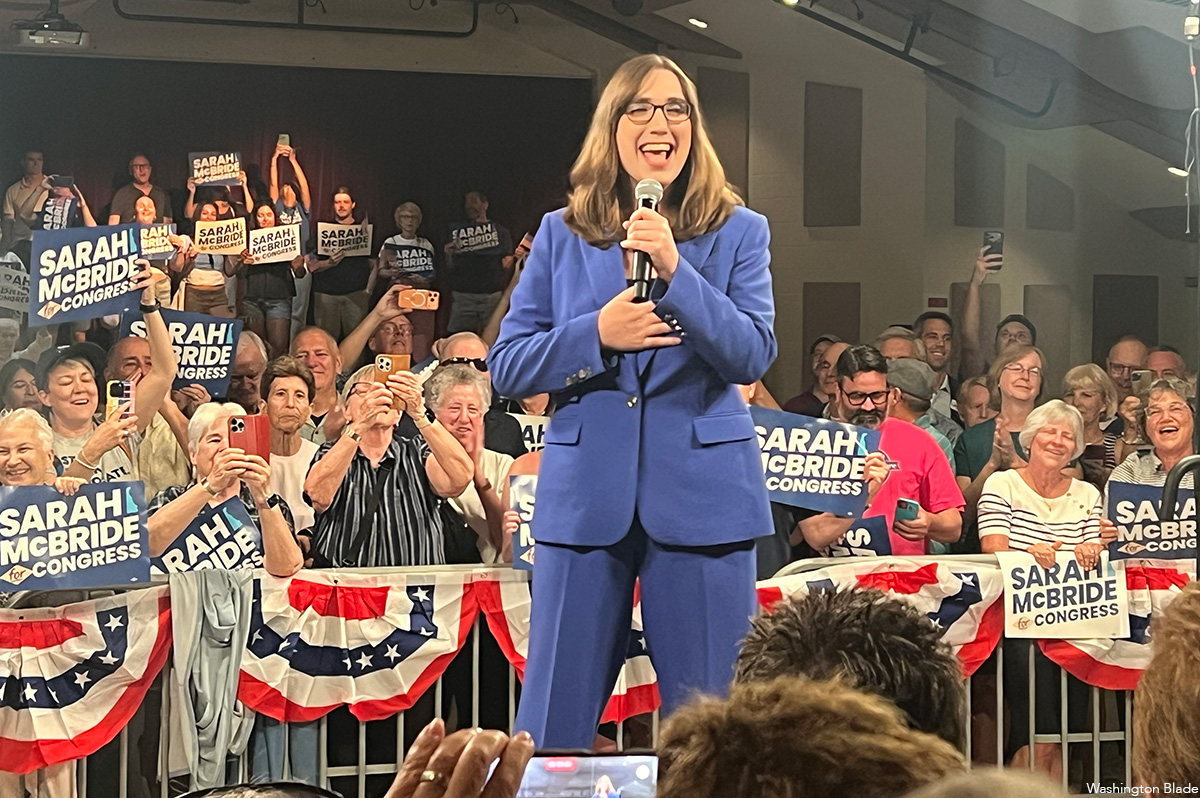
Rep. Sarah McBride (D-Del.) officially kicked off her re-election campaign this week with a grueling tour of her state that saw her visit 57 municipalities in just 57 hours.
The tour culminated Monday evening in Rehoboth Beach with a packed crowd at the Convention Center. At least 400 attendees stood patiently in a line that wrapped around the block and snaked down Rehoboth Avenue. Once inside, a DJ entertained the ebullient crowd that kept busy batting beach balls around the venue.
The crowd featured a large LGBTQ presence that cheered speakers including state Rep. Claire Snyder-Hall, state Sen. Russ Huxtable, and Delaware Democratic Party Chair Evelyn Brady, who introduced McBride.
McBride took the stage to Chumbawamba’s “Tubthumping” and the lyrics “I get knocked down, but I get up again.” In her remarks, she touched on a record of introducing more bipartisan legislation than any other freshman lawmaker and touted an award her office won for providing superior constituent service.
“People want leaders who are focused on lowering costs, solving problems, and delivering results,” she said. “That’s exactly what I’ve worked to do in Congress, and that’s why I’m running for re-election – to continue delivering for and defending Delaware.”
McBride is the first transgender member of Congress and is Delaware’s sole representative in the U.S. House. She will face the winner of the Republican primary in November. Rev. Earl Cooper — a former Democrat McBride defeated two years ago — is running for the GOP nomination. The state primary election is Sept. 15 and the general election is Nov. 3.
District of Columbia
D.C. nude dance club Archibald’s to feature male strippers beginning Pride weekend
Popular downtown venue to debut new lower floor gay ‘underworld’
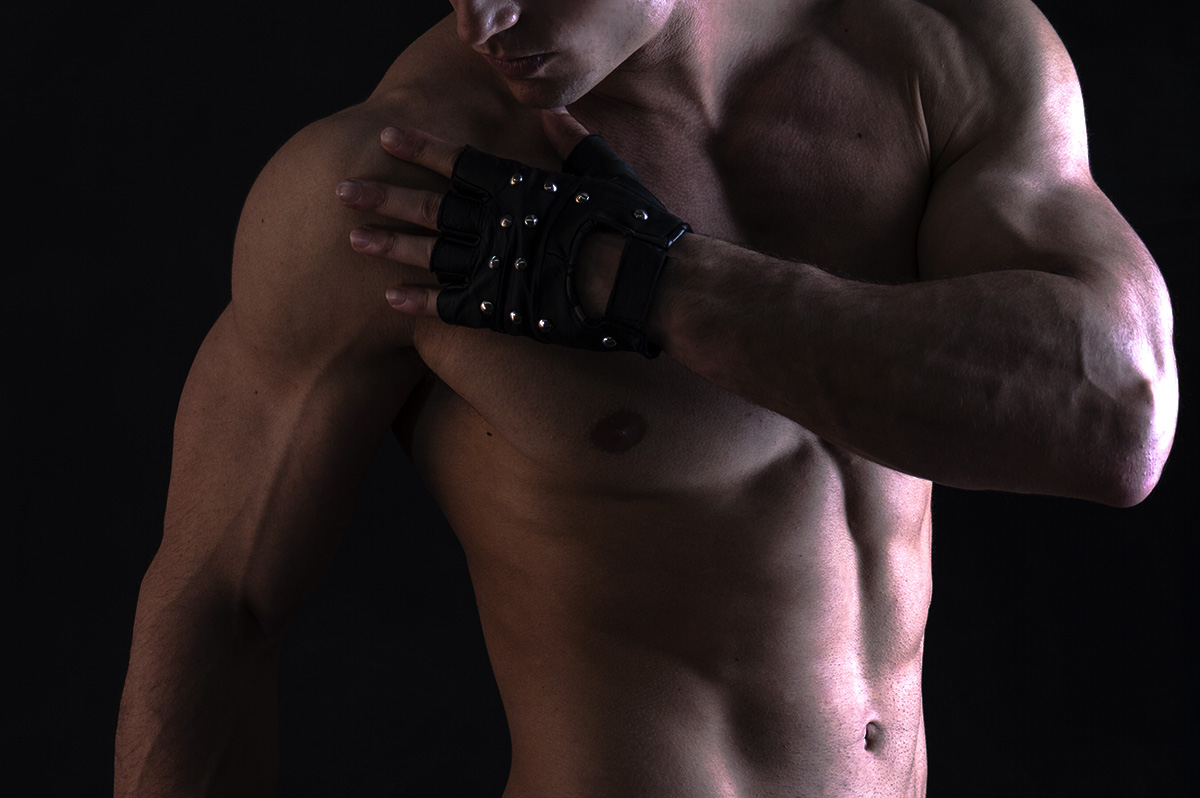
Archibald’s Gentlemen’s Club, which has offered adult entertainment in the nation’s capital involving nude female dancers since it first opened in 1969 at 1520 K St., N.W., will offer nude male dancers beginning Saturday night, June 20, according to co-owner Thom Naylor.
The female dancers will continue as usual on the upper two floors of Archibald’s three-story building, according to Naylor, who released a flier promoting the opening of the male dancer venue as an event “for Gay Pride.”
He told the Washington Blade he expects a dozen male dancers to perform beginning at 9 p.m. Saturday when D.C.’s LGBTQ Pride Parade will take place earlier in the day.
Following its opening night for the male dancers, Naylor said he plans to continue offering male nude dancers on Thursday, Friday, and Saturday evenings. The club is closed on Sundays and Mondays.
“I want to have an official Champagne grand opening probably in July,” he said referring to the male dance venue. “This is like a soft opening just to get going and to get everybody acclimated.”
The decision by Archibald’s to offer nude male dance entertainment for an LGBTQ clientele will mark the first time such entertainment will take place in D.C. since March 2020, when the LGBTQ nightclub Ziegfeld’s-Secrets, which featured nude male dancers, was forced to close at the start of the coronavirus pandemic.

The owner of the building at 1824 Half St., S.W., discontinued the Ziegfeld’s-Secrets lease a short time later to demolish the building and construct a high-rise residential condominium.
Naylor, who identifies as gay, said he has long believed nude male entertainment should be available in D.C. for a gay clientele as well as anyone else interested in that type of entertainment.
“So, we decided to go with three days in the summer and then come September go into a full swing when we’re open five days a week,” he said, referring to the male dancers.

Netherlands to ban conversion therapy

Lewis George holds strong lead over McDuffie in D.C. mayor’s race

War, geopolitical tensions with U.S. overshadow Pride month events

Confronting homophobia at school