National
Senate panel omits bullying bills from education reform
Franken, Casey pledge to bring up measures on floor
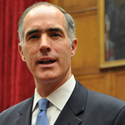
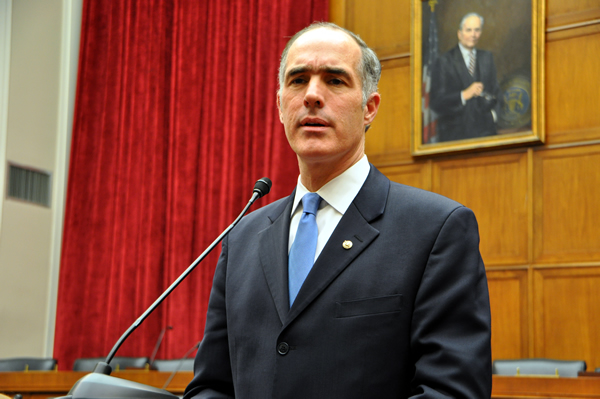
Sen. Bob Casey (D-Pa.) (Blade photo by Michael Key)
A Senate committee left out pro-LGBT anti-bullying measures from education reform as the sponsors of the legislation pledged to offer these bills as amendments on the floor.
The Senate Health, Education, Education & Pensions Committee late Thursday reported out a massive education bill known as Elementary & Secondary Education Act reauthorization by a bipartisan vote of 15-7.
But the Democratic-controllled panel didn’t vote on pro-LGBT bills that advocates were seeking to have included as part of the larger legislation — the Student Non-Discrimination Act, or SNDA, and the Safe Schools Improvement Act, or SSIA.
Sen. Al Franken (D-Minn.), the sponsor of SNDA, and Sen. Bob Casey (D-Pa.), the sponsor of SSIA, both offered their bills as amendments during the markup, but withdrew them before a vote could be held.
During the markup, Franken delivered a speech in which he said he feels “very, very strongly” about SNDA as he pledged to bring up the measure as an amendment on the floor.
Franken said recent stories about gay youths committing suicide after they had been bullied in school demonstrates the need for passing SNDA. One such youth, Justin Aaberg, a gay 15-year old who committed suicide last year, resided in Franken’s state of Minnesota.
“We are faced with a group of students that is facing pervasive discrimination,” Franken said. “They are being viciously harassed and bullied. They are staying home from school. They are dropping out of school. They are literally killing themselves, and our schools aren’t doing enough to stop it. And yet again, these students have nothing they can do about it. There is no law that prohibits discrimination on the basis of sexual orientation in schools.”
April Mellody, a Casey spokesperson, said Casey also introduced his bill as an amendment, but then “made the difficult decision” to withdraw the measure because it feared it would sink the education bill as a whole.
“Pennsylvania teachers, principals, and parents have been asking for a new law to replace No Child Left Behind since he arrived in the Senate and he felt he could not jeopardize the bipartisan committee vote to pass ESEA out of committee,” Mellody said.
Mellody added Casey “is committed to addressing the bullying epidemic” and intends to offer his bill as an amendment again when the full Senate considers the larger education legislation.
Justine Sessions, a Senate HELP committee spokesperson, said committee Chair Tom Harkin (D-Iowa) indicated he hopes the full Senate will take up the education reform bill during the next work period. The Senate is out of session next week for recess.
Joe Solmonese, president of the Human Rights Campaign, chided the committee for not including the pro-LGBT measures as part of the education bill before it went to the Senate floor.
“We are disappointed that the committee did not adopt anti-LGBT bullying amendments that enjoyed bipartisan, majority support,” Solmonese said. “This major reauthorization bill was the best opportunity the Senate will have in this Congress to address the problem of bullying faced by LGBT students. It is imperative that the committee revisit this issue and acknowledge the consequences bullying has on the youth in our community.”
Both Franken and Casey would have more difficulty having successful votes for their legislation on the floor than they would in committee.
Each of the 12 Democrats on the Senate HELP Committee co-sponsor SNDA, which would easily have given the measure the necessary votes for inclusion as part of education reform during the panel markup.
Only 11 members of the committee co-sponsor of SSIA, which is one vote short necessary for passage. Ten Democrats are co-sponsors in addition to Sen. Mark Kirk (R-Ill.), an original co-sponsors. However, the two of the Democrats who aren’t co-sponsors — Sen. Michael Bennet (D-Colo.) and Jeff Bingaman (D-N.M.) — would likely have voted for the measure should it have come up in committee, giving the amendment the necessary support for passage.
If Franken and Casey were to offer SNDA and SSIA on the Senate floor, they would likely need 60 votes to overcome a Senate filibuster.
The number of co-sponsors for the legislation aren’t anywhere near 60 and neither bill enjoys significant Republican support. SNDA has 34 co-sponsors — all Democrats. SSIA has 32 co-sponsors and Kirk is the only Republican supporter.
An LGBT advocate earlier this week speaking anonymously identified Harkin as the “obstacle” to including SNDA and SSIA as part of education reform during the markup and said he wanted a clean bill that could easily pass committee.
Harkin is a co-sponsor of both SNDA and SSIA. A Harkin spokesperson responded to the charge by saying the senator has “long supported efforts to ensure that all children feel safe and secure in our schools.”
Additionally, President Obama has yet to endorse either SSIA or SNDA. The White House has said it supports the goals of the legislation, but hasn’t offered explicit support for the bills.
Watch the video of Franken’s remarks before the committee on SNDA here:




National
LGBTQ Catholic groups slam Trump over pope criticism
‘Moral truth and compassion always overcome ignorant hate’
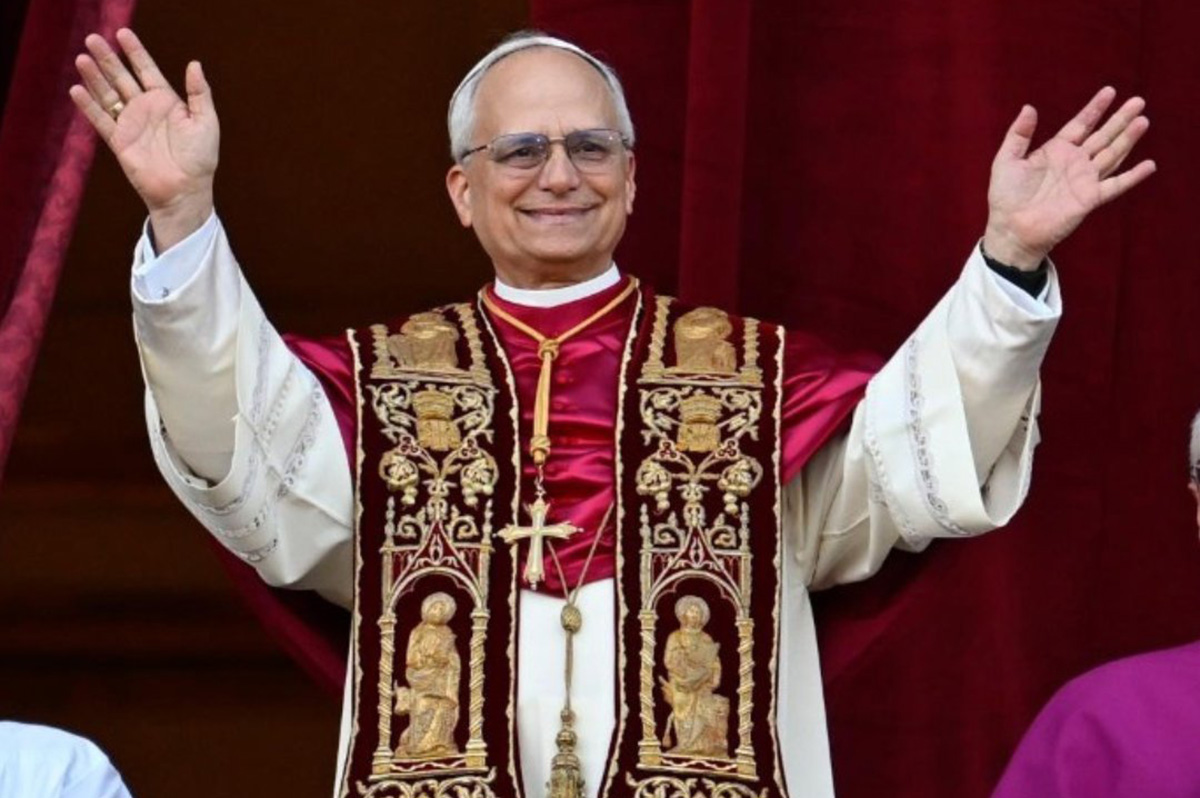
LGBTQ Catholic groups have sharply criticized President Donald Trump over his criticisms of Pope Leo XIV.
Leo on April 13 told reporters while traveling to Algeria that he had “no fear of the Trump administration” after the president described him as “weak on crime” and “terrible for foreign policy” in response to his opposition to the Iran war. (Trump on the same day posted to Truth Social an image that appeared to show him as Jesus Christ. He removed it on April 13 amid backlash from religious leaders.)
Vice President JD Vance, who is Catholic, during a Fox News Channel interview on the same day said “in some cases, it would be best for the Vatican to stick to matters of morality, to stick to matters of what’s going on with the Catholic church, and let the president of the United States stick to dictating American public policy.” Vance on April 14 once again discussed Leo during an appearance at a Turning Point USA event in Athens, Ga., saying he should “be careful when he talks about matters of theology.”
Italian Prime Minister Giorgia Meloni; former U.S. Ambassador to the Vatican Miguel Díaz; and Oklahoma City Archbishop Paul Coakley, president of the U.S. Conference of Catholic Bishops, are among those who have criticized Trump over his comments. The president, for his part, has said he will not apologize to Leo.
“The world is being ravaged by a handful of tyrants,” said Leo on Thursday at a cathedral in Bamenda, Cameroon.
Francis DeBernardo is the executive director of New Ways Ministry, a Maryland-based LGBTQ Catholic organization. He told the Washington Blade on Thursday that Trump’s comments about Leo “are one more example of the ridiculous hubris of this leader (Trump) whose entire record shows that he is nothing more than a middle-school bully.”
“LGBTQ+ adults were often bullied as children, and they have learned the lesson that bullies act when they feel frightened or threatened,” said DeBernardo. “But secular power does not threaten the Vicar of Christ, and Pope Leo’s response illustrates this truth perfectly.”
DeBernardo added Trump “is obviously frightened that Pope Leo, an American, has more power and influence than the president on the world stage.”
“Like most Trumpian bullying, this strategy will backfire,” DeBernardo told the Blade. “Moral truth and compassion always overcome ignorant hate. Trump’s actions are not an example of his power, but of his impotence.”
Marianne Duddy-Burke, executive director of DignityUSA, an LGBTQ Catholic organization, echoed DeBernardo.
“He [Trump] has demonstrated throughout both presidencies that he doesn’t understand the basic concepts of any faith system that is founded on the dignity of human beings, the importance of common good,” Duddy-Burke told the Blade on Thursday during a telephone interview. “It’s just appalling.”
Duddy-Burke praised Leo and the American cardinals who have publicly criticized Trump.
“The pope’s popularity — given how much more respect Pope Leo has than the man sitting in the White House — is a blow to his ego,” Duddy-Burke told the Blade. “That seems to be a sore sport for him.”
“It’s such an imperialistic world view,” she added.
Leo ‘is the real peacemaker’
The College of Cardinals last May elected Leo to succeed Pope Francis after his death.
Leo, who was born in Chicago, is the first American pope. He was the bishop of the Diocese of Chiclayo in Peru from 2015-2023.
Francis made him a cardinal in 2023.
Juan Carlos Cruz — a gay Chilean man and clergy sex abuse survivor who Francis appointed to the Pontifical Commission for the Protection of Minors — has traveled to Ukraine several times with Dominican Sister Lucía Caram since Russia launched its war against the country in 2022. Cruz on Thursday responded to Trump’s criticism of Leo in a text message he sent to the Blade from Kyiv, the Ukrainian capital.
“I am in Ukraine under many attacks,” said Cruz. “Trump is an asshole and has zero right to criticize the Pope who is the real peacemaker.”
Tennessee
Charlie Kirk Act advances in Tenn.
Bill would limit protests, protects speakers opposing ‘transgender’ identities
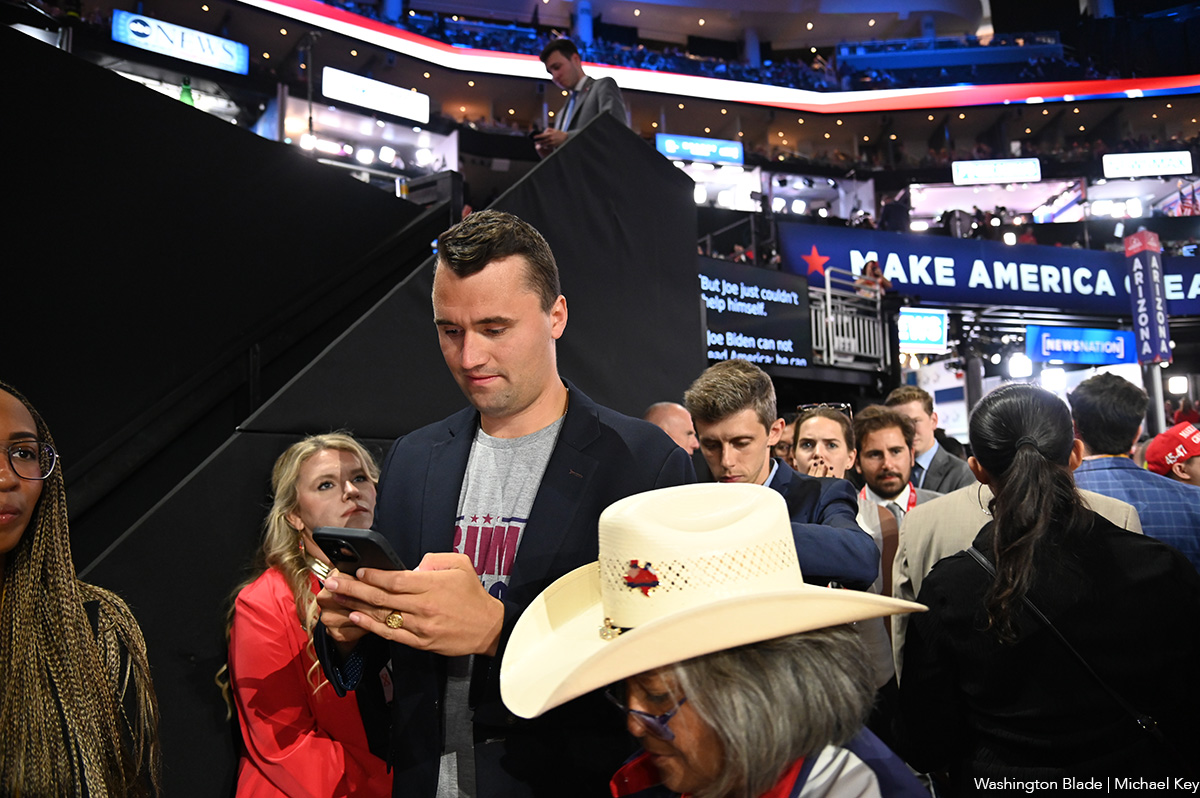
The Tennessee legislature has passed Senate Bill 1741 / House Bill 1476, dubbed the “Charlie Kirk Act,” which, if signed by Republican Gov. Bill Lee, would reshape how public colleges and universities regulate speech on campus.
The measure targets all public higher education institutions and requires them to adopt a “free expression” policy modeled on the University of Chicago’s framework. That framework emphasizes that universities should not shield students from controversial or offensive ideas and requires state schools to formally embrace institutional neutrality — meaning they do not publicly take a stance on political or social issues.
Under the legislation, publicly funded schools cannot disinvite or cancel invited speakers based on their viewpoints or in response to protests from students or faculty. Student organizations, however — like Turning Point USA, an American nonprofit that advocates for conservative politics on high school, college, and university campuses, founded by Charlie Kirk, and often lack widely represented liberal counterparts — would retain broad authority to bring speakers to campus regardless of controversy.
The law includes broad protections for individuals and organizations expressing religious or ideological beliefs, including opposition to abortion, homosexuality, or transgender identity, regardless of whether those views are rooted in religious or secular beliefs. It further prohibits public institutions from retaliating against faculty for protected speech or scholarly work.
The bill, which has been hailed by supporters as an effort to “preserve campus free speech,” ironically also limits protest activity. Shouting down speakers, blocking sightlines, staging disruptive walkouts, or physically preventing entry to events are now considered “substantial interference” under the legislation, making those who engage in such actions subject to discipline.
Some of those disciplinary consequences include probation, suspension, and even expulsion for students, while faculty who protest in ways deemed to violate the policy could face unpaid suspensions and termination after repeated violations.
Supporters of the bill argue it strengthens free expression on campus. State Rep. Gino Bulso (R-Brentwood), the bill’s sponsor, said it reinforces a commitment to “civil and robust” debate at public universities.
“The Charlie Kirk Act creates critical safeguards for students and faculty and renews the idea that our higher education institutions should be centers of intellectual debate,” Bulso told Fox 17. “This legislation honors the legacy of Charlie Kirk by promoting thoughtful engagement and defending religious freedom.”
Critics, including Democratic lawmakers, have raised concerns that the legislation effectively elevates certain ideological viewpoints — particularly those tied to religious objections to LGBTQ identities — while exposing students and faculty to punishment for protest or dissent.
“It’s ironic that this body is talking about free speech when we had professors in Tennessee schools expelled and suspended when they did not mourn the death of Charlie Kirk — when they said that his statements were problematic and that the way he died did not redeem the way he lived,” state Rep. Justin Jones (D-Nashville) told WKRN.
Kirk, the right-wing activist and founder of Turning Point USA, for whom the bill is named, was assassinated in September 2025 at a public event at Utah Valley University. His legacy and rhetoric remain deeply polarizing, particularly among LGBTQ advocates, who have cited his history of anti-LGBTQ statements in opposing his campus appearances.
The bill now heads to Lee’s desk for his signature.
National
Demonstrators disrupt OMB director hearing over PEPFAR
Capitol Police arrested five protesters
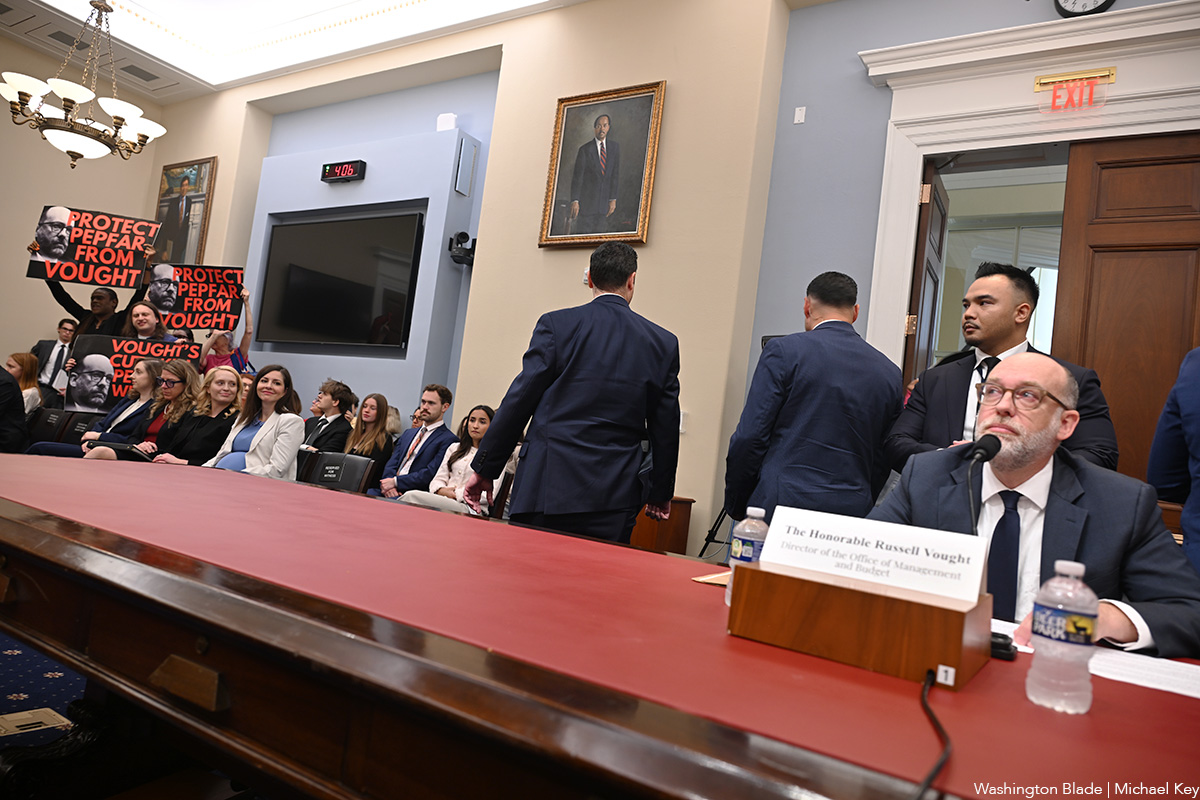
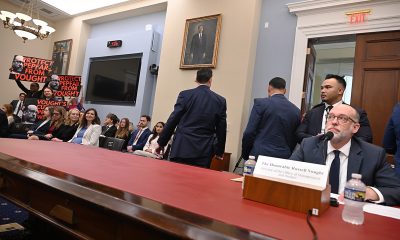
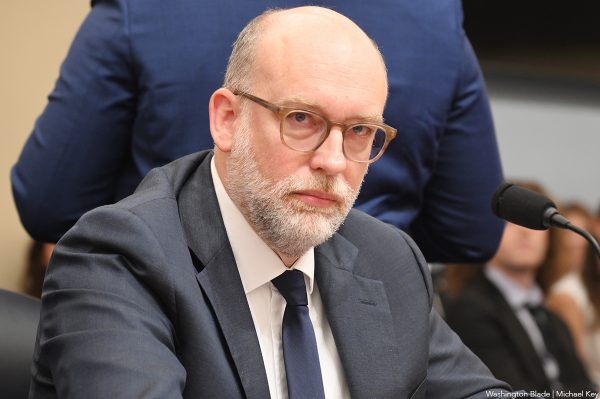
A group of protesters interrupted Office of Management and Budget Director Russell Vought during his testimony before Congress on Wednesday.
Vought was at the Cannon House Office Building to give testimony to the House Budget Committee.
Committee Chair Jodey Arrington (R-Texas) began the hearing by touting what he described as economic accomplishments of the Trump-Vance administration’s economic accomplishments. Ranking Member Brendan Boyle (D-Pa.) disputed those claims in his opening statement.
Boyle went on to admonish Vought for not attending a committee hearing in the previous year.
Vought, the “Project 2025” architect, was invited to speak after Arrington and Boyle made their statements.
Shortly after Vought began reading his statement, Housing Works CEO Charles King stood up in the gallery and began shouting, “PEPFAR saves lives: spend the money!”
The U.S. Capitol Police moved quickly to escort King from the room. Other activists began chanting with King as they unfolded signs bearing a picture of Vought’s face and statements such as, “Vought’s cuts kill people with AIDS,” and “Protect PEPFAR from Vought.”
The group of HIV/AIDS activists included independent activists, former U.S. Agency for International Development and PEPFAR staff, members of Health GAP, Housing Works, and the Treatment Action Group. Six activists were escorted from the hearing and the U.S. Capitol Police detained five of them.
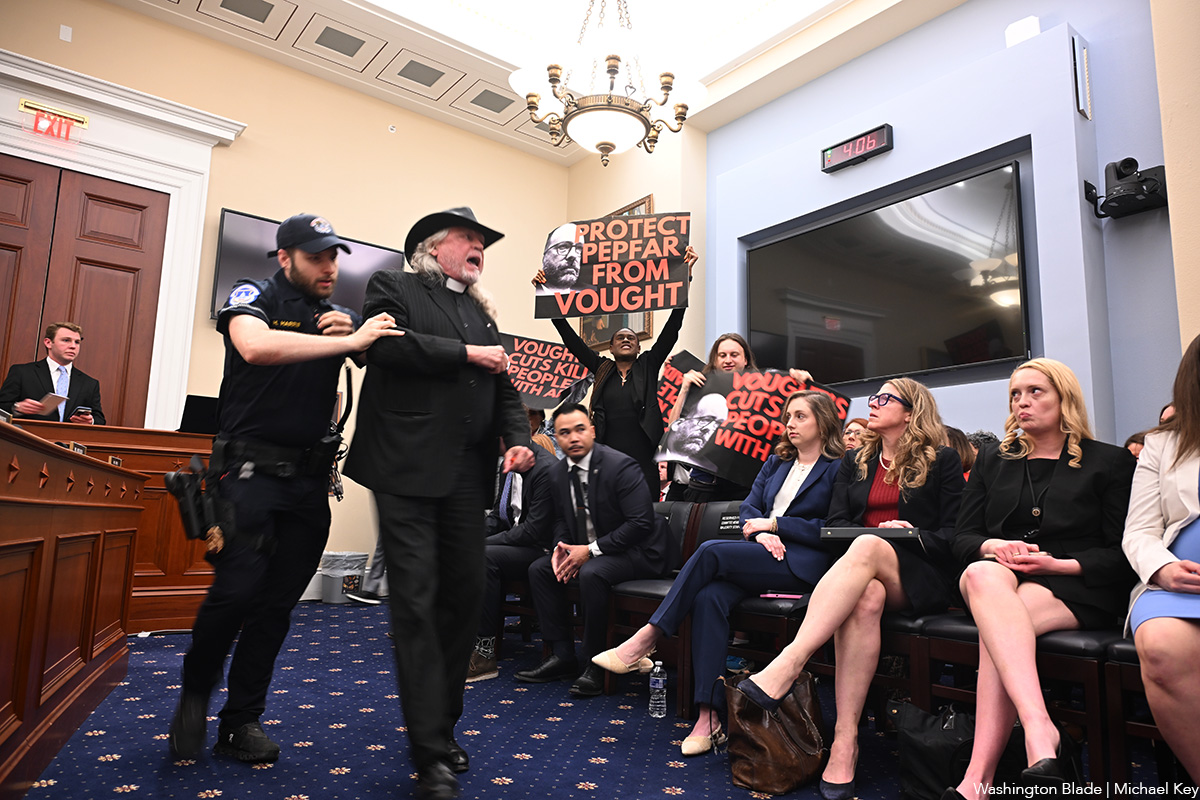
The HIV/AIDS treatment activists protested at the hearing in response to the dismantling of global health programs, including PEPFAR, a federally-funded program credited with saving millions of lives from HIV/AIDS, particularly in sub-Saharan Africa.
“Russell Vought is directly responsible for illegally withholding Congressionally appropriated funds for PEPFAR and related global health initiative,” King said in a statement provided to the Washington Blade. “These funding disruptions have already contributed to preventable deaths and threaten to reverse decades of progress in the fight against HIV worldwide. Enough is enough. Congress must ensure Vought stops this deadly sabotage.”

‘Big Mistakes’ an uneven – but worthy – comedic showcase

Rorschach stages ‘Dragon Play’ in unlikely, raw space

Wagons ho! High-class, head-turning haulers

Judge rescinds stay-away order in Capital Pride anti-stalking case

The latest Supreme Court case erasing LGBTQ identity

Trailblazing trans Brazilian lawmaker refuses to set foot in Trump’s America

Gay D.C. police lieutenant arrested on child porn charges

D.C. bar, LGBTQ+ Community Center to mark Lesbian Visibility Week

Demonstrators disrupt OMB director hearing over PEPFAR

Madonna announces release date for new album
-

 Brazil5 days ago
Trailblazing trans Brazilian lawmaker refuses to set foot in Trump’s America
-
District of Columbia4 days ago
Gay D.C. police lieutenant arrested on child porn charges
-
District of Columbia5 days ago
D.C. bar, LGBTQ+ Community Center to mark Lesbian Visibility Week
-
National4 days ago
Demonstrators disrupt OMB director hearing over PEPFAR