National
Republicans argue DOJ can’t litigate against DOMA
Boehner group asserts Obama admin got what it wanted from lower court ruling
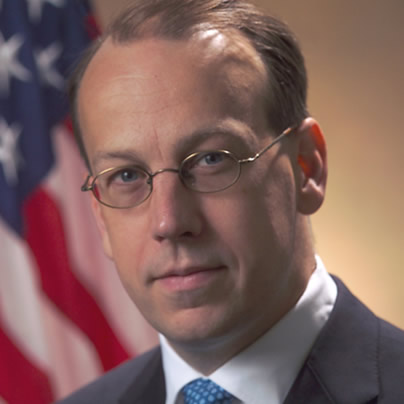
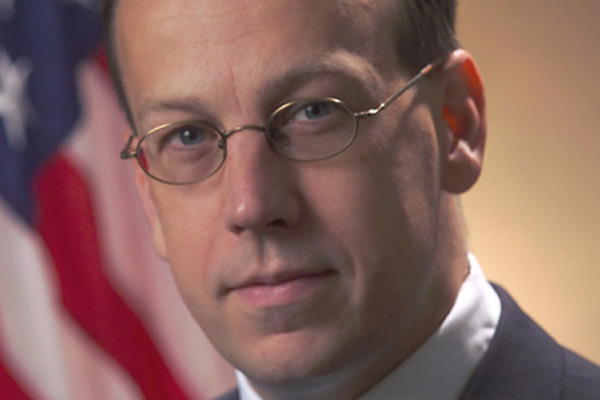
Former U.S. solicitor general Paul Clement argues DOJ lacks standing in his latest DOMA brief .(Public domain photo)
Attorneys representing House Republicans in litigation against the Defense of Marriage Act before the Supreme Court are asserting that the Justice Department lacks standing to participate in the lawsuit.
The Bipartisan Legal Advisory Group, under the direction of U.S. House Speaker John Boehner, makes the argument in a 38-page brief filed on Friday in response to the court’s jurisdictional questions on standing in the challenge to Section 3 of DOMA, known as Windsor v. United States.
BLAG argues the Justice Department lacks standing because the Obama administration received the result it wanted from lower courts — including the U.S. Second Circuit Court of Appeals — striking down DOMA.
“It obtained the precise relief it believed was appropriate based on the precise theory (heightened scrutiny) it advocated,” the brief states. “The executive can fare no better before this Court. While this Court’s affirmance would have a greater precedential impact, the executive cannot ground its appellate standing on a desire for an opinion with the identical effect on this case and controversy, but a broader precedential scope for other cases.”
The brief is signed by private attorney Paul Clement, a former U.S. solicitor general hired at $520 an hour to defend DOMA, and House General Counsel Kerry Kircher, among other lawyers.
But BLAG contends the court can nonetheless hear the case because it has standing to defend DOMA now that the Obama administration has declined to continue defending it.
“Indeed, without the House’s participation, it is hard to see how there is any case or controversy here at all,” the brief states. “Both Ms. Windsor and the executive agree that DOMA is unconstitutional and that Ms. Windsor was entitled to a refund. And the lower courts granted them all the relief they requested. Only the House’s intervention provides the adverseness that Article III demands.”
The Obama administratio discontinued defense of DOMA in court in February 2011 and since that time has filed briefs against the anti-gay law and litigated against it in oral arguments. House Republicans have taken up defense of the law in the administration’s stead following a 3-2 party line in BLAG.
In the brief, the committee also invokes as a source of its standing the rules passed at the start of the 113th Congress by the Republican-controlled House giving authority to the committee to speak for the House against DOMA. The rules were approved by a vote of 228-196.
Notably, the brief in a footnote asserts the House Democrats also believe that BLAG has standing to defend DOMA, even though they oppose House Republican intervention in the lawsuit.
“While the Democratic Leader and the Democratic Whip have declined to support the position taken by the Group on the merits of DOMA Section 3’s constitutionality in this and other cases, they support the Group’s Article III standing,” the brief states.
Drew Hammill, a spokesperson for House Minority Leader Nancy Pelosi (D-Calif.), said the case against DOMA should indeed proceed on the merits regardless of who has standing in the lawsuit.
“We believe that the case should proceed to the merits, regardless of who has standing, and that the Supreme Court should rule DOMA unconstitutional once and for all,” Hammill said.
The BLAG brief was but one that was filed on Friday in response to jurisdictional questions in the DOMA case. In another 39-page brief, the ACLU asserts that the Supreme Court has standing to hear the case because a “controversy” remains in the case; existing law and appellate practice affirm the court has jurisdiction; and practice concerns favor the court exercising jurisdiction.
“[L]eaving DOMA’s constitutionality to the courts of appeals poses its own set of problems for married gay couples,” the brief states. “It may well take years for ‘a uniform rule’ to emerge. … And absent this Court’s intervention, uniformity may never come. In the meantime, married gay couples will continue to be denied equality under the law and essential government benefits that all other married couples can depend on.”
The ACLU also veers away from a position on whether BLAG has standing in the case — saying it at most can be an intervenor or have “piggyback” standing in the lawsuit — but maintains the court has jurisdiction to hear the case regardless of whether BLAG has standing.
“Whether BLAG would have had independent Article III standing if the United States had not petitioned for certiorari is a counterfactual question that this Court need not answer,” the brief states. “Indeed, because of controlling Second Circuit precedent, neither court below found it necessary to resolve the nature of BLAG’s standing.”
The brief is signed by attorneys that include private attorney Roberta Kaplan, who’s slated to deliver oral arguments against DOMA before the Supreme Court on March 27, as well as James Esseks, director of the ACLU’s LGBT Project.
The court hired Vicki Jackson, a Harvard law professor, to argue that neither the Justice Department nor BLAG have standing to participate in the DOMA case. In a brief filed last month, she contended the Supreme Court doesn’t have jurisdiction to hear the case.
The Justice Department was due on Friday to file its own brief on the jurisdictional questions presented by the court and another brief on the constitutionality. The brief wasn’t available as of this posting.
After those briefs, the next step in the lawsuit is for the ACLU to file its brief on the merits against the constitutionality of DOMA, which is due on Tuesday. Oral arguments in the DOMA case are set for March 27.


Federal Government
Markwayne Mullin confirmed as next DHS secretary
Okla. senator to succeed Kristi Noem
The U.S. Senate confirmed Markwayne Mullin as the next secretary of Homeland Security on Monday, as the agency continues to grapple with what lawmakers have described as a “never-ending” funding standoff, with Democrats attempting to withhold funding from one of the nation’s largest and most costly agencies.
Mullin — a Republican senator from Oklahoma, former mixed martial arts fighter, and plumbing business owner — was confirmed in a 54–45 vote. Two Democrats — U.S. Sens. John Fetterman (D-Pa.) and Martin Heinrich (D-N.M.) — sided with Republicans in supporting his confirmation.
The new agency head is expected to follow the policy direction set by President Donald Trump, emphasizing stricter immigration enforcement. This includes proposals to support immigration agents at polling sites and to cut funding to so-called “sanctuary cities.”
Mullin replaces Kristi Noem, who was fired earlier this month following a widely scrutinized 2-day congressional hearing on Capitol Hill.
During the hearing, Noem faced intense questioning over her response to several crises, including the fatal shooting of two American citizens in Minneapolis by U.S. Immigration and Customs Enforcement agents, a $220 million border security advertising campaign that featured her on horseback near Mount Rushmore amid one of the largest federal workforce reductions in U.S. history, and the federal response to major natural disasters such as the July 2025 Texas floods and Hurricane Helene in 2024.
Noem had previously drawn criticism for a series of policy decisions in South Dakota that broadly focused on restricting the rights of LGBTQ individuals. In 2023, she signed House Bill 1080, banning gender-affirming medical care for transgender minors. She also signed legislation and executive orders restricting trans athletes’ participation in women’s sports, as well as the state’s “Religious Freedom Restoration Act,” which critics argued enabled discrimination against LGBTQ individuals. Additionally, the state canceled contracts related to LGBTQ support services — including suicide prevention and health care navigation programs‚ and later agreed to a $300,000 settlement with trans advocacy group, The Transformation Project.
Despite her removal from DHS, Noem will remain in the Trump-Vance administration as a special envoy for the “Shield of the Americas,” an initiative aimed at promoting U.S. influence in the Western Hemisphere, including efforts to counter cartel networks, reduce Chinese influence, and manage migration.
The new head of DHS has served in Congress since 2013, in both houses of the federal legislature. While in the Senate and a member of the Health, Education, Labor, and Pensions (HELP) Committee, Mullin has been a vocal critic of policies aimed at expanding LGBTQ inclusion. He led a group of lawmakers in urging the Administration for Community Living to reverse a rule requiring states to prioritize Older Americans Act services based on sexual orientation and gender identity, arguing the policy could have unintended consequences.
Mullin also makes history as the first Native American — and a citizen of the Cherokee Nation — to lead the Department of Homeland Security. He was also among the 147 Republicans who voted to overturn the 2020 presidential election results despite no evidence of widespread fraud, and was present in the U.S. House of Representatives chamber on Jan. 6.
Federal Government
Protesters say SAVE Act targets voters, transgender youth
Bill described as ‘Jim Crow 2.0’
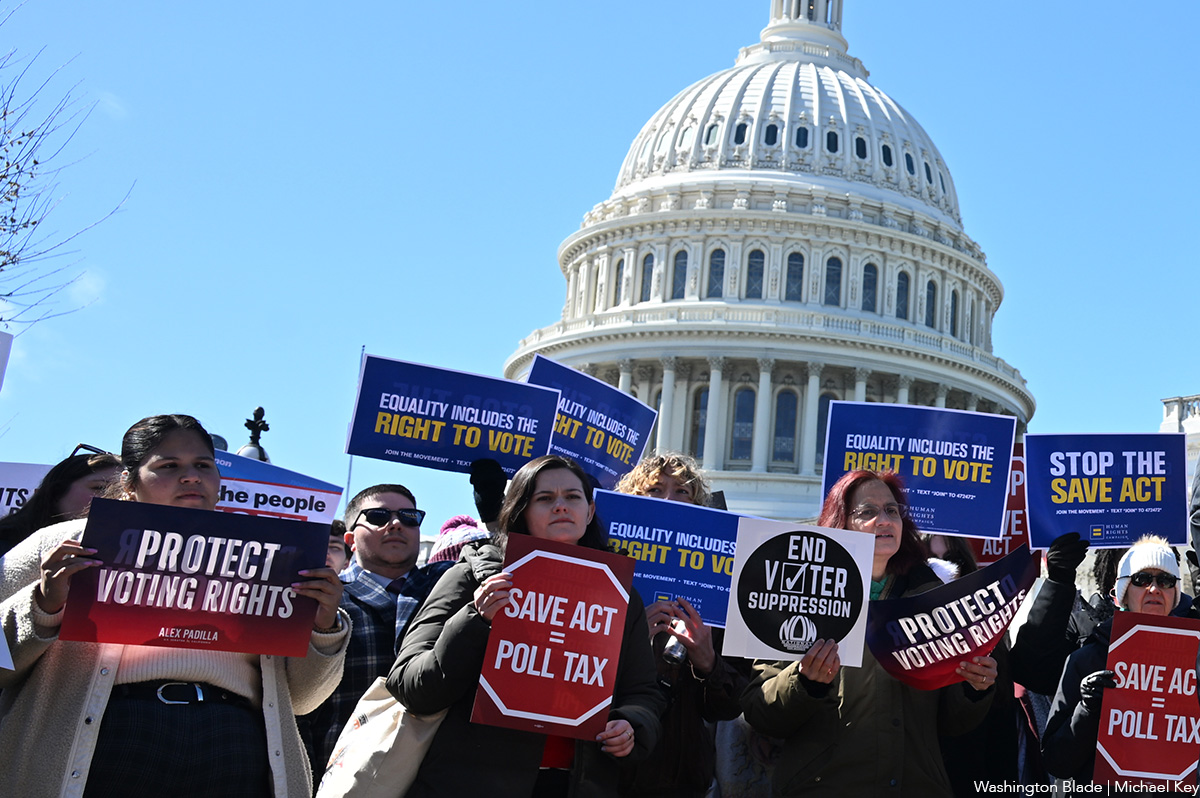
Members of Congress, advocates, and people from across the country gathered outside the U.S. Capitol on Tuesday to protest proposed federal legislation that voting rights activists have deemed “Jim Crow 2.0.”
The Safeguard American Voter Eligibility (SAVE) Act would amend the National Voter Registration Act of 1993 to require in-person proof of citizenship for anyone seeking to vote in U.S. elections.
President Donald Trump has also pushed for the proposed legislation to include a section that would ban gender-affirming medical care for transgender minors, even with parental consent, and prohibit trans people from participating in school or professional sports consistent with their gender identity rather than their sex assigned at birth.
In addition to changing voter registration requirements, the bill would limit acceptable forms of identification to documents such as a birth certificate or passport — records that the Brennan Center for Justice estimates more than 21 million Americans do not have — effectively restricting access to the ballot. It would also ban online voter registration, DMV voter registration efforts, and mail-in voter registration.
A 2021 investigation by the Associated Press found that fewer than 475 people voted illegally or improperly, a tiny fraction of the estimated 160 million Americans who voted in the 2020 election.
Senate Minority Leader Chuck Schumer (D-N.Y.) spoke at the event.
“It will kick millions of American citizens off the rolls. And they don’t even require you to be told,” the highest-ranking Democrat in the Senate told protesters and reporters outside the Capitol. “If this law passes — and it won’t — you’re gonna show up in November … and they’ll say… sorry, you’re no longer on the voting rolls.”
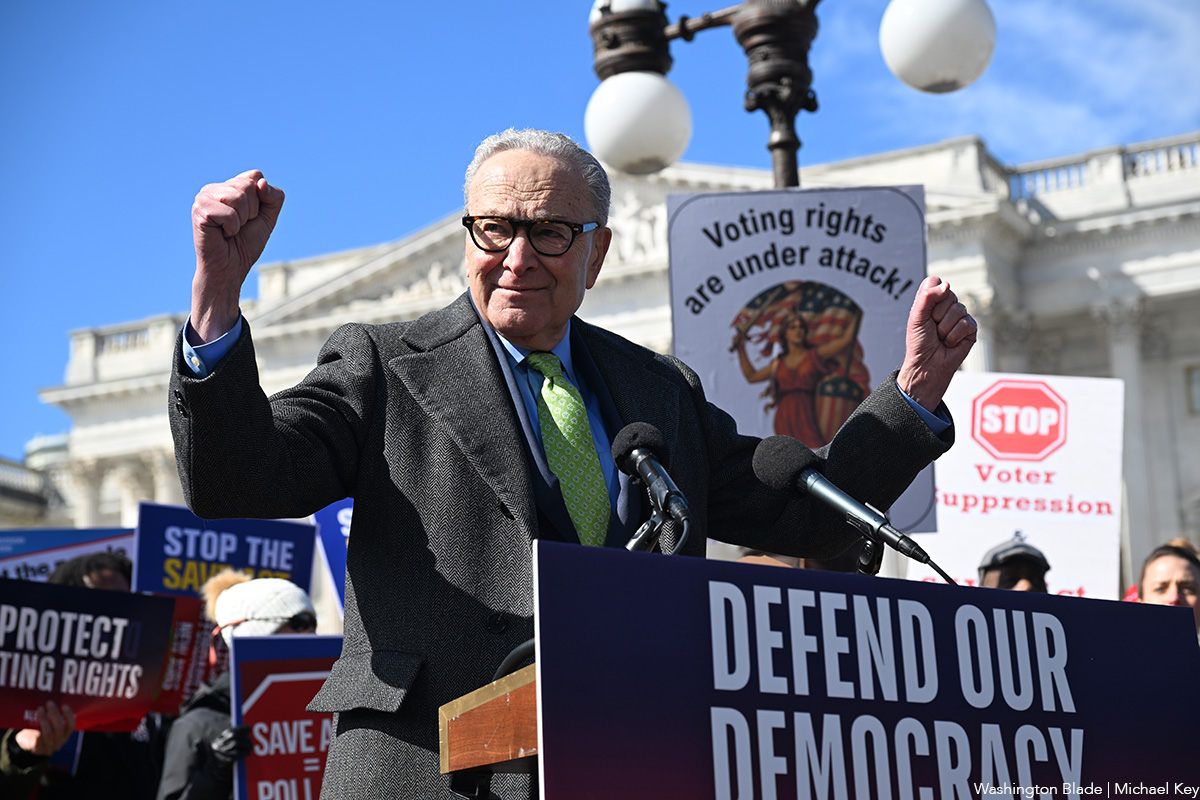
He, like many other speakers, emphasized the bill in the context of American history, pointing to what he described as its racist roots and its impact on Black and brown Americans.
“I have called this act, over and over again, Jim Crow 2.0 … because they know it’s the truth.”
U.S. Sen. Alex Padilla (D-Calif.) was one of the lawmakers leading opposition to the legislation and spoke at the rally.
“It’s not just voting rights that are on the line — our democracy is on the line,” the California lawmaker said. “It’s not a voter I.D. bill. It’s a bait and switch bill.”
He added historical context, noting the significance of voting rights legislation passed more than 60 years ago. In 1965, Alabama civil rights activists marched to protest barriers to voter registration. Alabama state troopers violently attacked peaceful demonstrators at the Edmund Pettus Bridge in Selma, using tear gas, clubs, and whips against more than 500 — mostly Black — protesters.
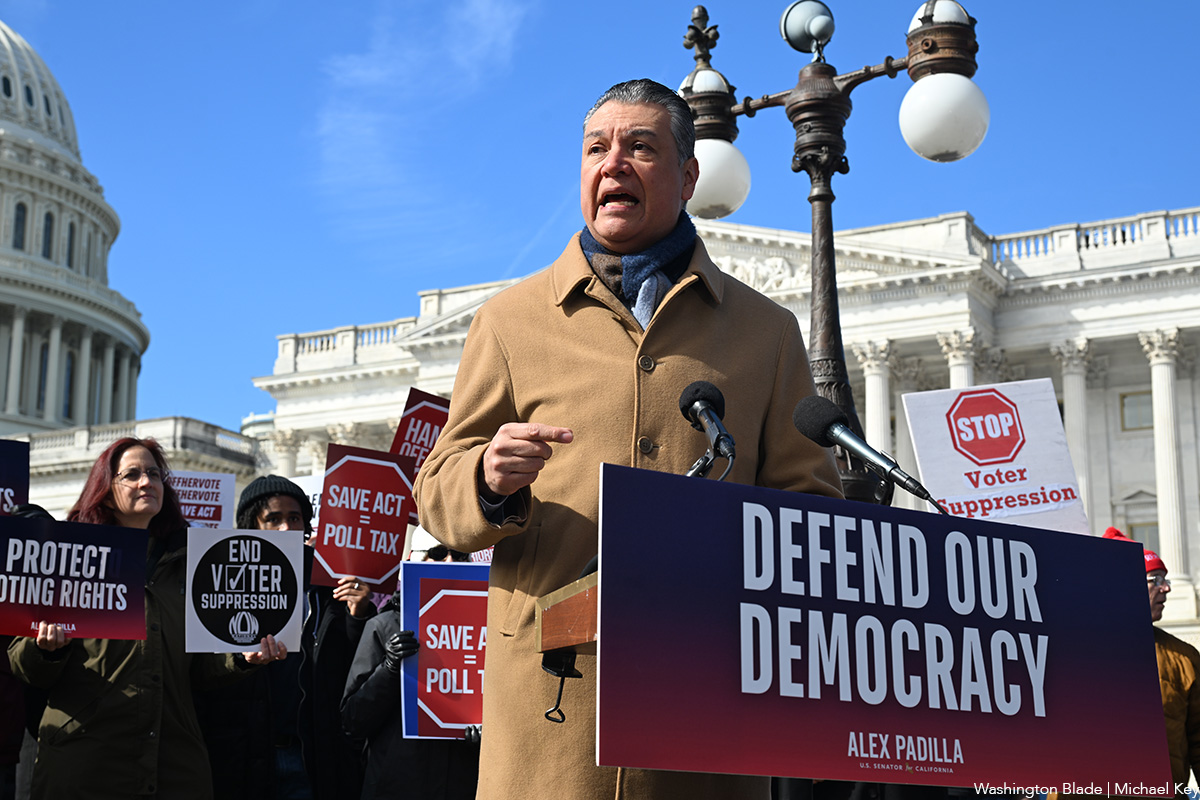
“61 years ago — not to the day — but this week, President Lyndon Johnson came to the Capitol and addressed a joint session of Congress in the wake of Bloody Sunday and pushed Congress to pass the Voting Rights Act,” Padilla said. “61 years later, Donald Trump and this Republican majority wants to take us backwards. We’re not gonna let that happen.”
U.S. Sen. Ben Ray Luján (D-N.M.) also spoke, emphasizing that he views the effort as a Republican-led and Trump-backed attempt to restrict voting access, particularly among Black, brown, and predominantly Democratic communities.
“President Trump told Republicans when they were meeting behind closed doors that ‘The SAVE Act will guarantee Republicans win the midterms and ensure they do not lose an election for 50 years,’” Luján said. “The first time I think Donald Trump’s been honest … This voter suppression bill is only that. Taking away vote by mail? I hope my Republican colleagues from states that voted for Donald Trump or where vote by mail is popular have the courage and the backbone to stand up and say no to this nonsense, because their constituents are going to push back.”
U.S. Sen. Lisa Blunt Rochester (D-Del.) also spoke.
“Our Republican colleagues have already cut Medicaid, Medicare, people don’t know how they’re gonna be able to afford energy,” she said, providing context for the broader political moment. “We’re in the middle of a war that they can’t even get straight while we’re in it and don’t have a way to get out of it. And we are now faced with defending our democracy?”
She then showed the crowd something that she said has been with her throughout her political journey in Washington.
“I brought with me something that I carried on the day that I was sworn into the House of Representatives when I was elected in 2016, and I carried it with me on the day that I was sworn in as United States senator. And I also carried it with me when I was trapped up in the gallery on Jan. 6 and all I could think to do was pray … This document allowed my great great great grandfather, who had been enslaved in Georgia, to have the right to vote. We took this and turned it into a scarf. It is the returns of qualified voters and reconstruction code from 1867. This is my proof of what we’ve been through. This is also our inspiration.”
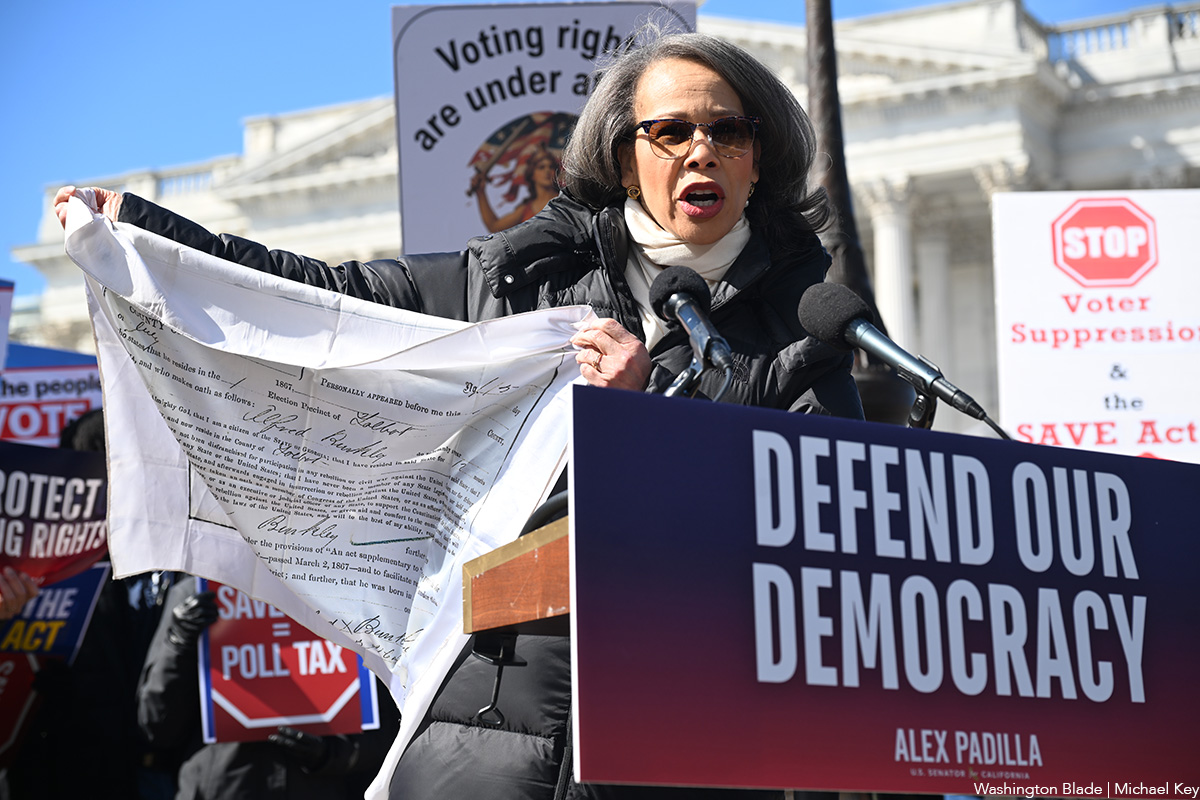
“I got to travel between the Edmund Pettus Bridge two times. And even as I thought about this moment, I recognized that while we wish we weren’t in it, while we don’t know why we’re in it, I do know we were made for it … So I came today to tell you that, um, just like the leader said, that he calls it Jim Crow 2.0. I call it Jim Crow 2.NO.”
Kelley Robinson, president of the Human Rights Campaign, the largest LGBTQ advocacy organization in the U.S., also spoke, highlighting the impact of the bill’s proposed provisions affecting trans people.
“This bill is not about saving America. This bill is about stealing an election. This bill is about suppressing voters,” Robinson said. “This bill not only tries to disenfranchise voters that deserve their right to vote, it also tries to criminalize trans kids and their families … It tries to criminalize doctors providing medically necessary care for our trans youth.”
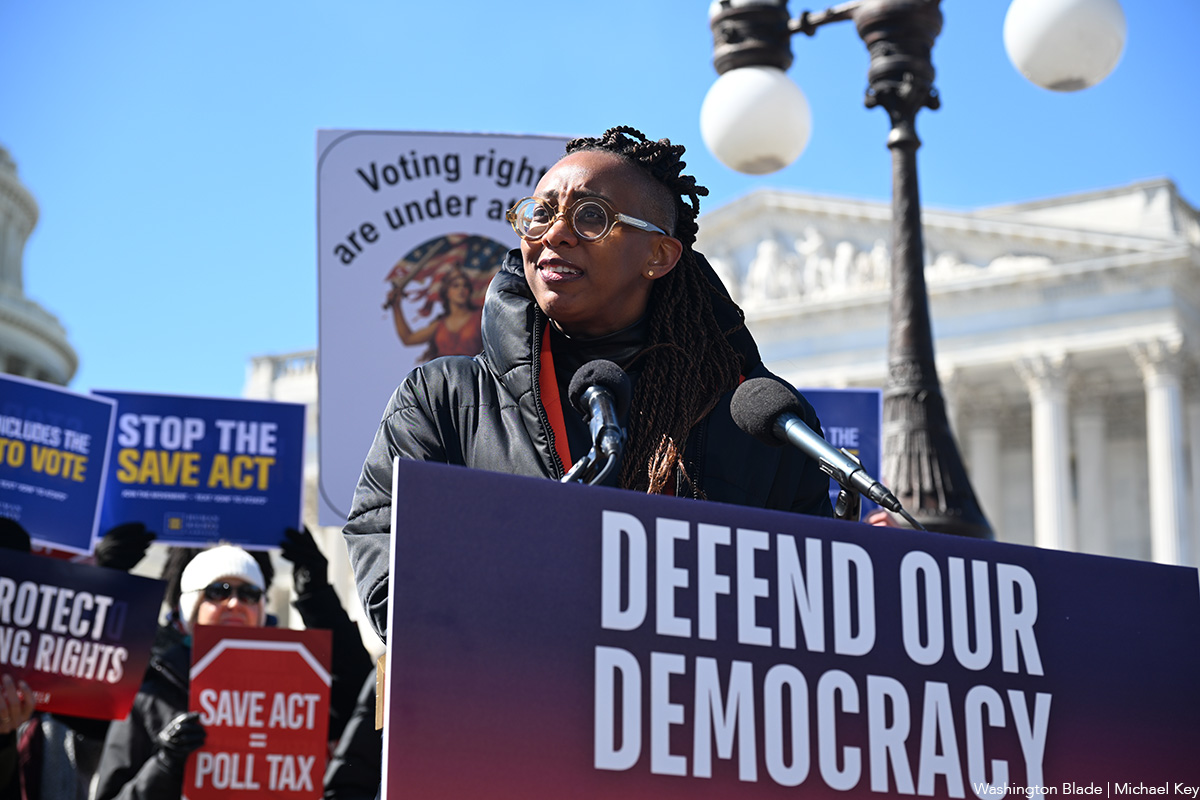
The SAVE Act passed the U.S. House of Representatives on Feb. 11 but has not yet been considered in the U.S. Senate.
Idaho
Idaho advances bill to restrict bathroom access for transgender residents
HB 752 passed in state House of Representatives on Monday
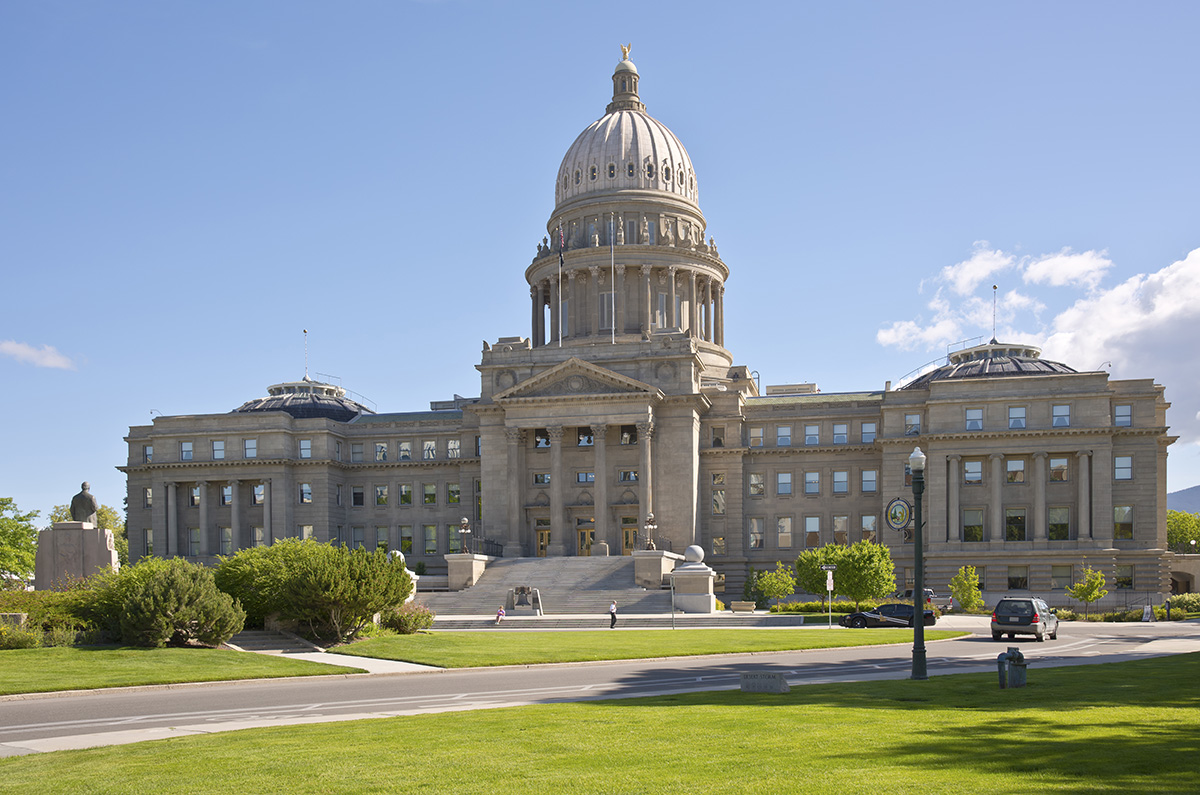
The Idaho House of Representatives passed House Bill 752 on Monday, a measure that would make it a crime for a person to use a bathroom other than the one designated for their “biological sex.”
The story was first reported by the Idaho Capitol Sun after the bill cleared the House.
House Bill 752 would make it a criminal offense — either a misdemeanor or a felony, depending on the number of prior offenses — for individuals who “knowingly and willfully” enter a bathroom or changing room designated for the opposite sex.
The bill would apply to public buildings, including government-owned spaces, and places of “public accommodation,” a category that includes private businesses.
According to the bill’s text, it would “prohibit a person from entering a restroom or changing room designated for the opposite sex; provide a penalty; provide exceptions; define terms; and declare an emergency and provide an effective date.”
A first offense would be a misdemeanor, punishable by up to one year in prison. A second or subsequent offense within five years would be a felony, punishable by up to five years in prison.
The bill passed in a 54–15 vote on Monday. Six Republicans broke with their party’s majority to join nine Democrats in opposing the measure.
The bill’s sponsor, state Rep. Cornel Rasor, a Republican from Sagle near the Washington-Idaho border, told House lawmakers that the legislation is intended to protect women and girls.
“It prevents discomfort and voyeurism escalation and assaults, while preserving single-user options and narrow exceptions so no one is denied access for emergency aid,” Rasor said.
State Rep. Chris Mathias, a Democrat from Boise, disagreed, arguing that the legislation would unfairly target transgender Idahoans.
“The truth of the matter is — and I know a lot of people don’t want to say it — but forcing people who don’t look like the sex they were assigned at birth, or transgender folks, to use other people’s bathrooms is going to put a lot of people in danger,” Mathias said.
The Idaho American Civil Liberties Union made a statement about the bill following its passage.
“Idaho lawmakers continue pushing these harmful, invasive bathroom laws, yet cannot present credible evidence that transgender people using gender-aligned bathrooms threaten public safety,” the Idaho ACLU said. “The bill does nothing to address real criminal acts, such as sexual assault or voyeurism, and disregards concerns from law enforcement about the burden enforcement would place on local resources.”
In addition to human rights advocates, who have spoken out against similar bills advancing in state legislatures across the country, Idaho law enforcement groups have also opposed the measure. They argue that the way the legislation is written would “pose significant practical enforcement challenges,” noting that officers are tasked with maintaining public safety — not conducting gender checks or policing bathroom access.
During a committee hearing last week, law enforcement representatives and several trans Idahoans testified that the bill would make many residents less safe.
“Officers responding to a complaint would be placed in the difficult position of determining an individual’s biological sex in order to enforce the statute,” Idaho Fraternal Order of Police President Bryan Lovell wrote. “In many circumstances, there is no clear or reasonable way for officers to make that determination without engaging in questioning or investigative actions that could be viewed as invasive and inappropriate.”
The Idaho Sheriffs’ Association requested that lawmakers amend the bill to require that individuals be given an opportunity to leave a bathroom immediately before facing potential prosecution.
The bill now heads to the Idaho Senate for consideration. To become law, it must pass both chambers and avoid a veto from the governor.
A separate bathroom bill, House Bill 607, which would be enforced through civil lawsuits, passed the House last month but has not yet received a committee hearing in the Senate.

Trans-led HIV clinic in Portsmouth struggles amid funding cuts

D.C. goes gaga for Gaga

Gay priest credited with boosting church support for LGBTQ Catholics

HRC to host National Rainbow Seder

Markwayne Mullin confirmed as next DHS secretary

Calendar: March 21-26

‘How We Survived’ panel set for March 25

Small is beautiful: subcompact SUVs

‘Inherit the Wind’ isn’t about science vs. religion, but the right to think