Arts & Entertainment
Presidential sweet
Teddy a tasty follow-up to Lincoln
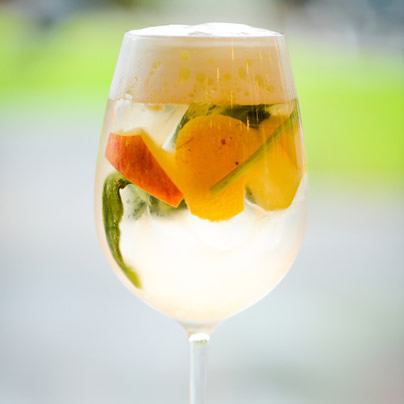
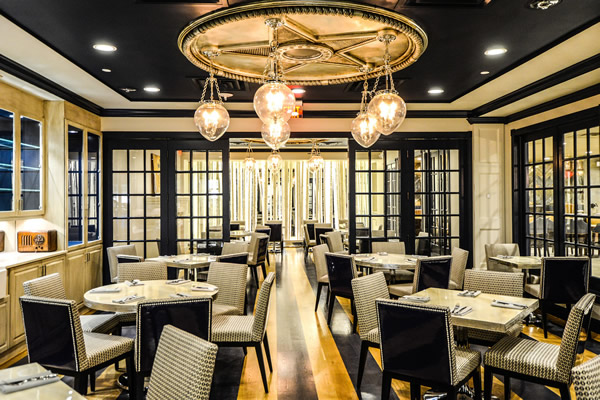
Teddy and the Bully Bar (1200 19th Street, N.W.). (Photo courtesy Teddy and the Bully Bar)
The same visionary who brought us Lincoln Restaurant (1110 Vermont Ave., N.W.) is back with another. Teddy and the Bully Bar (1200 19th Street, N.W.) doesn’t quite scream Roosevelt to the degree that its predecessor conjures Honest Abe, but it’s still a fun concept with rich offerings served in the oh-so-D.C.-style of small — and I do mean small — plates.
Owner Alan Popovsky, a political science major in college, unveiled Teddy last month in the former site of Sam and Harry’s Steakhouse, which boasts 230 seats, an in-house bakery and quirky contributions from about 50 local artists. Designer Maggie O’Neill makes clever use of the theme with the “rock wall,” created from small Mount Rushmore replicas.
Roosevelt was an avid hunter and outdoorsman, so it’s no surprise that Executive Chef Michael Hartzer has incorporated wild game into the menu. Mixologist John Hogan has developed a distinctive cocktail program to complement the cuisine through the use of homemade tonics, syrups and bitters. And there’s even a gay member of the management staff, Justin Gulledge, assistant general manager.
His favorite thing about his new position is making sure every guest is content, as well as seeing his regulars who come in multiple times per week and enjoy a great meal. Gulledge was a server at Lincoln before taking this promotion. He says his experience on the floor helped prepare him for management, but the need to multitask and help out all his servers at the same time is his biggest challenge.
He adjusted with help from General Manager Romeo Santos III. Gulledge is a huge fan of the rich food served at Teddy and the Bully Bar; his favorites include the fried fish sandwich with spicy mayo and peppers on the lunch menu and the mac and cheese with three cheeses. He says everyone needs to try the peaches-and-goat cheese salad. With this in mind, I gathered a group to give it a try.
Safari Sangria. (Photo courtesy Teddy and the Bully Bar)
It turned out to be my usual dining gaggle plus one of my groomsman who happened to be visiting. We entered Teddy and the Bully Bar after a long day in the sun. We needed something to cool us down and the waiter recommended The Safari Sangria with Veev Acai (a spirit), Vinho Verde (a Portuguese wine), sage, apple, grapefruit and sweet lime foam. From the moment we took a sip of this glorious concoction we trusted our waiter wholeheartedly and not once did he steer us wrong.
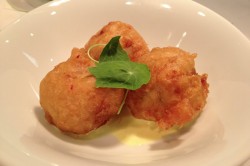
Oyster Bay Fritters. (Photo courtesy Teddy and the Bully Bar)
We enjoyed the spectacular basket of fresh made breads accompanied by butters and jams, the delectable Havana croquettes with a green pepper sauce that I was tempted to lick off the plate, and the wonderful oyster bay fritters that were beer battered and had the perfect amount of heat from the chili peppers. The grilled romaine salad and the peaches and goat cheese were also favorites at the table; Gulledge was definitely correct with his recommendation of this dish.
The golden potato puree and the Teddy Macaroni and Cheese were also enjoyable, although the portion was so small we needed to order seconds so the entire table could have a spoonful of each. The small plates here — as with Lincoln — are quite small, so plan accordingly. Even if your waiter tells you they’re suitable to share, you may want to order a couple extras to satiate your hunger. Nothing spoils a tasty meal like the urge to order a pizza when you get home.
The fried chicken, which Chef Hartzer says was Roosevelt’s favorite dish, had a crispy coating and the chicken was tender and juicy.
One standout dish rose above the rest — the crab and avocado with charred corn. The layered dish with fresh cool avocado and rich sweet crab was perfectly balanced, flavorful and refreshing, an excellent summer dish. Be sure to try it if you go.
Popovsky has brought another great concept restaurant to the District and with the help of Hartzer and Hogan, there’s a food and beverage menu full of tantalizing treats. The waitstaff, led by Santos and Gulledge, is customer focused and doesn’t disappoint.
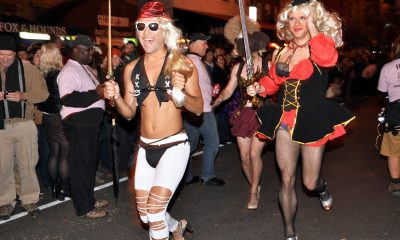
The 44th annual Queen of Hearts pageant was held at The Lodge in Boonsboro, Md. on Friday, Feb. 20. Six contestants vied for the title and Bev was crowned the winner.
(Washington Blade photos by Michael Key)


View on Threads
Books
New book profiles LGBTQ Ukrainians, documents war experiences
Tuesday marks four years since Russia attacked Ukraine
Journalist J. Lester Feder’s new book profiles LGBTQ Ukrainians and their experiences during Russia’s war against their country.
Feder for “The Queer Face of War: Portraits and Stories from Ukraine” interviewed and photographed LGBTQ Ukrainians in Kyiv, the country’s capital, and in other cities. They include Olena Hloba, the co-founder of Tergo, a support group for parents and friends of LGBTQ Ukrainians, who fled her home in the Kyiv suburb of Bucha shortly after Russia launched its war on Feb. 24, 2022.
Russian soldiers killed civilians as they withdrew from Bucha. Videos and photographs that emerged from the Kyiv suburb showed dead bodies with their hands tied behind their back and other signs of torture.

Olena Shevchenko, chair of Insight, a Ukrainian LGBTQ rights group, wrote the book’s forward.

The book also profiles Viktor Pylypenko, a gay man who the Ukrainian military assigned to the 72nd Mechanized Black Cossack Brigade after the war began. Feder writes Pylypenko’s unit “was deployed to some of the fiercest and most important battles of the war.”
“The brigade was pivotal to beating Russian forces back from Kyiv in their initial attempt to take the capital, helping them liberate territory near Kharkiv and defending the front lines in Donbas,” wrote Feder.
Pylypenko spent two years fighting “on Ukraine’s most dangerous battlefields, serving primarily as a medic.”
“At times he felt he was living in a horror movie, watching tank shells tear his fellow soldiers apart before his eyes,” wrote Feder. “He held many men as they took their final breaths. Of the roughly one hundred who entered the unit with him, only six remained when he was discharged in 2024. He didn’t leave by choice: he went home to take care of his father, who had suffered a stroke.”
Feder notes one of Pylypenko’s former commanders attacked him online when he came out. Pylypenko said another commander defended him.
Feder also profiled Diana and Oleksii Polukhin, two residents of Kherson, a port city in southern Ukraine that is near the mouth of the Dnieper River.
Ukrainian forces regained control of Kherson in November 2022, nine months after Russia occupied it.
Diana, a cigarette vender, and Polukhin told Feder that Russian forces demanded they disclose the names of other LGBTQ Ukrainians in Kherson. Russian forces also tortured Diana and Polukhin while in their custody.
Polukhim is the first LGBTQ victim of Russian persecution to report their case to Ukrainian prosecutors.

Feder, who is of Ukrainian descent, first visited Ukraine in 2013 when he wrote for BuzzFeed.
He was Outright International’s Senior Fellow for Emergency Research from 2021-2023. Feder last traveled to Ukraine in December 2024.
Feder spoke about his book at Politics and Prose at the Wharf in Southwest D.C. on Feb. 6. The Washington Blade spoke with Feder on Feb. 20.
Feder told the Blade he began to work on the book when he was at Outright International and working with humanitarian groups on how to better serve LGBTQ Ukrainians. Feder said military service requirements, a lack of access to hormone therapy and documents that accurately reflect a person’s gender identity and LGBTQ-friendly shelters are among the myriad challenges that LGBTQ Ukrainians have faced since the war began.
“All of these were components of a queer experience of war that was not well documented, and we had never seen in one place, especially with photos,” he told the Blade. “I felt really called to do that, not only because of what was happening in Ukraine, but also as a way to bring to the surface issues that we’d had seen in Iraq and Syria and Afghanistan.”

Feder also spoke with the Blade about the war’s geopolitical implications.
Russian President Vladimir Putin in 2013 signed a law that bans the “promotion of homosexuality” to minors.
The 2014 Winter Olympics took place in Sochi, a Russian resort city on the Black Sea. Russia annexed Crimea from Ukraine a few weeks after the games ended.
Russia’s anti-LGBTQ crackdown has continued over the last decade.
The Russian Supreme Court in 2023 ruled the “international LGBT movement” is an extremist organization and banned it. The Russian Justice Ministry last month designated ILGA World, a global LGBTQ and intersex rights group, as an “undesirable” organization.
Ukraine, meanwhile, has sought to align itself with Europe.
Ukrainian President Volodymyr Zelenskyy after a 2021 meeting with then-President Joe Biden at the White House said his country would continue to fight discrimination based on sexual orientation and gender identity. (Zelenskyy’s relationship with the U.S. has grown more tense since the Trump-Vance administration took office.) Zelenskyy in 2022 publicly backed civil partnerships for same-sex couples.
Then-Ukrainian Ambassador to the U.S. Oksana Markarova in 2023 applauded Kyiv Pride and other LGBTQ and intersex rights groups in her country when she spoke at a photo exhibit at Ukraine House in D.C. that highlighted LGBTQ and intersex soldiers. Then-Kyiv Pride Executive Director Lenny Emson, who Feder profiles in his book, was among those who attended the event.
“Thank you for everything you do in Kyiv, and thank you for everything that you do in order to fight the discrimination that still is somewhere in Ukraine,” said Markarova. “Not everything is perfect yet, but you know, I think we are moving in the right direction. And we together will not only fight the external enemy, but also will see equality.”
Feder in response to the Blade’s question about why he decided to write his book said he “didn’t feel” the “significance of Russia’s war against Ukraine” for LGBTQ people around the world “was fully understood.”
“This was an opportunity to tell that big story,” he said.
“The crackdown on LGBT rights inside Russia was essentially a laboratory for a strategy of attacking democratic values by attacking queer rights and it was one as Ukraine was getting closet to Europe back in 2013, 2014,” he added. “It was a strategy they were using as part of their foreign policy, and it was one they were using not only in Ukraine over the past decade, but around the world.”
Feder said Republicans are using “that same strategy to attack queer people, to attack democracy itself.”
“I felt like it was important that Americans understand that history,” he said.
More than a dozen LGBTQ athletes won medals at the Milan Cortina Winter Olympics that ended on Sunday.
Cayla Barnes, Hilary Knight, and Alex Carpenter are LGBTQ members of the U.S. women’s hockey team that won a gold medal after they defeated Canada in overtime. Knight the day before the Feb. 19 match proposed to her girlfriend, Brittany Bowe, an Olympic speed skater.
French ice dancer Guillaume Cizeron, who is gay, and his partner Laurence Fournier Beaudry won gold. American alpine skier Breezy Johnson, who is bisexual, won gold in the women’s downhill. Amber Glenn, who identifies as bisexual and pansexual, was part of the American figure skating team that won gold in the team event.
Swiss freestyle skier Mathilde Gremaud, who is in a relationship with Vali Höll, an Austrian mountain biker, won gold in women’s freeski slopestyle.
Bruce Mouat, who is the captain of the British curling team that won a silver medal, is gay. Six members of the Canadian women’s hockey team — Emily Clark, Erin Ambrose, Emerance Maschmeyer, Brianne Jenner, Laura Stacey, and Marie-Philip Poulin — that won silver are LGBTQ.
Swedish freestyle skier Sandra Naeslund, who is a lesbian, won a bronze medal in ski cross.
Belgian speed skater Tineke den Dulk, who is bisexual, was part of her country’s mixed 2000-meter relay that won bronze. Canadian ice dancer Paul Poirier, who is gay, and his partner, Piper Gilles, won bronze.
Laura Zimmermann, who is queer, is a member of the Swiss women’s hockey team that won bronze when they defeated Sweden.
Outsports.com notes all of the LGBTQ Olympians who competed at the games and who medaled.
-
District of Columbia4 days agoJudge rescinds order against activist in Capital Pride lawsuit
-
District of Columbia4 days agoTrans activists arrested outside HHS headquarters in D.C.
-
Opinions4 days agoHow do we honor Renee Good, Alex Pretti?
-
Sports5 days agoUS wins Olympic gold medal in women’s hockey