News
Onward to the House for ENDA
Boehner pressured to allow vote after bipartisan Senate passage
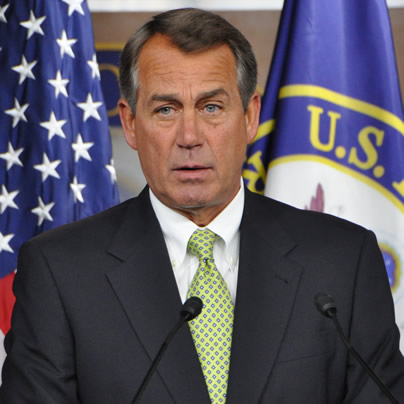
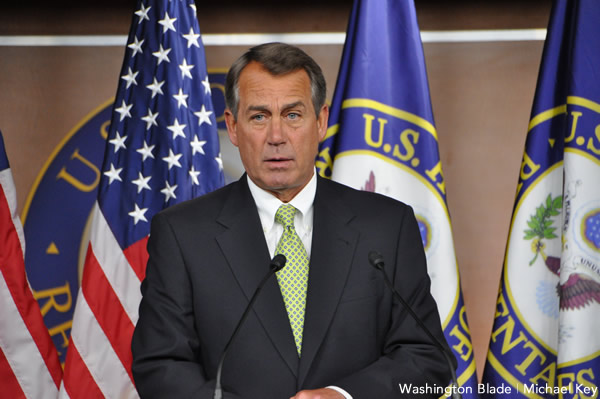
All eyes will be on Speaker John Boehner as advocates push for a House vote on ENDA. (Washington Blade file photo by Michael Key)
Supporters of the Employment Non-Discrimination Act are hoping to capitalize on the momentum from last week’s historic bipartisan Senate victory as they pursue a vote on the bill in the U.S. House.
Ten Senate Republicans voted for ENDA, which would prohibit most employers from discriminating on the basis of sexual orientation or gender identity. Their support gave the bill more bipartisan support than “Don’t Ask, Don’t Tell” repeal, which had just eight GOP votes, and more than any other pro-LGBT bill that has come to a vote in the Senate.
Liz Mair, a Republican political strategist who favors LGBT inclusion in the party, said the support that ENDA received in the Senate from Republicans demonstrates the party isn’t as opposed to LGBT rights as some observers might think.
“The fact that ENDA garnered 10 Republican votes in the Senate — and from a Republican caucus that is significantly less moderate than certain predecessor versions now that it lacks Scott Brown, Olympia Snowe, Judd Gregg and the like — is a reminder that the GOP is much more attuned to gay rights issues and much more in line with mainstream American attitudes on those issues than one would think from the image of the GOP that certain very conservative party leaders and the media tend to present,” Mair said.
The two Republican original co-sponsors — Sens. Susan Collins (R-Maine) and Mark Kirk (R-Ill.) — were joined in support by Sens. Rob Portman (R-Ohio), Kelly Ayotte (R-N.H.), Pat Toomey (R-Pa.), Dean Heller (R-Nev.), Orrin Hatch (R-Utah), Lisa Murkowski (R-Alaska) John McCain (R-Ariz.) and Jeff Flake (R-Ariz.).
Of those 10, the votes from McCain and Flake are particularly noteworthy because they represent a “red” state that President Obama lost in both 2008 and 2012. In addition, both senators expressed misgivings about ENDA before they ultimately voted for the bill.
Gregory Angelo, executive director of the Log Cabin Republicans, nonetheless said he wasn’t surprised by their support for the bill in the end.
“I know that both senators had expressed some hesitancy before casting their votes, but Flake is someone who voted for ENDA in 2007 when he was a member of the House, and Sen. McCain had even indicated that he would be open to supporting ENDA when he was running for president in 2008 — as part of, I believe, a questionnaire or interview he did with the Blade no less,” Angelo said.
A Senate source familiar with ENDA said McCain was able to support the bill after the adoption of the Portman-Ayotte amendment, which would prohibit federal, state and local governments from retaliating against institutions that invoke the religious exemption in the bill to discriminate against LGBT employees.
For Flake, who earlier told the Washington Blade he’d vote against ENDA because of the transgender protections in the bill, the Senate source said his support was solidified after he received assurances that businesses would receive guidance on the prohibition of gender identity discrimination.
Also significant on the Republican position on ENDA was the fact that Senate Minority Leader Mitch McConnell, according to Senate Republican aides familiar with the bill, didn’t whip the vote on the legislation and instead allowed members of his caucus to vote their conscience.
Angelo was among those who saw no evidence of Republican leadership instructing members to vote against ENDA.
“The fact that you had almost one-in-four members of the GOP caucus in the Senate vote in favor shows that membership was allowed to take a vote of conscience on this issue,” Angelo said.
Will the House vote on ENDA?
Now that the Senate has wrapped up its consideration of ENDA, attention has turned to passing the bill in the House, where Republican support will be necessary, first, to bring the bill to the floor and, second, to find 218 votes for the bill in the Republican majority chamber.
House Speaker John Boehner (R-Ohio) has indicated his opposition to the bill out of concern it would lead to “frivolous lawsuits” and a spokesperson for House Minority Leader Eric Cantor (R-Va.) was quoted in The Huffington Post as saying the bill “is currently not scheduled in the House.”
Nonetheless, Democrats ranging from Senate Majority Leader Harry Reid (D-Nev.) to gay Rep. Jared Polis (D-Colo.), ENDA’s chief sponsor in the House, insist that the House has enough votes for passage should it come to the floor.
Drew Hammill, a spokesperson for House Minority Leader Nancy Pelosi (D-Calif.), told the Blade his boss is among those who believe ENDA has sufficient support in the House for passage.
“Leader Pelosi has made it clear that there is sufficient support in the House to pass ENDA now,” Hammill said. “Instead of scheduling a vote on this measure, House Republicans are planning to vote for the 46th time to repeal or undermine the Affordable Care Act. There is only one man standing in the way of the expansion of workplace protections for millions of LGBT Americans. His name is John Boehner.”
ENDA has 196 House sponsors. That’s just 22 votes short of the necessary votes to pass the legislation on the House floor.
While the bill could technically come up at any time during the 13 months that remain in the current Congress, Polis said the legislation should come up sooner rather than later because, as Election Day approaches, members of the House will leave to campaign in their districts. It would be the first time that ENDA has come to the House floor since 2007, and the first time ever the chamber would consider a version of the bill that included transgender protections.
ENDA supporters claimed another Republican as their own last week when former White House Press Secretary Ari Fleischer, who served as spokesperson for former President George W. Bush, penned an op-ed in Politico urging the House to pass the bill.
“Allowing people to be successful in their workplaces is an essential piece of individual opportunity and liberty,” Fleischer said. “Working for a living is one of America’s freedoms. It’s a virtue to be encouraged — and supporting it is important to the future of the Republican Party.”
But not all LGBT advocates agree that sufficient votes exist to pass ENDA in the House. Some Republican supporters of the legislation stopped short of saying ENDA already has sufficient support to pass on the floor.
Jeff Cook-McCormac, senior adviser to the pro-LGBT Republican group American Unity Fund, said more work is needed when asked if ENDA is ready to move to the House floor.
“We’re encouraged by the momentum, working to identify and demonstrate majority support and committed to engaging legislators in the thoughtful and respectful conversations necessary to get there as quickly as possible,” Cook-McCormac said.
Mair said ENDA will be “a more uphill battle in the House” not only because of conservative worries over the bill’s content, but also out of fear of supporting anything seen as part of Obama’s agenda. Still, she wouldn’t rule out a surprise.
“Even back in 2007, ENDA garnered a noteworthy amount of GOP support in the House, including from some rather conservative members,” Mair said. “Thirty-five Republicans voted for ENDA then, including John Campbell, Jeff Flake, Thaddeus McCotter and Paul Ryan. So it will be interesting to see how it plays out this time around.”
For Cook-McCormac, the next priority is to build the number of Republican co-sponsors for ENDA. There are currently five: Reps. Charlie Dent (R-Pa.), Chris Gibson (R-N.Y.), Richard Hanna (R-N.Y.), Ileana Ros-Lehtinen (R-Fla.) and Jon Runyan (R-N.J.).
Dent told the Washington Post that Boehner “should allow a vote on this bill” because the American public believes the workplace should be free of discrimination.
Ros-Lehtinen said in a statement to the Blade that she also hopes Republican leadership will bring ENDA to the floor for a vote, but chose her words carefully about its prospects.
“The passage of ENDA by the Senate is a great first step toward making this bill law,” Ros-Lehitnen said. “I urge my colleagues in the House to sign on to the companion bill and hope House leadership will bring it up for a vote. I believe if it is brought to a vote, it has the opportunity to pass.”
Renee Gamela, a Hanna spokeswoman, said ENDA is good for business.
“Rep. Hanna would like ENDA to receive a vote in the House when it is clear that there are sufficient votes for passage,” Gamela said. “He intends to speak directly with his colleagues about why, as a small business owner, he believes supporting the legislation is good for economic competitiveness, individual liberty and our party.”
As articulated by Pelosi, one approach seen as a pathway for passage of ENDA in the House would be similar to what happened with reauthorization of the Violence Against Women Act. Amid public pressure, the House in February passed a bill with protections for LGBT victims of domestic violence after the Republican version of the bill without the provisions failed on the floor.
Log Cabin’s Angelo said whether a vote on ENDA will take place in the House “comes down to pressure” both from Republicans in the House who support it and advocates on the outside who want to see it passed.
“I think if you had a similar push that happened with the Violence Against Women Act, where you had a tremendous surge among grassroots, and you also had GOP members of Congress urging leadership to bring this up for a vote, you got there,” Angelo said. “But it’s going to take considerable pressure. I’m not a Pollyanna when it comes to prospects in the House, but I am cautiously optimistic.”



Turkey
‘Governments that attack LGBTQ+ rights learn from each other’
Turkish authorities on Sept. 12 launched anti-LGBTQ ‘My Family Is Safe’ campaign

Sept. 12 is a solemn day for the people of Turkey. It is the anniversary of the 1980 coup d’état — when members of the National Security Council, along with the armed forces, dissolved the Turkish parliament, arrested hundreds of thousands of people, and entered a three-year period of martial law.
On Sept 12, the 46th anniversary of the 1980 coup, the country faced another wave of arrests; this time they targeted the LGBTQ community. The government launched the national “My Family Is Safe” campaign, which triggered mass raids and arrests of LGBTQ organization leaders, advocates, academics, and sexual health treatment centers for people with HIV. (These include EU-funded organizations launched by the Turkish government in 2005.) Since the nation has seen a decline in birthrate and a swelling economic crisis, this has allowed authoritarian President Recep Tayyip Erdoğan and conservatives in Turkey to use the LGBTQ community as the ideal scapegoat.
“This is the cruelest part. It was Erdoğan’s own party that made it easier to found NGOs in 2005 as an EU accession process, and that is how many LGBTI+ groups came to be officially registered.” Ali Yildiz, a linguistics graduate student at the University of Cologne in Germany, told the Washington Blade. “Everything was legal, transparent and official. Now those same registrations are being used as arrest lists. The state is basically punishing those who trusted it. It sounds very much like the nazis. They also used member lists of associations to persecute them later.”
Yildiz has witnessed the oppression of the Turkish government firsthand: in 2024, he moved to Germany. As one of the board members of a grassroots NGO that focuses on sexual health, Yildiz was at risk of arrest and prosecution.
As part of the “My Family Is Safe” operation on Sept. 12, police raided Yildiz’s family’s former home to find him.
In the aftermath of these raids in Turkey’s major cities, protestors have gathered at Turkish embassies across Europe and the U.S.
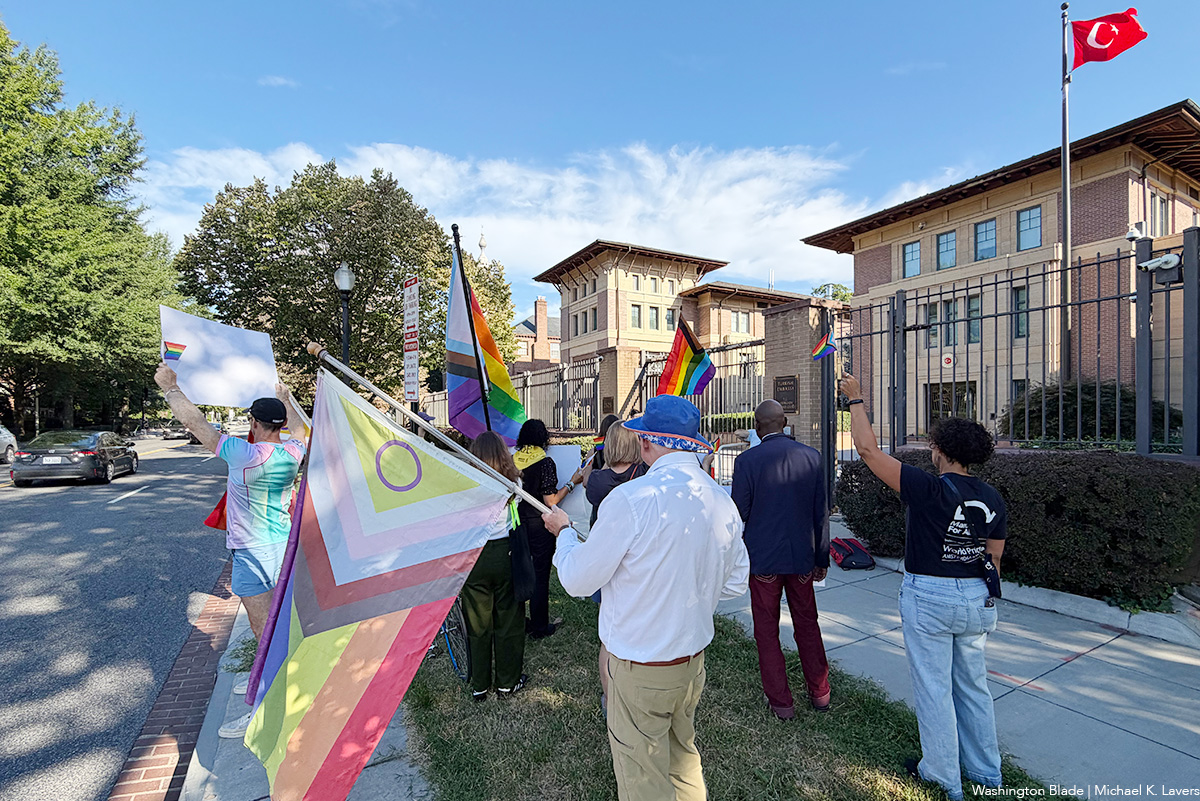
A critical discourse has also emerged as a response to the crackdown across international queer media: how should the West cover oppressive regimes abroad?
“From what I see, the Western reading of Turkey’s crackdown on LGBTI+ people usually goes: it’s a conservative, Muslim country, so this is what you’d expect. I believe that framing is incomplete, and it lets the people responsible off the hook. The Erdoğan regime is also heavily relying on this contextualization,” said Yildiz. “The government is not simply reacting to existing conservatism but is actively shaping it. Look at how operations are presented: raids on LGBTI+ organizations and activists come packaged with claims about drugs, obscenity, sex work, or organized crime on other groups in the news. The evil strategy is to link LGBTI+ people with criminality in the public mind.”
The LGBTQ community is not the only group that has been under the weight of oppression. Political opponents and descendants whom Erdoğan deems criminals are also charged with treason.
Istanbul Mayor Ekrem İmamoğlu, who is the leading candidate for the upcoming 2028 presidential elections for the opposition center-left Republican People’s Party, was arrested on terrorism charges in 2024. On the same day, he was nominated as the CHP’s presidential candidate.
For a while, X served as a platform to express discontent with the government, but that changed recently when Elon Musk blocked nearly 500 accounts in Turkey. The Turkish government also banned Grok after the AI system responded to a user’s question about Erdoğan, which government leaders found offensive.
The visibility of these pages has decreased. With a VPN, citizens can still access the pages because they were banned only in Turkey, not internationally.
Discontent with the government is increasing, but so is government oppression.
Not only have LGBTQ pages been shut down, but many journalists and academics have also had their pages banned.
The Blade spoke to an anonymous academic living in Ankara, the Turkish capital, who said Erdoğan, U.S. President Donald Trump, and other authoritarian leaders are constantly learning from each other.
“These anti LGBTQ+ policies are being created in the name of preserving traditional family values and are not only a threat to Türkiye,” they said. “It is also a global issue that threatens people everywhere. It should be perceived as an international problem. That is why we LGBTQ+ people need to act in solidarity internationally.”
Because of the compounding human rights crisis happening simultaneously around the globe, visibility has been advocates in Turkey’s main challenge.
Since 2022 there have been a series of crackdowns against opposition parties, academics, labor unions, student organizations, journalist and advocates. Another anonymous academic in Istanbul told the Blade that after the 2022 crackdown, “people were intimidated, and most people did not feel encouraged to organize.”
In the weeks following this recent crackdown, discontent with the Erdoğan government has increased along with inflation and unemployment, not helped by the war in Iran.
“Our leaders do not say anything about the financial crisis,” said the Istanbul academic.
High inflation, high unemployment rates, many factories, and businesses have left Türkiye and transferred their businesses to other countries. And because of the timing of these recent crackdowns, during this financial crisis, many people haven’t been paying attention.
Though for many queer and transgender Turks, post-Sept. 12 life has been radically different.
“I stopped doing drag in order to protect myself, and many queer performance artist friends of mine have also given up this part of their lives,” said one source who asked the Blade to remain anonymous.
“Everybody is not scared, but they simply bring their fear with them to the march and march courageously, because they believe they are on the right side of history,” they added. “However, I think it is important that people in Turkey are not represented only through their experiences of victimization. There should also be spaces where artists, activists, journalists, and other queer people can express themselves in their own words.”
The justification for this crackdown has been preserving “traditional family and conservative values.” The Turkish government has persecuted these offenses with raids, trials, and arrests that have gone beyond just the LGBTQ community. It targeted last year musicians, performers, and artists whom they deemed obscene or offensive.
In September 2025, the K-pop-inspired girl band Manifest was investigated for three months. Footage from their shows was banned from the internet, and the remainder of their tour was canceled. All seven members of the group faced 3 1/2 months prison sentences before the charges were ultimately dropped.
“I believe there is no pride for only some of us. Governments that attack LGBTQ+ rights learn from each other.” Yildiz tells the Blade, “Erdoğan borrows from Putin’s playbook, and parts of the Western right eagerly adopt the same rhetoric. This is a call for our community to see how important international solidarity is. People show up every single year for the Pride March, even though they know the police are going to attack. What I see in our community is pure courage.”
2026 Midterm Elections
Annie Andrews denounces trans athletes after Trump targets her
President used anti-trans slur to describe SC Senate candidate

Days after President Donald Trump called Annie Andrews, the cisgender Democratic nominee for South Carolina’s U.S. Senate seat, an anti-transgender slur on social media, Andrews came out against transgender girls and women participating in sports.
Trump called Andrews a “trannie” on Truth Social while attempting to garner support for her opponent, U.S. Sen. Darline Graham (R-S.C.), the incumbent seeking reelection in South Carolina.
After the president’s use of the slur was widely reported, the incident provided an opportunity for Andrews to explain her position on the ongoing trans debate that has shaped political discourse in the 2020s, despite trans people making up only 1 percent of the U.S. population, according to the Williams Institute.
She used the opportunity to denounce trans rights and pointed out that, as a physician, she had never performed gender-affirming surgery on minors.
“I want you to hear me loud and clear: I don’t support biological men playing women’s sports, and I don’t support and haven’t ever performed gender surgery for minors,” Andrews said in a political ad.
Despite these recent developments, Andrews has previously voiced support for trans South Carolinians. In 2022, she posted on her X account, criticizing the Save Women’s Sports Act, which was signed into law by Republican Gov. Henry McMaster and restricts trans girls from participating on girls’ sports teams.
“This is shameful legislation that does nothing to protect or support women or children in SC. In fact, it is actively harmful. I will always support trans youth,” Andrews wrote in after the legislation passed.
The Washington Blade reached out to Andrew’s campaign about the comments, and asked if she supports trans rights but did not receive a response.
2026 Midterm Elections
On Republican Long Island, gay Democrat Chris Gallant bets on public service over politics
Chris Gallant sat down with the Blade ahead of his race for NY’s 1st congressional district.
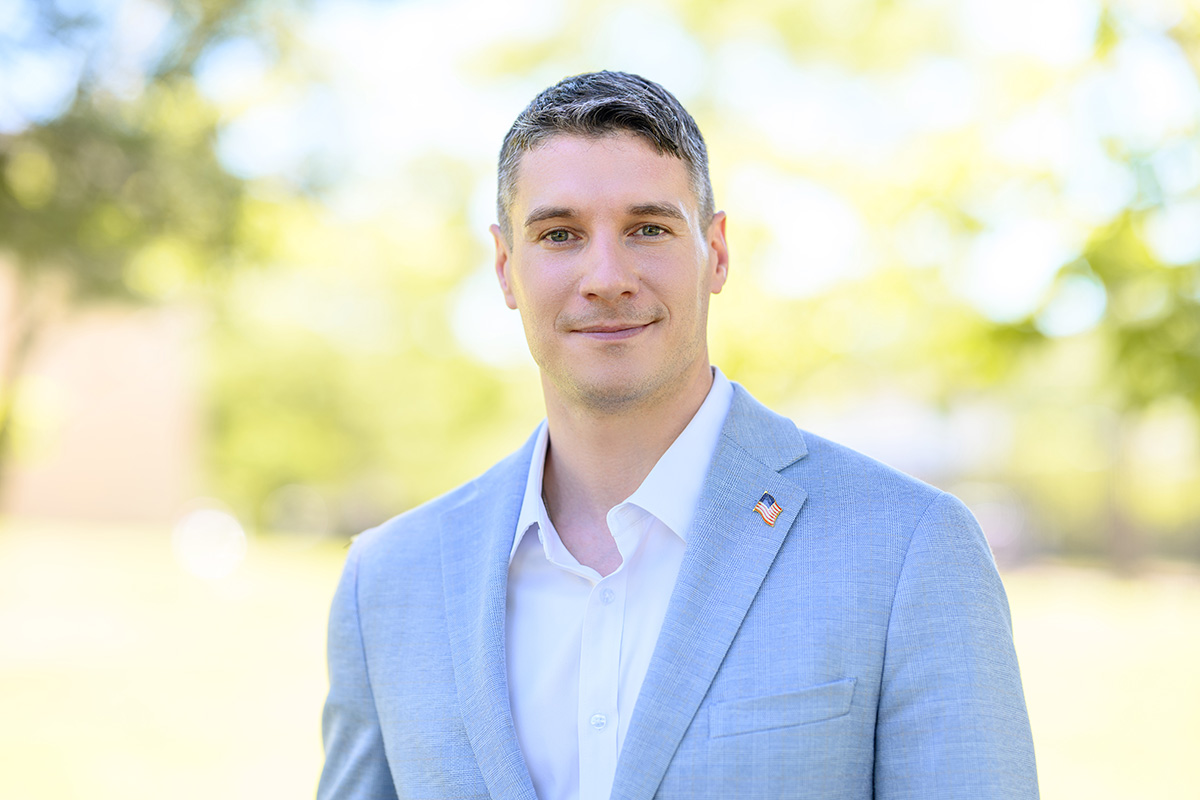
New York’s Long Island, which is just 50 miles from the Stonewall Inn, is a reliably red enclave where President Trump won easily in 2024.
Chris Gallant, an openly gay Democrat running for New York’s 1st Congressional District, which includes the eastern side of Long Island, is trying to capitalize on what he sees as growing frustration with the Republican Party and its ability to deliver for everyday Americans.
The Blade sat down with Gallant to discuss his move from civil servant to the fight for public office, how he has been personally impacted by the changes from the Trump administration, and the recent release of photos from his past that have brought the national spotlight his way.
Gallant has a long record of public service that, on paper, would make him an unconventional but compelling candidate for a heavily Republican district. His résumé includes New York Army National Guard service that began when he was 17, multiple overseas deployments, including multiple tours in Kuwait, work as an FAA air traffic controller, union leadership and service as a volunteer firefighter.
That record of service is central to how Gallant describes himself — particularly as he navigates the unusual combination of being an openly gay candidate, a military veteran, and a Democrat running in a district where Republicans have historically held the advantage.
“My fiancé and I both serve in the military and we built our relationship through trust, timing, and a lot of miles between us,” his campaign website says, highlighting the idea of family values that has become a central part of winning the area. “I’ve been openly gay in the military since just after ‘Don’t Ask, Don’t Tell’ ended, and I’ve learned to speak plainly, hold the line, and back up what I say. I’ve also learned how to listen — and how to bring people with very different views to the table and actually make progress.”
Gallant said that record, rather than his sexual orientation, is what should define his candidacy.
“I think who I am as a person is an asset,” he told the Blade when asked if his sexuality has played any role in his decision to run. “I’m not running because I’m gay. I’m running, and,’Oh, I’m gay.’ It’s part of my identity. It’s just a part of who I am. But it’s not necessarily on the table because that shouldn’t make a difference on how I’m going to respond in Congress or how I’m going to run into a burning building. I don’t think those things necessarily matter so much.”
For Gallant, the campaign is ultimately about something broader than identity politics. He said he is running because he wants to restore Americans’ confidence in a government that he says has become less about its people and more about the wealthy leaders in charge.
“I’ve always said that part of the reason why I am running for Congress is because I want to restore faith in our government,” he said. “We’re all drastically exhausted with what’s going on in this world, and particularly with Donald Trump being in office, [his] type of politics, and the way he works, essentially. When Biden got into office after Trump won, it was like the release of a pressure cooker… the pressure cooker is just even worse now this second time around.”
He also explained that his experience working inside the federal government has shaped how he believes Washington should approach its problems. Gallant pointed specifically to the Trump administration’s efforts to reduce the size of government and the role of the Department of Government Efficiency (DOGE), arguing that cutting government spending should not mean indiscriminate cuts.
“I understand that we as a nation need to save money, or at least fix the budget or balance it. We are getting further and further in debt … The budget is always a huge issue and something that we definitely 100% need to fix. But we need to do it with experts and, you know, attack these issues with a scalpel, not a chainsaw.”
The chainsaw Gallant mentioned is a clear reference to controversial Trump supporter Elon Musk, who announced he would be heading the highly politicized DOGE agency, where he, the first-ever trillionaire, brandished a shiny chainsaw symbolic of them cutting government spending with no regard for the impact on everyday Americans.
That philosophy, of scalpel over chainsaw, is also part of Gallant’s argument to voters who may be more accustomed to voting Republican. He does not present himself as a traditional politician, but rather as someone whose career outside politics could be an asset in Congress.
“I’m not a politician. This is my first foray into politics, and I think that’s what our politics need. We need fresh new faces, not career politicians. Someone who has brand new ideas, not tainted by politics. So I would say, give me the opportunity to prove myself, because, you know, until I actually get there and I can actually do a job, we won’t know.”
Gallant also shared signs that the political landscape on Long Island may be shifting. He pointed to gains Democrats made across the district last November and said economic concerns could further erode Republican support.
“Last November, in this district we [Democrats] gained 13 and 14 points across the district..And this district lost by 10 points last year. So even just in one year, you can tell that there’s a difference.”
The swapping of support from the Republican side to Democratic reflects the real concern voters have about the economy — impacted by the war in Iran, tariffs, and growing inflation.
“People are feeling it here in their pockets. The cost of living here on Long Island is already high, and things are just getting worse. There’s a lot of promises that were made with this administration that weren’t kept.”
Gallant said that frustration has directly translated into support from some voters who previously backed President Donald Trump.
“I know a lot of people who have voted for Donald Trump that have my lawn sign on their front lawn today. If that’s the change that they’re looking for, I’m going to provide it.”
But Gallant’s campaign has been complicated by a very different kind of political issue: the publication of photos from his past that have become a national story.
The photos, which include pictures of Gallant wearing various fetish gear for Mr. S Leather — including a harness and a collar — were shared with the New York Post.
Gallant has consistently rejected the idea that he should be ashamed of the images or that they undermine his qualifications for public office since their Sept. 13 publication. Instead, he has argued that his record of service should be considered alongside a private chapter of his life from 15 years ago.
“I mean, look, I’m totally not ashamed of who I am as a person. Those pictures were taken in my private life. I can still run into a burning building faster than most people. I can still fly a helicopter. And those are from 15 years ago, right? I built an entire life based around my commitment to the military and the Army National Guard.”
Rather than allowing the controversy to define him, Gallant said he hopes it can become part of a broader conversation about privacy and the consequences of living in a digital age — and indicated that this sort of scenario would become something semi-regular for those who grew up with technology.
“The reality is that we live in a digital age.This is what our generation is going to be stuck with. I laugh all the time because this is the reason why Congress and the Senate are about to die in their chairs. They didn’t have cameras and pictures and photos like that.”
“If I have to be the person to wave the banner now to fight and advocate for not only our community but anybody that could be put in this situation, that realizes now that we’re living in a digital age and this is what the future is going to be. It’s, you know, everything’s left online now.”
That argument extends beyond his own campaign. Gallant said he worries that the prospect of having a digital footprint scrutinized could discourage highly qualified and passionate potential public servants from seeking office.
“I understand that getting into public life means that the rest of your life becomes public. I get it, I do. But I also feel bad because there’s a lot of good people out there wanting to do a job in the public world, and they’re just afraid of what their digital footprint might have on them or might—what might exist because we’ve done things when we’re 12 or 15, or 20, or 30, or whatever.”
“I think living in this digital world, I would love to advocate for people to say, ‘How do we prevent some of these things from coming out into the public view so people can still maintain some kind of a private life?’”
For an openly gay candidate, the issue also carries a particular significance. Gallant said his experience has made him more interested in advocating for other LGBTQ people who may hesitate to enter public life because of what could eventually surface online.
His own LGBTQ policy priorities are relatively focused. He said adding further protections for same-sex marriage in federal law would be one of the issues he would want to pursue if elected, particularly as questions about the Supreme Court’s future approach to marriage equality continue to loom.
“My partner, who’s my fiancé, is currently deployed. We got engaged before he left in December because if the question came up to the Supreme Court– whether gay marriage was going to be a thing– we had to question whether, when he got back from deployment after Christmas this year, whether we were actually going to be able to legally get married.”
“I mean, these are questions that shouldn’t even be questions anymore. So if we can put something like [codifying same-sex marriage] into law, where it’s just not a Supreme Court decision and it can get overturned, like Roe v. Wade, then let’s do it.”
Gallant’s opponent, Rep. Nick LaLota (R-N.Y.), is the two-term incumbent and has a mixed record on LGBTQ rights. LaLota has been vocal in his opposition to overturning Obergefell v. Hodges, the Supreme Court case that established the constitutional right to same-sex marriage, but he has also been outspoken in his opposition to transgender rights. He co-sponsored and voted for H.R. 28, the Protection of Women and Girls in Sports Act, which would restrict participation in women’s sports based on sex assigned at birth rather than gender identity.
Gallant, on the other hand, has few official positions on LGBTQ issues but assured the Blade that, if elected, he would become “an advocate, particularly for the LGBTQ community.”
He also said he believes same-sex marriage should be codified into law and that nondiscrimination protections should be expanded. “I would definitely be pushing no discrimination against anyone for any reason — and that should not have any place in any workplace — especially on the federal government level.”
For Gallant, however, LGBTQ rights are only one part of a broader platform centered on public service, affordability and restoring trust in government.
He repeatedly returned to the idea that a member of Congress should be accessible to the people they represent — something he believes his experience holding town halls and working directly with members of his community demonstrates.
“I always find that a record of service and showing up every day at work and in our communities is what’s going to be key and important. And I think that’s what a representative needs to do. As a representative you’re supposed to represent and work with the people that elect you to office. And so that’s what I’m going to make sure I start today.”
Current prediction markets give LaLota a significant advantage over his challenger, with the incumbent holding an 81 percent chance of winning compared with Gallant’s 19 percent.

‘Governments that attack LGBTQ+ rights learn from each other’

Horror genre has evolved into space to explore queer identity

Annie Andrews denounces trans athletes after Trump targets her

On Republican Long Island, gay Democrat Chris Gallant bets on public service over politics

Report: LGBTQ exclusion costs Japanese economy billions a year

Bet Mishpachah participates in D.C. Oct. 7 commemoration ceremony

Man charged in Mall of America shooting plot inspired by Pulse massacre: report

ICC unseals arrest warrants for Taliban officials accused of persecuting LGBTQ people, women

Physician: addiction doesn’t always look the way you think it does

Calendar: October 9-15
-

 District of Columbia5 days ago
Bet Mishpachah participates in D.C. Oct. 7 commemoration ceremony
-
National5 days ago
Man charged in Mall of America shooting plot inspired by Pulse massacre: report
-
Afghanistan4 days ago
ICC unseals arrest warrants for Taliban officials accused of persecuting LGBTQ people, women
-
District of Columbia4 days ago
Physician: addiction doesn’t always look the way you think it does