Arts & Entertainment
Shop talk
Organist Christopher Houlihan on tricks of the trade, his weekend recital and why being out is not a big deal
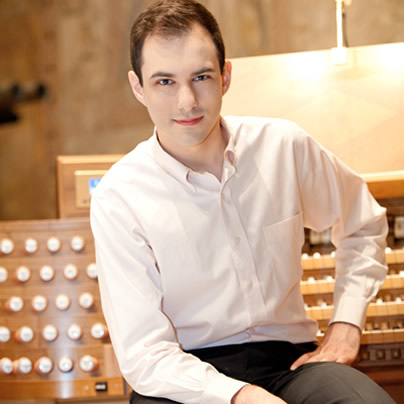
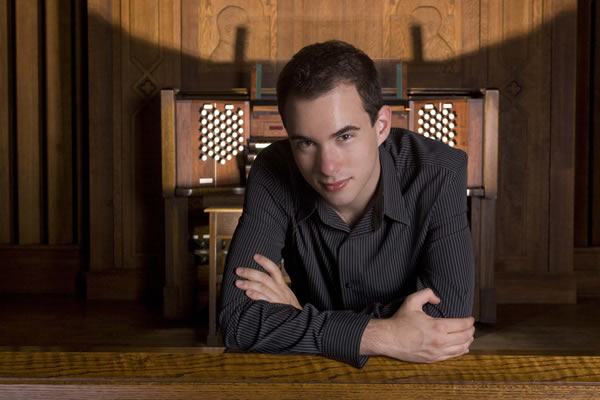
Christopher Houlihan is slated to perform works such as Liszt’s Fantasy and Fugue on the chorale ‘Ad Nos ad salutarem undam’ and Patrick Greene’s ‘Steel Symphony for Organ’ at his recital Sunday at First Baptist. (Photo by Ali Winberry; courtesy Classical Music Communications)
Organist Christopher Houlihan
In recital
Playing the new 118-rank Austin organ
First Baptist Church of Washington
1328 16th Street, N.W.
Sunday at 4 p.m.
Free
Organ virtuoso Christopher Houlihan will be in Washington this weekend for a recital at First Baptist Church.
He lives in Queens, New York but is on the road more often than not. We caught up by phone with the 26-year-old during a rehearsal break two weeks ago in Hartford, Conn. His comments have been slightly edited for length.
WASHINGTON BLADE: Do you have an organ at home?
CHRISTOPHER HOULIHAN: No. I practice at a church on the Upper West Side where I’m artist in residence. I practice there and play for them a few times a year. I’m on the road too much to have a regular church job.
BLADE: Is it far from your place? Is it like many of us are with the gym — if it’s too much hassle to get there, we don’t go as often as we should?
HOULIHAN: It’s a subway ride but it works out OK. It gets me out of my apartment. If I were a violinist, I’d just pick up my instrument and practice. But I get to practice in all these amazing spaces, which is much more inspiring than just sitting in my apartment. I like it that practicing takes me to these beautiful spaces.
BLADE: The organ at First Baptist is new. How long will you need to familiarize yourself with it before your recital?
HOULIHAN: I’ll be arriving on Friday afternoon. I never know how long it will take with a new organ. I estimate needing more time when it’s a larger instrument. I’ll be practicing late into the night on Friday and probably Saturday as well.
BLADE: Some young organists say they’re tired of having to constantly learn a new instrument while most seem to accept that it’s part of the deal. Are you frustrated by it?
HOULIHAN: It can be frustrating. Believe me, I’ve had situations where I’m really frustrated because the organ I’m playing can’t do the things I want it to do or it might not be a great instrument. But pianists have to do deal with that too in some ways. Of course organs are much more different. But at the same time, it can also be incredibly rewarding. I think of it like being a conductor and working with different orchestras. Some, maybe, the woodwinds are weak. With others, it might be the brass. … Others you play with are just stunning and inspiring and wonderful. The site specificity, the uniqueness of each instrument, brings so much more to the idea of going to hear an organ recital so each performance ends up being different from the rest.
BLADE: Is it sort of like driving a rental car and you can’t figure out how to turn the wipers on?
HOULIHAN: Sort of. I have that problem in rental cars all the time. It can be scary but exciting.
BLADE: Do you have a favorite organ builder or company?
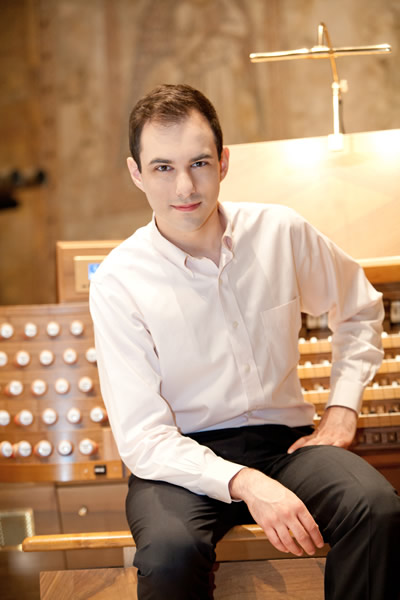
Christopher Houlihan. (Photo by Ali Winberry; courtesy Classical Music Communications)
HOULIHAN: No, but I have a soft spot for Austin because I’ve played a lot of them and the first organ I had lessons on was an Austin.
BLADE: Do you play from memory?
HOULIHAN: For the most part. … It’s a lot harder to change registrations if I have to read the music too.
BLADE: Does it come naturally as you practice or is memorizing a significant part of the rehearsal process?
HOULIHAN: It’s never a skill that came naturally. I had to develop it, but it’s part of the learning process. … I find once I internalize the piece that way, I’m able to digest it better.
BLADE: Isn’t the thought of blanking out terrifying? I suppose it happens occasionally on the stage for actors.
HOULIHAN: Everyone has those scary moments sometimes but you just deal with it and that’s really the only answer. It can be terrifying, but you move forward and get over it.
BLADE: When you’re playing standard repertoire that so many great organists have played over the years, how do you bring something new to it or do you think in those terms?
HOULIHAN: I don’t necessarily try to be different. I just try to be honest to my personality and try to play it like I want to play it. … I just try to listen to my instincts and play it the way I think it should be played. That may be different from other interpretations or very similar, but I just try to be honest to the music and to myself.
BLADE: It seems the gulf is widening between the world of organ music aficionados and the general public. There are obviously folks who are really into it and can geek out and talk ad infinitum, but so many of the media questions asked of organists are stuff like, “How would you describe this for somebody who’s never been to an organ recital before?” I know you’ve had that question. Whereas nobody on ESPN asks pro athletes to describe their event for someone who’s never been to a football or baseball game. Do you feel this is true? If so, why?
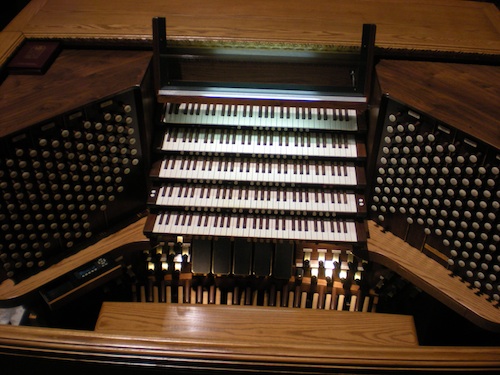
The new Austin Organ (Op. 2795) at First Baptist Church of Washington. (Blade photo by Joey DiGuglielmo)
HOULIHAN: I think it’s true with classical music in general, not just organ music. I think fewer and fewer people attend churches so they’re hearing less and less organ music. So it becomes something that seems more foreign to the general public.
BLADE: But is the public generally less interested in classical music than it was, say, 50 years ago?
HOULIHAN: I think so, but I have no idea why. When people ask me the “what to expect” question, it makes me feel as if I have to prove it’s something they should care about. I think maybe we have to prove ourselves a bit more than musicians in other fields, but I also think maybe organists overall could do a better job of bringing people in and intriguing them. It’s such an instrument that’s unlike any other instrument. It’s big and epic and you see people getting hooked and drawn in by it all the time. I try to convey that this is different and exciting and something that’s worth giving it a shot. People do end up loving it many times, this happens over and over. But as for how to fill that gap more generally, I don’t know. It’s never gonna be the kind of music that fills stadiums, but it is exciting and can really communicate to your soul, as cliché as that sounds. It’s music that can reach out and communicate in a very deep way. I try to reach people to their core and move them somehow. That’s what music does for me.
BLADE: Did you decide to be out at the beginning of your career or was it just a natural outgrowth of your personal life?
HOULIHAN: I came out in high school to my friends and family. It’s not really a big part of my musical public personality but it’s who I am. It’s never been a problem.
BLADE: Are you in a relationship now?
HOULIHAN: No.
BLADE: With movie and TV performers, there’s a huge degree of interest in who’s sleeping with whom, yet in classical music it swings to the other extreme where it’s treated as a non-issue, but sometimes so much so that it seems kind of disingenuous. Why?
HOULIHAN: Right. I think maybe there should be a bit more conversation about that. I think it would make it seem much less like what we’re doing is so elitist or something. I think a bit more talk about that sort of thing or excitement about people’s lives could be a positive development. I think it would make us seem more interesting to the general public like we’re not just these old farts, we are interesting people. And of course the organ world is very gay and there are lots of gay people involved. It’s never been a thing for me. I’m out and there’s never been any reason not to be.

Television
‘Big Mistakes’ an uneven – but worthy – comedic showcase
In the years since “Schitt’s Creek” wrapped up its six season Emmy-winning run, nostalgia for it has grown deep – especially since the still painfully recent loss of its iconic leading lady, Catherine O’Hara, whose sudden passing prompted a social media wave of clips and tributes featuring her fan-favorite performance as the deliciously daft Moira Rose. Revisiting so many favorite scenes and funny moments from the show naturally reminded us of just how much we loved it, even needed it during the time it was on the air; it also reminded us of how much we miss it, and how much it feels now like something we need more than ever.
That, perhaps more than anything else, is why the arrival of “Big Mistakes” – the new Netflix series starring, co-created and co-written by Dan Levy – felt so welcome. We knew it wouldn’t be the Roses, but it seemed cut from the same cloth, and it had David Rose (or at least someone who seemed a lot like him) in the middle of a comically dysfunctional family dynamic, complete with a mother who gets involved in town politics and a catty sibling rivalry with his sister, and still nebbish-ly uncomfortable in his own gay shoes. Only this time, instead of running a pastor of the local church, and instead of a collection of kooky small town neighbors to contend with, there are gangsters.
As it turns out, it really does feel cut from the same cloth, but the design is distinctly different. Set in a fictional New Jersey suburb, it centers on Nicky (Levy) and his sister Morgan (Taylor Ortega) – he openly gay with an adoring boyfriend (Jacob Gutierrez), yet still obsessive about keeping it all invisible to his congregation, and she drudging aimlessly through life as an underpaid schoolteacher after failing to achieve her New York dreams of show biz success – who inadvertently become enmeshed in a shady underworld when a gesture for their dead grandmother’s funeral goes horribly awry.
They’re surrounded by a crew of equally compromised characters. There’s their mother Linda (Laurie Metcalf), whose campaign to become the town’s mayor only intensifies her tendency to micromanage her children’s lives; Yusuf (Boran Kuzum), the Turkish-American mini-mart operator who pulls them into the criminal conspiracy yet is himself a victim of it; Max (Jack Innanen), Morgan’s live-in boyfriend, who pushes her for a deeper commitment and is willing to go to couples’ therapy to prove it; Annette, his mother (Elizabeth Perkins), who lends her society standing toward helping Linda’s campaign against a misogynistic opponent (Darren Goldstein); and Ivan (Mark Ivanir), the seemingly ruthless crime boss who enslaves the siblings into his network but may really be just another slave in it himself. It’s a well-fleshed out assortment of characters that helps our own loyalties shift and adapt, generating at least a degree of empathy – if not always sympathy – that keeps everyone from coming off as a merely “black-and-white” caricature of expectations and typecasting.
To be sure, it’s an entertaining binge-watch, full of distinctive characters – all inhabiting familiar, even stereotypical roles in the narrative – who are each given a degree of validation, both in writing and performance, as the show unspools its narrative. At the same time, it makes for a fairly bleak overall view of humanity, in which it’s difficult to place our loyalties with anyone without also embracing a kind of “dog eat dog” morality in which nobody is truly innocent – but nobody is completely to blame for their sins, anyway.
In this way, it’s a show that lets us off the hook in the sense that it places the idea of ethical guilt within a framework of relative evils as it permits us to forgive our own trespasses through our acceptance of its lovably amoral – when it comes right down to it – characters, each of whom has their own reasons and justifications for what they do. We relate, but we can’t quite shake the notion that, if all these people hadn’t been so caught up in their own personal dramas, none of them would have ended up in the compromised morality that they do, and that they are all therefore, at some level, to blame for whatever consequences they endure.
However, it’s not some bleak morality play that Levy and crew undertake; rather, it’s more an egalitarian fantasy in which even “bad” choices feel justified by inevitability. Everybody has their reasons for doing what they do, and most of those reasons make enough sense to us that it’s hard to judge any of the characters for making the choices – however unwise – that they do. In a system where everyone is forced to compromise themselves in order to achieve whatever dream of self-fulfillment they may have, how can anybody really blame themselves for doing what they have to do to survive?
Of course, all things considered, this is more a relatable comedy than it is a morality play, and it is, perhaps, taking things a bit too seriously to go that “deep.” As a comedy of errors, it all works well enough on its own without imposing an ideology on it, no matter how much we may be tempted to do so. Indeed, what is ultimately more to the point is how well this pseudo-cynical exercise in the normalization of corruption – for that is what it really about, in the end – succeeds in letting us all off the hook for our compromises. In a reality in which we can only respond to corruption by finding the ethical validation for making the choice to survive, how can we judge ourselves – or anyone else – for doing whatever is necessary?
In the end, of course, maybe all that analysis is too deep a dive for a show that feels, in the end, so clearly to be focused merely on reminding us of how much necessity dictates our choices –for truly, the fate of all its characters hinges on how well they respond to the compromised decisions that must make along the way. The more important observation, perhaps, has to do with the necessity to make such moral choices along our way – and it comes not from a moralistic urge toward making the “right” choice as much as it does from a candid recognition that all of us are compromised from the outset, and that’s a refreshing enough bit of honesty that we can easily get on board.
It helps that the performances are on point, especially the loony and wide-eyed fanaticism of Metcalf – surely the MVP of any project in which she is involved – and the directly focused moral malleability of Ortega, Levy, of course, is Levy – a now-familiar persona that can exist within any milieu without further justification than its own queer relatability – and, in this case, at least, that’s both the icing on the cake and substance that defines it. That’s enough to make it an essential view for fans, queer or otherwise, of his distinctive “brand,” even if he – or the show itself – doesn’t quite satisfy in the way that “Schitt’s Creek” was able to do.
Seriously, though, how could it?
Theater
Rorschach stages ‘Dragon Play’ in unlikely, raw space
Out sound designer Madeline ‘Mo’ Oslejsek notes ‘sound is my bag’
‘Dragon Play’
Through May 17
Rorschach Theatre
The Stacks @ Buzzard Point
101 V St., S.W.
$50 ($35 for students and seniors)
Rorschachtheatre.org
Celebrated for its site-specific, immersive productions, Rorschach Theatre puts on plays all over town. The unlikely spots have included greenhouses, church vestibules, closed retail spaces (including a vacant downtown big and tall men’s store) and historic locales like Rock Creek Cemetery’s Adams Memorial.
For its current offering “Dragon Play” (through May 17), a tale of love and longing, Rorschach is using a raw space in The Stacks at Buzzard Point, a new mixed-use neighborhood situated where the Anacostia and Potomac rivers meet.
Out sound designer Madeline ‘Mo’ Oslejsek considers all sites – whether traditional theatrical spaces or not – specific, particularly in terms of sound. She says, “Part of my practice is if you’re creating a soundscape for a theatrical production you’re also working with sound that already exists with the space.”
For instance, The Stacks space comes with its own unique qualities. It’s a large cement room that has a different reverberation, an echo.
“Some sounds (a car, dog bark) are planted or they might just happen. What starts as a live sound might be heard again as something recorded.”
Whip smart with a ready laugh, Oslejsek never set out to be a sound designer. She was going to direct. And now, the 2025 Helen Hayes Award nominee for Outstanding Sound Design (“Astro Boy and the God of Comics” at Flying V,) says, “Sound is my bag. Sometimes it seems that I’m the only one in the room thinking about it.”
As an undergrad studying theater at Ohio Wesleyan University, she was first exposed to sound design, but it didn’t make a big impression.
In grad school at Royal Central School of Speech and Drama, University of London, she was interested in direction. But when students were offered a choice of three more specific tracks to choose from (performance, composition, and scenography, which includes sound design), Oslejsek was swayed.
“An introduction to scenography by the department head radically changed the course of my life,” she says.
What struck her most about sound was the subjectivity: “The core of my practice is that sound has no meaning until it’s experienced. All sound is noise. It’s just a pitch, active, or vocalization. It becomes real when you hear it and apply meaning to it. That’s very exciting to me.”
Today, Oslejsek and partner Caitlin Hooper, an actor and intimacy choreographer, are based in Baltimore but work primarily in D.C.
“It feels good to be in a place where art and queerness in art are celebrated. It’s not like that everywhere, and making that kind of work down the street from this White House where that’s not the vibe, is real resistance. That feels really meaningful.”
Also important to Oslejsek (who identifies alternately as queer and lesbian) is “queer as a practice,” a concept suggesting that a queer identity or practice does not seek to replace other identities but to encompass and bridge them.
“I’m queer because I like women, but the work is more about making room for what everyone in the room hears,” she says. “Never do I want to come into a space thinking I have all the answers. That’s no fun.”
As its title might suggest, Jenny Connell Davis’ play directed by Rorschach’s Randy Baker is filled with magic. “Dragon Play,” blurs the past and present; one world bleeds into the next; and, of course, there are dragons. At 80 minutes with no intermission, the play moves in and out of different timelines; increasingly things start to overlap.
And it’s also about the magic of relationships – all kinds. There’s a line where the dragon girl asks a Texas boy what he dreams about and he replies “you, always you.”
Oslejsek, 30, is touched by those words: “In my little gay heart, I cried. It makes me think of my partner. This play is about the idea of people who strike a match in your heart that never really goes away.”
In creating a layered soundscape, she brings her own brand of magic to the production. Her big goal was “not to play with how we think a dragon might sound, but rather with how does the world sound to a dragon.”
Sometimes sound design takes the lead, but in some productions, sound is purposely subtle or secondary, she says. Either way, sound can be monumental in shaping theater.
Friday, April 17
Center Aging Monthly Luncheon With Yoga will be at 12 p.m. at the DC Center for the LGBT Community. Email Mac at [email protected] if you require ASL interpreter assistance, have any dietary restrictions, or questions about this event.
Go Gay DC will host “LGBTQ+ Social in the City” at 7 p.m. at Hotel Zena. This is a chance to relax, make new friends, and enjoy happy hour specials at this classic retro venue. Attendance is free and more details are available on Eventbrite.
Trans and Genderqueer Game Night will be at 7:00p.m. at the DC Center for the LGBT Community. This is a relaxing, laid-back evening of games and fun. All are welcome and there’ll be card and board games on hand. Feel free to bring your own games to share. For more details, visit the DC Center’s website.
Saturday, April 18
Go Gay DC will host “LGBTQ+ Community Brunch” at 11 a.m. at Freddie’s Beach Bar & Restaurant. This fun weekly event brings the DMV area LGBTQ+ community, including allies, together for delicious food and conversation. Attendance is free and more details are available on Eventbrite.
The DC Center for the LGBT Community will host “Sunday Supper on Saturday” at 2 p.m. It’s more than just an event; it’s an opportunity to step away from the busyness of life and invest in something meaningful, and enjoy delicious food, genuine laughter, and conversations that spark connection and inspiration. For more details, visit the Center’s website.
Sunday, April 19
Go Gay DC will host “LGBTQ+ Community Lunch” at 11 a.m. at Federico Ristorante Italiano. This fun weekly event brings the DMV area LGBTQ+ community, including allies, together for delicious food and conversation. Attendance is free and more details are available on Eventbrite.
Monday, April 20
“Center Aging: Monday Coffee Klatch” will be at 10 a.m. on Zoom. This is a social hour for older LGBTQ+ adults. Guests are encouraged to bring a beverage of choice. For more information, contact Adam ([email protected]).
Tuesday, April 21
Center Bi+ Roundtable will be at 7 p.m. on Zoom. This is an opportunity for people to gather in order to discuss issues related to bisexuality or as Bi individuals in a private setting.Visit Facebook or Meetup for more information.
Senior Self Defense Class with Avi Rome will be at 12:30 p.m. This inclusive and beginner-friendly class, led by Instructor Avi Rome, offers a light warm-up, stretching, and instruction in basic techniques, patterns, and striking padded targets. Each session is designed to be adaptable for all ability and mobility levels, creating a welcoming space for everyone to build strength, confidence, and community through martial arts. For more details, visit the DC Center’s website.
Wednesday, April 22
Job Club will be at 6 p.m. on Zoom upon request. This is a weekly job support program to help job entrants and seekers, including the long-term unemployed, improve self-confidence, motivation, resilience and productivity for effective job searches and networking — allowing participants to move away from being merely “applicants” toward being “candidates.” For more information, email [email protected] or visit thedccenter.org/careers.
Asexual and Aromantic Group will meet at 7 p.m. on Zoom. This is a space where people who are questioning this aspect of their identity or those who identify as asexual and/or aromantic can come together, share stories and experiences, and discuss various topics. For more details, email [email protected].
Thursday, April 23
The DC Center’s Fresh Produce Program will be held all day at the DC Center for the LGBT Community. People will be informed on Wednesday at 5:00 pm if they are picked to receive a produce box. No proof of residency or income is required. For more information, email [email protected] or call 202-682-2245.
Virtual Yoga Class will be at 7 p.m. on Zoom. This free weekly class is a combination of yoga, breath work and meditation that allows LGBTQ+ community members to continue their healing journey with somatic and mindfulness practices. For more details, visit the DC Center’s website.
-
Brazil5 days agoTrailblazing trans Brazilian lawmaker refuses to set foot in Trump’s America
-
District of Columbia4 days agoGay D.C. police lieutenant arrested on child porn charges
-
District of Columbia5 days agoD.C. bar, LGBTQ+ Community Center to mark Lesbian Visibility Week
-
National4 days agoDemonstrators disrupt OMB director hearing over PEPFAR